.webp)


AC Repair in Fresno, CA: Troubleshooting Your Fall HVAC Transition
Why we take fall furnace smells seriously. Get clear answers with these home maintenance tips and troubleshooting for a safe heating startup.
Living in the Central Valley means dealing with a unique environmental "dust load" that most other regions never experience. While a homeowner in a coastal city might deal with a little pollen or lint, residents in Fresno, Clovis, and Madera are fighting a constant battle against inorganic particulate matter.
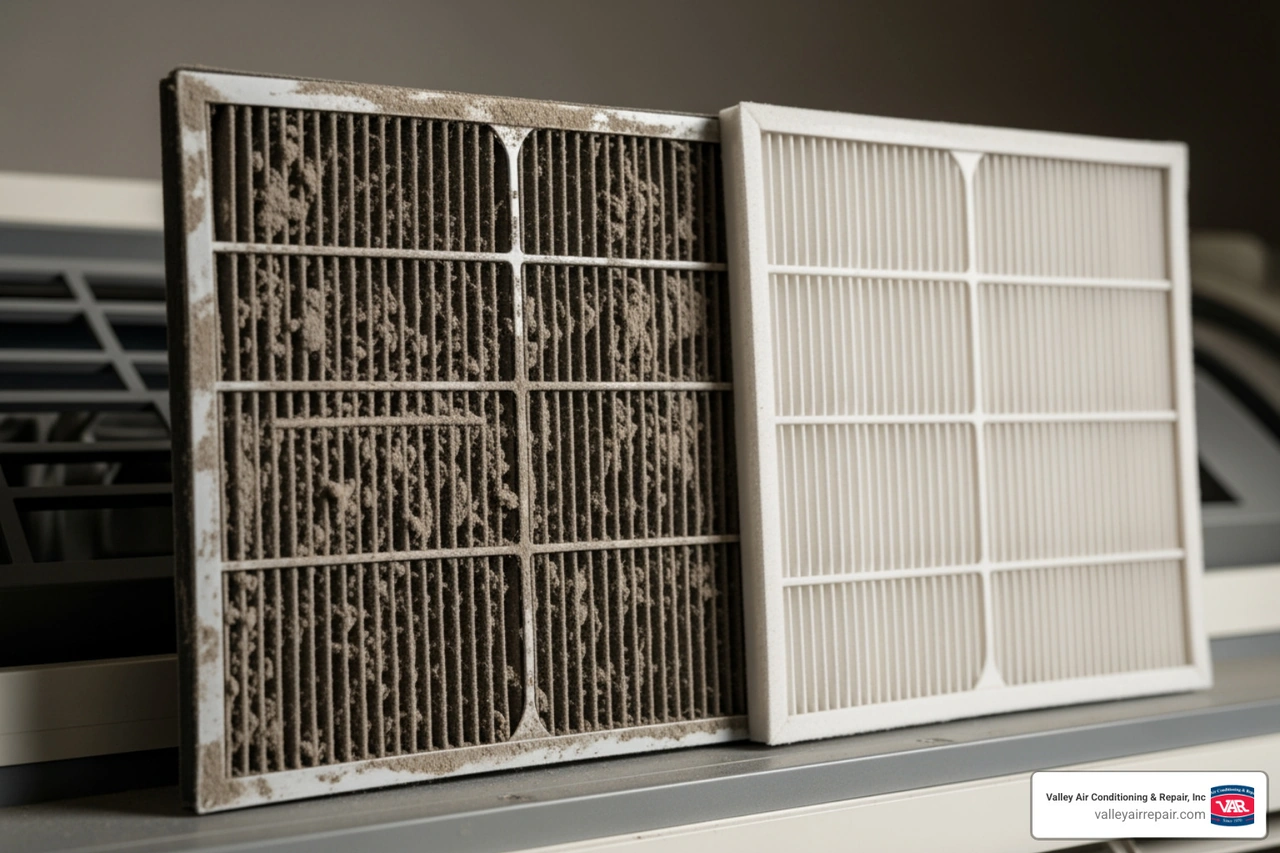
The primary culprit is agricultural dust. Our region is the backbone of the nation's food supply, but the tilling, harvesting, and almond shaking that occur throughout the year kick up massive amounts of fine silt and soil. These particles are often composed of silica, which is much sharper and more abrasive than standard household dust. When these silica particles hit your air filter, they don't just sit on the surface; they wedge themselves into the fibers, creating a dense, air-impenetrable mat.
Beyond agriculture, we also face seasonal challenges like wildfire smoke and "haboobs" (large dust storms). During wildfire season, the air is thick with microscopic ash and soot. These particles are so small that they can saturate a standard filter in a matter of days. Furthermore, wind events in areas like Kerman or Sanger can transport desert-like sand directly into your return vents. This is why proper HVAC maintenance for desert climate conditions is essential for our local homeowners; your system is essentially operating in a high-intensity filtration zone 24/7.
When we talk about how dirty air filters destroy your AC in dusty climates, we aren't just talking about a little extra dust on your furniture. We are talking about a mechanical chain reaction that leads to total system failure. Your AC is designed to move a very specific volume of air—usually around 400 cubic feet per minute (CFM) per ton of cooling capacity. When a filter is packed with Central Valley silt, that airflow drops off a cliff.
This restriction places immense strain on three primary components: the evaporator coil, the blower motor, and the compressor. If the airflow is blocked, the heat exchange process fails. Instead of the refrigerant absorbing heat from your home, it stays too cold, leading to ice formation. If left unaddressed, this can lead to a situation where your AC unit won't start, often because a safety switch has tripped or a major component has physically burned out. For those living in high-heat areas like Dinuba or Lemoore, this type of failure usually happens on the hottest day of the year when the system is under maximum stress. Professional HVAC service in Fresno, CA often reveals that these "sudden" breakdowns were actually months in the making, caused by a simple $20 filter that was never changed.
It sounds like a paradox: how can your AC freeze when it’s 105 degrees in Reedley? The answer lies in the evaporator coil. This coil is filled with cold refrigerant. To work correctly, warm air from your home must blow over these coils so the refrigerant can absorb that heat.
When a dirty filter restricts that airflow, there isn't enough heat for the refrigerant to absorb. The coil temperature continues to drop until it falls below freezing. Any moisture in the air (humidity) that hits that cold coil instantly turns to ice. Once a thin layer of ice forms, it acts as a thermal barrier, further insulating the coil and causing even more ice to build up. Eventually, you end up with a solid block of ice that completely blocks air from entering your home. This is a primary reason why we emphasize the AC service Fresno complete guide to maintenance; catching a dirty filter early prevents this "freeze-thaw" cycle that can eventually buckle the coil or cause water damage to your home.
The blower motor is the "lungs" of your HVAC system. Its job is to pull air through the filter and push it through the ductwork. When the filter is clogged, the motor has to work significantly harder to overcome the "static pressure" (resistance).
In the dusty environment of the Central Valley, this isn't just a matter of the motor running longer; it’s a matter of the motor drawing more electrical current and generating more internal heat. This extra heat breaks down the lubrication in the motor bearings and stresses the electrical windings. Furthermore, fine silica dust that manages to bypass a saturated filter can settle on the blower wheel itself. This adds weight to the blades, unbalancing the motor and causing it to vibrate. If you need to fix weak airflow from your HVAC vents, the culprit is often a blower motor that is on its last legs due to years of fighting against clogged filters.
You don’t always need to open the cabinet to know your filter is failing. Your home will give you several "warning shots" before the system actually dies.
| Symptom | What It Means | Likely Outcome |
|---|---|---|
| Short Cycling | The AC turns on and off every 5-8 minutes. | Overheated compressor and high energy bills. |
| Weak Airflow | Vents feel like they are barely blowing. | Uneven temperatures and "hot spots" in rooms. |
| Whistling Noises | High-pitched sound near the return vent. | Air is being forced through tiny gaps in a clogged filter. |
| Dust Accumulation | Visible dust around supply registers. | Filter bypass is occurring; dirt is entering the ductwork. |
| Constant Operation | The AC runs all day without reaching the set temp. | System lifespan is being cut in half. |
If you notice that your AC runs constantly, it’s often because the restricted airflow prevents the system from removing enough heat to satisfy the thermostat. This constant "on" state is what leads to the premature death of your equipment.
The damage caused by how dirty air filters destroy your AC in dusty climates extends to your wallet and your well-being. According to industry statistics, an HVAC system with a dirty filter can draw 15% to 25% more energy than one with a clean filter. In the peak of a Fresno summer, that can mean a massive spike in your monthly utility bill.
Beyond the money, there is the health factor. When a filter becomes completely saturated, the pressure from the blower motor can actually cause the filter to "blow out" or pull away from its frame. This allows unfiltered air—complete with allergens, agricultural chemicals, and mold spores—to bypass the filter and circulate directly into your bedrooms. Dirty air filters on your HVAC system are a leading cause of poor indoor air quality in our region, contributing to asthma flare-ups and seasonal allergies. Furthermore, if your coils freeze and melt repeatedly, the excess moisture can lead to mold growth inside your air handler, which is then dispersed throughout your home.
In the Central Valley, you cannot use a "one-size-fits-all" approach to air filters. You need a strategy that balances air purification with mechanical safety.
MERV stands for Minimum Efficiency Reporting Value. For most homes in our service areas like Clovis or Sanger, we recommend a MERV rating between 8 and 11.
Choosing the right AC filter replacement is about finding that balance. If you have severe allergies, we often recommend a whole-home air purification system rather than simply installing a higher MERV filter, as this protects your health without killing your blower motor.
Because of our unique climate, we suggest a more aggressive schedule than what you might find in a generic owner's manual.
Our Maintenance Plan is specifically designed to take the guesswork out of this process, ensuring your system is cleaned and inspected by experts who understand the local "dust load."
During active wildfires in the Sierra Nevadas, smoke and ash can clog a filter in as little as 7 to 10 days. We recommend checking it weekly and replacing it the moment you see a grey or black discoloration.
Yes! When a dirty filter causes the evaporator coil to freeze, that ice eventually has to melt. If the volume of melting ice is more than your condensate drain pan can handle, or if dust has clogged the drain line itself, the water will overflow, potentially causing damage to your ceiling or floors.
For most residential systems in Fresno, Clovis, and Modesto, a MERV 8 or 10 pleated filter provides the best protection against local agricultural dust without causing excessive backpressure on the blower motor.
At Valley Air Conditioning & Repair, Inc., we have seen thousands of systems fail prematurely simply because a dirty filter was ignored. Since 1970, our family-owned business has been built on the principle of helping our neighbors in "the Valley" stay comfortable without breaking the bank. By staying on top of your filter changes, you aren't just improving your air quality; you are protecting the most expensive appliance in your home.
Don't wait for your system to start whistling or freeze over. If you haven't had your system inspected recently, or if you're noticing weak airflow, we are here to help. Schedule your professional HVAC maintenance and repair today and let our expert technicians ensure your AC is ready to handle whatever dust the Central Valley throws its way.

As a business with many AC units, it is essential to have a responsive AC company. Valley Air Conditioning understands our needs. They are always responsive and our AC is up and running very quickly.
I had them do an AC check on the home I was buying, they were honest and quick. I hired them to do the summer and Fall maintenance for $149. Happy with this company!
100% recommend. I called, same day they came out and gave me estimate. Conley was honest and didn't try to recommend/sell us anything we didn't need. When I called him with questions before making a decision, he happily answered and was not annoyed by me contacting him. Conley and VAR
This is a group of good people. Very professional and knowledgeable. They take the time to listen and find the best solution that fits best for any situation. There's no way you can go wrong in choosing VAR.
We have used Valley Air for over fifteen years. The last two years ,Matt came to our house to service twice a year. Always on time, so polite and so professional. This is a very honest company and you can always depend on them and trust them. The office always treats everyone cheerfully and always want to do what you need done very fast YOU CAN COUNT ON THIS Company