.webp)


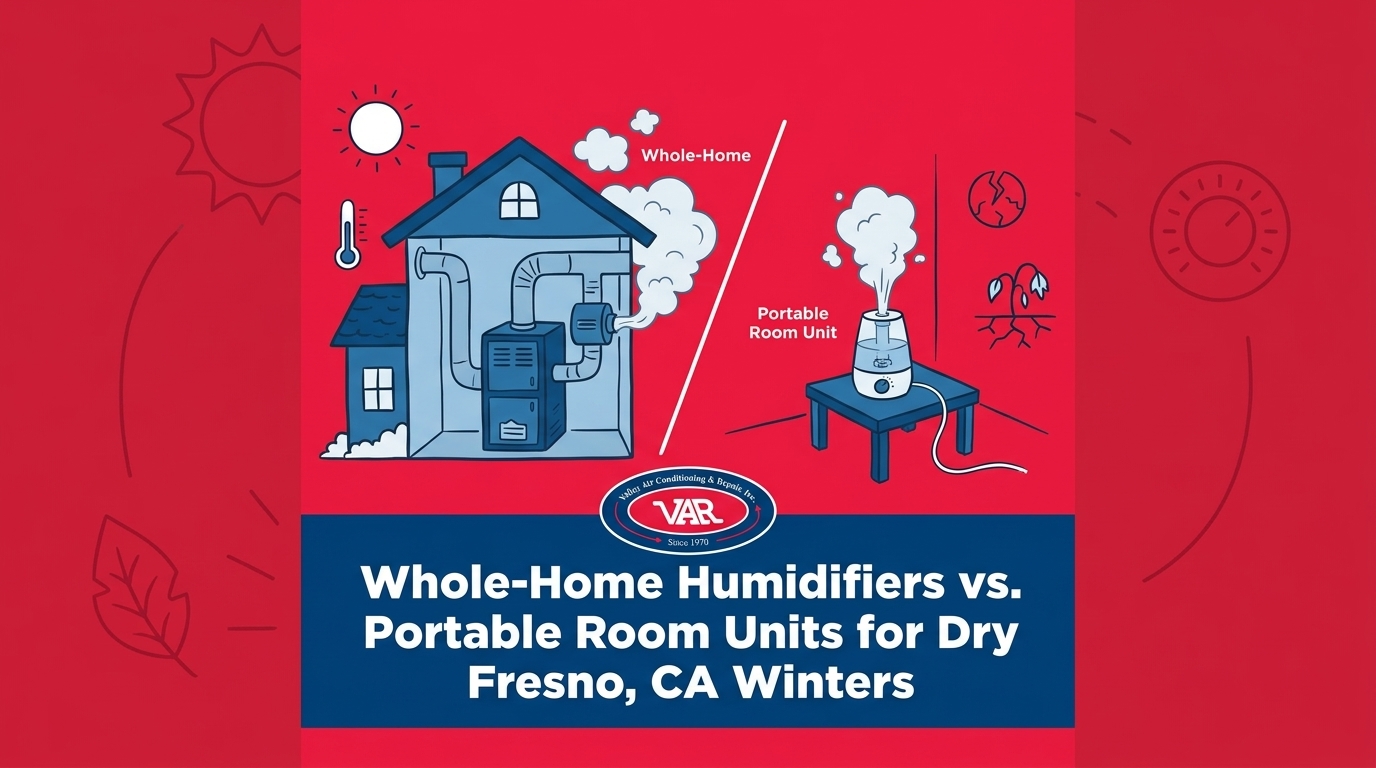
Whole-Home Humidifiers vs. Room Units for Dry Fresno Winters
Escaping dry indoor air means choosing between the daily chore of refilling portable tanks or upgrading to a central system. See which option delivers lasting comfort.
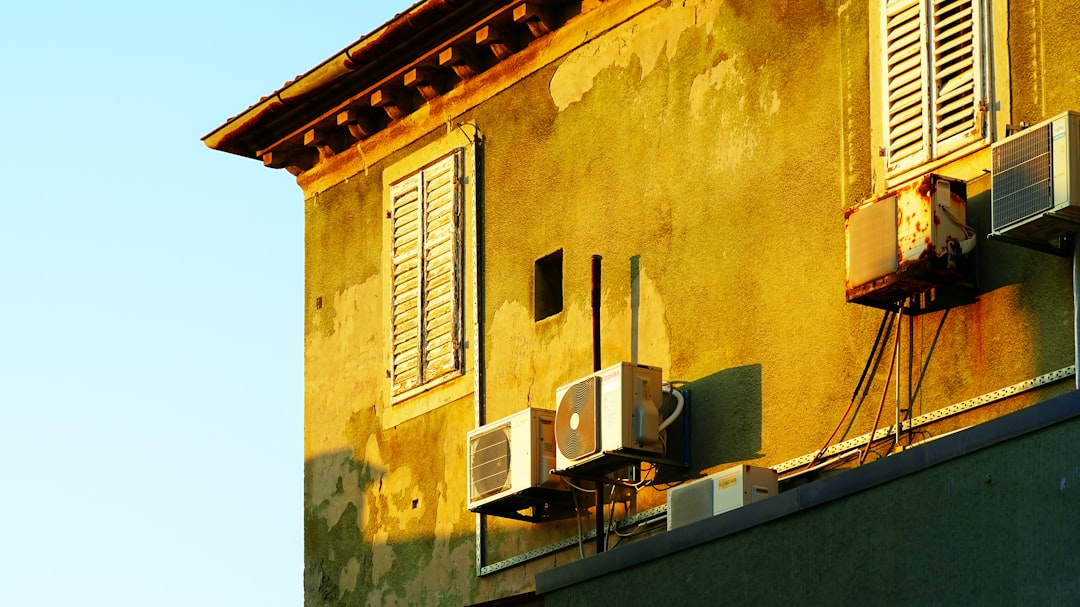
Is it worth fixing an old ac unit in the desert — and the honest answer depends on a few key factors most homeowners don't think to check until something goes wrong.
Here's a quick breakdown to help you decide:
| Situation | Likely Best Move |
|---|---|
| Unit is under 10 years old, minor repair | Repair |
| Unit is 10-15 years old, moderate repair | Evaluate with 50% Rule and $5,000 Rule |
| Unit is 15+ years old, major repair | Replace |
| Uses R-22 refrigerant | Replace |
| Frequent breakdowns (2+ per year) | Replace |
| Planning to sell home in 1-2 years | Repair may make sense |
In the desert, an air conditioner isn't just a comfort appliance — it's a survival tool. When summer temperatures in places like California's Central Valley regularly push past 100°F, a failing AC can turn a home into a genuinely dangerous place fast. That's not an exaggeration.
The problem is that desert heat is brutal on equipment. AC units in extreme climates like the Coachella Valley or Las Vegas typically last just 12 to 15 years — several years less than the national average — because compressors in these regions can run anywhere from 2,000 to 2,700 hours per year. Compare that to roughly 800 hours in a milder climate like the Pacific Northwest, and you start to see why desert systems age so much faster.
So when your aging unit starts acting up mid-July, you're facing a real dilemma: pour money into repairs, or invest in a replacement? The answer isn't always obvious, and the wrong call can cost you significantly — whether that's a sky-high repair bill on a unit that fails again next season, or an emergency replacement at the worst possible time.
This guide walks you through exactly how to make that call with confidence.

When we talk about the lifespan of an air conditioner, we usually hear a national average of 15 to 20 years. However, in the Central Valley—from Fresno and Madera down to Kingsburg and Selma—the "desert math" is a bit different. Because our units are forced to work significantly harder than their counterparts in cooler regions, they often reach the end of their useful life by the 12-to-15-year mark.
The primary culprit is runtime. An AC compressor in a desert climate can run up to 2,700 hours per year. This constant operation leads to rapid component fatigue. Beyond the heat, we also deal with fine desert dust and sand. These particles act like sandpaper on moving parts and can clog delicate fins, causing the system to overheat and struggle. This is why Proper HVAC Maintenance for Desert Climate is so vital; without it, a unit might only last 10 or 11 years.
If you are noticing that your system is running longer and longer just to maintain a standard temperature, it’s likely suffering from heat-induced wear. Regular AC Service Fresno CA can help identify these issues early, but once a unit crosses that 12-year threshold, the internal components are often operating on borrowed time.
One of the first signs that a system is waving a white flag is the noise it makes. While some sounds are minor, others indicate catastrophic mechanical failure. If you are wondering Why is My AC Suddenly Making Loud Noises, it could be anything from a loose screw to a failing compressor.
However, certain sounds are "deal-breakers." For instance, there are specific Reasons Your AC is Making a Grinding Noise, often pointing to a motor bearing failure. If your AC Condenser Fan Motor is failing on a unit that is already 15 years old, you have to ask yourself if you want to fix the motor today only to have the compressor fail next month. In the desert, these mechanical failures often happen in a "cascading" fashion—one part fails because another part is straining, and soon you're replacing the whole internal assembly piece by piece.
Deciding whether to call for AC Repair Fresno CA or look into a full AC Replacement Fresno CA can be stressful. To take the emotion out of the decision, we recommend using two industry-standard rules:
In our experience serving areas like Clovis and Sanger, homeowners who "chase bad money with good" often end up spending more on repairs over three years than they would have spent on a new, warrantied system.
Efficiency isn't just about being "green"; in the Central Valley, it’s about your monthly survival budget. Older units typically have SEER (Seasonal Energy Efficiency Ratio) ratings of 10 or lower. Modern systems now start at 14.3 SEER2 and can go much higher.
If you find yourself asking Why is My AC Running but Not Cooling, it might simply be that the unit is too inefficient to keep up with 110°F days. An aging 10 SEER system can consume 40% to 60% more electricity than a modern 18 SEER2 system. On a $400 monthly summer electric bill, that means you could be wasting $160 to $240 every single month just on lost efficiency.
Aside from age and bills, your AC will often give you physical warnings. One common issue is when the brains of the operation start to go. There are several Signs Your AC Control Board is Failing, including intermittent operation or the unit simply refusing to turn on.
Other red flags include:
If your unit was manufactured before 2010, it likely uses R-22 refrigerant (often called Freon). The EPA has phased this out because of its environmental impact. Today, R-22 is extremely scarce and expensive. If your old unit has a leak, the cost to recharge it can be astronomical.
Furthermore, R-22 systems are prone to Causes of AC Compressor Overheating Madera. When these older compressors overheat in the Madera sun, the internal chemicals can become acidic, essentially "burning" the system from the inside out. At that point, the technology is obsolete, and trying to fix it is like trying to find parts for a VCR in the age of Netflix.
There is a massive difference between choosing to replace your AC in the spring and being forced to replace it in the middle of a July heatwave. When temperatures hit 115°F in Parlier or Reedley, every HVAC company in the Valley is booked solid. You may end up waiting days for a replacement while your home becomes uninhabitable.
By being proactive, you gain several advantages:
While the national average is 15–20 years, desert units usually last 12–15 years. The extreme heat causes components like the compressor and fan motor to run nearly triple the hours of units in milder climates. Without strict annual maintenance, that lifespan can drop to as little as 10 years.
It is often recommended. HVAC systems are designed as "matched systems." When the indoor evaporator coil and outdoor condenser are designed to work together, they achieve higher SEER2 ratings. While you can sometimes replace just the AC, an older furnace blower may not be powerful enough to support the efficiency of a new AC, leading to higher bills and more wear on the new equipment.
Yes! Depending on your specific location and utility provider, there are often significant incentives. Many local utility companies offer rebates for moving to high-efficiency SEER2-rated equipment. Additionally, federal tax credits (such as those under the Energy Efficient Home Improvement Credit) can help offset the investment in a new, high-efficiency system.
At Valley Air Conditioning & Repair, Inc., we’ve been serving "the Valley" since 1970. We understand that is it worth fixing an old ac unit in the desert is a question of both finance and safety. Our customer-first philosophy means we won't push you into a replacement if a simple repair will truly solve the problem, but we will always be honest when a unit has become a "money pit."
Whether you are in Fresno, Clovis, Madera, or any of our surrounding communities, we are here to provide expert advice built on over 50 years of honorable intentions. Don't wait until the next 110-degree day to find out if your AC has one more summer left in it.
If you’re ready for a professional evaluation of your aging system, explore our Air Conditioning Services and let us help you stay cool all summer long.

As a business with many AC units, it is essential to have a responsive AC company. Valley Air Conditioning understands our needs. They are always responsive and our AC is up and running very quickly.
I had them do an AC check on the home I was buying, they were honest and quick. I hired them to do the summer and Fall maintenance for $149. Happy with this company!
100% recommend. I called, same day they came out and gave me estimate. Conley was honest and didn't try to recommend/sell us anything we didn't need. When I called him with questions before making a decision, he happily answered and was not annoyed by me contacting him. Conley and VAR
This is a group of good people. Very professional and knowledgeable. They take the time to listen and find the best solution that fits best for any situation. There's no way you can go wrong in choosing VAR.
We have used Valley Air for over fifteen years. The last two years ,Matt came to our house to service twice a year. Always on time, so polite and so professional. This is a very honest company and you can always depend on them and trust them. The office always treats everyone cheerfully and always want to do what you need done very fast YOU CAN COUNT ON THIS Company