Why Is the Guest Room Freezing? Fixing Uneven Heating in a Two Story Home
Upstairs freezing? See why closing vents damages your system and the technical fix we use to resolve uneven heating in two story home layouts before winter.
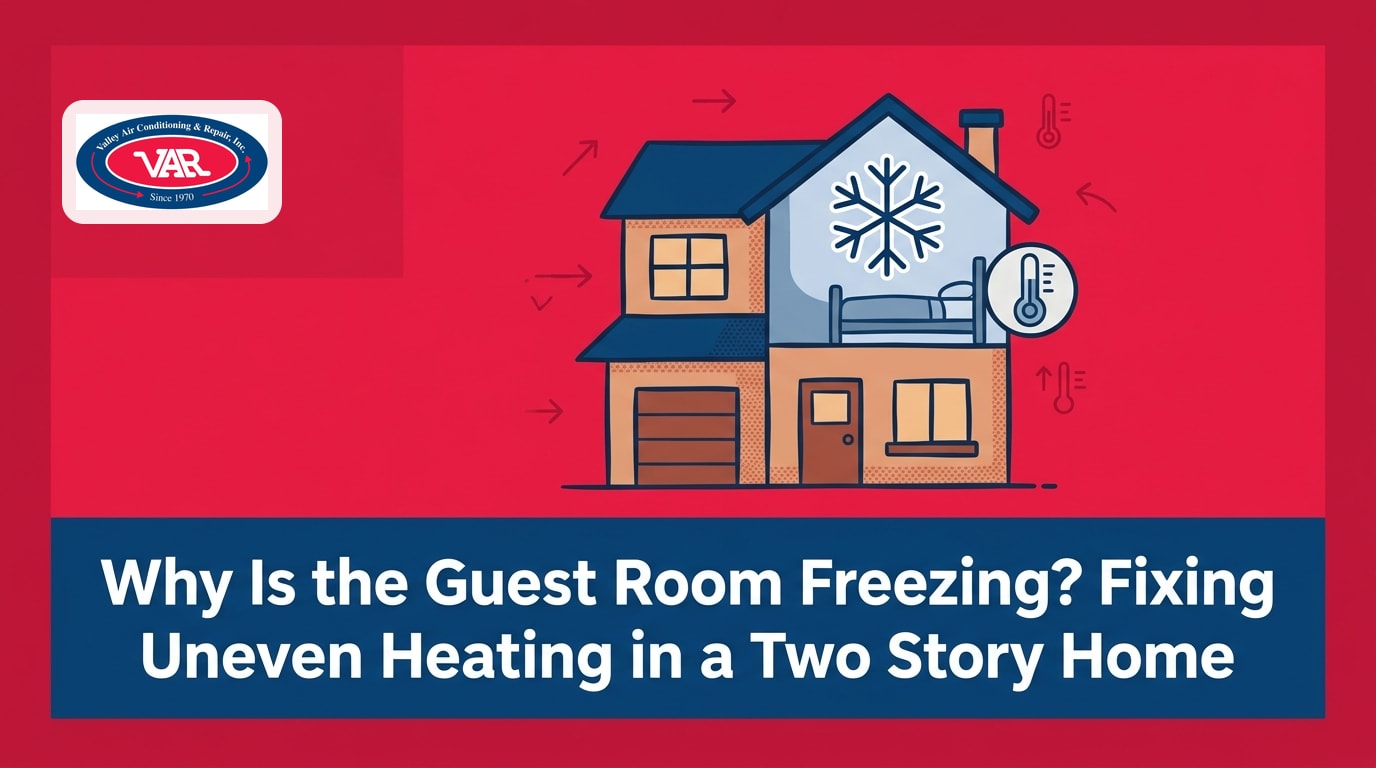
Are you dealing with uneven heating in two story home layouts, constantly wondering why the upstairs guest room feels like an icebox while the downstairs living room is perfectly warm? You are not alone. At Valley Air Conditioning & Repair, Inc., our team frequently helps Fresno homeowners tackle this exact problem. As we enter late fall and focus on November pre-winter readiness, many families start preparing their houses for holiday guests. Nothing is more frustrating than setting up a welcoming room, only to realize the space is uncomfortably cold by the time the sun goes down.
The root of this issue usually starts at the thermostat. Most traditional systems have a single thermostat located on the ground floor. When the downstairs area reaches your set temperature, the thermostat tells the system to shut off. Because the main floor warms up quickly, the heating cycle ends long before adequate warmth ever reaches the second floor. This leaves you with a tough decision: do you start closing downstairs vents to force air upstairs, or do you address the actual trunk dampers hidden in your ductwork?
Understanding how your airflow works is the first step to safely resolving these temperature imbalances. To get your HVAC system balanced correctly without causing mechanical damage, you need professional heating services.
To fix a cold upstairs room, you first have to understand the natural forces working against your heating equipment. The most powerful of these forces is thermal buoyancy. Simply put, thermal buoyancy is the natural tendency of warm air to rise and cold air to sink. Because hot air is less dense, it floats upward. In theory, this should mean your second floor stays naturally warm.
However, in our years of working in Fresno two-story residential neighborhoods, we regularly see a different reality. Even though heat rises, upstairs rooms still lose heat rapidly if the ductwork isn't pushing enough warm air to compensate for the heat escaping through your roof and attic. Thermal buoyancy alone is not enough to heat a room; you need consistent, pressurized airflow delivery to maintain a comfortable temperature.
The environment outside your home plays a massive role in how quickly your upstairs rooms cool down. With Fresno's dense winter inversion layers (commonly known as Tule fog) and chilly nighttime temperatures dropping into the high 30s, we notice that moisture and cold air pull heat away from your home's exterior walls and roof at a rapid pace. Second-story rooms have more exterior surface area exposed to these elements, including the ceiling right below the attic.
When the cold outside air pulls heat out of the guest room faster than your heating equipment can push warm air in, the room temperature drops fast. This creates an environment where precise airflow is absolutely critical. If the ductwork is not perfectly balanced to overcome both natural heat loss and the local winter climate, those upper rooms will always feel damp and freezing.
When our technicians respond to service calls for a freezing upstairs room, the most common homeowner reaction we see is that they've walked around the ground floor and shut the supply registers in the warmest rooms. The logic seems sound: if you block the air from coming out downstairs, it has to go upstairs, right? Unfortunately, this is a dangerous myth that can severely damage your equipment.
The Problem: Modern heating systems are engineered to push a very specific volume of air throughout your home. They are not smart enough to know that a vent is closed; they just keep pushing the same amount of air against a blocked exit.
The Cause: The Department of Energy guidelines state that closing more than 20% of a home's supply registers severely restricts your system's required airflow. When you close those floor or ceiling registers, the air does not magically redirect to the second floor. Instead, it backs up inside the ductwork, creating an immediate and dangerous spike in pressure.
The Solution: You must leave your interior room registers completely open to allow the system to breathe. High static pressure from closed registers is one of the leading causes of winter breakdowns. Instead of blocking the endpoints, the airflow must be regulated at the source using the correct mechanical components.
To understand why closing vents is so harmful, we have to look at the mechanics of your equipment. The fan that pushes warm air through your home is called a blower motor. This motor is designed to operate within a specific range of resistance, known as static pressure. Static pressure is simply the resistance to airflow within the duct system.
When you create high static pressure from closed registers, you force the blower motor into a highly stressful operating condition. Here is exactly how that restriction destroys your equipment over time:
1. Airflow Restriction: The closed vents block the air from escaping the ductwork, causing pressure to build up rapidly inside the metal or flexible tubes.
2. Motor Strain: The blower motor has to work twice as hard to push the same volume of air against this artificial wall of pressure. It begins drawing more electrical current just to keep spinning.
3. System Overheating: Because less air is moving over the heat exchanger (the part of your furnace that gets hot), the internal temperature of the equipment spikes. The blower motor itself also begins to overheat from the excess electrical draw.
4. Premature Failure: Over days and weeks of running hot, the motor's internal wiring and bearings degrade. Eventually, the motor burns out completely, leaving you with no heat at all.
If your vents are currently closed, you might already notice signs of high static pressure. Our technicians often hear whistling sounds coming from the grilles during inspections, which indicates air squeezing through tight spaces. You may also notice your energy bills creeping up as the motor draws more power. The cost of replacing a ruined blower motor far outweighs the temporary convenience of blocking a vent to warm up a guest room.

If you cannot close the vents in your rooms, how are you supposed to direct more warm air to the second floor? The answer lies in a completely different component: the HVAC zone dampers. Many homeowners confuse room registers with trunk dampers, but they serve entirely different purposes.
Floor and ceiling registers are the decorative grilles at the very end of your ductwork. Their only job is to direct the air as it enters the room—spreading it out so it doesn't blow directly on you. Trunk dampers, on the other hand, are mechanical valves located deep inside the main ductwork trunks, usually near the indoor unit or in the attic.
Here is a breakdown of the differences:
• Location — Room Registers: Floors, walls, or ceilings inside the living space. — Trunk Dampers: Inside the main metal ductwork branches.
• Function — Room Registers: Directs the air pattern as it enters the room. — Trunk Dampers: Acts like a traffic valve, regulating the total volume of air sent to a zone.
• Adjustment Impact — Room Registers: Causes high static pressure from closed registers. — Trunk Dampers: Safely restricts volume at the source without spiking pressure.
• Safety — Room Registers: Dangerous to the blower motor if closed. — Trunk Dampers: Safe and necessary for proper system balancing.
Trunk dampers act like traffic valves. When adjusted correctly, they safely regulate the volume of air sent to different zones of the house before that air ever reaches the smaller branch ducts. Adjusting these dampers at the source prevents the static pressure spikes associated with blocking end-point registers. Because they are so critical to your system's health, evaluating and adjusting these dampers should always be part of a routine maintenance plan.
Knowing that trunk dampers control your airflow is helpful, but balancing them is absolutely not a do-it-yourself project. Properly balancing dampers requires calculating the exact heating load and airflow requirements for each floor of your home. If you simply go into the attic and start guessing which way to turn the damper levers, you can easily recreate the exact same high static pressure problems as closing floor vents.
Professionals use specialized diagnostic tools to get this right. The most important tool is a manometer, which measures the static pressure inside the ductwork in real-time. By reading these pressure measurements while making micro-adjustments to the dampers, a technician ensures that the system is pushing enough air to the second floor without crossing the threshold into dangerous resistance levels.
Leveraging Valley Air Conditioning & Repair, Inc.'s hands-on diagnostic experience in Central Valley homes, our technicians physically measure static pressure to safely balance airflow, ensuring the system operates strictly within manufacturer safety limits. We don't guess; we measure. This level of precision is why we always emphasize that professional intervention is required. Having our certified technicians optimize the system is a core part of residential pre-season preparation, guaranteeing your equipment runs safely and efficiently all winter long.
As we move deeper into the season, our team at Valley Air Conditioning & Repair, Inc. makes late fall and November pre-winter readiness a top priority for our customers. If you are expecting family or friends for the holidays, now is the time to test the heating loads in all your rooms. Do not wait until the first freezing night to discover that the guest bedroom is uninhabitable.
Proactive balancing ensures consistent comfort across all levels of your home. It also prevents emergency breakdowns during peak heating demands. When the system is balanced, the downstairs thermostat doesn't have to overwork the equipment, and the upstairs rooms receive the steady flow of warm air they need to combat the cold outside temperatures.
While manual damper balancing is the baseline for most two-story homes, modern technology offers even more advanced solutions. If your home has a particularly complex layout, manual adjustments might only take you so far. In these cases, automated zoning systems can provide dynamic control over your airflow. If you want to explore how technology is changing the way we heat multi-level homes, you can read more about smart vents vs. traditional dampers for balancing upstairs temperatures.
When dealing with temperature imbalances in Fresno two-story residential neighborhoods, our technicians hear many of the same questions. Here are the most common inquiries we receive regarding multi-level heating dynamics, answered clearly to help you understand your system better.
Your upstairs is cold primarily due to a lack of proper airflow balancing to the second floor, combined with rapid heat loss through the roof. Because the downstairs thermostat is located in a naturally warmer area, it satisfies its temperature setting and shuts the heating cycle off too quickly. This leaves the upstairs rooms without enough warm air to overcome the cold outside temperatures. Without balanced dampers pushing a higher volume of air upward, the second floor will continually struggle to retain heat.
Balancing the heat requires adjusting the main trunk dampers located inside your ductwork, not closing the decorative floor registers. This process must be done by a professional who can measure the static pressure of the system while making adjustments. By properly aligning the dampers, a technician ensures that adequate airflow reaches the furthest runs of ductwork on the second floor without causing strain on the blower motor.
No, you should never close downstairs vents in the winter because doing so restricts airflow and spikes the static pressure inside your ductwork. When you close more than 20% of your home's registers, the blower motor has to work against a wall of trapped air. This can cause the motor to overheat, draw excessive electricity, and eventually fail entirely. Furthermore, closing vents does not effectively redirect the air to the second floor; it simply traps it in the lower ducts.
A duct booster fan can provide a temporary band-aid for a cold room, but it does not solve the root airflow imbalance in your system. Often, these fans merely mask underlying ductwork issues, such as crushed flex ducts, disconnected joints, or closed trunk dampers. Instead of relying on a noisy booster fan that treats the symptom, professional damper balancing is a much more effective, permanent solution that addresses the actual cause of the poor airflow.
Floor registers are the decorative metal or plastic covers at the very end of the duct run, while zone dampers are mechanical valves located deep inside the main ductwork trunks. Dampers are designed to safely regulate the volume of air flowing to an entire section of the house without causing pressure issues. Registers, however, only direct the air as it exits the vent into the room and should never be used to control air volume.
High static pressure forces your blower motor to work significantly harder to push air through the restricted ductwork. This excessive resistance leads to increased mechanical wear, higher monthly energy bills, and a high risk of the system overheating and shutting down. Properly balanced trunk dampers keep the static pressure within the manufacturer's safe operating limits, ensuring the motor runs smoothly and efficiently all winter.
A freezing guest room is usually a symptom of poor airflow balancing, not necessarily a broken heater. As we focus on late fall and November pre-winter readiness, it is vital to remember that proper damper adjustment controls your airflow safely without risking blower motor damage.
Our team encourages you to address uneven heating now, ensuring your whole house is perfectly comfortable for both your family and your holiday guests. Don't risk your equipment by closing vents. Instead, have our professionals evaluate your system's static pressure and damper alignment. For safe, effective solutions, rely on Valley Air Conditioning & Repair, Inc.'s professional heating services to keep your home warm all season long.

As a business with many AC units, it is essential to have a responsive AC company. Valley Air Conditioning understands our needs. They are always responsive and our AC is up and running very quickly.
I had them do an AC check on the home I was buying, they were honest and quick. I hired them to do the summer and Fall maintenance for $149. Happy with this company!
100% recommend. I called, same day they came out and gave me estimate. Conley was honest and didn't try to recommend/sell us anything we didn't need. When I called him with questions before making a decision, he happily answered and was not annoyed by me contacting him. Conley and VAR
This is a group of good people. Very professional and knowledgeable. They take the time to listen and find the best solution that fits best for any situation. There's no way you can go wrong in choosing VAR.
We have used Valley Air for over fifteen years. The last two years ,Matt came to our house to service twice a year. Always on time, so polite and so professional. This is a very honest company and you can always depend on them and trust them. The office always treats everyone cheerfully and always want to do what you need done very fast YOU CAN COUNT ON THIS Company