.webp)


AC Repair in Fresno, CA: Troubleshooting the Fall HVAC Transition After a Brutal Summer
Why we emphasize safe fall heating startups. Use these home maintenance tips and troubleshooting steps to decide with confidence when to call a pro.
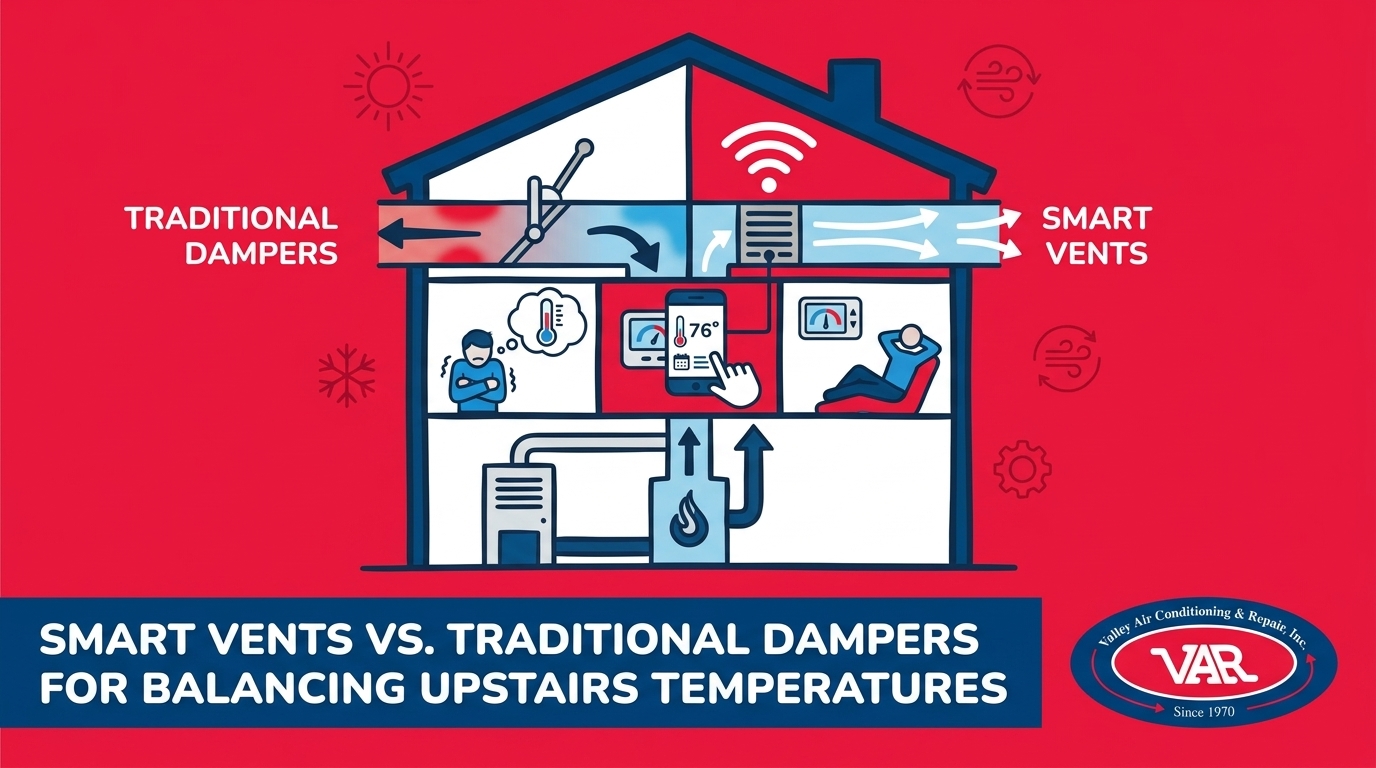
Closing vents in unused downstairs rooms doesn't save energy—it actually forces your system to work harder, and it rarely solves the real issue. If you are researching Smart Vents vs. Traditional Dampers for Balancing Upstairs Temperatures, you are likely dealing with a frustrating but common household problem. Downstairs, the living room feels like an icebox, while the upstairs bedrooms remain uncomfortably hot despite the air conditioner running continuously.
Many homeowners believe that restricting airflow right at the floor or ceiling register is a harmless way to force cold air up to the second floor. It seems logical on the surface: block the air here so it travels there. However, modern residential cooling equipment is highly sensitive to changes in HVAC system airflow. When you start shutting off pathways for the air to escape, you aren't just redirecting the breeze; you are fundamentally altering the mechanical pressures inside your ductwork.
In our years of serving the community at Valley Air Conditioning & Repair, Inc., we see this pattern often. This creates a critical decision point for anyone living in typical Fresno two-story homes. Do you retrofit your current setup with automated, smartphone-controlled smart vents, or do you invest in having a technician install professional manual duct dampers inside the ductwork itself? Making the wrong choice can lead to more than just a warm bedroom—it can cause catastrophic damage to your cooling equipment. To safely manage these extreme temperature differences without destroying your compressor, you need professional air conditioning solutions that respect the physics of how air moves through your home.
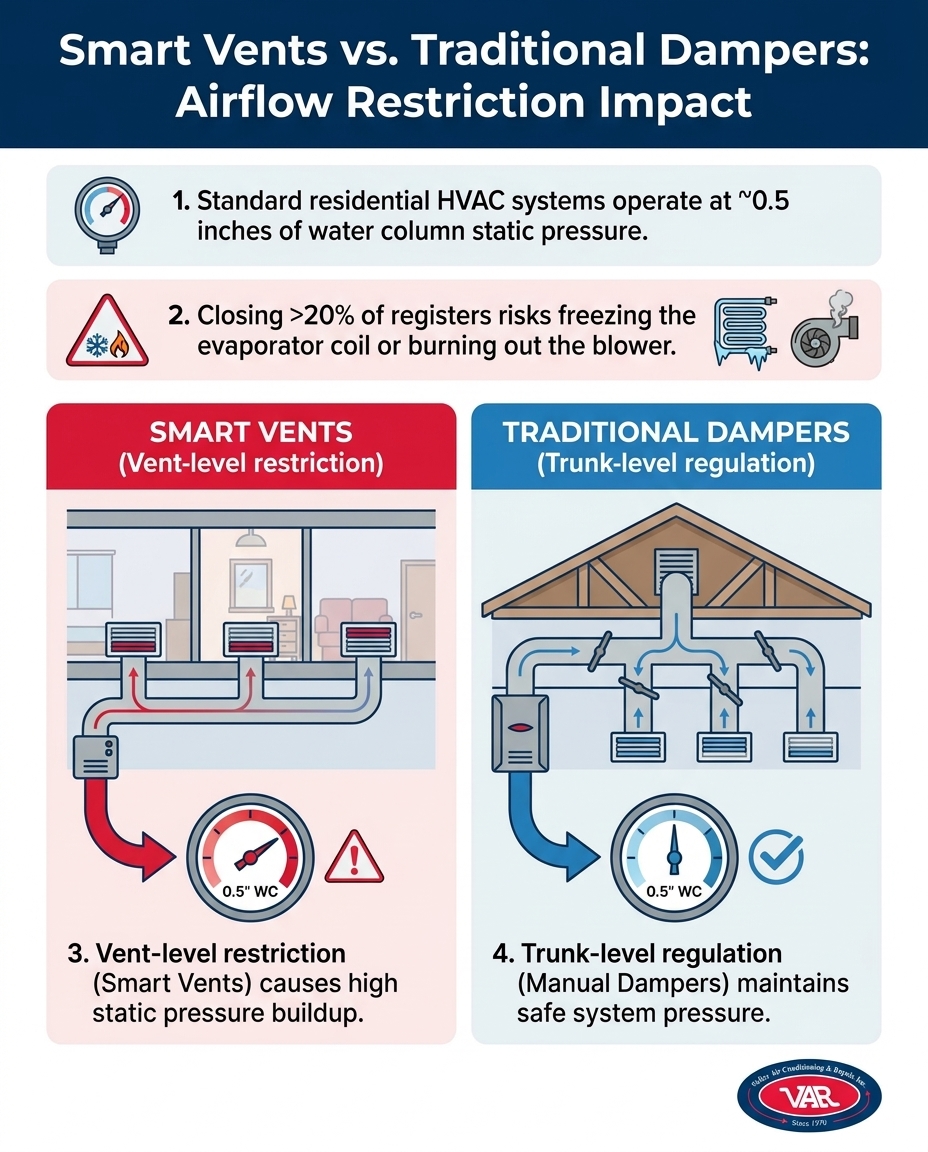
To understand why one airflow balancing method is safer than the other, you have to look past the thermostat and understand a concept called static pressure. Standard residential HVAC systems are precisely engineered to operate at a specific static pressure, typically around 0.5 inches of water column. This measurement represents the resistance your blower motor must overcome to push conditioned air through the ductwork and into your living spaces.
Think of your ductwork like a garden hose. If you turn on the spigot (your blower motor) and leave the nozzle wide open, the water flows freely with minimal resistance. But if you put your thumb over the end of the hose, the pressure inside the hose spikes dramatically. The water might spray further, but the hose itself is under intense stress. In an HVAC system, restricting air at the end of the line—the room vents—creates this exact same pressure spike inside your ducts.
Conversely, restricting the air at the beginning of the line—using trunk dampers near the indoor unit—is like slightly turning down the spigot. The volume of air is reduced, but the pressure inside the branch ducts remains stable and safe.
The mechanical danger of excess pressure: Closing more than 20% of a home's registers can restrict airflow so severely that it causes major equipment strain. When static pressure builds up in typical Fresno two-story homes, our service team routinely sees two disastrous things happen:
• Blower Motor Burnout: Modern systems often use ECM (Electronically Commutated Motor) blowers. These smart motors are designed to ramp up their speed to overcome resistance. If vents are closed, the motor works harder, runs hotter, and eventually burns out prematurely.
• Frozen Evaporator Coils: Air conditioners require a constant, specific volume of warm return air flowing over the indoor coil to prevent the refrigerant from getting too cold. When airflow drops due to closed vents, the coil drops below freezing, turning atmospheric humidity into a solid block of ice that completely halts the cooling process.
Smart vents have surged in popularity because they appeal to our desire for smart-home integration. These devices replace your standard floor or ceiling registers with automated, motorized louvers that connect to your Wi-Fi network. They open and close based on room temperature sensors or smartphone commands.
On paper, the advantages of smart vents are incredibly tempting for homeowners dealing with late August end-of-season cooling issues.
• Granular Room Control: You can theoretically tell the system to stop cooling the guest room and push that air to the master bedroom.
• Easy DIY Installation: They require no ductwork modifications. You simply unscrew the old register, drop in the battery-powered smart vent, and connect it to an app.
• Perceived Energy Savings: Many manufacturers market these vents as a way to save money by not conditioning empty rooms.
Despite the high-tech appeal, our technicians know firsthand that smart vents carry significant hidden risks. The primary drawback is that they create vent-level restriction. When a smart vent closes, the air has already traveled all the way through the ductwork only to hit a literal wall at the very end of the run. This causes an immediate, dangerous buildup of static pressure.
Debunking the energy myth: There is a persistent myth that smart vents save energy on their own. In reality, unless your system is equipped with a professional bypass damper system designed to relieve excess pressure, closing vents actually forces your blower motor to consume more electricity as it fights against the newly created resistance. This strain frequently leads to uneven cooling issues and can shorten the lifespan of your entire system.
While smart vents try to solve the problem at the finish line, traditional manual dampers solve the problem at the starting line. Manual dampers are metal valves installed directly inside the main duct trunk lines or large branch ducts, usually located in the attic or basement near the indoor air handler.
Instead of slamming the door on air that has already traveled through the house, manual dampers operate by partially restricting the volume of air before it ever enters the branch ducts. By slightly closing the damper that feeds the downstairs ductwork, more air volume is naturally forced up into the second floor. Because this restriction happens at the source, it maintains proper velocity and pressure throughout the rest of the system.
The pros of a mechanical solution:
• Protects the Compressor and Blower: By maintaining safe static pressure, dampers prevent the blower motor from overworking and keep the evaporator coil from freezing.
• Permanent Mechanical Fix: There are no batteries to change, no Wi-Fi signals to drop, and no software updates required.
• Better Overall Comfort: Balancing the air at the trunk line provides a smoother, more consistent airflow that improves indoor air quality and overall home comfort.
The main drawback of manual dampers is that they are absolutely not a DIY project. Installing and calibrating these valves requires specialized tools to measure static pressure and ensure the system operates within safe parameters. Adjusting them blindly can cause the exact same pressure problems as smart vents.
When seeking a permanent fix for Fresno two-story homes, our team at Valley Air Conditioning & Repair, Inc. often helps homeowners upgrade their entire setup to ensure perfect airflow. For example, we recently assisted a local customer who needed a completely new air-conditioning system to combat the intense summer heat. After qualifying for flexible financing options, they had the new system—complete with proper airflow management—installed within a week, and it has been working wonderfully to keep both floors comfortable ever since.
When you are struggling through late August end-of-season cooling, making a quick decision is tempting. However, understanding how these two methods stack up against each other mechanically is vital for the long-term health of your home's cooling infrastructure. Below is a direct comparison of how each method handles the critical job of redirecting air.
• Location of Restriction — Smart Vents: Vent-level (at the end of the duct run in the ceiling or floor) — Manual Duct Dampers: Trunk-level (at the beginning of the duct run near the air handler)
• Impact on Static Pressure — Smart Vents: Causes dangerous, sudden increases in pressure inside the ductwork — Manual Duct Dampers: Safely manages and distributes pressure before air enters branch lines
• Equipment Safety — Smart Vents: High risk of frozen evaporator coils and blower motor burnout — Manual Duct Dampers: Protects system longevity by maintaining safe operational thresholds
• Long-Term Reliability — Smart Vents: Relies on batteries, Wi-Fi connections, and small motorized parts — Manual Duct Dampers: Permanent mechanical solution that rarely requires maintenance once set
As the table illustrates, the convenience of controlling a vent from your phone comes at a steep mechanical cost. While smart vents might offer a temporary band-aid for a hot room, manual dampers provide a comprehensive, system-safe cure.
The debate between these two airflow solutions becomes even more critical when you factor in the local climate. Fresno's extreme summer climate, frequently exceeding 100 degrees for days or weeks on end, requires HVAC systems to operate at absolute peak capacity. During these intense heatwaves, your air conditioner is running nearly constantly just to maintain a baseline level of comfort.
When an AC unit is already under maximum operational strain, introducing any additional airflow restriction is highly dangerous. If you are relying on DIY smart vents to balance your temperatures, the added static pressure during peak load accelerates compressor wear and tear exponentially. What might just be a minor inefficiency in a milder climate quickly turns into a total system breakdown when the Central Valley heat pushes the equipment to its limits.
During a brutal stretch of 100-degree days in Fresno that lasted for a month, our repair crew responded to a call where a homeowner's aging system failed entirely due to the extreme heat and poor airflow management. We were able to step in and provide a new A/C unit, complete with convenient phone control and flexible financing, ensuring they had reliable, unobstructed cooling restored quickly just in time for the back-to-school transition.
A mechanically sound system with proper trunk dampers ensures reliable cooling when it is needed most. Valley Air Conditioning & Repair's deep understanding of HVAC static pressure ensures that airflow balancing solutions actually solve your comfort problems without silently damaging the compressor. Of course, even the best damper system needs support. Combining proper airflow management with regular HVAC maintenance ensures that balanced airflow doesn't mask other underlying issues, especially during late August end-of-season cooling when systems are most fatigued.
Yes, if used incorrectly, they can be highly detrimental. Closing too many smart vents increases static pressure inside the ductwork beyond safe operating limits. This excess pressure forces the blower motor to overwork, which can lead to premature burnout, and restricts the airflow over the indoor coil, which can cause the evaporator coil to freeze solid.
Manual dampers work by partially restricting airflow to the downstairs duct branches right at the main trunk line. By slightly closing off the path to the cooler lower level, they force more air volume up into the second-floor ductwork. Because this restriction happens early in the system, it redirects the air without causing dangerous pressure backups at the room vents.
Yes, when they are properly adjusted by a professional who measures static pressure, they provide a highly effective, permanent fix for uneven temperatures. They address the root cause of the imbalance in typical Fresno two-story homes by ensuring the right volume of air reaches the distant upstairs rooms without straining the equipment.
Dampers should always be installed in the main trunk lines or inside the large branch ducts immediately near the indoor air handler. They should never be installed at the end of the duct run near the room registers, as regulating air at the end of the line causes the harmful pressure spikes that damage blower motors.
No, installing and calibrating manual dampers is not a DIY project. The process requires cutting into the main sheet metal ductwork and, more importantly, using specialized tools like a manometer to measure static pressure. A professional must ensure that the newly balanced system still operates within safe mechanical parameters to protect your compressor.
Balancing the temperatures between the first and second floors of your home doesn't have to mean putting your expensive cooling equipment at risk. While smart vents offer undeniable tech appeal and the promise of easy smartphone control, traditional manual dampers provide the mechanical safety and reliability your system desperately needs to survive the heat.
At Valley Air Conditioning & Repair, Inc., we've seen firsthand how regulating air at the source protects your blower motor, prevents frozen coils, and ensures consistent comfort during late August end-of-season cooling. If you are tired of sweating upstairs while freezing downstairs, it is time to consult our local experts to evaluate your ductwork, measure your static pressure, and balance your home's temperatures safely and permanently.

As a business with many AC units, it is essential to have a responsive AC company. Valley Air Conditioning understands our needs. They are always responsive and our AC is up and running very quickly.
I had them do an AC check on the home I was buying, they were honest and quick. I hired them to do the summer and Fall maintenance for $149. Happy with this company!
100% recommend. I called, same day they came out and gave me estimate. Conley was honest and didn't try to recommend/sell us anything we didn't need. When I called him with questions before making a decision, he happily answered and was not annoyed by me contacting him. Conley and VAR
This is a group of good people. Very professional and knowledgeable. They take the time to listen and find the best solution that fits best for any situation. There's no way you can go wrong in choosing VAR.
We have used Valley Air for over fifteen years. The last two years ,Matt came to our house to service twice a year. Always on time, so polite and so professional. This is a very honest company and you can always depend on them and trust them. The office always treats everyone cheerfully and always want to do what you need done very fast YOU CAN COUNT ON THIS Company