.webp)


AC Repair in Fresno, CA: Troubleshooting Summer Wear and Fall Heating Startup
Smelling burning dust on that first chilly night? Decide with confidence using our home maintenance tips and troubleshooting steps for safe fall HVAC startups.
The cost of repairing old ac vs buying a new system is one of the most common questions homeowners face when their unit starts struggling — especially during the brutal summer heat of California's Central Valley. The short answer: it depends on your system's age, repair history, and efficiency. Here's a quick breakdown to help you decide fast:
Quick Decision Guide: Repair vs. Replace
| Situation | Likely Best Choice |
|---|---|
| Unit is under 10 years old, minor issue | Repair |
| Unit is 10-15+ years old, major failure | Replace |
| Repair cost × unit age exceeds $5,000 | Replace |
| Repair cost is over 50% of a new system | Replace |
| System uses R-22 (Freon) refrigerant | Replace |
| Unit is under warranty, small repair needed | Repair |
| Frequent breakdowns in the last 2-3 years | Replace |
Most residential AC units last between 10 and 15 years. After that, the math starts working against you. Repairs get more expensive, parts get harder to find, and energy bills quietly creep upward — sometimes by 30% to 50% compared to a modern system.
For homeowners in Modesto and across the Central Valley, this isn't just a financial question. Running an old, inefficient system through a 100°F+ summer puts serious strain on the equipment — and your wallet.
The good news is there's a clear, logical way to figure out which path makes more sense for your home. You don't have to guess.
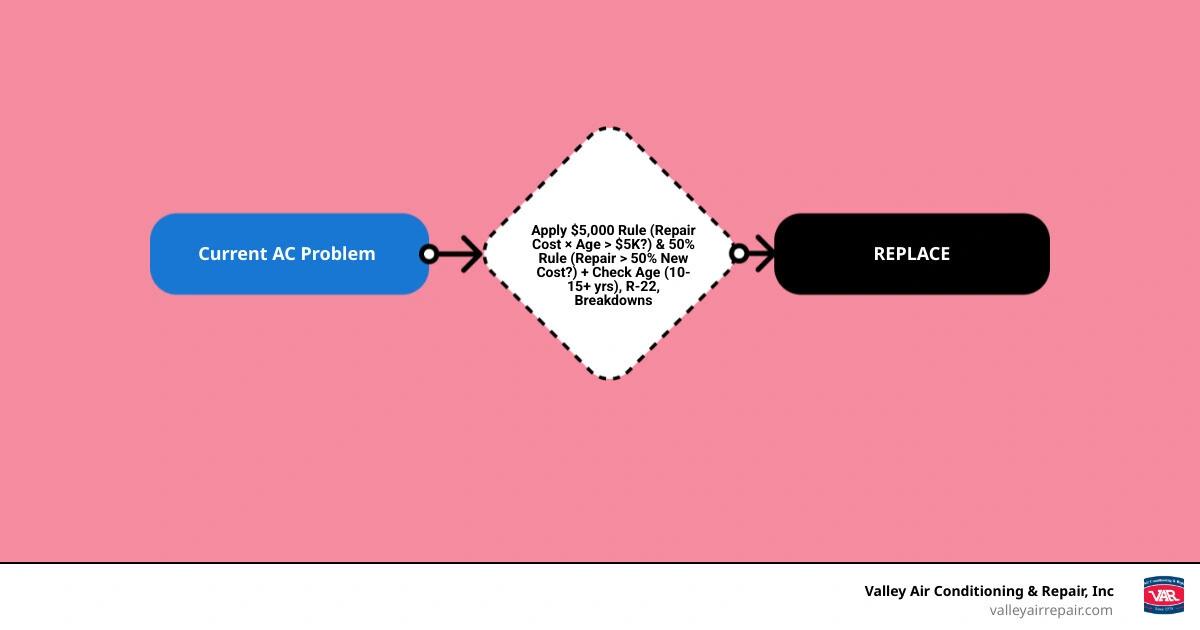
When we visit homes in Fresno, Clovis, or Modesto, we often see homeowners caught in what we call the "repair spiral." This is when you pay for a small fix this year, a medium fix next year, and before you know it, you’ve spent a significant portion of what a new, reliable system would have cost. To avoid this, we recommend using two industry-standard "rules of thumb" to evaluate the cost of repairing old ac vs buying a new system.
The $5,000 Rule is a simple mathematical formula that removes the emotion from the decision. You take the age of your air conditioning unit and multiply it by the estimated repair quote. If the resulting number is higher than $5,000, the investment in a repair is likely not worth it.
For example, if you have a 12-year-old unit and the repair quote is $500, the math (12 x 500) equals $6,000. Since $6,000 is greater than $5,000, we would advise looking into a replacement. Conversely, if that same unit only needed a $300 fix, the result is $3,600, making the repair a more reasonable short-term gamble.
Another perspective we use is the 50% Rule. If the cost of a single repair exceeds 50% of the value of a brand-new system, it is almost always better to replace. Why? Because a repair only fixes one component. The rest of your system is still the same age and remains prone to the next failure. When you choose a replacement, you aren't just buying a part; you're buying a fresh warranty, modern efficiency, and peace of mind for the next decade.
Beyond the math, you have to consider the frequency of breakdowns. If we’ve seen you three times in the last two summers, your unit is sending you a message. At a certain point, the "sunk cost fallacy" kicks in—you feel like you have to keep repairing it because you’ve already spent so much. We want to help you break that cycle. There are many Benefits of upgrading your aging HVAC system, including lower monthly bills and significantly improved reliability during our "Valley" heatwaves.
We aren't always going to tell you to replace your system. In fact, there are many scenarios where a professional repair is the smartest financial move. If your system is under 10 years old, it is generally considered to be in its "prime." Most major components are still robust, and the overall efficiency hasn't degraded significantly yet.
Many common AC issues are actually quite simple to fix. Components like capacitors, contactors, and fan motors are wear-and-tear items. Replacing them is routine maintenance. If your unit won't start or is making a clicking sound, it might just be a failed capacitor. In these cases, repairing is the clear winner. These parts are relatively inexpensive to replace and can get your system back up and running in an afternoon.
Always check your warranty! Most modern systems come with a 5-to-10-year parts warranty. If your unit is still covered, the manufacturer may pay for the replacement part itself, leaving you only responsible for the labor and refrigerant. Repairing a unit under warranty is almost always more cost-effective than a full replacement. We encourage our customers in Fresno and surrounding areas to keep their original installation paperwork handy for this very reason. If you're unsure where to start with a system that isn't performing, our AC repair Fresno CA complete guide can help you navigate the process.
Sometimes, a repair is a strategic choice. If you are planning to move in the next year, or if a full replacement isn't in the budget this month, a "bridge repair" can keep you comfortable while you plan for the future. However, we always provide an honest assessment of how long that bridge might last. Our goal is to ensure you aren't throwing money into a system that will fail again before the season is over.
In the HVAC industry, "diminishing returns" refers to the point where the money you spend to keep an old unit running is no longer providing a good value. In May 2026, this is more relevant than ever due to several technological and regulatory shifts.
If your AC was installed before 2010, there is a high probability it uses R-22 refrigerant (often called Freon). The EPA completely phased out the production and import of R-22 in 2020. Because the supply is now extremely limited, the cost to "recharge" a system with a leak has skyrocketed. We often tell homeowners that if an R-22 system has a major leak in the evaporator coil or compressor, it is effectively a "totaled" system. Investing in expensive, obsolete refrigerant is like putting premium silk into a tattered old shirt—it doesn't fix the underlying holes.
Age isn't the only indicator. You should look for these physical signs that your unit is failing:
If you are noticing these signs, it’s time to consult our AC replacement Clovis CA complete guide to see what modern options are available for your specific neighborhood.
The true cost of repairing old ac vs buying a new system isn't just the number on the repair invoice. There are "hidden costs" that many homeowners overlook until they see their bank statements at the end of a long summer.
As of May 2026, the HVAC landscape has changed significantly. If you haven't looked at a new air conditioner in ten years, you might be surprised by how much technology has advanced. Modern systems are not just "newer versions" of the old ones; they operate on entirely different principles that prioritize comfort and extreme efficiency.
You’ve likely heard of SEER (Seasonal Energy Efficiency Ratio). In 2023, the industry moved to SEER2, which uses a more rigorous testing protocol that better reflects how a unit actually performs in a home. A unit rated at 18 SEER2 is vastly more efficient than the 10 or 12 SEER units common a decade ago. For homeowners in the Valley, where the AC runs for several months straight, these efficiency gains translate directly into lower utility bills.
Older AC units are either "on" or "off." They blast cold air at 100% capacity until the thermostat is satisfied, then they shut down. Modern premium systems use variable-speed compressors. These act like a dimmer switch rather than an on/off switch. They can run at 25% or 50% capacity to maintain a perfectly steady temperature, which uses much less energy and provides superior humidity control.
One of the biggest reasons to consider an HVAC system upgrade in 2026 is the availability of federal incentives. Under the Inflation Reduction Act, homeowners can qualify for significant tax credits—sometimes up to $2,000 for high-efficiency heat pumps. When you combine these credits with local utility rebates and the monthly energy savings, the "net cost" of a new system becomes much more attractive.
To make a truly informed decision, you have to look at the 5-year total cost of ownership. When you repair an old unit, you are paying for the repair PLUS the high energy bills PLUS the risk of another repair next month. When you buy a new system, you have a higher upfront cost, but your monthly bills drop, and your repair costs go to zero because of the warranty.
Efficiency Comparison: Old vs. New
| System Type | Efficiency Rating | Estimated Energy Usage | Reliability Risk |
|---|---|---|---|
| 15-Year-Old Unit | 10 SEER | High (100%) | Very High |
| Standard Modern Unit | 14.3 SEER2 | Medium (70%) | Low |
| High-Efficiency Unit | 18+ SEER2 | Low (50-60%) | Very Low |
| Variable-Speed Unit | 22+ SEER2 | Lowest (40-50%) | Minimal |
By upgrading from a 10 SEER unit to a high-efficiency SEER2 system, many of our customers see their cooling costs cut by 30% to 40%. Over five years, that savings can add up to a significant portion of the system's purchase price.
At Valley Air Conditioning & Repair, Inc., we’ve been serving "the Valley" since 1970. Our business was built on a customer-first philosophy and honorable intentions. We know that deciding between a major repair and a new system is a big financial step, and we are here to provide the honest, expert advice you need to make the right choice for your family.
Whether you are in Fresno, Clovis, Modesto, or any of our surrounding communities, we treat your home like our own. We don't believe in high-pressure sales; we believe in providing the math, the facts, and the quality service that has kept us growing through word-of-mouth for over five decades. If your AC is struggling, don't wait for a total breakdown in the middle of July. Let us help you evaluate your options today.
Our Service Areas Include:Biola, Clovis, Coarsegold, Del Rey, Dinuba, Fowler, Fresno, Friant, Kerman, Kingsburg, Laton, Lemoore, Madera Ranchos, Madera, O’Neals, Parlier, Reedley, Riverdale, Sanger, Selma, and Yosemite Lakes.
More info about air conditioning services
If your system is over 15 years old, you have reached the end of its reliable service life. In the Modesto heat, units work harder and age faster. If your repair-to-value ratio is consistently high—meaning you are spending a significant amount every year just to keep it running—it is time to stop the "slow bleed" of cash and invest in a new, warrantied system. Frequent breakdowns and rising energy consumption are the two biggest red flags that replacement is the only logical path forward.
Yes! We recommend the Age-to-Repair formula (The $5,000 Rule). Multiply the age of your unit by the repair estimate; if it’s over 5,000, replace it. You should also consider the 50% Rule: if a repair costs more than half of a new unit, it’s not a good investment. Finally, we always recommend a professional load calculation. If your home has had new windows or insulation added since the AC was installed, your old unit might be the wrong size, making it inefficient regardless of its mechanical health.
R-22 refrigerant was phased out completely by the EPA due to its ozone-depleting properties. Because it is no longer manufactured, the remaining supply is extremely scarce and subject to strict environmental regulations. This has driven the price of the refrigerant itself to record highs. Additionally, because R-22 units are older, finding replacement parts like coils or compressors often involves sourcing refurbished or expensive "new old stock" parts, making the total repair cost prohibitively high compared to modern, eco-friendly systems.

As a business with many AC units, it is essential to have a responsive AC company. Valley Air Conditioning understands our needs. They are always responsive and our AC is up and running very quickly.
I had them do an AC check on the home I was buying, they were honest and quick. I hired them to do the summer and Fall maintenance for $149. Happy with this company!
100% recommend. I called, same day they came out and gave me estimate. Conley was honest and didn't try to recommend/sell us anything we didn't need. When I called him with questions before making a decision, he happily answered and was not annoyed by me contacting him. Conley and VAR
This is a group of good people. Very professional and knowledgeable. They take the time to listen and find the best solution that fits best for any situation. There's no way you can go wrong in choosing VAR.
We have used Valley Air for over fifteen years. The last two years ,Matt came to our house to service twice a year. Always on time, so polite and so professional. This is a very honest company and you can always depend on them and trust them. The office always treats everyone cheerfully and always want to do what you need done very fast YOU CAN COUNT ON THIS Company