.webp)


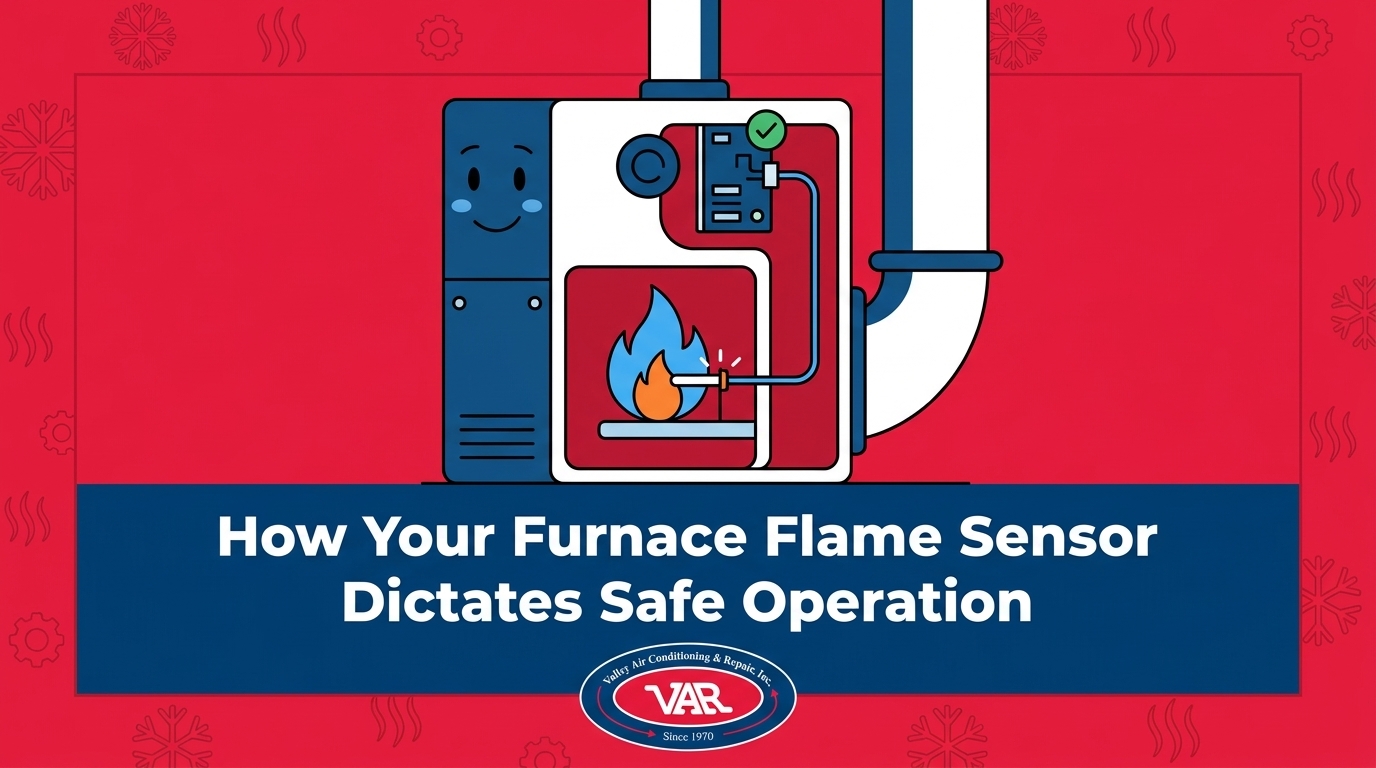
How Your Furnace Flame Sensor Dictates Safe Operation
If your heating system fires up only to shut down seconds later, a dirty flame sensor is likely to blame. See why this tiny rod triggers a strict safety lockout.
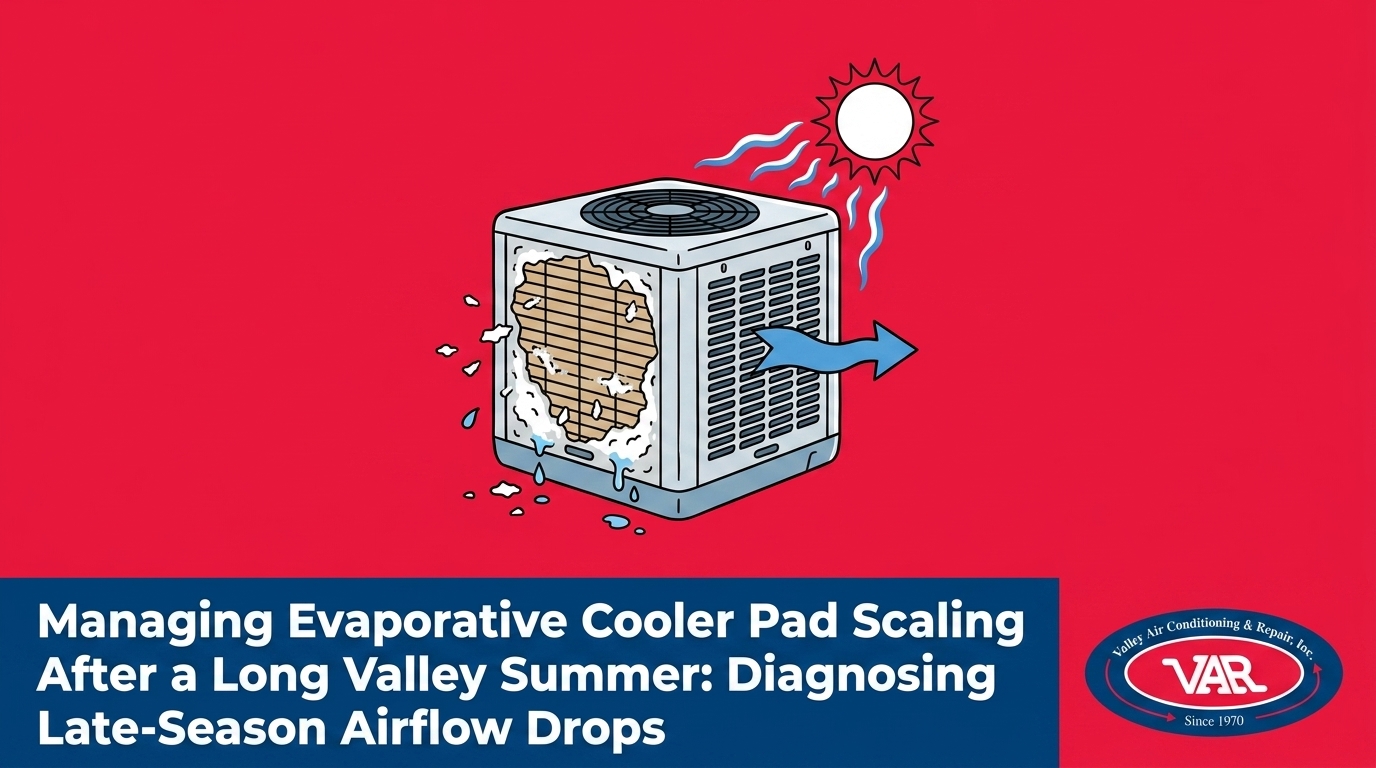
Managing Evaporative Cooler Pad Scaling After a Long Valley Summer requires understanding a surprising statistic: a standard evaporative cooler can consume between 3 to 15 gallons of water every single hour it operates. According to data from EPA WaterSense, this massive volume of water is necessary to facilitate the heat exchange that keeps your home comfortable. However, while pure water evaporates into the air to lower indoor temperatures, the heavy minerals dissolved in that water do not leave the system. Instead, they remain trapped within the fibrous matrix of your cooling pads.
For expert help, explore our Air Conditioning Services and Evaporative Cooler Services.
As the relentless heat persists month after month, this continuous evaporation cycle creates a significant concrete problem. By the time the late summer back-to-school transition arrives in August, those accumulated minerals have transformed your once-porous cooling pads into rigid, calcified walls. This dense buildup severely restricts the amount of air the blower motor can pull through the system. Homeowners often notice that the cooler runs constantly, yet the house still feels uncomfortably warm.
This drop in performance forces a critical decision point. You must determine if your cooling pads are simply dirty and in need of a rinse, or if they have become too deeply calcified to function. When pads reach a state of terminal scaling, no amount of basic maintenance will restore proper airflow. Understanding the hidden impact of these high evaporation rates is the first step in diagnosing why your system is struggling just when you need it most to finish out the cooling season.
To properly diagnose late-season airflow drops, you first need to understand the physical process of how scaling occurs over hundreds of hours of runtime. Evaporative coolers rely on a relatively simple mechanical sequence. A water pump continuously draws water from a reservoir pan and pushes it up through a network of distribution tubes, often called spider tubes. This water then cascades down over the cooling pads, keeping them thoroughly saturated. Meanwhile, a powerful blower motor pulls hot outside air through these wet pads, causing the water to evaporate and cool the air before pushing it into your home.
The issue lies in the process of mineral concentration. Pure H2O evaporates easily, but the dissolved solids carried in the water supply—primarily calcium and magnesium—are left behind on the pad material.
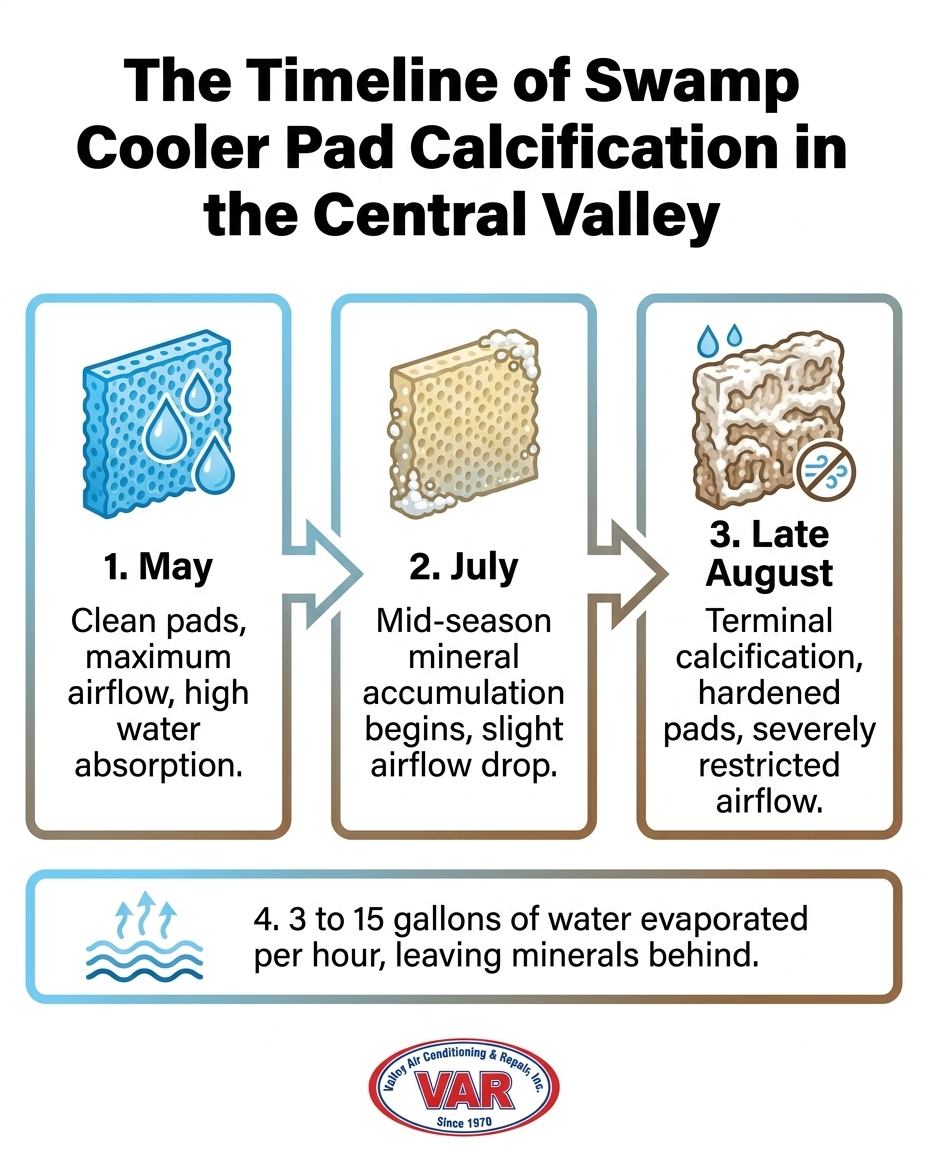
• Early Season (May) — Pad Condition: Clean, highly porous, flexible — Airflow Status: Maximum intake and output — Mineral Concentration: Minimal to none
• Mid Season (July) — Pad Condition: Slightly stiff, minor crusting — Airflow Status: Slight drop in efficiency — Mineral Concentration: Moderate accumulation
• Late Season (August) — Pad Condition: Hardened, heavy white scale — Airflow Status: Severely restricted airflow — Mineral Concentration: Terminal calcification
The evaporation cycle acts as a highly efficient separation mechanism. As water evaporates to cool the incoming air, the dissolved minerals crystallize and bond to the fibers of the cooling pad. Continuous cycling without proper bleed-off accelerates this concentration rapidly. The water remaining in the reservoir pan becomes increasingly saturated with these heavy minerals. As the pump recirculates this highly concentrated water back over the pads, the rate of calcification speeds up exponentially.
By the time late August arrives, this physical buildup creates a literal rock-solid barrier. The blower motor is designed to pull air through a porous matrix, not a solid sheet of calcium. When the pads become choked with scale, the motor works harder to draw air, creating high static pressure within the unit while delivering very little cooled air into the living space.
Standard national advice on evaporative cooler maintenance often suggests that cooling pads can last an entire year, or even multiple seasons, with simple mid-summer cleanings. However, that advice typically assumes milder climates with softer water. Here in the Fresno area, local data from the City of Fresno Annual Water Quality Report consistently shows moderate to high levels of hardness, primarily in the form of calcium carbonate, in the groundwater supply.
When you combine our specific regional water chemistry with the extreme dry heat in the Central Valley, it accelerates the evaporation process, leaving behind dense mineral deposits much faster than in milder climates. This combination creates a "perfect storm" for rapid calcification. The hotter it gets, the more water evaporates; the more water evaporates, the faster the calcium carbonate crystallizes on the pads.
At Valley Air Conditioning & Repair, our deep local expertise shows that the unique interaction between Central Valley groundwater hardness and our extreme evaporation rates requires a highly specialized approach to maintenance. Standard mid-summer advice, such as attempting a simple vinegar rinse, often fails completely against this dense late-season Central Valley scale. Vinegar is a mild acid that can dissolve light, superficial mineral spotting. It is entirely ineffective against thick, layered sheets of crystallized calcium that have baked onto the pads over hundreds of hours of peak-season runtime.
When the airflow from your evaporative cooler drops significantly during the late summer back-to-school transition, the immediate challenge is pinpointing the exact cause. You need to differentiate between severe pad calcification and underlying mechanical issues that mimic the same symptoms. The sensory signs of restricted airflow are usually the first clue. You might hear the blower motor running louder than usual, sounding strained as if it is working incredibly hard, yet very little air is actually entering the home through the vents.
If you want to keep things running smoothly, getting the most from your evaporative cooler requires knowing when to inspect the system physically. A visual inspection of the cooling pads is the most definitive way to confirm scaling.
• Solid white crust: Look for thick, chalky sheets of calcium carbonate covering the louvered panels and the pad matrix itself.
• Brittle texture: Healthy pads are somewhat flexible and spongy. Heavily scaled pads feel rigid, brittle, and may crumble to dust when poked.
• Water channeling: Instead of absorbing evenly into the pad, the pump water runs over the surface of the scale, channeling around the pad entirely and leaving large dry spots.
• High static pressure noises: A whistling or groaning sound from the blower motor indicates it is struggling to pull air through a blocked barrier.
It is important to contrast these pad scaling symptoms with signs of a failing blower motor or a malfunctioning water pump. If the pads are clean and wet, but airflow is still low, the blower motor capacitor or the belt may be failing. If the pads are completely dry and there is no white scale, the water pump has likely failed or the spider tubes are clogged. When diagnostic checks reveal complex mechanical stress rather than simple pad calcification, it indicates the need for professional assessment rather than simple troubleshooting.
Ignoring heavily scaled pads does more than just make your home uncomfortable; it creates a destructive ripple effect throughout the entire evaporative cooling system. When calcified pads block incoming air, they force the blower motor to work significantly harder to overcome the increased static pressure. This continuous strain drastically increases the unit's energy consumption and elevates the internal operating temperature of the motor, creating a high risk of premature motor burnout.
Furthermore, when water cannot properly saturate a calcified pad, it takes the path of least resistance. This often means the water drips, sprays, or channels into areas of the cabinet where it shouldn't go. Chronic water channeling leads to standing water in the dry sections of the unit, accelerating rust and corrosion on the metal housing, the blower wheel, and the motor mounts.
Investing in a comprehensive HVAC Maintenance Plan catches these issues early, before they cause cascading mechanical failures. One local homeowner with an older system learned this firsthand during a spring visit. By performing ongoing preventive maintenance and thoroughly cleaning the components before mineral buildup could cause secondary damage, the technician kept their 13-year-old unit running like new. Keeping an older unit running efficiently requires proactive management of wear-and-tear components like pads, especially in the harsh conditions of the Central Valley.
When evaporative cooler pads reach terminal calcification by late August, professional interventions are required to resolve the airflow restriction and prepare the system for the remainder of the season. The primary solution is professional pad replacement. Technicians evaluate whether your system utilizes Aspen wood fiber pads or rigid media (honeycomb) pads, as each handles scale differently. Aspen pads are highly absorbent but degrade quickly under heavy scale, requiring complete replacement. Rigid media pads last longer but require specialized professional descaling chemicals if they are to be saved, though late-season replacement is often the most reliable way to restore full airflow.
Beyond simply swapping the pads, a professional intervention includes descaling the water distribution system. Over hundreds of hours of operation, the small spider tubes that deliver water to the pads become choked with the same calcium deposits. Technicians flush these lines and clean the water pump intake to ensure even water flow over the new pads.
Additionally, professionals adjust the bleed-off valves. A properly calibrated bleed-off valve continuously drains a small amount of the mineral-heavy water from the pan, replacing it with fresh water to reduce the rate of future mineral concentration.
Proactive Residential Pre-Season Preparation is great, but late-summer professional interventions are just as important. Professionals ensure that the new pads are properly sized and seated within the frames. If pads are even slightly too small, hot air will bypass the wet media entirely, pulling directly into the blower and neutralizing the cooling effect. Furthermore, technicians can safely clean the water reservoir and check the pump for mineral damage without risking the electrical hazards associated with standing water and high-voltage motor connections. Scheduling these interventions proactively ensures the system is fully prepared to handle the inevitable late-season heatwaves.
The most obvious sign that swamp cooler pads need replacement is a severe drop in airflow combined with a solid, white, crusty buildup on the pad material. When the pads feel stiff and brittle to the touch, or when water begins channeling around them instead of absorbing evenly, they have reached terminal calcification. At this stage, cleaning is no longer effective, and replacement is required to restore cooling power.
Restricted airflow in an evaporative cooler is most frequently caused by heavy mineral scaling on the cooling pads, which creates a physical barrier that the blower motor cannot pull air through. Other potential causes include a loose or slipping blower belt, a failing blower motor, or inadequate exhaust ventilation inside the home preventing proper air circulation. A visual inspection of the pads is the fastest way to rule out severe calcification.
Hard water contains high levels of dissolved minerals, primarily calcium and magnesium, which do not evaporate with the water. As the cooler operates, these heavy minerals are left behind, crystallizing onto the cooling pads, clogging the water distribution tubes, and accumulating in the reservoir pan. Over time, this rapid calcification severely restricts airflow, forces the motor to work harder, and accelerates corrosion throughout the system.
When swamp cooler pads get hard due to mineral buildup, they lose their ability to absorb water and allow air to pass through freely. This forces the blower motor to strain against high static pressure, increasing energy use and risking motor burnout. Additionally, the hardened surface causes water to channel and splash into dry areas of the cabinet, leading to internal rust and potential electrical damage.
While light mineral spotting early in the season can sometimes be mitigated with mild descaling solutions like vinegar, heavy late-summer calcium buildup is usually permanent. Once the scale has baked into a solid, thick crust over hundreds of hours of operation, attempting to dissolve it will often destroy the underlying pad material. In these late-season scenarios, professional pad replacement is the only reliable way to restore proper airflow.
Effectively Managing Evaporative Cooler Pad Scaling After a Long Valley Summer is the key to maintaining indoor comfort when late-season heatwaves strike. By understanding why hard water scaling causes severe airflow drops, you can avoid wasting time on ineffective maintenance. Identifying when pads are too calcified to save allows you to seek timely professional replacement, ensuring your cooling system finishes out the season strong.

As a business with many AC units, it is essential to have a responsive AC company. Valley Air Conditioning understands our needs. They are always responsive and our AC is up and running very quickly.
I had them do an AC check on the home I was buying, they were honest and quick. I hired them to do the summer and Fall maintenance for $149. Happy with this company!
100% recommend. I called, same day they came out and gave me estimate. Conley was honest and didn't try to recommend/sell us anything we didn't need. When I called him with questions before making a decision, he happily answered and was not annoyed by me contacting him. Conley and VAR
This is a group of good people. Very professional and knowledgeable. They take the time to listen and find the best solution that fits best for any situation. There's no way you can go wrong in choosing VAR.
We have used Valley Air for over fifteen years. The last two years ,Matt came to our house to service twice a year. Always on time, so polite and so professional. This is a very honest company and you can always depend on them and trust them. The office always treats everyone cheerfully and always want to do what you need done very fast YOU CAN COUNT ON THIS Company