Why We Tell Homeowners Not to Panic When Using a Heat Pump in Heavy Fog
Running a heat pump in heavy fog can make it look like it's on fire. Why we tell Fresno homeowners not to panic, and how to spot a normal defrost cycle.

November Tule fog season is just around the corner, which means you will soon rely heavily on your heating system to stay comfortable during damp, chilly mornings. At Valley Air Conditioning & Repair, Inc., our dispatchers field frantic calls every November from Fresno homeowners who think their outdoor unit is up in flames. If you operate a heat pump in heavy fog, you might wake up one cold morning, look out the window, and see thick white clouds billowing directly from your outdoor unit. For most homeowners, this is a startling experience. It is incredibly easy to assume the worst—that your system has caught fire, blown a motor, or suffered a catastrophic electrical failure overnight.
Before you rush outside in your slippers to shut off the breaker, take a deep breath. Running your home heating systems during late fall and early winter mornings involves dealing with significant temperature drops and rapidly rising moisture levels. What looks like a dangerous electrical fire is almost always a completely normal, built-in function of your equipment. Modern HVAC systems are designed to handle freezing temperatures and high humidity, and they have automated routines to protect themselves from ice buildup.
Understanding how your equipment behaves in cold, damp weather is the best way to avoid unnecessary panic. In almost all cases, that massive cloud of white "smoke" is actually just steam. Your system is performing a vital self-maintenance routine to keep your house warm. Let's break down exactly what is happening inside that metal cabinet so you know what to expect as the morning temperatures drop.
To understand why your outdoor unit is steaming, you first need to understand how it generates heat. Unlike a traditional gas furnace that burns fuel to create warmth, your system moves existing heat from one place to another. Even when it feels freezing outside, there is still ambient thermal energy in the air. Your equipment extracts that heat and pumps it inside your home. If you rely on heat pump services to stay warm, your system is working constantly to pull that outdoor energy indoors.
During this heat extraction process, the refrigerant inside your outdoor coils becomes extremely cold—often dropping below the freezing point of water. As the outdoor fan pulls cold, damp air across these freezing metal fins, the ambient moisture in the air condenses and instantly freezes. Over the course of a cold night, a thick layer of white frost will build up across the entire surface of the outdoor coil.
If that ice is left unchecked, it will eventually form a solid block, suffocating the unit and stopping all airflow. To prevent your unit from becoming encased in a block of ice, built-in electronic sensors constantly monitor the coil temperature and the runtime of the compressor. When the sensors detect too much ice, they trigger a standard defrost cycle. This usually happens on a set timer, typically every 30, 60, or 90 minutes depending on the weather conditions and your specific equipment settings.
When the defrost cycle begins, the system temporarily reverses its operation. A specialized component called the reversing valve shifts position, taking the hot refrigerant that was heading inside your house and sending it back to the outdoor coil instead. At the same time, the outdoor fan stops spinning. This allows the outdoor coil to heat up rapidly, melting the accumulated frost in a matter of minutes. Once the ice is gone, the system shifts back into its normal heating mode.
A defrost cycle happens on almost every cold night, but you rarely notice it. So, why does it suddenly look like a massive fire when you run a heat pump in heavy fog? The answer lies in the unique environmental conditions of Fresno and the Central Valley. Our team at Valley Air Conditioning & Repair knows firsthand how our local weather patterns create the perfect storm for dramatic visual effects.
The Central Valley is famous for its thick radiation fog, commonly known as Tule fog. This type of weather event creates an environment with near-100% relative humidity right at ground level. The air is so heavily saturated with moisture that it literally cannot hold another drop of water. This extreme dampness means your outdoor coils accumulate frost much faster than they would on a dry, clear winter night, forcing the system to enter its defrost cycle more frequently.
When the defrost cycle kicks in, the outdoor coils get incredibly hot very quickly. As this intense heat meets the thick layer of freezing frost, the ice melts and instantly vaporizes into steam. Because the outdoor fan is turned off during the defrost cycle, this steam rises straight up out of the top of the unit.
On a dry winter night, that steam would quickly dissipate into the surrounding air and vanish. However, during a dense Tule fog event, the surrounding air is already completely saturated with moisture. The new steam has nowhere to go. It cannot evaporate into the surrounding atmosphere, so it lingers, creating a massive, dense white cloud that looks exactly like thick smoke billowing from a fire. The visual effect is dramatically amplified by the fog, turning a normal mechanical process into an alarming morning spectacle.
When you are standing outside in your pajamas staring at a billowing cloud, it is easy to let anxiety take over. However, there are several clear, actionable sensory cues you can use to evaluate your unit safely. By checking these basic signs, you can easily tell the difference between normal defrost steam and an actual electrical fire without calling for unnecessary help.
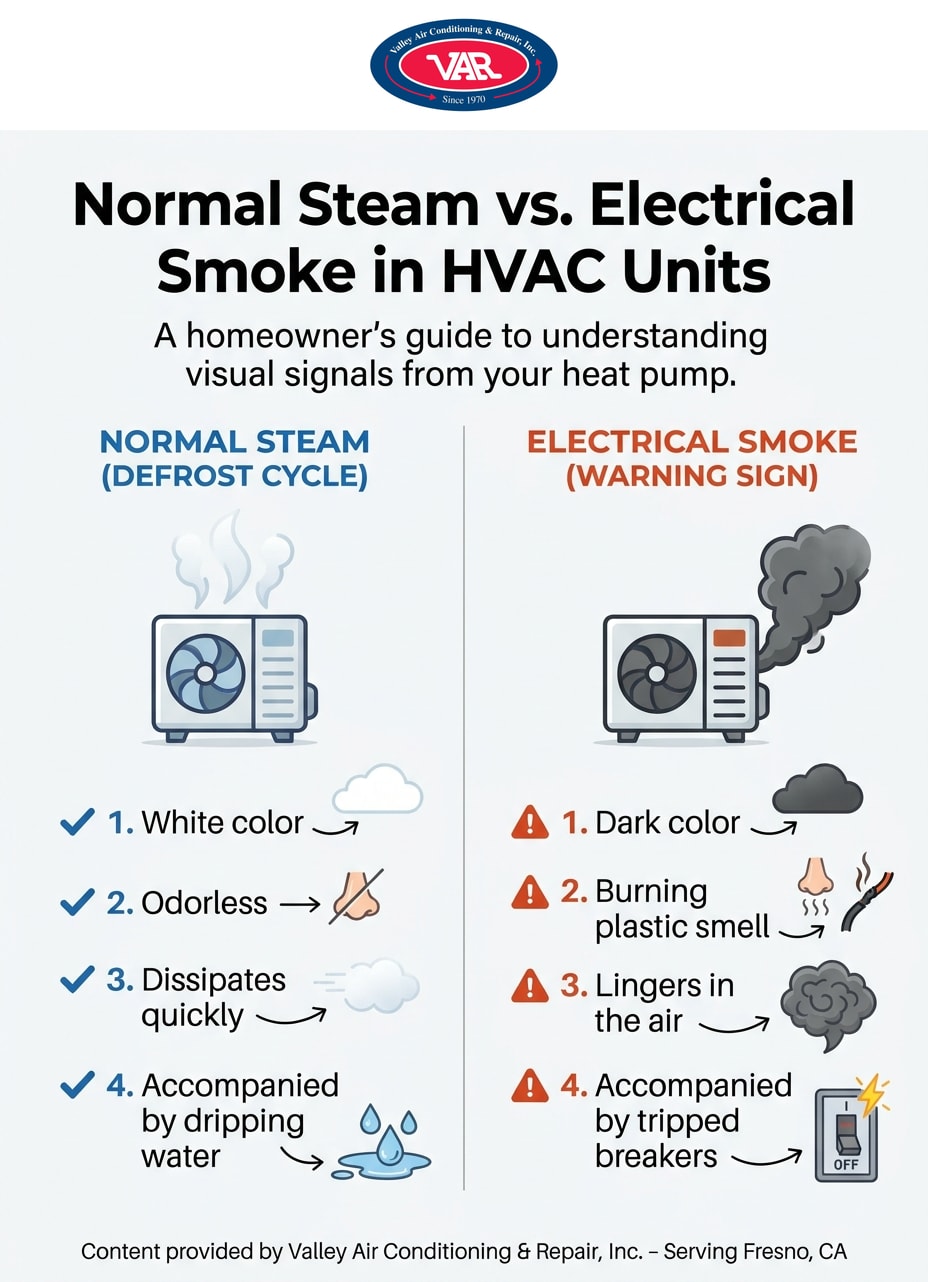
• Look at the color and behavior: Normal steam is bright white, wispy, and will eventually dissipate into the air without leaving any soot or residue on the metal cabinet. Electrical smoke is often dark gray or black, travels in a thick, continuous plume, and leaves dark marks on the equipment.
• Listen for normal operational sounds: When a defrost cycle starts, you will hear a distinct "whoosh" sound as the reversing valve shifts pressure. This is followed by the sound of the outdoor fan motor stopping, while the main compressor continues to emit a low, steady hum.
• Check for pooling water: A properly defrosting unit is actively melting ice. Look at the concrete pad underneath the equipment. You should see water steadily dripping or actively pooling on the ground as the frost turns back into a liquid.
• Smell the surrounding air: This is the most definitive test. Steam is just vaporized water; it is completely odorless. If your unit is actually experiencing an electrical fire, you will immediately notice a sharp, acrid smell of burning plastic, melting rubber, or ozone.
If you observe white clouds, hear the compressor humming, see water dripping, and smell nothing but damp morning air, your system is functioning perfectly. You can learn more about the exact mechanics of heat pump defrost cycles to better understand how your specific model handles these cold mornings.
• Visual Color — Normal Defrost Steam: Bright white, wispy, dissipates into the fog. — Electrical Smoke (Danger): Dark gray or black, thick plume, lingers heavily.
• Sounds — Normal Defrost Steam: Initial "whoosh" sound, fan stops, compressor hums. — Electrical Smoke (Danger): Loud grinding, popping, buzzing, or dead silence.
• Smell — Normal Defrost Steam: Odorless (smells like wet outdoor air). — Electrical Smoke (Danger): Sharp, acrid burning plastic or melting rubber.
• Moisture — Normal Defrost Steam: Water dripping or pooling under the unit. — Electrical Smoke (Danger): No new water pooling; cabinet may feel dangerously hot.
While the vast majority of steaming units are just performing a normal defrost cycle, there are rare scenarios where a homeowner should actually cut the power and seek professional diagnostic help. In our years of diagnosing HVAC issues across Fresno, our team at Valley Air Conditioning & Repair wants to educate homeowners so they can avoid paying unnecessary emergency diagnostic fees for normal system behavior. We would much rather you keep your money in your pocket than pay a technician to come out and watch your ice melt. However, if you notice any of the following warning signs, it is time to turn off the thermostat and call for backup.
• The cycle never ends: A normal defrost cycle is brief. If the outdoor unit continues to emit smoke or steam for longer than 15 to 20 minutes without the fan turning back on and returning to normal heating mode, a sensor may be stuck.
• Electrical failures: If the system repeatedly trips the circuit breaker at your main electrical panel every time it attempts to turn on, do not keep resetting it. This indicates a hard electrical short that requires immediate professional attention.
• Dangerous odors: If there is a persistent smell of burning rubber, melting plastic, or ozone inside your home near the vents, or outside near the cabinet, shut the system off immediately.
• Failing to heat the home: During a defrost cycle, the system temporarily stops blowing warm air indoors. However, if the system is blowing cold air indoors for extended periods (an hour or more) and failing to recover after the defrost cycle ends, the reversing valve or auxiliary heat strips may have failed.
Once you realize your steaming unit isn't actually on fire, it is easy to just go back inside and forget about it. However, the heavy moisture of the November Tule fog season puts significant stress on your equipment. Pivoting from immediate panic resolution to ongoing system health is crucial for keeping your home comfortable all winter long. Proactive care directly impacts how efficiently your system handles these freezing, damp mornings.
Our technicians frequently see how systems with dirty outdoor coils struggle to transfer heat efficiently. When a layer of dirt, dust, or yard debris coats the aluminum fins, it acts as an unwanted layer of insulation. This causes the coil to drop in temperature much faster than a clean coil would, meaning it freezes faster and requires much more frequent defrosting. More time spent in defrost mode means less time actually heating your house.
Improper refrigerant levels can severely impact the unit's ability to generate enough heat to melt ice quickly. If your system is slightly low on refrigerant due to a microscopic leak, it won't be able to get the outdoor coil hot enough during the defrost cycle. This leads to incomplete melting, where a layer of ice remains on the coil, forcing the system to work harder and run longer to keep you warm.
Routine professional checkups ensure the reversing valve, defrost thermostat, and defrost control board are all communicating properly. A well-maintained system spends less time in defrost mode, saving energy and reducing wear and tear on the compressor. Enrolling in a preventative maintenance plan ensures a technician cleans those coils, checks the refrigerant charge, and tests the defrost sensors before the heavy fog arrives, giving you peace of mind when the temperature drops.
Dealing with a heat pump in heavy fog is just one part of overall winter readiness. As the November Tule fog season transitions into the core winter months, taking a few simple, proactive steps around your property will ensure your equipment runs smoothly no matter how cold it gets outside. Broadening your focus to general system health protects your comfort and your energy bills. If you're considering replacing an aging unit, keep in mind that federal tax credits and local utility rebates may apply to qualifying heat pump installations—always verify current programs with your utility provider or a tax professional.
1. Clear the perimeter: Keep the area around the outdoor unit completely clear of wet leaves, overgrown bushes, and yard debris. The system needs at least two feet of unobstructed clearance on all sides to ensure maximum airflow. Restricted airflow causes faster freezing.
2. Replace indoor filters: Change your indoor air filters regularly. A clogged indoor filter restricts airflow inside the house, which alters the refrigerant pressures outside. Clean filters support proper system pressure and ensure faster indoor temperature recovery after a defrost cycle finishes.
3. Check the drainage: Elevate the outdoor unit or clear the drainage path if it sits in an area prone to heavy water pooling. When the unit melts pounds of ice during a defrost cycle, that water needs to drain away quickly. If it pools around the base of the unit, it can freeze solid and damage the lower coils.
4. Book a seasonal checkup: Schedule a comprehensive pre-winter inspection before the coldest overnight temperatures arrive. Investing in residential winter preparation allows a professional to verify that your auxiliary heat strips are working correctly, ensuring your home stays warm even while the outdoor unit is busy melting ice.
Waking up to a cloud of steam enveloping your outdoor equipment is never a fun way to start the day, but understanding normal system behavior prevents unnecessary stress during cold, damp mornings. If you live in Fresno and the Central Valley, heavy fog and freezing coils are just a standard part of the winter season. By keeping a close eye on the color of the vapor, listening for the normal hum of the compressor, and checking for melting water, homeowners can confidently monitor their equipment using simple visual and auditory cues.
You don't have to panic every time the fog rolls in. If you have lingering concerns about how your system sounds, or if you want to ensure your equipment is fully prepared for the upcoming winter workload, our team at Valley Air Conditioning & Repair provides ultimate peace of mind. Schedule your seasonal tune-up today to ensure reliable, efficient warmth all season long.
Is it normal for a heat pump to steam in the fog?
Yes, it is completely normal and expected behavior. When the system enters a defrost cycle to melt accumulated ice, the hot coils vaporize the frost into steam. In heavy fog, the surrounding air is already saturated with moisture, which prevents the steam from dissipating quickly, making the cloud look much larger and more alarming than usual.
How to tell if a heat pump is steaming or on fire?
You can tell the difference by looking at the color and smelling the air. Normal steam is bright white, wispy, and completely odorless, while an electrical fire will produce dark smoke and a sharp, acrid smell of burning plastic or rubber. Additionally, a steaming unit will usually have water dripping underneath it as the ice melts safely.
Why is my heat pump smoking in winter?
What looks like smoke is almost certainly just steam from the unit's automated defrost cycle. As the system works to pull heat from the cold winter air, moisture freezes onto the outdoor coils. The system periodically reverses itself to melt this ice, creating a large cloud of water vapor that resembles white smoke.
How often should a heat pump go into defrost mode?
Most modern systems are designed to enter defrost mode every 30, 60, or 90 minutes of active runtime when the outdoor temperatures are near or below freezing. The exact frequency depends on the humidity levels, the outdoor temperature, and how quickly frost builds up on the outdoor coils. In heavy fog, the system will defrost more frequently due to the high moisture content in the air.
What does a heat pump defrost cycle sound like?
A defrost cycle typically begins with a loud "whoosh" sound as the internal reversing valve shifts the flow of refrigerant. Following this, the outdoor fan motor will stop spinning entirely, leaving only the low, steady humming sound of the compressor running. Once the ice is melted, you will hear another whoosh as the system returns to normal heating mode and the fan kicks back on.
Can I pour hot water on my heat pump to melt the ice faster?
No, you should never pour hot water over your outdoor unit to speed up the melting process. The sudden extreme temperature change can crack the delicate metal tubing, and the water can easily damage sensitive electronic components or short out the control board. Trust the system's automated defrost cycle to handle the ice buildup safely.
Does high outdoor humidity affect how quickly my house warms up?
Yes, high outdoor humidity can impact your system's overall heating efficiency. When the air is heavily saturated with moisture, frost builds up on the outdoor coils much faster, forcing the system to spend more time in defrost mode. Because the system temporarily stops blowing warm air inside during a defrost cycle, it may take slightly longer for your home to reach the desired temperature on very damp, foggy days.

As a business with many AC units, it is essential to have a responsive AC company. Valley Air Conditioning understands our needs. They are always responsive and our AC is up and running very quickly.
I had them do an AC check on the home I was buying, they were honest and quick. I hired them to do the summer and Fall maintenance for $149. Happy with this company!
100% recommend. I called, same day they came out and gave me estimate. Conley was honest and didn't try to recommend/sell us anything we didn't need. When I called him with questions before making a decision, he happily answered and was not annoyed by me contacting him. Conley and VAR
This is a group of good people. Very professional and knowledgeable. They take the time to listen and find the best solution that fits best for any situation. There's no way you can go wrong in choosing VAR.
We have used Valley Air for over fifteen years. The last two years ,Matt came to our house to service twice a year. Always on time, so polite and so professional. This is a very honest company and you can always depend on them and trust them. The office always treats everyone cheerfully and always want to do what you need done very fast YOU CAN COUNT ON THIS Company