Is Switching Between AC and Heat Daily Safe for Your Heat Pump?
Is switching between ac and heat daily safe? See what we typically find inside stressed heat pumps and why adjusting your thermostat deadband prevents wear.
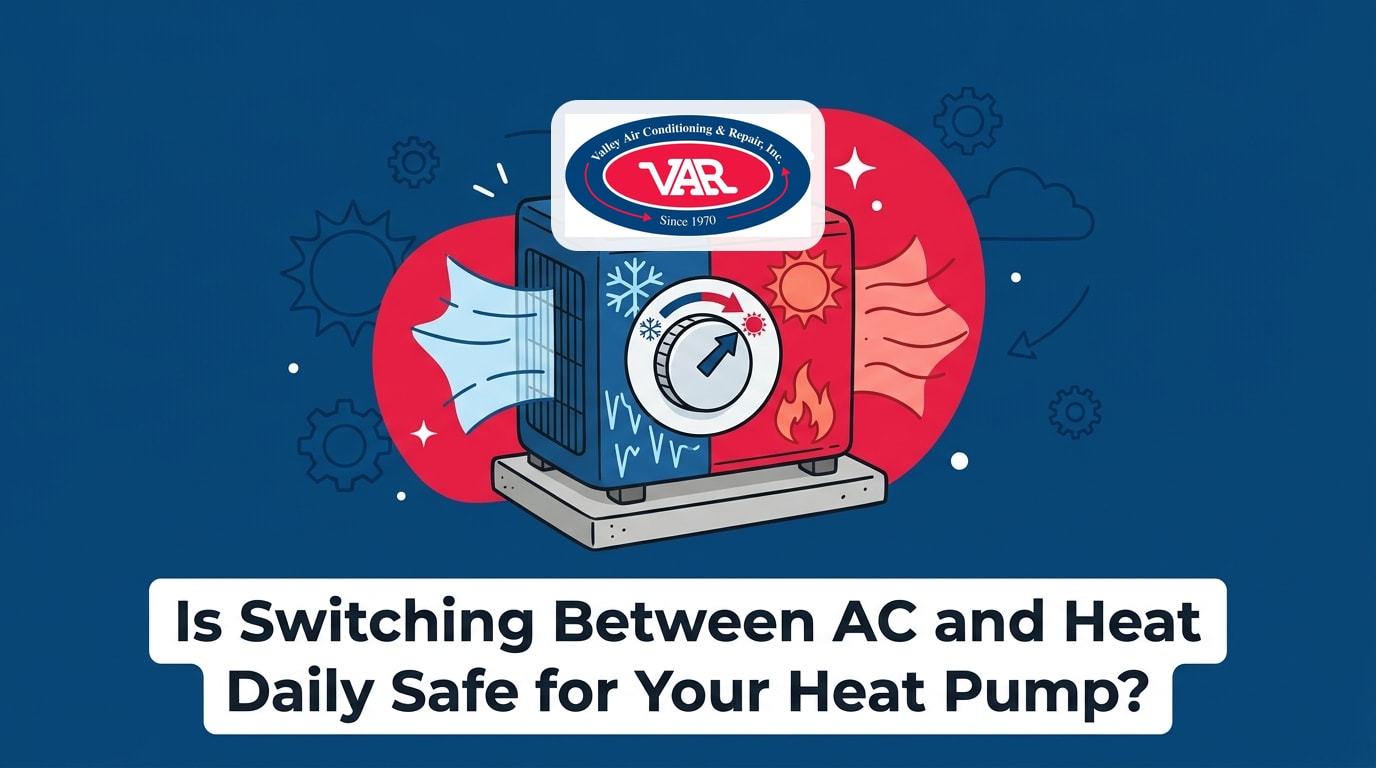
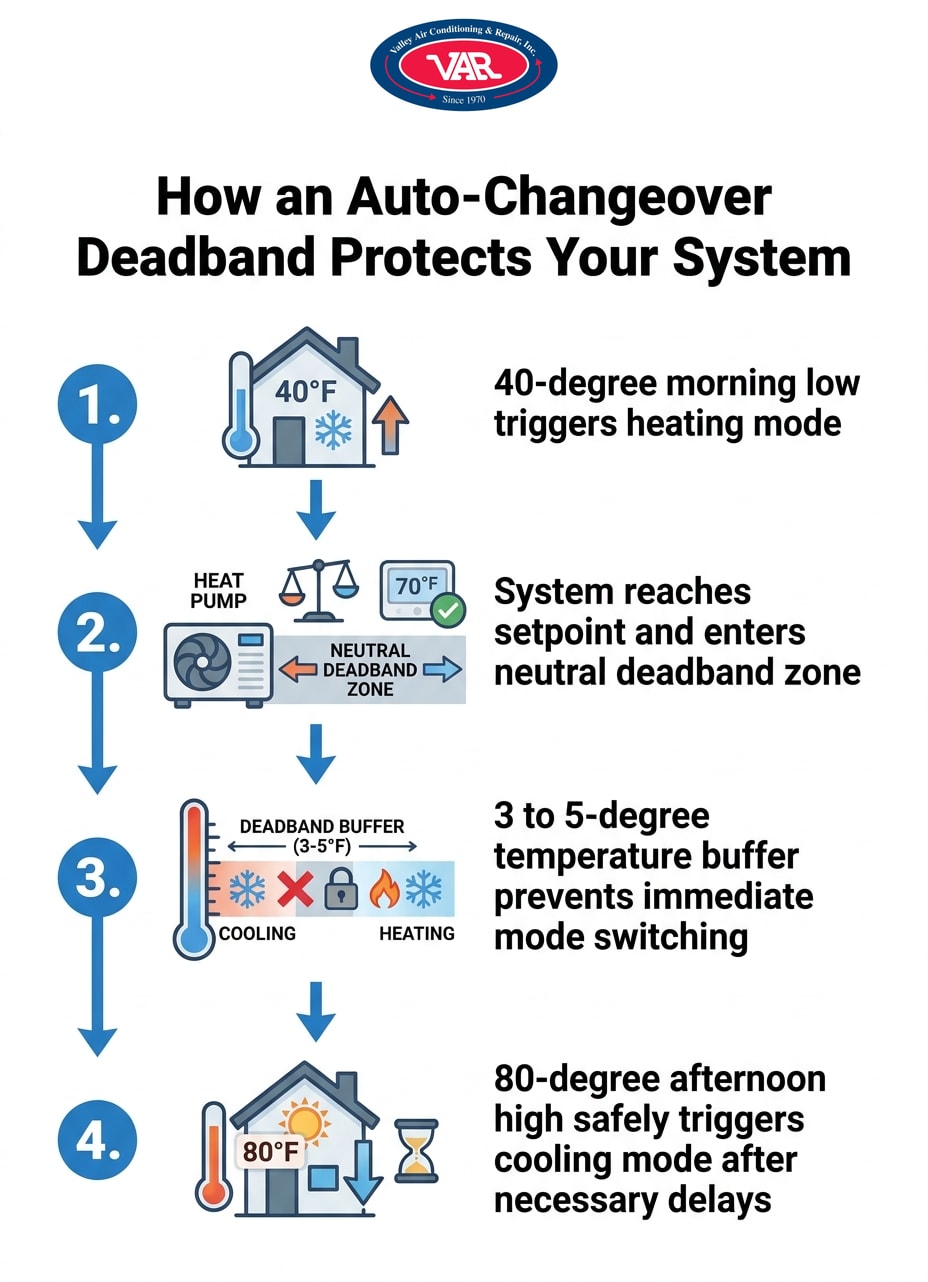
Are you constantly adjusting your thermostat to keep up with wild temperature changes outside? If you find yourself switching between ac and heat daily, you might be wondering if this constant back-and-forth is causing hidden damage to your equipment. During mid-fall in the Central Valley, our team at Valley Air Conditioning & Repair, Inc. sees it all the time: homes experiencing 40-degree morning to 80-degree afternoon temperature swings. You wake up needing the furnace to take the chill out of the air, but by the time you get home from work, the house feels like an oven and you desperately need cooling.
This leaves many homeowners facing a difficult decision: do you continue to manually force the system to flip back and forth to maintain your comfort, or do you suffer through the afternoon heat to protect your equipment? The short answer is that modern systems are designed to switch modes, but manually forcing them to do so rapidly without proper delays can cause accelerated mechanical wear. Fortunately, there are smarter, safer thermostat configurations that handle this process automatically.
To ensure your primary HVAC system operates efficiently and safely through unpredictable weather, it helps to understand exactly what happens behind the scenes when you push that button.
When October arrives, the weather rarely cooperates with a simple "heating season" or "cooling season" schedule. The extreme diurnal temperature shifts mean your home is subjected to vastly different thermal loads within a single 24-hour period. In the early morning, the outdoor temperature strips heat away from your home's exterior walls. By 3:00 PM, intense solar radiation is baking those same walls, trapping heat inside.
Because your home cannot passively adapt to these rapid shifts, the burden falls entirely on your climate control equipment. While it is completely normal to need both heating and cooling on the same day, the method you use to achieve that comfort dictates how much stress your equipment endures. Manually flipping the switch from "Heat" to "Cool" the moment you feel warm bypasses several natural operational rhythms your system relies on to stay healthy.
To understand why rapid manual switching can be problematic, we first need to look at how a heat pump operates compared to traditional, separate air conditioning and furnace setups. A heat pump does not have two completely different machines for heating and cooling. Instead, it uses the exact same compressor, coils, and refrigerant to do both jobs. It simply reverses the direction that the heat is moved.
The magic behind a heat pump's ability to both heat and cool your home relies on a critical component called the heat pump reversing valve. This heavy-duty brass valve sits near the compressor and contains a sliding mechanism inside. When your thermostat calls for a mode change, an electrical solenoid on the valve energizes or de-energizes, shifting the internal slide.
What this means for your system:
• In cooling mode: The valve directs hot, high-pressure refrigerant gas outside to release heat into the outdoor air, while sending cold refrigerant inside to absorb heat from your rooms.
• In heating mode: The valve physically shifts, reversing the flow. It now pulls ambient heat from the outside air and pumps it inside to warm your home.
• The physical stress: This valve operates under extreme pressure. Shifting it requires mechanical force, and doing so forces the entire refrigerant cycle to abruptly change direction.
Your climate control system operates using high-pressure and low-pressure zones. When the system is running, the compressor squeezes the refrigerant gas, creating a massive pressure difference between the indoor and outdoor coils. You cannot instantly pivot from cooling to heating because these pressures must balance out first.
If you force the system to switch modes instantly, the compressor has to try and start against an enormous wall of unequalized pressure. This is known as "hard starting," and it is one of the leading causes of premature compressor failure.
• Indoor Coil — During Cooling Mode: Acts as the evaporator (gets cold) — During Heating Mode: Acts as the condenser (gets hot) — During the Transition (Equalization): Pressures slowly balance to neutral
• Outdoor Coil — During Cooling Mode: Acts as the condenser (gets hot) — During Heating Mode: Acts as the evaporator (gets cold) — During the Transition (Equalization): Pressures slowly balance to neutral
• Refrigerant Flow — During Cooling Mode: Flows indoors to outdoors — During Heating Mode: Flows outdoors to indoors — During the Transition (Equalization): Flow halts momentarily to allow shifting
If you have ever manually switched your thermostat from cooling to heating and noticed that nothing happens right away, you might have panicked. The screen might flash, an hourglass icon might appear, or the system might just sit silently for several minutes. This is not a malfunction; it is a vital protective feature.
Modern thermostats and internal control boards are programmed with a mandatory compressor time delay—usually lasting exactly 5 minutes. This delay is specifically designed to allow the high and low refrigerant pressures to equalize before the compressor is allowed to turn back on.
The 5-minute delay prevents a destructive phenomenon known as short-cycling. Short-cycling occurs when a compressor is rapidly turned off and then immediately back on. Because the refrigerant pressures have not had time to settle, the compressor motor has to draw a massive surge of electricity to overcome the resistance.
Signs your system is in a normal protective delay:
• Flashing icons: A blinking "Cool On" or "Heat On" text indicator on the digital display.
• Total silence: The indoor blower fan may shut off completely while the outdoor unit rests.
• Clicking sounds: You may hear a soft click from the thermostat, followed by several minutes of waiting before the main system engages.
The worst thing you can do during this 5-minute window is repeatedly press the thermostat buttons, drop the temperature lower, or flip the system off and on again at the breaker. Doing so only resets the 5-minute timer, keeping you uncomfortable for longer and potentially confusing the control board.
The core question remains: if the system has built-in delays, is it harmful to manually flip the switch every single day during mid-fall? While the equipment is technically built to change modes, aggressive, manual daily switching does introduce unnecessary mechanical stress over time.
When you manually force the system back and forth, you are constantly demanding that the heat pump reversing valve slide back and forth under pressure. You are also forcing the compressor to stop, wait, and restart multiple times a day, often before the home's temperature has naturally stabilized.
Homeowners naturally want instant comfort. When the house hits 78 degrees on an October afternoon, the instinct is to march to the wall and force the cooling on. However, our field technicians at Valley Air Conditioning & Repair, Inc. frequently observe accelerated reversing valve wear in Fresno homes subjected to rapid, manual mode-switching without proper delays. The internal sliding mechanism of the valve can eventually stick, stick halfway, or fail to seal properly, leading to a system that blows lukewarm air in both modes.
Manual switching often leads to a scenario where the system battles itself. You might heat the house to 72 degrees in the morning, only to manually trigger the air conditioning two hours later because the sun came out and pushed the indoor temperature to 74. This wastes an immense amount of energy. The solution is to remove human impatience from the equation and let the thermostat manage the transitions mathematically.
Instead of acting as a manual switchboard operator for your home's climate, you can utilize a standard feature found on almost all modern and smart thermostats: auto-changeover. Auto-changeover allows the thermostat to automatically decide whether it needs to heat or cool based on the current indoor temperature.
However, auto-changeover only works safely if you utilize a "deadband." A deadband is a temperature buffer—a neutral zone—where the system does absolutely nothing. This buffer prevents the equipment from immediately bouncing between heating and cooling.
1. Enable Auto Mode: Switch your thermostat from "Heat" or "Cool" to "Auto" (sometimes labeled as "Heat/Cool").
2. Set the Heating Setpoint: Choose the minimum temperature you want your house to reach before the heat kicks on (for example, 68°F).
3. Set the Cooling Setpoint: Choose the maximum temperature you will tolerate before the air conditioning kicks on (for example, 74°F).
4. Verify the Deadband Gap: Ensure there is an industry-standard 3 to 5-degree deadband between these two numbers. In the example above, the deadband is 6 degrees (68 to 74).
5. Let the System Manage Itself: Walk away. The thermostat will now enforce its own delays, allow pressures to equalize naturally, and only shift the heat pump reversing valve when absolutely mathematically necessary.
This setup is the perfect technological solution for navigating 40-degree morning to 80-degree afternoon temperature swings without sacrificing your comfort or destroying your hardware. If you need help transitioning your smart thermostat settings for unpredictable falls, a professional can easily program these parameters for you.
A climate control system that is required to heat and cool in the exact same day works significantly harder than a system running in a single, continuous mode. When mid-fall arrives, your equipment is effectively working double duty. This makes seasonal maintenance absolutely critical.
During a standard pre-season inspection, our technicians will explicitly test the components that handle mode switching. The heat pump reversing valve must be tested to ensure the internal solenoid engages cleanly without sticking. If the valve is sluggish due to wear and tear from previous manual switching, it may fail entirely when the first true winter freeze hits.
Furthermore, proper refrigerant charge is critical for safe mode switching and pressure equalization. If your system is even slightly low on refrigerant, the pressures will not balance correctly during the 5-minute delay window, putting extreme strain on the compressor motor. Investing in pre-season preparation acts as a safeguard against unexpected breakdowns during erratic fall weather, ensuring that when your thermostat calls for a transition, the mechanical parts can actually deliver.
The short answer is no, as long as it is done correctly. Heat pumps are specifically designed to change modes as needed to maintain indoor comfort. However, manually forcing the system back and forth rapidly without allowing for proper compressor delays can cause accelerated wear on the heat pump reversing valve over time.
You should always wait a minimum of 5 minutes before switching modes. This 5-minute window allows the high and low refrigerant pressures inside the system to equalize fully. Most modern thermostats enforce this delay automatically, but manually waiting ensures you do not accidentally trigger a hard start on the compressor.
No, a residential heat pump cannot heat and cool simultaneously because it relies on a single flow of refrigerant. The heat pump reversing valve dictates the direction of that flow, meaning the system can only operate in one mode at a time. Trying to bypass controls to force both modes will result in immediate mechanical failure or tripped breakers.
The delay is a built-in safety mechanism designed to protect your compressor from short-cycling. When you switch to heat, the system pauses for about 5 minutes to let internal refrigerant pressures balance out. Without this delay, the compressor would have to fight against immense pressure to start, which can burn out the motor.
If the heat pump reversing valve gets stuck, your system will be trapped in whatever mode it was last operating in. You might turn on the heat, but the system will continue blowing cold air because the valve failed to shift the refrigerant flow. A stuck valve requires professional diagnosis and replacement.
Industry standards recommend a minimum deadband of 3 to 5 degrees Fahrenheit. For example, setting your heat to kick on at 68°F and your AC to kick on at 73°F creates a safe 5-degree buffer. This prevents the system from constantly battling itself during 40-degree morning to 80-degree afternoon temperature swings.
Staying comfortable during erratic mid-fall weather shouldn't come at the cost of your system's lifespan. While it is completely normal to experience 40-degree morning to 80-degree afternoon temperature swings, relying on manual daily switching can put unnecessary miles on your heat pump reversing valve and compressor.
If you are unsure whether your auto-changeover settings are configured safely, or if you suspect your system is struggling to transition between modes, it is time to have your equipment professionally evaluated. Reach out to Valley Air Conditioning & Repair, Inc. to schedule comprehensive heat pump services today, and let our local experts optimize your thermostat and system mechanics so you can enjoy reliable, worry-free comfort all season long.

As a business with many AC units, it is essential to have a responsive AC company. Valley Air Conditioning understands our needs. They are always responsive and our AC is up and running very quickly.
I had them do an AC check on the home I was buying, they were honest and quick. I hired them to do the summer and Fall maintenance for $149. Happy with this company!
100% recommend. I called, same day they came out and gave me estimate. Conley was honest and didn't try to recommend/sell us anything we didn't need. When I called him with questions before making a decision, he happily answered and was not annoyed by me contacting him. Conley and VAR
This is a group of good people. Very professional and knowledgeable. They take the time to listen and find the best solution that fits best for any situation. There's no way you can go wrong in choosing VAR.
We have used Valley Air for over fifteen years. The last two years ,Matt came to our house to service twice a year. Always on time, so polite and so professional. This is a very honest company and you can always depend on them and trust them. The office always treats everyone cheerfully and always want to do what you need done very fast YOU CAN COUNT ON THIS Company