Common Draft Issues in Older Fresno Homes During Early Fall Breezes
Common Draft Issues in Older Fresno Homes During Early Fall Breezes
Why Fresno's September Weather Challenges Historic Home Comfort
Nearly 30% of residential heating and cooling energy is lost through aging thermal envelopes, which is exactly why common draft issues in older Fresno homes during early fall breezes become so noticeable the moment the seasons begin to shift. If you live in a historic property, you are likely intimately familiar with this concrete problem: feeling icy cold drafts in your perimeter rooms while the central hallway remains uncomfortably stuffy. This seasonal shift forces a critical decision point. You must choose between constantly overworking your modern heating systems—cranking the thermostat up to combat the chill—or properly diagnosing the architectural air leaks that are actually causing the discomfort.
The root of this challenge lies in a unique local weather pattern often called the "September swing." At Valley Air Conditioning & Repair, Inc., our team fields countless calls this time of year because it is entirely normal in our region to experience blistering 90-degree afternoons that suddenly plummet into the 50s or 60s as soon as the sun goes down. When those brisk early fall (September) breezes kick up, they immediately test the boundaries of your home's exterior. Older architecture simply was not designed to retain conditioned air the way modern construction is. Instead of wasting energy by forcing your furnace to run non-stop, the smartest approach is to understand how your home's unique structure interacts with modern climate control so you can schedule targeted residential pre-season preparation before peak winter weather arrives.
The Architectural DNA of 1920s-1940s Fresno Construction
In our extensive experience working on local heritage properties, we've learned that to truly understand why your home feels so drafty, we have to look closely at the materials and building techniques used during the era of 1920s-1940s home construction. Homes built nearly a century ago were crafted with incredible durability and charm, but they were not built with modern thermal retention in mind. In fact, many of these structures were intentionally designed to "breathe" to prevent moisture buildup and to allow for natural cross-ventilation during hot summer months.
Common structural features of this era include:
• Lath-and-plaster walls: Unlike modern drywall, lath-and-plaster construction typically lacks original cavity insulation. The empty wall cavities act as hollow channels where cold outdoor air can easily circulate.
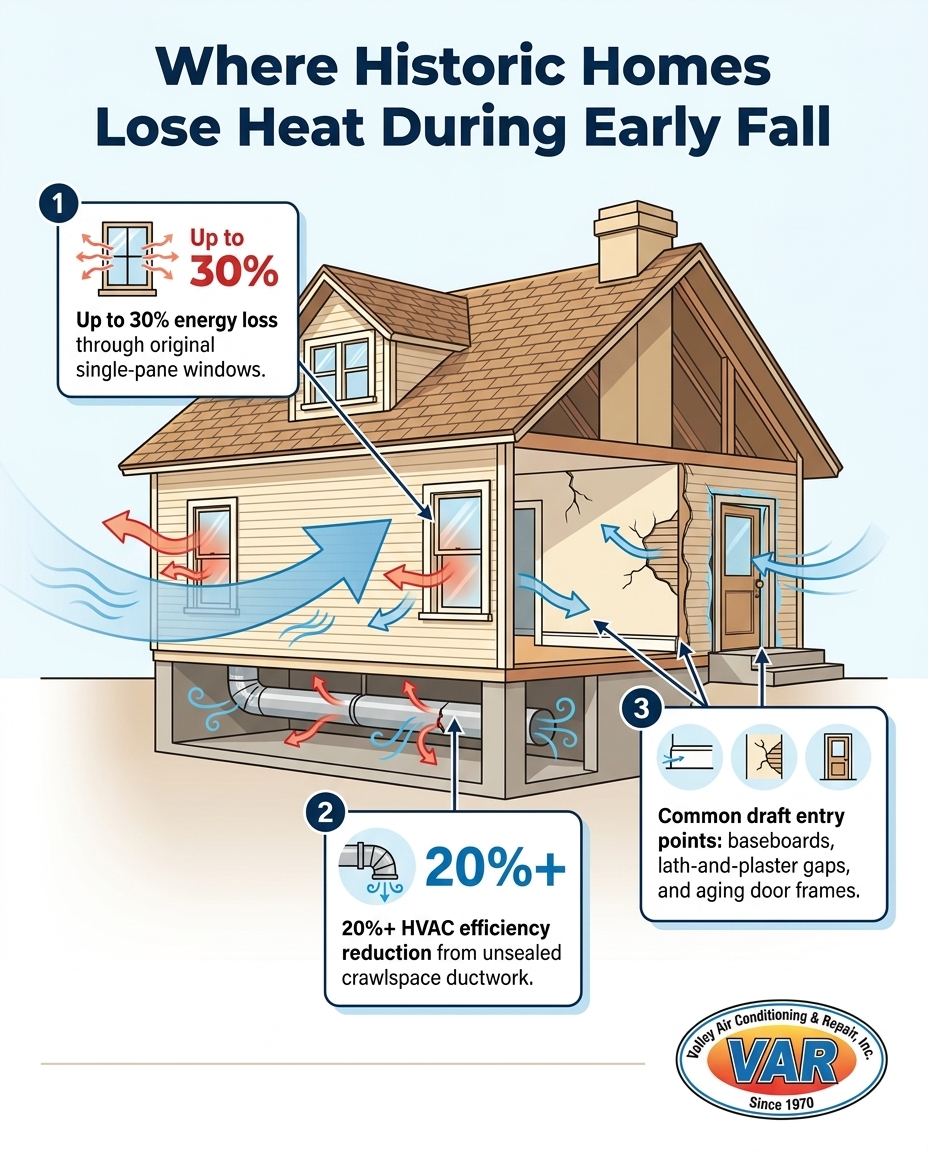
• Single-pane wood-frame windows: Original glass offers virtually zero thermal resistance. Even when completely closed and locked, these windows transfer the cold outdoor temperature directly into your living space.
• Raised foundations with unsealed crawlspaces: Designed to keep the home elevated and dry, these crawlspaces are often highly ventilated, allowing early fall breezes to sweep directly underneath your floorboards.
• Natural structural settling: Over 80 to 100 years, heavy building materials naturally shift and settle. This creates thousands of micro-gaps around baseboards, door frames, and window sashes where conditioned air escapes and cold drafts enter.
Tower District and Huntington Boulevard Characteristics
When our technicians are out on service calls in the iconic Tower District or along Huntington Boulevard, we always note the specific architectural quirks that define these historic neighborhoods. The original builders prioritized deep eaves, large covered porches, and strategically placed windows to maximize summer cooling. While these features are beautiful and highly functional in July, they present distinct challenges when the weather cools. The lack of modern vapor barriers and the reliance on natural ventilation mean that these homes require a specialized approach to winter heat retention.
Where Historic Homes Lose Heat During Early Fall
How Early Fall Breezes Expose Hidden Thermal Leaks
When the early fall (September) breezes arrive, they do more than just rattle the autumn leaves—they actively change the air pressure dynamics inside your home. This process is driven by the physics of the stack effect. As evening temperatures drop rapidly, the warm air generated inside your home naturally rises toward the ceiling and the attic. This upward movement creates a negative pressure zone in the lower levels of your house. When the wind picks up outside, that negative pressure acts like a vacuum, aggressively pulling cold outdoor air indoors through every available gap and crevice.
The extreme daily temperature swing in Fresno during September physically stresses your home's building materials. As the wood framing, plaster, and glass heat up during the 90-degree afternoons, they expand. When the temperature rapidly drops into the 50s at night, those same materials contract. This constant daily expansion and contraction continuously widens the microscopic gaps around your windows and doors, making the thermal envelope even more vulnerable to evening winds.
Because original single-pane glass provides virtually zero thermal resistance, the cold wind hitting the exterior of the window instantly cools the air inside the room. Homeowners often feel this sudden influx of cold air and mistakenly assume their heating system is failing. In reality, we frequently find that the furnace is operating perfectly, but it is fighting a losing battle against a structural envelope that is actively inviting the cold air inside.
The Ripple Effect on Your Modern Central Heating
Pairing a modern, high-efficiency forced-air system with a leaky historic envelope creates a frustrating ripple effect throughout your home. The most immediate symptom is severe uneven heating. Because thermostats are typically installed in interior hallways—areas largely protected from exterior drafts—the sensor registers a comfortable temperature and signals the system to shut off. Meanwhile, the perimeter rooms facing the wind remain freezing cold.
The hidden costs of structural drafts:
• System short-cycling: As continuous drafts rapidly cool the house, the thermostat detects the temperature drop and turns the heater back on just minutes after it turned off. This constant on-and-off cycling accelerates wear and tear on blower motors and electrical components.
• Wasted energy consumption: Simply walking over to the thermostat and raising the temperature by five degrees does not solve the root airflow issue. It only forces the equipment to burn more energy while the newly heated air continues to escape through the walls.
• Uneven comfort zones: You may find yourself sweating in the kitchen while needing a heavy blanket in the living room, completely defeating the purpose of central heating.
For our customers in historic Fresno neighborhoods, navigating this imbalance requires more than just turning up the heat. Adjusting smart thermostat settings for unpredictable fall weather can help manage the daily temperature swings, but the equipment can only do so much if the structural envelope is compromised.
• Freezing bedrooms, warm hallways — How the HVAC Reacts: System shuts off prematurely based on central hallway temperature — Architectural Root Cause: Single-pane windows and uninsulated exterior walls cooling perimeter air
• Furnace turning on and off constantly — How the HVAC Reacts: Short-cycling to combat rapid temperature fluctuations — Architectural Root Cause: Significant air leaks around baseboards and door frames
• High energy bills despite feeling cold — How the HVAC Reacts: Running extended cycles to reach target temperature — Architectural Root Cause: Conditioned air escaping through the attic or unsealed crawlspace
Hidden Culprits: Duct Leakage and Unsealed Crawlspaces
While drafty windows are easy to spot, some of the most significant thermal leaks our team discovers in 1920s-1940s home construction are completely hidden from view. According to Department of Energy data, duct leakage in unconditioned spaces can reduce your overall HVAC efficiency by 20% or more. In historic homes, the ductwork is almost always routed through an unsealed crawlspace or an uninsulated attic.
Consider the environment of a 1930s crawlspace during a brisk fall evening. The space is heavily ventilated to the outside, meaning the air temperature under your floorboards is nearly identical to the chilly outdoor air. If your aging ductwork has deteriorated seals, disconnected joints, or micro-tears, the powerful blower motor of your furnace will actively pull that freezing, dusty outdoor air directly into your home's air supply. Instead of circulating warm, conditioned air, the system dilutes your heat with cold drafts from below.
This crawlspace air intrusion doesn't just ruin your thermal comfort; it introduces serious air quality issues into your living space. Musty odors, dust, and outdoor allergens are pulled through the compromised ducts and blown directly into your bedrooms and living areas. Our technicians routinely address these hidden leaks by implementing specialized indoor air quality solutions and professional duct sealing to ensure that the air you are paying to heat actually makes it to your vents.
Balancing HVAC Optimization with Historic Preservation
One of the biggest concerns for homeowners in historic Fresno neighborhoods is the fear that upgrading their comfort will require destroying their home's original charm. We understand that preserving the architectural integrity of your property is paramount. The good news is that optimizing central air in an older home does not require tearing open original lath-and-plaster walls or replacing stunning historic windows with generic vinyl.
Professional techniques for non-invasive optimization include:
• Crawlspace and attic sealing: By accessing the home's thermal envelope from the unfinished spaces above and below, technicians can seal major air leaks and insulate ductwork without ever touching the interior living spaces.
• Targeted airflow balancing: Older homes often feature duct sizing that was originally designed for gravity furnaces or early air conditioning retrofits. By adjusting dampers and balancing the airflow, we can push more conditioned air to the drafty perimeter rooms without altering the visible vents.
• Custom-calibrated blower speeds: Modern variable-speed blowers can be precisely calibrated to accommodate the specific static pressure of older duct systems. This ensures a slow, steady stream of warm air that gently combats drafts rather than blasting air aggressively and causing the system to short-cycle.
At Valley Air Conditioning & Repair, Inc., our team's deep understanding of local historic architecture allows us to position your comfort upgrades perfectly. We know exactly how these 80-to-100-year-old structures were engineered, enabling us to protect the home's unique charm while thoroughly modernizing its winter performance. Depending on the upgrades, generic federal tax credits or local utility rebates may apply to qualifying high-efficiency installations, so we always advise homeowners to verify current incentive programs with their utility provider or tax professional.
Strategic Fall HVAC Preparation for Older Properties
Preparing a historic property for the heating season requires a much more rigorous approach than a standard filter change. Because early fall (September) breezes expose the unique vulnerabilities of aging homes, your pre-season maintenance must address both the mechanical equipment and the structural airflow dynamics.
The level of precision required for older residential properties often mirrors the complexity of large-scale commercial networks. For example, during a recent winter deep freeze, our technicians assisted a local customer managing commercial HVAC systems on a large campus who required extensive maintenance, airflow adjustments, and thermostat replacements across numerous buildings to ensure consistent performance. We apply that exact same knowledgeable, rigorous diagnostic approach to your home—ensuring your historic property receives commercial-grade attention.
A comprehensive pre-season inspection for historic homes should include:
• Heat exchanger integrity checks: Older duct systems can create high static pressure, which puts immense stress on the furnace's heat exchanger. Checking for hairline cracks is vital before the heavy winter usage begins.
• Static pressure testing: Measuring the airflow resistance within the ductwork ensures the blower motor is calibrated correctly for the specific layout of your 1920s or 1930s home.
• Ductwork inspection in unconditioned spaces: Visually inspecting the crawlspace and attic ducting for collapsed runs, disconnected joints, and deteriorated insulation.
• Envelope sealing recommendations: Identifying areas where professional weatherstripping and targeted envelope sealing can work in tandem with your HVAC maintenance to block evening drafts.
Remember, while basic weatherstripping around a door is a great weekend project, complex duct sealing and system calibration require licensed professionals. Scheduling thorough residential pre-season preparation is the most effective way to protect your equipment and ensure your home stays cozy all winter long.
Frequently Asked Questions About Heating Historic Fresno Homes
Why is my old house so drafty in the fall?
Your old house feels drafty in the fall due to a combination of settling foundations, single-pane windows, and sudden temperature drops. As the warm afternoon air gives way to brisk evening winds, the negative pressure inside your home pulls cold outdoor air through the micro-gaps in your aging 1920s-1940s home construction. These structural vulnerabilities make early seasonal shifts feel much colder indoors than they actually are.
How do you fix drafts in a historic home?
Fixing drafts in a historic home involves non-invasive envelope sealing, weatherstripping, and professional duct sealing. Instead of tearing into original plaster walls, professionals focus on sealing the hidden air leaks in the attic and crawlspace where the majority of heat loss occurs. Upgrading your window glazing and installing heavy thermal curtains can also significantly reduce perimeter drafts.
Can you optimize central air in a 100-year-old house?
Yes, you can absolutely optimize central air in a 100-year-old house through proper duct sizing, variable-speed blowers, and targeted airflow balancing. By calibrating the modern equipment to work with the home's existing architectural constraints, you can achieve consistent, efficient heating without compromising the property's historic charm.
Does a drafty house mean bad insulation?
Not always; a drafty house often points to active air leaks around windows, doors, and unsealed ductwork rather than just missing wall insulation. Even if you were to fill the walls with modern insulation, cold air would still find its way inside if the physical gaps around the structural framing and crawlspace ducts remain unsealed.
How do early fall breezes impact my HVAC efficiency?
Early fall breezes impact your HVAC efficiency by physically forcing cold air into the home, which causes the thermostat to trigger the heating system prematurely. Because the wind continuously strips away the conditioned air, your furnace is forced to run longer, more frequent cycles, dramatically increasing your energy usage before winter even officially begins.
Restore Consistent Comfort to Your Historic Home This Fall
Understanding your home's unique architecture is the critical first step to achieving consistent comfort. You do not have to sacrifice the beauty and charm of historic Fresno neighborhoods just to stay warm when the evening winds pick up. By having our experts diagnose the root causes of uneven airflow and seal hidden thermal leaks, you can protect your equipment from unnecessary wear and tear. If you are already noticing common draft issues in older Fresno homes during early fall breezes, now is the time to take action. Schedule a comprehensive pre-season inspection with Valley Air Conditioning & Repair, Inc. today to diagnose your airflow challenges before the harsh winter weather truly sets in.
As a business with many AC units, it is essential to have a responsive AC company. Valley Air Conditioning understands our needs. They are always responsive and our AC is up and running very quickly.
Brenda F.
I had them do an AC check on the home I was buying, they were honest and quick. I hired them to do the summer and Fall maintenance for $149. Happy with this company!
Gayle B.
100% recommend. I called, same day they came out and gave me estimate. Conley was honest and didn't try to recommend/sell us anything we didn't need. When I called him with questions before making a decision, he happily answered and was not annoyed by me contacting him. Conley and VAR
Erma C.
This is a group of good people. Very professional and knowledgeable. They take the time to listen and find the best solution that fits best for any situation. There's no way you can go wrong in choosing VAR.
Gabriel A.
We have used Valley Air for over fifteen years. The last two years ,Matt came to our house to service twice a year. Always on time, so polite and so professional. This is a very honest company and you can always depend on them and trust them. The office always treats everyone cheerfully and always want to do what you need done very fast YOU CAN COUNT ON THIS Company


.webp)