.webp)


AC Repair in Fresno, CA: Troubleshooting the Fall HVAC Transition After a Brutal Summer
Why we emphasize safe fall heating startups. Use these home maintenance tips and troubleshooting steps to decide with confidence when to call a pro.
Your air conditioner is running nonstop, but the house still feels uncomfortably warm, leading many homeowners to question the relationship between attic insulation and late summer AC run times. You walk past the thermostat, and it reads 80 degrees, even though it is set to 72. Outside, the temperatures are soaring, and inside, your cooling equipment sounds like it is working overtime. For most homeowners, the immediate reaction is panic. You assume your compressor is failing, your refrigerant is leaking, or your entire system is about to break down right at the end of the season.
However, before you assume the worst about your equipment, you need to look at the whole picture. In our years of serving the Fresno community, our team at Valley Air Conditioning & Repair frequently sees that the problem is not a mechanical failure at all. Instead, it is a failure of your home's thermal boundary. To get to the root of the issue, you need a comprehensive approach to your home's comfort, which is why our professional air conditioning services focus on more than just the machinery in your backyard.
When those relentless late August back-to-school heatwaves hit, your home is subjected to extreme thermal pressure. A perfectly functioning HVAC system can easily be overpowered if your home cannot keep the heat out. Think of it like trying to cool down a cooler that has no lid. No matter how much ice you put inside, the heat from the surrounding environment will melt it rapidly. Your home operates on the exact same principle. Before you decide that your air conditioner needs a costly repair, you must evaluate whether your home is actually holding onto the cold air your system is working so hard to produce.
To understand why your air conditioner is struggling, you have to look up. The space directly above your living area is likely the source of your endless cooling cycles. Radiant heat transfer is the invisible force pushing your system to its limits, and it happens entirely out of sight.
Heat always moves from warmer areas to cooler areas. In a residential home, this movement happens in three distinct ways. Understanding these mechanisms reveals why the ceiling is the most vulnerable thermal boundary in a single-story home or the top floor of a multi-level house.
• Conduction — How It Works in Your Home: Heat moving directly through solid materials, like hot roof shingles transferring heat to the wooden roof deck. — Impact on Cooling: Warms the structural components of your home, creating a domino effect of heat transfer.
• Convection — How It Works in Your Home: Heat carried by moving air, such as hot air rising and circulating within your attic space. — Impact on Cooling: Traps hot air in enclosed spaces, turning your attic into a pressurized pocket of heat.
• Radiation — How It Works in Your Home: Heat traveling in invisible waves across open spaces, moving from the hot roof deck down to your ceiling drywall. — Impact on Cooling: The primary reason your ceiling feels warm to the touch, forcing your AC to cool the room continuously.
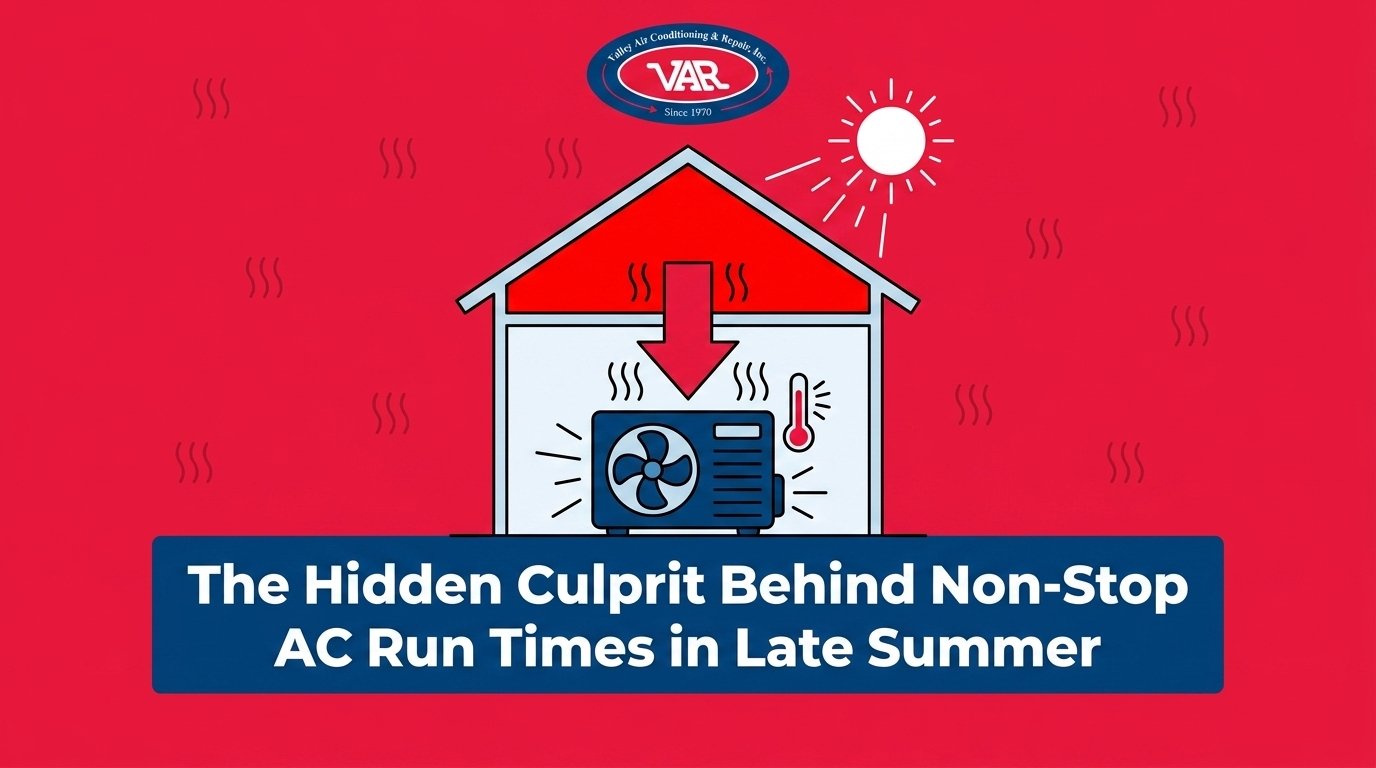
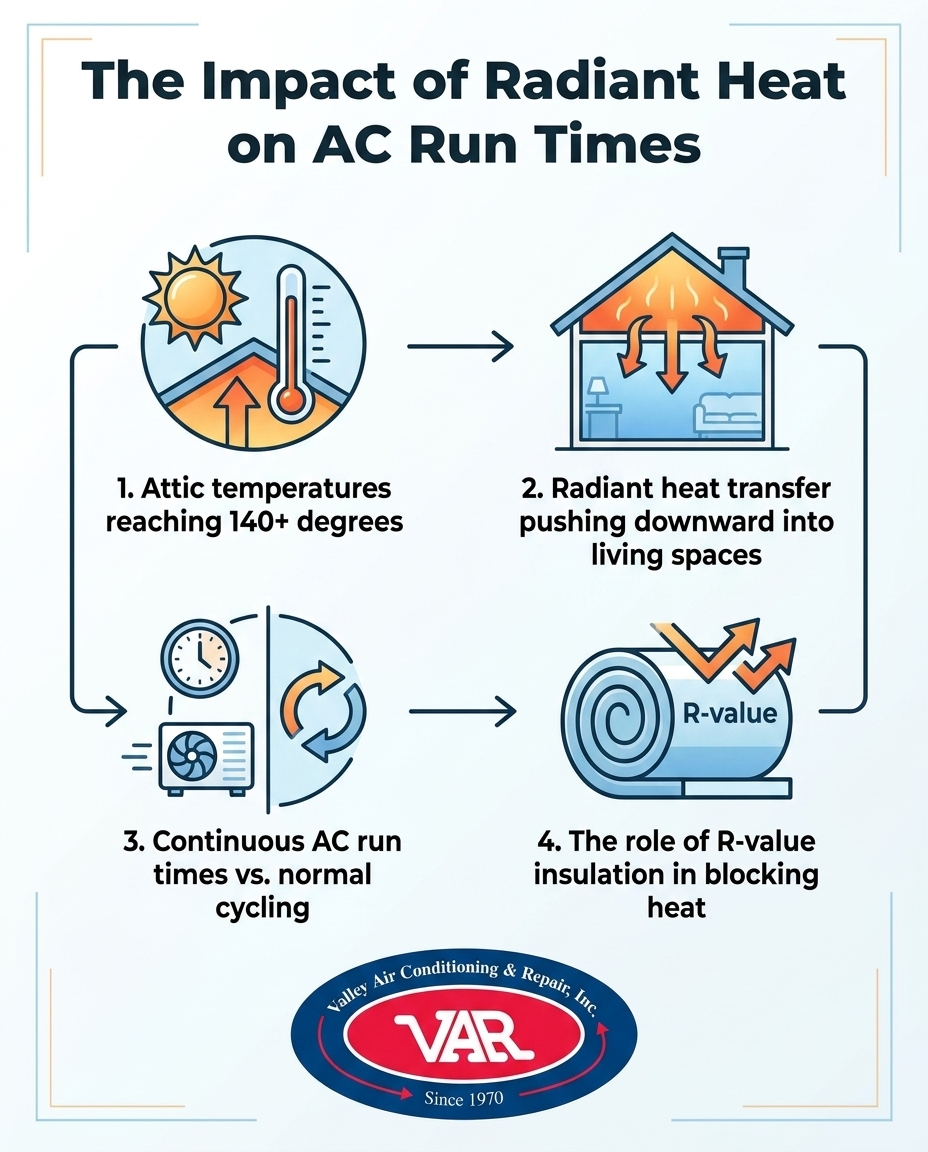
During the peak of the day, the sun relentlessly bakes your roof deck. Because heat rises and gets trapped, you are often dealing with 140+ degree attic temperatures directly above your living space. This massive temperature differential creates an overwhelming downward pressure.
The heat radiates from the roof deck, through the attic air, and directly into the insulation sitting on your ceiling. If that insulation is thin, compressed, or inadequate, the heat pushes straight through the drywall and into your home. Your air conditioner is forced to run continuously simply to combat this constant influx of new heat. It is not that the unit is broken; it is that the unit is fighting a losing battle against a 140-degree oven. This is exactly why our proactive preventative maintenance plan evaluates the entire operating environment of your system, ensuring your equipment isn't being overworked by external factors.
It is incredibly easy to fall into the psychological trap of blaming the machinery when the house gets hot. You hear the compressor running, you feel the warm room, and you immediately assume the equipment is at fault. However, distinguishing between a true mechanical failure and a compromised thermal boundary is critical for homeowners. In our experience working through relentless Fresno Central Valley heatwaves, we've found that sustained triple-digit days put every home's thermal envelope to the test.
Signs of Actual Mechanical Failure:
• Warm air from vents: If the air blowing out of your registers is lukewarm or room temperature, your system has a mechanical issue, such as a refrigerant leak or a failed compressor.
• Weak airflow: If you can barely feel the air coming out of the vents, you likely have a failing blower motor, a frozen evaporator coil, or a severely clogged filter.
• Strange noises: Grinding, squealing, or loud banging sounds point directly to failing internal components.
Signs of a Thermal Boundary Issue:
• Ice-cold air from vents: The system is producing beautifully cold air, and the airflow is strong, but the room temperature simply will not drop.
• Non-stop operation: The unit runs for hours on end without cycling off, desperately trying to satisfy the thermostat setting.
• Hot ceilings: If you safely touch the ceiling in your living space and it feels physically warm, radiant heat is pouring in.
If your system is blowing cold air but the house remains hot, your thermal envelope is likely the actual failure point. Understanding this distinction is the first step in diagnosing why your AC is running but not cooling the space effectively. A holistic diagnosis saves you from replacing parts that are not broken.
Thermal issues do not happen overnight. They build up over time, which is why these problems almost always peak at the very end of the summer season. Building materials like wood framing, drywall, roofing shingles, and masonry all possess thermal mass. This means they absorb and retain heat energy.
When the first hot day of summer arrives, your home's structure is relatively cool, so it absorbs the heat without transferring much of it inside. But as the weeks drag on, the materials become thoroughly saturated with heat. By the time those late August back-to-school heatwaves arrive, your home has entirely lost its ability to cool down overnight. The structure starts every single morning already at a disadvantage, holding onto the heat from the day before.
Our team recently worked with one Fresno homeowner who experienced this compounding thermal load firsthand when their older system struggled to keep up during a brutal stretch of 100-degree weather that lasted for 30 consecutive days. While that specific situation ultimately required a full system replacement to handle the extreme, relentless conditions, it highlights exactly what happens when relentless heat bakes a home's structure week after week. The longer the heatwave lasts, the harder your air conditioner has to work just to maintain the status quo. The sudden spike in AC run times during late-season heat events is a direct result of this compounding thermal load overwhelming your home's defenses.
If radiant heat is the invisible threat, adequate insulation is your primary shield. Upgrading or restoring your attic insulation creates a robust thermal boundary that drastically alters how your cooling system performs. When you stop the heat at the ceiling, you change the entire dynamic of your home's comfort.
Insulation is measured by its R-value, which stands for resistance to heat flow. The higher the R-value, the better the material is at stopping heat from transferring into your living space. For residential cooling in extreme climates, a high R-value is non-negotiable. It acts as a dense physical barrier that slows conduction and blocks radiant heat from penetrating the drywall.
When you have a strong thermal boundary in place, the immediate impact on your air conditioner is profound. Because the unit no longer has to fight a constant downward heat load from a baking attic, it can actually cool the room down, satisfy the thermostat, and shut off. This normal cycling is exactly what you want.
The secondary benefits of a tighter envelope include:
• Prolonged equipment lifespan: Systems that cycle normally experience far less wear and tear than systems forced to run continuously.
• Consistent indoor comfort: Eliminating hot spots and warm ceilings creates a much more comfortable living environment.
• Better humidity control: When an AC cycles properly, it has the right amount of time to pull moisture out of the air.
Before you commit to major mechanical changes, a comprehensive AC system inspection should always account for the state of this thermal barrier.
If you suspect your home is suffering from a compromised thermal boundary, it is time to take action. However, the attic is one of the most dangerous places in a home during the summer. You should never attempt dangerous DIY attic inspections during peak heat, as temperatures can easily cause heatstroke, and navigating exposed joists poses a severe fall risk.
Instead, rely on professionals who understand the deep nuances of Central Valley climate dynamics. At Valley Air Conditioning & Repair, our team focuses on diagnosing the root cause of your comfort issues, rather than just blindly pushing mechanical repairs when the envelope is to blame. When we perform a professional whole-home assessment, here is what it entails:
1. Safety and Accessibility Check: Technicians safely access the attic space using proper protective gear and lighting to evaluate the environment without risking injury.
2. Insulation Depth and Condition Measurement: Professionals measure the current depth of your insulation and check for areas where it has settled, compressed, or been moved by pests, calculating your true current R-value.
3. Ductwork Integrity Inspection: Because your ducts likely run through this incredibly hot space, technicians inspect them for leaks, tears, or poor insulation. If cold air leaks into the hot attic, your AC will run forever.
4. Mechanical Baseline Testing: Finally, the team will test your air conditioner's output, checking refrigerant levels and airflow to ensure the machinery itself is operating at peak capacity.
Addressing the root cause of heat gain is often a much more permanent solution than repeatedly servicing an overworked unit. Working with experts for your AC repair in Fresno ensures you get a holistic solution that protects your home for years to come.
Yes, inadequate insulation allows radiant heat to penetrate the living space, forcing the AC to run continuously to maintain the thermostat setting. When the barrier between your hot roof and your cool ceiling is too thin, the heat gain outpaces your system's cooling capacity. Upgrading the insulation stops this constant influx of heat, allowing the system to finally cycle off.
Extreme attic heat increases the thermal load on the home and can also heat up ductwork running through the attic, reducing the cooling capacity of the air before it reaches the vents. If your ducts are exposed to 140-degree air, the cold air inside them absorbs that heat. By the time the air blows into your living room, it has lost a significant amount of its cooling power.
It may be undersized, suffering from mechanical issues, or fighting an overwhelming heat load from a compromised thermal envelope. If the unit is blowing ice-cold air but still running non-stop, the issue is almost always related to heat entering the home faster than it can be removed. A thorough inspection is required to determine which specific factor is causing the continuous operation.
Yes, it significantly reduces the cooling load, allowing the AC to cycle normally and reducing wear and tear on the system. By creating a strong barrier against radiant heat, the air conditioner can cool the indoor air quickly and efficiently. This not only improves your daily comfort but also extends the operational lifespan of your expensive HVAC equipment.
During peak summer heatwaves, attic temperatures can easily soar past 140 degrees Fahrenheit if improperly ventilated and insulated. The sun bakes the roofing materials, and without proper airflow to vent that heat outside, it becomes trapped. This trapped heat acts like a heavy blanket pressing down on your home's ceiling all day long.
Understanding the relationship between attic insulation and late summer AC run times is the key to finally achieving consistent, reliable comfort in your home. When your system is running non-stop, it is rarely a sign that you need to panic, but it is a clear signal that your home's thermal boundary needs an evaluation. The extreme radiant heat pressing down from your roof is a relentless force, and without the proper defense, your cooling equipment will always struggle to keep up.
Do not wait for your overworked air conditioner to fail completely before addressing the root cause of the problem. Take the proactive step to evaluate your home's envelope today. By addressing your insulation and ensuring your equipment is functioning properly, you can restore efficiency, reduce the strain on your system, and secure your home's comfort long before the next heatwave hits.

As a business with many AC units, it is essential to have a responsive AC company. Valley Air Conditioning understands our needs. They are always responsive and our AC is up and running very quickly.
I had them do an AC check on the home I was buying, they were honest and quick. I hired them to do the summer and Fall maintenance for $149. Happy with this company!
100% recommend. I called, same day they came out and gave me estimate. Conley was honest and didn't try to recommend/sell us anything we didn't need. When I called him with questions before making a decision, he happily answered and was not annoyed by me contacting him. Conley and VAR
This is a group of good people. Very professional and knowledgeable. They take the time to listen and find the best solution that fits best for any situation. There's no way you can go wrong in choosing VAR.
We have used Valley Air for over fifteen years. The last two years ,Matt came to our house to service twice a year. Always on time, so polite and so professional. This is a very honest company and you can always depend on them and trust them. The office always treats everyone cheerfully and always want to do what you need done very fast YOU CAN COUNT ON THIS Company