Why Does My Ductwork Pop and Bang When the Heat Turns On?
Startled by loud vents? See why does my ductwork pop and bang when the heat turns on. Get clear answers on thermal expansion and when to call a pro.
Here in Fresno, our technicians at Valley Air Conditioning & Repair often get frantic calls on chilly November pre-winter mornings from homeowners who just turned up the thermostat and suddenly heard a loud metallic boom echoing through the vents. If you are wondering why does my ductwork pop and bang when the heat turns on, you are certainly not alone. That jarring sound can easily make you think your entire heating system is on the verge of a catastrophic failure. For many of the homeowners we assist, the immediate reaction is to turn the system off and worry about expensive repairs.
Before you panic, our team wants you to understand that a heating system is a complex network of metal, moving parts, and pressurized air. To keep your home comfortable and safe, we focus on comprehensive HVAC systems that are designed to handle temperature extremes. Whether you need a simple filter change or professional heating inspection services, knowing what those sounds mean is the first step toward peace of mind.
When your heating equipment sits idle for months, the metal channels that carry air throughout your home settle into a dormant, cold state. The first time the blower motor kicks on and pushes heated air through those cold channels, the physical reaction can be loud. However, as we often reassure our customers, not all noises indicate a broken system. Some sounds are a natural byproduct of the seasonal shift, while others are a cry for help from a system struggling to breathe.
The core goal of this guide: We want to help you distinguish between the normal, harmless settling of your home's infrastructure and the more serious airflow restrictions that require immediate attention. By understanding the mechanics behind the noise, you can protect your equipment and ensure a warm, comfortable winter.
To understand the source of the noise, we have to look at the underlying physics of your heating system. The loud popping sound you hear is known in the HVAC industry as "oil canning." This term describes the physical flexing of sheet metal when it expands and contracts, much like the sound of pressing your thumb into the bottom of an old-fashioned metal oil can and releasing it.
Your ductwork is primarily made of thin, rigid sheet metal. When this metal is exposed to sudden, drastic temperature changes, it undergoes a process called thermal shock. In our years of servicing HVAC systems across Fresno CA, we've noticed our late fall weather creates the perfect environment for this phenomenon. Our team frequently sees ductwork struggle to adapt to the drastic temperature shifts from warm, sunny days to freezing nights. This creates significant temperature deltas in unconditioned spaces like your attic or crawlspace, where your ductwork is typically routed.
Consider the rapid temperature shift your system experiences during a typical morning startup:
• Unconditioned Attic — Typical Temperature: 40°F to 50°F — Impact on Ductwork: Metal becomes cold, rigid, and slightly contracted.
• Furnace Output Air — Typical Temperature: 120°F to 140°F — Impact on Ductwork: Pushes a sudden blast of intense heat into the cold metal.
• The Resulting Shift — Typical Temperature: 80°F+ sudden change — Impact on Ductwork: Rapid thermal expansion forces the metal sides to bow outward.
When that 120-degree air hits the 40-degree metal, the material rapidly expands. Because the sheet metal is fastened tightly at the joints and seams, the expanding metal has nowhere to go but outward. The tension builds until the flat side of the duct suddenly buckles outward, producing that distinct, echoing boom.
Once the heating cycle finishes and the blower turns off, the metal begins to cool down again. As it cools, it contracts, often producing another, slightly quieter pop as the metal snaps back into its original resting position.
Hearing a loud noise from your vents can be unsettling, but our technicians always emphasize that it is important to recognize when these sounds are simply a harmless byproduct of the season. A single, brief pop shortly after the blower motor turns on is often completely normal, especially during the first few weeks of the heating season.
When you hear a pop and bang right as the system starts, monitor how long the noise lasts. In a healthy system, the expansion noises should subside relatively quickly. As the heated air continues to flow, the sheet metal eventually reaches a steady operating temperature. Once the metal is uniformly warm, the rapid expansion stops, and the ductwork remains quietly bowed outward for the duration of the heating cycle.
Signs of normal thermal expansion include:
• A single pop: One distinct noise shortly after the heat turns on.
• A matching pop later: A similar noise 10 to 15 minutes after the system turns off, indicating the metal has cooled and contracted.
• Location consistency: The sound always comes from the same general area, usually near the furnace where the temperature change is most extreme.
• No other symptoms: The house heats evenly, and airflow from the vents feels strong and steady.
Minor thermal expansion does not immediately threaten the integrity of your heating system. Sheet metal is designed to flex to a certain degree. If your system is operating efficiently and the noise is isolated to the beginning and end of the cycle, you are likely just hearing the normal settling of the house. For more insights on what to expect during the transition to cooler weather, learning about troubleshooting your first fall furnace startup can help put your mind at ease.
While a single pop is usually harmless thermal expansion, continuous or abnormally loud banging points to a much more serious issue: a static pressure imbalance. When our team is called out to investigate ductwork that sounds like a thunderstorm every time the system runs, or if the metal repeatedly flexes back and forth while the blower is actively running, we are usually dealing with restricted airflow.
Think of static pressure like blood pressure for your home's heating system. Your furnace's blower motor is designed to push a very specific volume of air against a specific amount of resistance. When something restricts that airflow, the pressure inside the metal channels spikes dramatically.
On crisp November pre-winter mornings, your furnace works hard to distribute heat. If the air cannot escape the supply vents fast enough, or if the system cannot pull enough air through the return vents, that trapped air pushes aggressively against the sheet metal walls. This extreme pressure forces the metal to bulge outward violently, causing repeated banging.
The Hidden Danger to Your Blower Motor
A static pressure imbalance is not just a noise nuisance; it is an active threat to your equipment. When airflow is restricted, the blower motor has to work much harder to move the same amount of air. This causes the motor to draw more electrical current, run hotter, and eventually burn out prematurely. Prolonged high static pressure can permanently damage your furnace, leading to complete system failure right when you need heat the most.
If you notice any of the following warning signs alongside the noises, you likely have an airflow restriction:
• Repeated banging: The metal pops in and out continuously while the fan is running.
• Whistling sounds: High-pitched noises coming from the return grilles or small gaps in the duct joints.
• Weak airflow: Some rooms feel drafty while others get no heat at all.
• Short cycling: The furnace runs for only a few minutes, shuts off abruptly, and turns right back on.
Catching these pressure issues early is the key to preventing expensive motor replacements. Proper residential pre-season preparation ensures that airflow restrictions are identified before they cause lasting damage.
If you suspect a static pressure issue is causing your ductwork to act up, there are several safe, actionable steps you can take right now. Before we dispatch a Valley Air Conditioning & Repair technician, we always ask customers to check a few basic things, as most pressure imbalances are caused by simple blockages that homeowners can resolve without opening the furnace cabinet or touching any electrical components.
1. Check and replace your HVAC air filter: This is the single most common cause of high static pressure. A dirty, clogged filter acts like a solid wall, choking off the air supply to the blower motor. When the motor starves for air, the pressure drops drastically on the return side and spikes on the supply side, causing the metal to violently pop and bang. Pull your filter out and hold it up to a light. If you cannot see light shining through the material, it is time for a new one.
2. Verify all supply registers are fully open: Walk through every room in your home and check the vents on the floor, walls, or ceiling. Many homeowners mistakenly believe that closing vents in unused guest rooms will save energy. In reality, closing more than 20% of a home's registers alters the static pressure, damages the blower motor, and guarantees loud duct noises. Keep all louvers fully open to allow the system to breathe.
3. Inspect return air grilles for blockages: Locate the large return grilles in your hallways or living areas. These are the vents that pull air back into the system. Ensure they are completely unblocked. A heavy rug pushed over a floor return, or a large sofa placed directly in front of a wall return, will severely restrict airflow and cause the system to strain.
4. Listen for changes: After replacing the filter and opening all vents, turn the heat back on. Stand near the area where the noise was loudest. If the continuous banging stops and is replaced by a single, quiet pop of normal thermal expansion, you have likely solved the pressure imbalance.
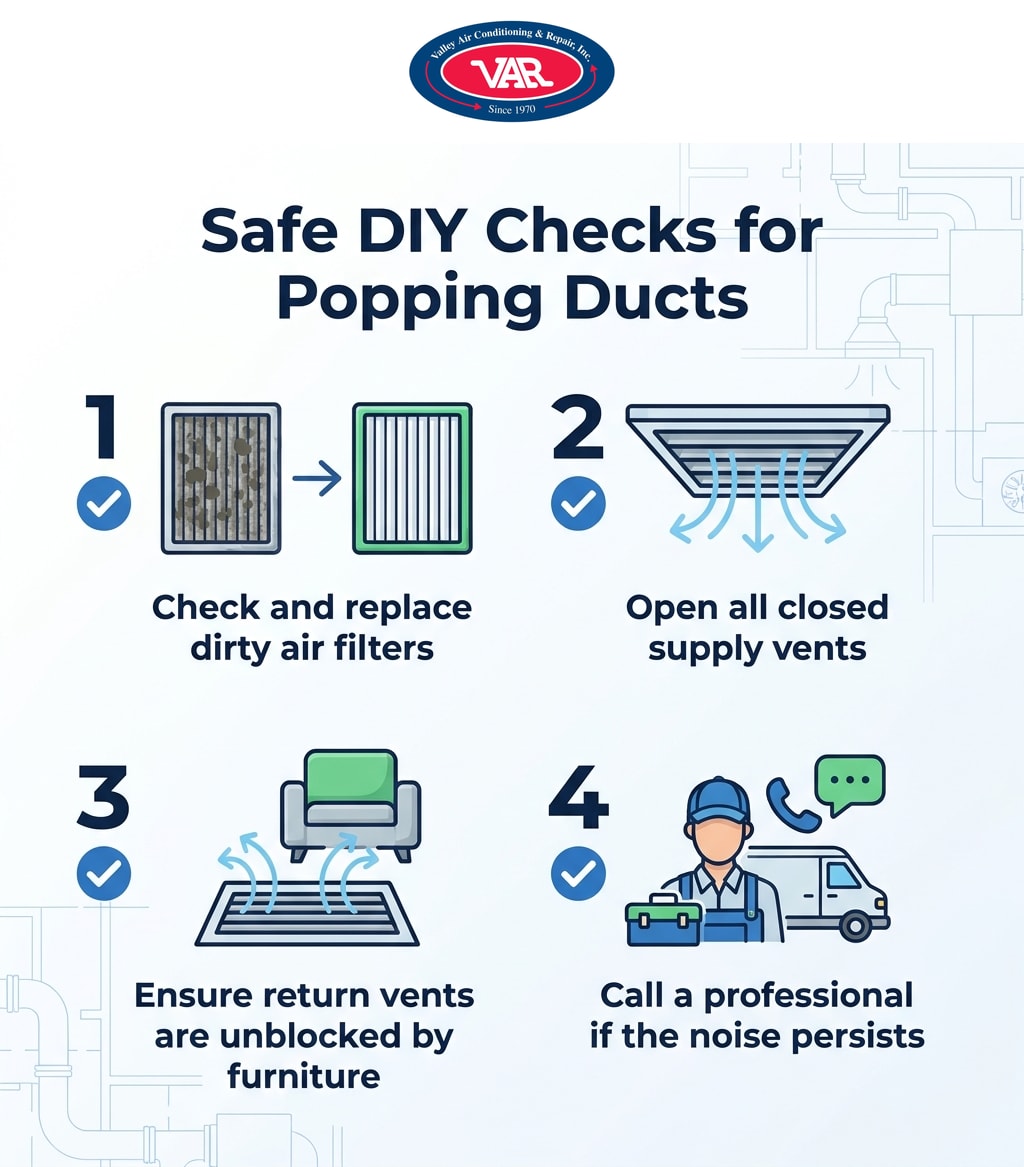
If you have changed the filter, opened every vent, and cleared all blockages, but the loud noises persist, you have reached the limit of safe DIY troubleshooting. At this stage, our technicians typically find that the problem is rooted in the physical design of the system or a failing mechanical component.
Sometimes, the ductwork installed in a home is simply too small for the volume of air the furnace produces. Undersized ductwork or improper sheet metal transitions create permanent pressure bottlenecks. When a powerful blower motor tries to force massive amounts of air through a channel that is too narrow, the static pressure remains permanently high, causing the metal to flex and bang aggressively during every single cycle.
Modifying sheet metal, installing acoustic dampeners, or adjusting blower motor speeds are not DIY tasks. These adjustments require licensed professional diagnostic tools, such as digital manometers and static pressure probes, to accurately measure the airflow dynamics inside the metal channels.
A licensed technician will drill small, precise test ports into the ductwork to measure the exact pressure on both the supply and return sides of the system. This data reveals exactly where the bottleneck is occurring. Sometimes, the solution is as simple as adjusting the fan speed on the control board. Other times, it requires installing a larger return drop or modifying the plenum transition above the furnace.
At Valley Air Conditioning & Repair, we believe in honest diagnostics. Our goal is to help you understand exactly what is happening inside your walls so you only pay for repairs when noises indicate a true safety or efficiency issue. We want you to feel confident in your home's infrastructure. Enrolling in a routine heating maintenance plan is one of the best ways to ensure these professional airflow tests are performed regularly, keeping your system quiet, efficient, and reliable for years to come.
If you are tired of being startled every time your home tries to warm up, taking action today ensures a quiet, comfortable winter. Your heating system should be felt, not heard.
Is it normal for heating ducts to bang?
A single, brief pop or bang shortly after the system turns on is often normal thermal expansion. As the cold sheet metal rapidly heats up, it expands and flexes outward. However, if the banging is continuous or extremely loud, it usually indicates a dangerous static pressure imbalance that needs attention.
How do I stop my air ducts from popping?
The easiest way to reduce popping is to ensure your system has unrestricted airflow. Change your air filter regularly, open all supply vents throughout the house, and make sure large furniture isn't blocking your return grilles. If the noise continues, a professional may need to adjust your blower speed or reinforce the sheet metal.
Why does my furnace sound like a loud boom when it turns on?
A loud boom from the ductwork is called "oil canning," which happens when a large, flat piece of sheet metal suddenly buckles outward under pressure or heat. If the boom comes from inside the furnace cabinet itself, rather than the vents, it could be a delayed ignition issue with the gas burners, which requires immediate professional repair.
Can ductwork explode from too much pressure?
No, residential ductwork will not literally explode from high static pressure. However, excessive pressure can cause the metal seams to split, leak conditioned air into your attic, and force your blower motor to overwork until it permanently fails.
Does a dirty air filter really make my vents louder?
Yes, a severely dirty air filter is the leading cause of loud vent noises. A clogged filter chokes the airflow, causing pressure to drop on one side of the system and spike on the other, which forces the sheet metal to violently buckle and bang.

As a business with many AC units, it is essential to have a responsive AC company. Valley Air Conditioning understands our needs. They are always responsive and our AC is up and running very quickly.
I had them do an AC check on the home I was buying, they were honest and quick. I hired them to do the summer and Fall maintenance for $149. Happy with this company!
100% recommend. I called, same day they came out and gave me estimate. Conley was honest and didn't try to recommend/sell us anything we didn't need. When I called him with questions before making a decision, he happily answered and was not annoyed by me contacting him. Conley and VAR
This is a group of good people. Very professional and knowledgeable. They take the time to listen and find the best solution that fits best for any situation. There's no way you can go wrong in choosing VAR.
We have used Valley Air for over fifteen years. The last two years ,Matt came to our house to service twice a year. Always on time, so polite and so professional. This is a very honest company and you can always depend on them and trust them. The office always treats everyone cheerfully and always want to do what you need done very fast YOU CAN COUNT ON THIS Company