.webp)


AC Repair in Fresno, CA: Troubleshooting the Fall HVAC Transition After a Brutal Summer
Why we emphasize safe fall heating startups. Use these home maintenance tips and troubleshooting steps to decide with confidence when to call a pro.
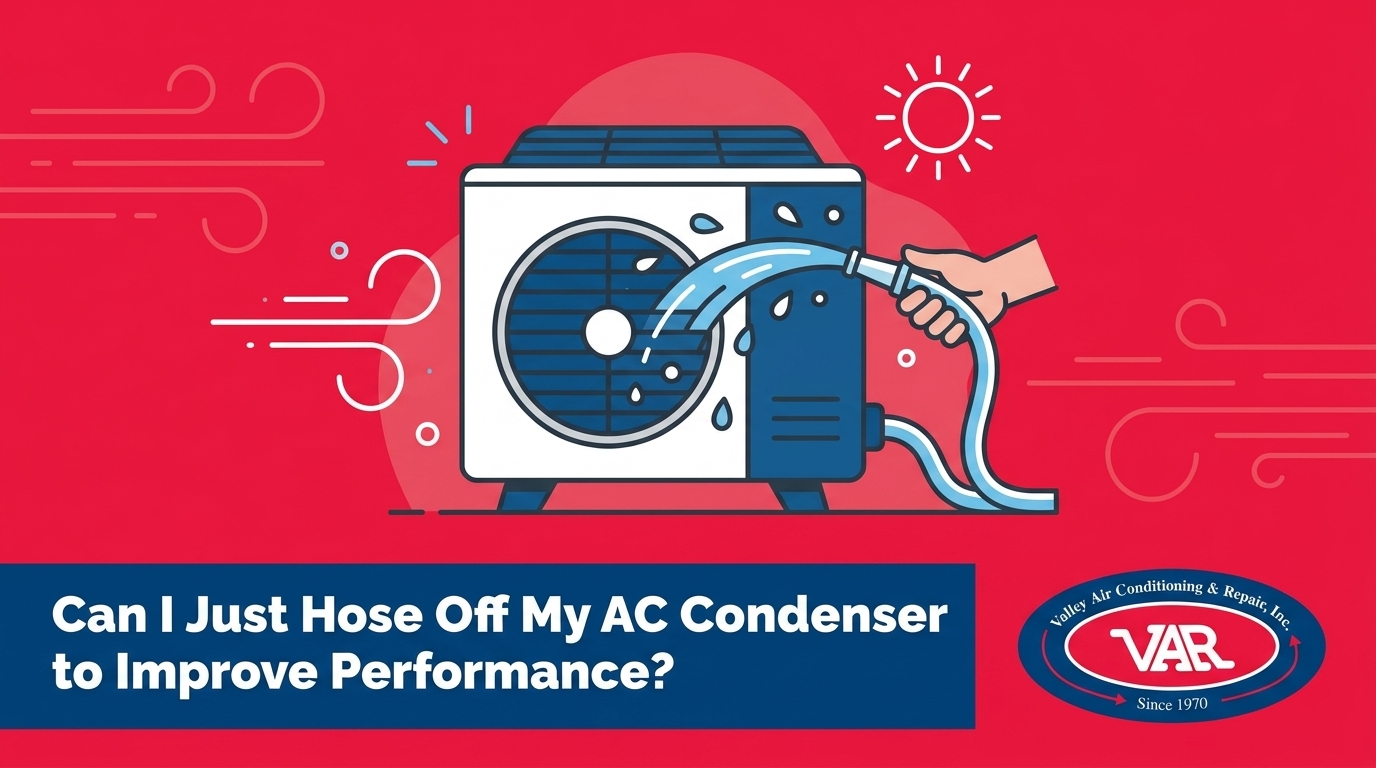
Are you wondering, "Can I just hose off my AC condenser to improve performance?" as you listen to your system run nonstop against the heat? It is a common question when your air conditioner is struggling to keep your house comfortable. You walk outside, see the metal box covered in thick grime, and immediately think a quick blast of water will solve the problem. Our team at Valley Air Conditioning & Repair, Inc. recently helped a local Fresno homeowner who faced a similar frustration during a brutal 30-day stretch of 100°F heat; their system ran constantly until it completely failed, ultimately requiring a brand-new installation. While the urge to grab a garden hose during the August late-summer heat is completely understandable, taking the DIY route can permanently damage your equipment and ruin your energy efficiency.
If your system is struggling to keep up, explore our air conditioning services for safe, professional support.
Most homeowners don't realize that their outdoor air conditioning unit is essentially a giant vacuum for outdoor air. As the fan spins, it pulls in massive amounts of air to cool the hot refrigerant circulating inside. Along with that air comes dust, pollen, leaves, and environmental debris. By the time the peak cooling season arrives, that outdoor unit can look like it is wearing a thick sweater made of dirt.
When you notice your home isn't cooling down as fast as it should, checking the outdoor unit is a logical first step. Seeing that blanket of grime naturally leads to a simple conclusion: the dirt is blocking the air, so washing it away will fix the problem. The logic makes sense on the surface. However, modern air conditioning systems are highly engineered pieces of precision equipment. Treating them like a dirty driveway or a muddy car is one of the fastest ways to cause catastrophic damage to the internal components.
The short answer is absolutely not. You should never just hose off your AC condenser. While it might seem like a harmless chore, applying high-pressure water from a standard garden hose to your outdoor unit introduces severe risks to the system's mechanical integrity.
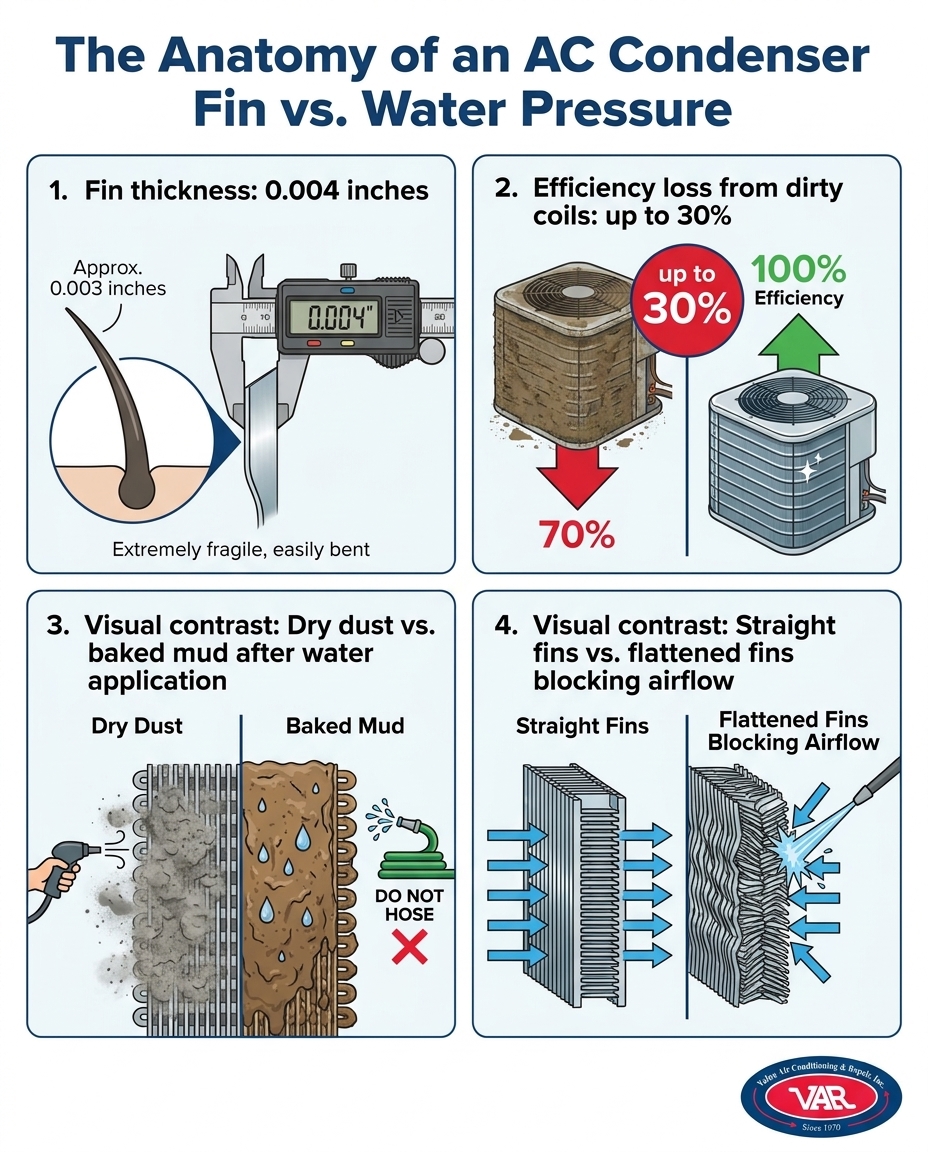
Here's the thing: the exterior of your condenser is made up of thousands of incredibly delicate aluminum fins. These fins are designed to facilitate heat transfer, not to withstand the blunt force of a pressurized water stream. Even a standard garden hose nozzle set to a moderate spray can easily bend, fold, or flatten these fins. Once those fins are flattened, they physically block the air from flowing through the system, trapping the heat inside.
Beyond the physical damage to the metal, there is a chemical and environmental reality to consider. The dirt on your unit isn't just loose dust. It is often a sticky, oily residue mixed with heavy particulate matter. When you spray plain water onto this buildup, you don't wash it away. Instead, you create a thick mud. The force of the water pushes this mud deeper into the center of the coil, where it becomes trapped.
Dirty coils can reduce your system's efficiency by up to 30%, forcing the unit to run longer and harder to achieve the same indoor temperature. But damaged coils and deeply embedded mud are far worse. Instead of a temporary efficiency drop, you are looking at permanent airflow restriction. If you want to protect your system's efficiency and lifespan, investing in professional AC maintenance is always the safer, more effective route.
To understand why a garden hose is so dangerous to your system, you have to look closely at how the outdoor unit is built. The large metal box sitting in your yard is called the condenser. Its primary job is to take the heat that was absorbed from inside your house and release it into the outdoor air.
It accomplishes this through a network of copper tubes surrounded by thousands of closely spaced aluminum fins. These fins act like a radiator. The hot refrigerant flows through the copper tubes, and the heat transfers into the aluminum fins. The large fan on top of the unit pulls cooler outdoor air through these fins, carrying the heat away into the atmosphere.
Because the goal is rapid heat transfer, these fins cannot be thick or bulky. They are typically made of incredibly thin aluminum—often measuring as thin as 0.004 inches. To put that into perspective, that is roughly the thickness of a standard sheet of printer paper.
• High surface area: The fins are packed tightly together to maximize the surface area exposed to the air.
• Low structural integrity: Because they are paper-thin, they have almost no resistance to lateral pressure.
• Precision spacing: The specific gap between each fin is mathematically calculated to allow the exact right volume of air to pass through.
When you point a garden hose at these fins, you are hitting them with a concentrated stream of water that far exceeds their structural capacity. The water pressure acts like a blunt instrument. Even if you think you are using a "gentle mist" setting, a slight change in the angle of your wrist can direct the water sideways across the fins, instantly folding them over like a row of dominoes. When the temperatures climb into the 100°F+ temperatures range, your system needs every millimeter of that surface area to dissipate heat. Flattening the fins destroys that capability.
The problem: In regions with heavy agricultural activity, the dirt that accumulates on your air conditioner is not normal household dust. In our years of providing AC service across the Fresno Central Valley, our technicians at Valley Air Conditioning & Repair, Inc. see firsthand how thick the air gets with agricultural dust (PM10), pollen, and exhaust particulates. By the time late summer arrives, this specific type of dust forms a dense, oily blanket over the condenser coils.
The cause: Plain water from a garden hose lacks the chemical surfactants needed to break down this oily, heavy particulate matter. When you spray water onto an agricultural dust buildup, the water doesn't lift the dirt off the metal. Instead, the pressure of the hose forces the wet dirt deeper between the tightly packed aluminum fins. The water mixes with the dust to create a thick, dense mud that settles into the microscopic crevices of the coil.
The solution: Once you turn the air conditioner back on, the copper tubes heat up rapidly. This heat literally bakes the wet mud into a solid, brick-like substance inside the coil. What started as a layer of dry dust on the outside of the unit has now been transformed into a solid barrier of baked mud on the inside. This is why DIY hosing actively worsens the situation. The specific combination of San Joaquin Valley agricultural dust and extreme heat makes plain water highly ineffective and actively destructive. Only specialized foaming agents can safely lift this specific type of grime without pushing it deeper.
To fully grasp the danger of hosing down your unit, we have to look at the physics of airflow. Your air conditioning system operates on a precise balance of pressure and temperature. The compressor—the heavy engine sitting at the bottom of the outdoor unit—is the heart of the system. It pumps the refrigerant through the lines, relying on a constant, unimpeded flow of air to keep it from overheating.
When the aluminum fins are flattened by a garden hose, they close the gaps where air is supposed to travel. This creates a physical wall.
While a dirty coil reduces efficiency by insulating the metal and slowing down heat transfer, bent fins completely choke the system's ability to "breathe." The consequences of this mechanical restriction are severe:
• Trapped heat: The heat pulled from your home has nowhere to go, so it stays trapped inside the condenser unit.
• Compressor strain: The compressor has to work twice as hard to push refrigerant through a system that cannot cool down.
• Overheating: Without airflow to cool the internal components, the compressor will quickly overheat and trigger a safety shutdown.
• Catastrophic failure: Repeated overheating will eventually burn out the compressor motor entirely, leading to a massive repair bill or a total system replacement.
During stretches of 100°F+ temperatures, your system is already operating near its maximum capacity. Adding the severe airflow restriction of bent fins is a guaranteed recipe for a breakdown. Proper residential pre-season preparation ensures that your system has the unimpeded airflow it needs to survive the harshest weather without failing when you need it most.
If water is so dangerous, how do the coils actually get clean? The difference lies in the specialized tools, calibrated equipment, and chemical solutions used by certified technicians. Professional maintenance is not just a simple wash; it is a precise restoration of the equipment's heat transfer capabilities.
We regularly see the difference this makes in the field. For instance, our team recently serviced a system for a customer who managed to keep their 13-year-old AC unit running like new through ongoing preventive maintenance and professional cleaning of the heat exchanger. This longevity is only possible when the equipment is treated with the correct chemical agents rather than brute force.
• Cleaning Agent — DIY Garden Hose: Plain, unpressurized tap water. — Professional Maintenance: Specialized foaming chemical coil cleaners.
• Dirt Removal Method — DIY Garden Hose: Blunt force pressure that pushes dirt deeper. — Professional Maintenance: Chemical expansion that lifts dirt out from the inside.
• Fin Protection — DIY Garden Hose: High risk of bending and flattening aluminum fins. — Professional Maintenance: Low-pressure application protects delicate metal.
• Restoration Tools — DIY Garden Hose: None. Damage is permanent without intervention. — Professional Maintenance: Use of specialized fin combs to straighten bent fins.
• Outcome — DIY Garden Hose: Baked mud, restricted airflow, potential system failure. — Professional Maintenance: Restored efficiency, lower energy bills, protected equipment.
Professionals use specialized foaming coil cleaners designed specifically for HVAC systems. When applied, these chemicals actively foam up and expand. This chemical reaction safely lifts heavy dust, pollen, and oily agricultural residue away from the coils without requiring high water pressure.
Furthermore, if a technician discovers that your fins have been bent by hail, debris, or previous DIY cleaning attempts, they don't leave them that way. Working with a professional means benefiting from specialized tools like fin combs. A fin comb is a precisely calibrated hand tool used by technicians to carefully separate and straighten bent aluminum fins, restoring the vital airflow gaps without tearing the metal. This level of care protects your expensive AC investment long-term, especially heading into the brutal August late-summer heat.
While you should never attempt to clean the internal condenser coils yourself, there are plenty of safe, actionable steps you can take to support your system's airflow. Maintaining the environment around the unit is just as important as the cleanliness of the unit itself. By keeping the exterior clear, you allow the system to pull in the air it needs without restriction.
As local HVAC experts serving the Fresno Central Valley, we know how quickly debris can accumulate after a windy late-summer day. Here is a safe checklist to help your system breathe:
• Maintain a 2-foot clearance zone: Ensure there are no shrubs, bushes, or tall grass growing within 24 inches of the condenser unit on all sides.
• Clear yard debris regularly: Sweep away fallen leaves, twigs, and grass clippings that accumulate around the base of the unit after mowing the lawn.
• Check overhead clearance: Make sure low-hanging tree branches are trimmed back at least five feet above the unit so the exhaust air can escape freely upward.
• Perform visual inspections: Walk out and look at the unit every few weeks. If you see a heavy mud or dust blanket forming on the metal grilles, do not reach for the hose.
• Leave the internal work to pros: Always schedule professional service to handle the internal coil cleaning to avoid expensive fin damage.
By focusing on the landscaping and perimeter of the unit, you provide immense support to the system's efficiency without taking on the mechanical risks of DIY cleaning. For more tips on identifying common system issues, check out our comprehensive AC troubleshooting guide.
No, hosing down an AC unit often pushes dirt deeper into the coils rather than cleaning them. While it might look cleaner on the outside, the water mixes with thick dust to create mud that settles inside the unit. Furthermore, it risks bending the delicate aluminum fins, which severely restricts airflow and forces the compressor to overwork.
Absolutely not. A pressure washer will instantly flatten the aluminum fins across the entire surface of the unit. Because the fins are as thin as a sheet of paper, the extreme PSI of a pressure washer causes severe airflow restriction and can ruin the condenser entirely, often requiring a complete replacement of the outdoor unit.
You should never spray water into the unit, running or not. Doing so while the unit is running is especially dangerous because the active fan can draw water and mud deeper into the mechanical components and the electrical contactors. Always leave the unit alone and let a professional handle the cleaning with the power safely disconnected.
The exterior casing can be wiped down with a dry cloth or soft brush as needed to remove loose leaves, but internal coils require professional cleaning. Professional coil cleaning should be performed at least once a year during routine maintenance. During stretches of 100°F+ temperatures, having clean coils is vital for the system to survive the season.
Do not attempt to pry them open with household tools like knives or screwdrivers, as they can easily tear the metal and puncture the refrigerant lines. Contact a professional technician who can carefully restore them using a specialized fin comb. This tool matches the exact spacing of the fins to straighten them safely without causing further damage.
The short-term satisfaction of hosing off a dirty outdoor unit is simply not worth the long-term risk of bent fins, baked mud, and catastrophic compressor failure. Proper, unrestricted airflow is the absolute key to surviving the extreme August late-summer heat without your system breaking down. Instead of taking a gamble with a garden hose, rely on professional expertise to restore your system's efficiency safely. Schedule your tune-up today to secure reliable cooling and protect your valuable equipment from unnecessary damage.

As a business with many AC units, it is essential to have a responsive AC company. Valley Air Conditioning understands our needs. They are always responsive and our AC is up and running very quickly.
I had them do an AC check on the home I was buying, they were honest and quick. I hired them to do the summer and Fall maintenance for $149. Happy with this company!
100% recommend. I called, same day they came out and gave me estimate. Conley was honest and didn't try to recommend/sell us anything we didn't need. When I called him with questions before making a decision, he happily answered and was not annoyed by me contacting him. Conley and VAR
This is a group of good people. Very professional and knowledgeable. They take the time to listen and find the best solution that fits best for any situation. There's no way you can go wrong in choosing VAR.
We have used Valley Air for over fifteen years. The last two years ,Matt came to our house to service twice a year. Always on time, so polite and so professional. This is a very honest company and you can always depend on them and trust them. The office always treats everyone cheerfully and always want to do what you need done very fast YOU CAN COUNT ON THIS Company