


.webp)


Why Is My AC Blowing Warm Air? Fall HVAC Troubleshooting & Startup Smells
Smelling burning dust this fall? Get clear answers with our home maintenance tips and troubleshooting to know when to call a pro for your heating system.
Here at Valley Air Conditioning & Repair, Inc., our team sees firsthand how a standard evaporative cooler running continuously through a Central Valley summer can process thousands of gallons of water, leaving behind pounds of solid mineral scale by the time fall arrives. If you are wondering how Clovis water quality affects your evaporative cooler lifespan, the answer lies in the heavy concentration of calcium and magnesium flowing through your municipal tap. While evaporative cooling is incredibly energy-efficient for our hot, arid climate, our technicians know that the local water chemistry introduces a serious mechanical threat to your equipment.
As we push into August and late-summer heatwaves, your system is forced to work harder just as mineral buildup reaches its absolute peak. This creates a critical decision point for homeowners. You can either implement proactive scale management, or you can risk complete pan rust-through, seized water pumps, and premature system failure. When standard HVAC systems rely on closed refrigerant loops, evaporative coolers (often called swamp coolers) are completely open to the elements and the local water supply. Understanding how this water interacts with your cooling equipment is the first step in protecting your investment from rapid degradation.
As HVAC professionals serving the Clovis and greater Fresno area, we know the municipal water supply relies heavily on groundwater sources. As water filters through the earth over decades, it naturally absorbs high levels of dissolved minerals, primarily calcium and magnesium. This is what we commonly refer to as "hard water." While this water is perfectly safe for drinking and household use, it behaves very differently when introduced to the harsh environment of an outdoor cooling system.
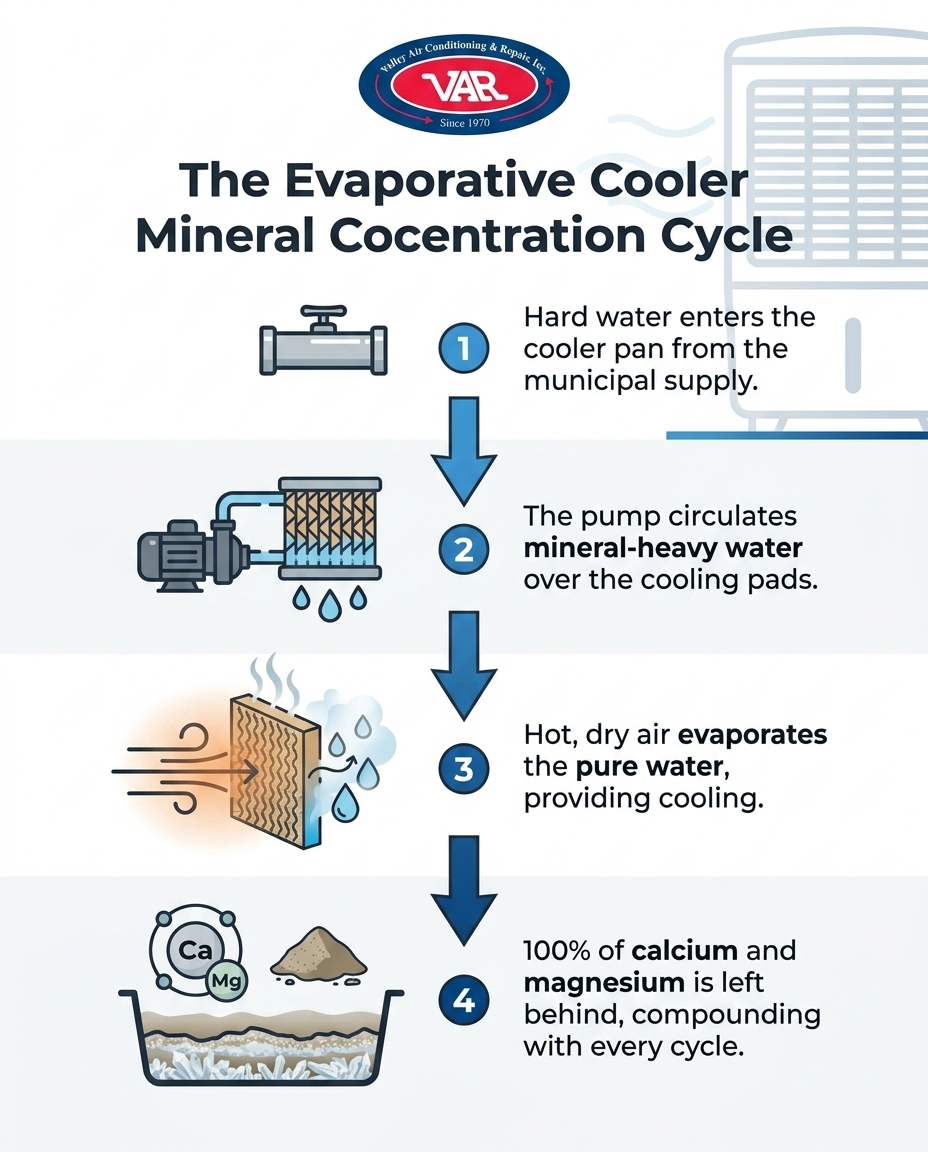
Evaporative coolers work on a simple scientific principle: hot, dry outside air is pulled through water-saturated cooling pads. As the water evaporates into vapor, it absorbs heat, dropping the temperature of the air before it is pushed into your home. However, while the water turns to vapor and enters your home, 100% of the heavy minerals are left behind in the unit. The evaporation process does not carry calcium or magnesium away. Instead, those minerals bake onto the pads, the pump, and the metal pan.
Because your cooler continuously refills itself with fresh municipal water to replace what has evaporated, it creates a relentless concentration cycle. The water sitting in your cooler pan in late July is significantly harder than the water coming out of your kitchen faucet. Every single day of operation multiplies the mineral concentration in the water pan.
• Fresh Municipal Tap Water — Mineral Concentration Level: Baseline (Hard to Very Hard) — Impact on Cooling Equipment: Normal starting conditions; safe for initial pan fill.
• Mid-Summer Pan Water — Mineral Concentration Level: Highly Concentrated — Impact on Cooling Equipment: Rapid scale formation begins on pads and moving pump parts.
• Late-Summer Pan Water — Mineral Concentration Level: Extreme Concentration — Impact on Cooling Equipment: Aggressive calcification, severely restricted airflow, high corrosion risk.
Many homeowners assume their indoor water softener protects their outdoor cooling unit. However, standard whole-home water softeners are rarely plumbed to exterior hose bibs or roof-mounted water lines. Even if they were, the sodium used in ion-exchange water softeners can be just as corrosive to outdoor metal components as calcium. This means your evaporative cooler is constantly battling the full force of local groundwater chemistry. If you want to avoid frequent repairs and get the most out of your evaporative cooler services, managing this chemical reality is non-negotiable.
The most visible victim of hard water in your evaporative cooler is the cooling pad system. Whether you use standard aspen wood fiber pads or rigid corrugated media, the constant flow of mineral-heavy water eventually turns these flexible, absorbent materials into rigid, calcified blocks. As the arid heat peaks in August and late-summer, restricted airflow from scaled pads makes the indoor environment uncomfortably warm, forcing your system to run longer to achieve the same comfort.
When our technicians inspect struggling units during the back-to-school season, here is the exact process we observe of how mineral scale destroys cooling pads and chokes off airflow:
1. Initial Saturation: Fresh pads easily absorb water, allowing air to pass smoothly through the flutes and channels.
2. Mineral Deposition: As water evaporates, microscopic calcium crystals attach to the pad fibers. Over a few weeks, these crystals grow into a crusty, white layer.
3. Channel Blockage: The rigid scale physically bridges the gaps in the pad media. The open channels designed to let air flow through become completely blocked by solid mineral deposits.
4. Loss of Absorbency: Calcified pads repel water rather than absorbing it. Water simply cascades down the outside of the scale rather than soaking into the media, destroying the cooling effect.
Increased energy consumption: When air cannot easily pass through the cooling pads, the blower motor has to work significantly harder to pull air into the house. This increased static pressure drives up energy consumption.
Uneven cooling throughout the home: Because the air volume is reduced, the cooled air lacks the velocity to reach the furthest rooms in your house. You will likely notice that rooms furthest from the cooler vent become stagnant and hot.
Premature wear on the blower motor: The blower motor is designed to operate within a specific airflow range. Forcing it to pull against a solid wall of calcified pads causes the motor to overheat, degrading its internal windings and drastically shortening its lifespan.
Our repair crews frequently replace seized components because while the cooling pads take the brunt of the visible damage, the water pump is the mechanical heart of your evaporative cooler. Its sole job is to continuously pull water from the bottom pan and push it up to the distribution spider, which then cascades the water over the pads. Because the pump is submerged in the most heavily concentrated, mineral-rich water in the entire system, it is highly vulnerable to hard water damage.
As the pump operates, calcium deposits inevitably form on the pump's impeller—the spinning component that actually moves the water. These deposits also clog the internal intake screens designed to keep debris out. As the scale thickens, it creates severe mechanical stress. The pump struggles against the hardened scale, requiring more electrical current to turn the impeller. Eventually, this friction leads to overheating and complete motor failure.
Friction caused by mineral deposits: An impeller coated in calcium carbonate loses its precise balance and smooth surface. The grinding friction generates excess heat and wears down the pump shaft.
Blockages preventing adequate water flow: Submersible cooler pumps rely on the water they pump to cool their own internal motors. When intake screens are blocked by scale, the pump runs dry, causing the motor to burn out rapidly.
The cost of ignoring early warning noises: A failing water pump rarely dies silently. If you hear a whining, humming, or grinding noise coming from your roof unit, the pump is likely fighting against severe mineral buildup. Catching these warning signs early can save you from a mid-summer breakdown. Understanding common water pump problems in evaporative coolers is crucial for homeowners in the Clovis and greater Fresno area.
Perhaps the most severe consequence of unmanaged hard water is the structural failure of the cooler's bottom pan. The water pan acts as the reservoir for the entire system. Because it holds highly concentrated, mineral-heavy water for months at a time, it is the prime location for aggressive rust and corrosion.
The chemical reaction between heavy dissolved minerals, oxygen, and the metal surface of the pan accelerates the breakdown of the factory protective coatings. Once the raw metal is exposed, rust spreads quickly. The risk of pan rust-through is a serious concern. A rusted-out pan does not just break the cooler; it dumps dozens of gallons of water directly onto your roof. This leads to severe roof leaks, damaged shingles, and significant structural water damage to your home's attic and ceilings.
At Valley Air Conditioning & Repair, Inc., our local technicians have firsthand experience seeing rusted-out cooler pans specifically in Clovis neighborhoods due to neglected water management. The difference between a cooler that lasts five years and one that lasts fifteen often comes down to the pan maintenance we perform.
• Regular pan inspections: Checking the pan for early signs of bubbling paint or surface rust allows you to address the issue before it eats through the metal.
• Applying protective coatings: Professional-grade elastomeric cooler coatings can be applied to the inside of the pan to create a waterproof, rust-proof barrier between the metal and the hard water.
• Managing water levels: A misadjusted float valve will cause the pan to constantly overflow, leading to exterior rust down the side of the unit and across your roof flashing. Keeping the water level properly calibrated is vital.
A pattern we see often across the Central Valley is that many homeowners are diligent about starting up their coolers in the spring but completely neglect them as the season winds down. However, the end of the cooling season is actually the most dangerous time for your equipment. By the time the back-to-school transition period arrives in August and late-summer, the weather is still brutally hot, but your system is highly fatigued.
Consider the math of evaporation. If your system has processed thousands of gallons of water since May, the mineral concentration in the pan is at its absolute maximum. The pads are heavily loaded with scale, the pump is working overtime, and the metal pan is soaking in a highly corrosive brine. The system has endured months of continuous stress.
Waiting until the following spring to address late-summer scale is a costly mistake. If you turn off the cooler in October and leave that mineral-heavy sludge sitting in the pan all winter, the corrosion process continues unchecked. The moisture trapped in the scale will rust the pan, and the pump impeller will seize completely as the calcium hardens like concrete. Addressing the cumulative effect of summer operation right now prevents compounding stress on aging components.
While you cannot change the municipal water quality in the Clovis and greater Fresno area, we can absolutely help you control how it affects your equipment. In our years of providing evaporative cooler maintenance, we've found that mitigating hard water damage requires a structured, professional approach. Attempting to chip away solid scale with a screwdriver or pouring harsh, undiluted household acids into the pan usually results in punctured metal and destroyed pumps.
Here are the professional-grade strategies our team uses to manage scale and extend the life of your evaporative cooler:
1. Calibrating Bleed-Off Valves: A bleed-off valve is a critical component that continuously drains a small amount of mineral-heavy water from the system while it runs. This prevents the water in the pan from ever reaching extreme concentration levels. A professional can install and calibrate this valve to balance water conservation with effective scale prevention.
2. Professional-Grade Scale Inhibitors: Specialized water treatment tablets and inline scale inhibitors change the chemical structure of the minerals, keeping them suspended in the water rather than allowing them to stick to the pads and metal surfaces.
3. Safe Descaling and Pad Replacement: When pads are fully calcified, they must be safely removed and replaced. During this process, the pump and internal water distribution tubes are professionally descaled using safe, non-corrosive treatments to restore full water flow.
Consistent maintenance is the only proven way to fight back against hard water. One local homeowner we worked with this past spring had an older unit that needed ongoing preventive maintenance and cleaning. By performing a thorough professional cleaning of the internal components and establishing a solid care routine, we kept their 13-year-old unit running like new. Regular monitoring of bleed-off rates, end-of-season deep cleaning to remove residual scale, and professional assessment of pump health are all part of a comprehensive preventative maintenance plan.
Does hard water ruin evaporative coolers?
Yes, if left unmanaged, hard water will significantly reduce the lifespan of an evaporative cooler. The high levels of calcium and magnesium cause rapid scale buildup on cooling pads, seize water pumps, and accelerate rust in the metal water pan. Proactive maintenance is required to prevent this damage.
How do you prevent calcium buildup in a swamp cooler?
The most effective way to prevent calcium buildup is by installing and properly calibrating a bleed-off valve, which constantly flushes out highly concentrated mineral water. Additionally, using professional-grade scale inhibitor tablets helps keep minerals suspended in the water rather than sticking to the components. Regular end-of-season draining and cleaning also stops calcium from hardening over the winter.
How often should I change swamp cooler pads with hard water?
In areas with very hard water like ours, standard aspen wood pads typically need to be replaced at least once a season, and sometimes twice if the cooler runs continuously through a hot August. Rigid media pads last longer but still require annual inspection and professional descaling to maintain proper airflow. If the pads feel crusty, brittle, or heavy, it is time for a change.
Why does my evaporative cooler smell earthy or musty late in the season?
A musty or earthy smell usually indicates that the cooling pads are holding onto stagnant water, dirt, and biological growth trapped within the mineral scale. As the scale blocks the natural flow of fresh water, bacteria can thrive in the damp, blocked channels. Replacing the calcified pads and thoroughly cleaning the water pan will eliminate the odor.
Can I just scrape the mineral scale off my cooler pads?
No, scraping mineral scale off cooling pads will destroy the fragile fibers or rigid media structure. Once the scale has heavily bonded to the pad material, it cannot be physically removed without ruining the pad's ability to absorb water evenly. The only effective solution for heavily calcified pads is complete replacement.
The reality for homeowners we serve in the Clovis and greater Fresno area is that local water chemistry remains a continuous threat to cooling equipment. Every gallon of water evaporated leaves behind minerals that actively degrade your pads, overwork your pump, and eat away at your water pan. Recognizing this threat is the first step, but taking action before the season ends is what truly protects your home.
Proactive management is the absolute key to preventing premature failure. Do not wait until your system starts blowing warm air or your roof suffers water damage from a rusted-out pan. Scheduling a thorough inspection with Valley Air Conditioning & Repair, Inc. now allows you to address scale buildup, replace degraded components, and ensure optimal performance through the hottest remaining weeks of the year. Reach out to our team today to get your evaporative cooler inspected, cleaned, and protected against the harsh realities of Central Valley hard water.

As a business with many AC units, it is essential to have a responsive AC company. Valley Air Conditioning understands our needs. They are always responsive and our AC is up and running very quickly.
I had them do an AC check on the home I was buying, they were honest and quick. I hired them to do the summer and Fall maintenance for $149. Happy with this company!
100% recommend. I called, same day they came out and gave me estimate. Conley was honest and didn't try to recommend/sell us anything we didn't need. When I called him with questions before making a decision, he happily answered and was not annoyed by me contacting him. Conley and VAR
This is a group of good people. Very professional and knowledgeable. They take the time to listen and find the best solution that fits best for any situation. There's no way you can go wrong in choosing VAR.
We have used Valley Air for over fifteen years. The last two years ,Matt came to our house to service twice a year. Always on time, so polite and so professional. This is a very honest company and you can always depend on them and trust them. The office always treats everyone cheerfully and always want to do what you need done very fast YOU CAN COUNT ON THIS Company


