


.webp)


Why Is My AC Blowing Warm Air? Fall HVAC Troubleshooting & Startup Smells
Smelling burning dust this fall? Get clear answers with our home maintenance tips and troubleshooting to know when to call a pro for your heating system.

Are you searching for reliable home maintenance tips and troubleshooting because your system is acting up during the unpredictable autumn weather? You are not alone. The transition into fall creates a unique and frustrating balancing act for your home comfort system. One afternoon, the sun is beating down and you need the air conditioner to cool the house. A few hours later, the sun sets, the temperature plummets, and you are rushing to turn on the furnace for the first time in months. This rapid switching back and forth often leads to significant confusion at the thermostat and unexpected behaviors from your equipment.
If you need immediate assistance navigating these seasonal shifts, exploring professional Air Conditioning Services can help stabilize your indoor climate. A typical pattern we see during the October heating-startup is a dual-layered problem. First, homeowners experience the frustration of their AC blowing warm air right when an unseasonable afternoon heatwave hits. Then, after finally getting the house cooled down, they switch over to heating at night, only to be greeted by an alarming burning dust smell echoing through the vents.
These dual symptoms often cause panic, leading many to believe their entire HVAC system is failing all at once. The reality is usually much more nuanced. While some of these transition issues are completely harmless and expected, others require professional diagnostics to ensure your home remains safe and comfortable. Understanding the difference between a temporary seasonal hiccup and a mechanical failure is the key to protecting your investment before the deep winter freeze arrives.
Before you assume your air conditioner has suffered a catastrophic breakdown, the first place you should look is the thermostat on your wall. Thermostat settings are the most common, non-mechanical culprit behind the mystery of warm air coming from your vents. In regions like Fresno and the Central Valley, the wild daily temperature swings in the fall often lead to frequent, confusing adjustments at the thermostat by different family members.
When the weather demands cooling at 2:00 PM and heating by 9:00 PM, it is incredibly easy for settings to get crossed. Someone might bump the switch to "fan-only" mode, meaning the system circulates unconditioned, room-temperature air throughout the house. To the person standing under the vent, this feels exactly like the AC blowing warm air, even though the cooling cycle was never actually initiated.
Quick checks to verify your thermostat settings:
• Verify the system mode: Ensure the switch is explicitly set to "Cool" or "Auto" rather than "Fan" or "Heat." A simple accidental nudge during cleaning can change the mode entirely.
• Check the batteries: Dead or dying thermostat batteries disrupt communication between the control unit and your HVAC equipment. If the thermostat cannot send a strong signal, the outdoor compressor may not engage, leaving only the indoor fan running.
• Monitor for short-cycling: If your system turns on and off rapidly, it never runs long enough to extract humidity and cool the space. This mimics the feeling of warm air because the cooling cycle is constantly interrupted.
• Review programmable schedules: Fall is the time when many homeowners forget to update their summer cooling schedules. Ensure your programmed temperature targets align with the current autumn weather patterns.
By ruling out these basic communication errors first, you can save yourself the stress of an unnecessary repair panic and narrow down whether you are dealing with a true mechanical failure.
If your thermostat is set correctly and you are still feeling warm air during an autumn heatwave, you likely have a legitimate mechanical issue that needs attention. Ignoring these problems just because winter is approaching is a mistake; whatever is broken now will still be broken when spring arrives, and sitting idle for months can actually make the damage worse. For comprehensive solutions, scheduling AC Repair in Fresno is the best way to address these underlying faults before they escalate.
One of the primary culprits for warm air is a severely clogged air filter. After a grueling summer of heavy use, your filter is likely packed with dust, pollen, and pet dander. A blocked filter chokes off the airflow to the evaporator coil. Without enough warm air blowing over the coil, the refrigerant cannot absorb heat, and the coil can actually freeze solid. When this happens, the system will only push warm, unconditioned air into your living space.
Another common issue is a slow refrigerant leak that developed over the long summer months. Air conditioners do not consume refrigerant like a car consumes gas; if the level is low, there is a leak somewhere in the line. As the refrigerant level drops, the system loses its ability to absorb and transfer heat, resulting in progressively warmer air coming from your registers.
Your outdoor unit relies heavily on the condenser fan motor to expel the heat that the refrigerant absorbs from inside your house. If this motor fails or struggles to spin, the heat remains trapped in the outdoor coil. Consequently, the compressor overheats, and the system fails to cool the indoor air.
Signs of a failing condenser fan motor include:
• Loud buzzing or humming: The motor is receiving electrical current but lacks the mechanical ability to spin the blades.
• Sluggish blade movement: The fan spins noticeably slower than usual, failing to pull enough air through the outdoor fins.
• Intermittent operation: The fan runs for a few minutes, overheats, shuts down, and then tries to restart once it cools off.
Even though we are moving into fall, late-season heatwaves can still push your system to the brink. One local homeowner reached out for a Saturday service call on short notice during a late summer heatwave when their AC failed. After initial attempts didn't resolve the issue, the technician returned with a secondary troubleshooting idea that successfully fixed the system. If you suspect your outdoor fan is the culprit, exploring common AC Condenser Fan Motor Issues can help you understand why this specific part requires professional replacement.
Once you have navigated the afternoon cooling challenges, the sun sets, and it is time to turn on the furnace. For many homeowners, this October heating-startup is accompanied by an immediate, alarming smell of burning dust. While it is natural to panic when you smell something burning in your home, this specific odor is usually completely harmless and entirely expected.
Throughout the long, idle summer months, your furnace sits quietly in the closet, garage, or attic. During this time, household dust, pet dander, dead skin cells, and microscopic debris settle on the internal components, particularly the furnace burners and the heat exchanger. When you finally switch the thermostat to "heat," those components rapidly heat up to extreme temperatures. The debris that has collected on the metal surfaces is instantly incinerated.
What to expect during the normal burn-off period:
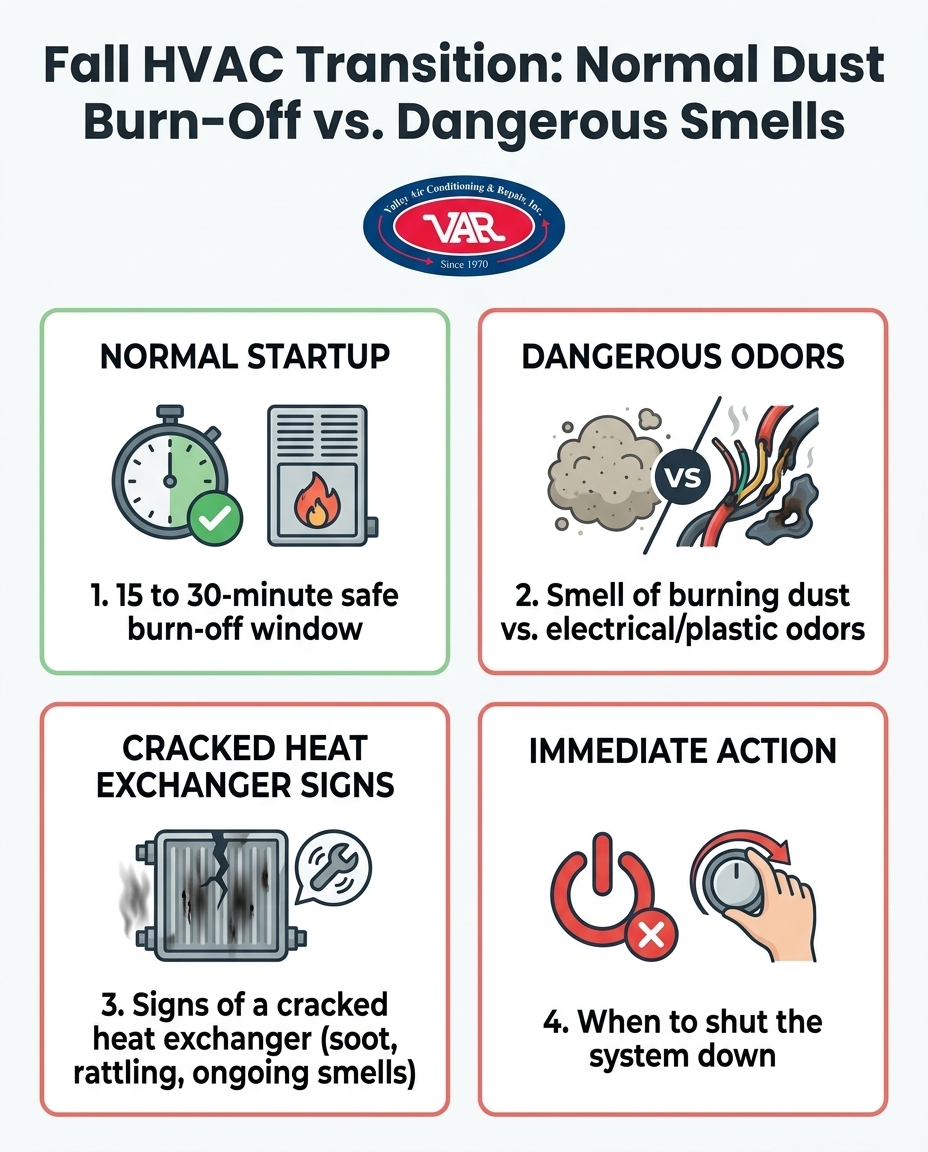
The resulting odor is best described as a dry, dusty burning smell. It should not smell like melting plastic, scorching rubber, or an electrical fire. Under normal conditions, this scent will circulate through your vents for a very specific duration. We refer to this as the 15 to 30-minute burn-off window. Once the accumulated summer dust is completely vaporized, the smell will naturally dissipate, and your system will continue to blow warm, clean-smelling air.
If the smell is particularly strong or bothersome, you can open a few windows to ventilate the house during this initial cycle. However, there is a hard rule you must follow: if the burning dust smell persists beyond this 15 to 30-minute burn-off window, or if it returns every time the heater cycles on, you must shut the system down immediately at the thermostat. An ongoing odor indicates that something more serious than surface dust is burning, and it requires prompt professional investigation.
While the initial dust burn-off is normal, distinguishing it from a dangerous mechanical failure is critical for your family's safety. The most serious threat during the October heating-startup is a cracked heat exchanger. The heat exchanger is the metal shield that separates the toxic combustion gases (created by burning the fuel) from the clean air that is blown into your living spaces. If this metal shield cracks, those dangerous gases can mix directly with your indoor air.
As a company with a deep understanding of local HVAC challenges, we strictly enforce safety protocols during seasonal changeovers. We know that distinguishing between a harmless nuisance and a severe hazard is paramount. If you notice symptoms of a compromised heat exchanger, securing a Professional AC Diagnostic Service—which handles full-system seasonal evaluations—is essential.
• Duration of Smell — Harmless Dust Burn-Off: Fades entirely within 15 to 30 minutes of the first use. — Cracked Heat Exchanger Danger: Persists for hours or returns every time the heater cycles on.
• Type of Odor — Harmless Dust Burn-Off: Smells like dry, toasted dust or singed hair. — Cracked Heat Exchanger Danger: Smells like sharp exhaust fumes, formaldehyde, or metallic burning.
• Physical Sounds — Harmless Dust Burn-Off: Normal blower motor humming and gentle air flow. — Cracked Heat Exchanger Danger: Loud rattling, popping, or scraping noises as the metal heats up.
• Visual Evidence — Harmless Dust Burn-Off: None. — Cracked Heat Exchanger Danger: Soot buildup around the registers or a yellow/dancing burner flame.
The severe risk of carbon monoxide:
A cracked heat exchanger allows carbon monoxide (CO) to enter your home. CO is an odorless, colorless gas that is highly toxic. Because you cannot smell carbon monoxide itself, the ongoing burning odors and strange rattling noises are your primary physical warning signs that the heat exchanger has failed.
Strict safety warning:
Never attempt to open your furnace cabinet, remove access panels, or visually inspect the heat exchanger yourself. Diagnosing a micro-fracture in this component requires specialized cameras, combustion analyzers, and a licensed professional. If you experience any of the danger signs listed above, turn off the heater immediately, ventilate the home, and call an expert.
You might wonder how a furnace could break if it hasn't been used since last winter. The answer lies in the intense physical toll of the seasonal transition. Extreme temperature shifts place immense stress on metal HVAC components, and the climate in Fresno and the Central Valley provides a perfect storm for this type of wear and tear.
During the summer, your idle furnace components sit in the sweltering heat, often baking in 100+ degree temperatures inside an attic or a hot garage. The metal expands under this ambient heat. Then, autumn arrives. The overnight temperatures plummet, and chilly air is drawn into the system. When the furnace ignites, the burners blast intense heat onto cold metal, causing rapid, violent thermal expansion. This constant cycle of baking in the summer, chilling in the fall, and blasting with fire during operation stresses the metal of the heat exchanger over time.
How maintenance prevents catastrophic failures:
• Catching micro-fractures early: Regular preventative maintenance allows technicians to spot tiny stress fractures in the metal before they widen into dangerous carbon monoxide leaks.
• Cleaning the burners: Removing the heavy summer dust load prevents the burners from misfiring or creating excessive soot.
• Verifying airflow: Ensuring the blower motor is operating correctly prevents the heat exchanger from overheating during those first crucial cycles.
Routine inspections are the best defense against these hidden summer-induced damages. In one instance, a homeowner assumed their failing system would require a massive out-of-pocket replacement. However, after a thorough inspection, the technician found that the necessary fix was actually covered under warranty, saving the customer significantly on the repair cost. Enrolling in a comprehensive HVAC Maintenance Plan ensures that a professional checks your warranty status and catches these heat-stressed components before they compromise your safety.
How long should a furnace smell like burning on startup?
A normal dust burn-off smell should completely dissipate within a 15 to 30-minute window. If the odor continues past this timeframe, or if it returns during subsequent heating cycles, it is no longer just burning dust. You should turn off the system and have it inspected to rule out a cracked heat exchanger or electrical issue.
What are the signs of a cracked heat exchanger?
The most common signs include a persistent exhaust or burning smell, loud rattling or popping noises when the heater turns on, and visible soot around your vents. You might also notice the furnace flame burning yellow instead of a steady blue. Because a cracked heat exchanger can leak carbon monoxide, these signs require an immediate system shutdown.
Why does my heater smell like burning dust in the fall?
Your heater smells like burning dust because airborne particles, pet dander, and debris settle on the internal components while the system sits idle all summer. When you turn on the heat for the first time in October, the burners ignite and instantly incinerate that accumulated debris. This creates a temporary, harmless odor that flows through your ductwork.
Is it normal for a heater to smell like burning on first use?
Yes, a mild burning dust smell is entirely normal for the first 15 to 30 minutes of operation after a long period of inactivity. However, it is never normal to smell melting plastic, burning rubber, or electrical sparking. If you detect those specific odors, cut the power to the unit right away.
Can extreme summer heat damage my furnace before I even turn it on?
Absolutely. The extreme ambient heat of the summer causes the metal components inside your idle furnace to expand, while cool autumn nights cause them to contract. This ongoing thermal stress can weaken the metal over time, making it more susceptible to cracking once the intense heat of the burners is finally applied in the fall.
Why would my AC blow warm air during an autumn heatwave?
Your AC might blow warm air due to a thermostat that was accidentally bumped to "fan-only" mode, a dead thermostat battery, or a clogged air filter leftover from heavy summer use. It could also indicate a mechanical failure, such as a struggling condenser fan motor or a slow refrigerant leak that finally depleted the system's cooling capacity.
Dealing with sudden temperature swings and unexpected startup smells can be overwhelming, but you do not have to guess about your home's safety. Applying these home maintenance tips and troubleshooting steps will help you identify minor issues early. If you are experiencing persistent odors or warm air, schedule your tune-up today for complete peace of mind before winter hits.

As a business with many AC units, it is essential to have a responsive AC company. Valley Air Conditioning understands our needs. They are always responsive and our AC is up and running very quickly.
I had them do an AC check on the home I was buying, they were honest and quick. I hired them to do the summer and Fall maintenance for $149. Happy with this company!
100% recommend. I called, same day they came out and gave me estimate. Conley was honest and didn't try to recommend/sell us anything we didn't need. When I called him with questions before making a decision, he happily answered and was not annoyed by me contacting him. Conley and VAR
This is a group of good people. Very professional and knowledgeable. They take the time to listen and find the best solution that fits best for any situation. There's no way you can go wrong in choosing VAR.
We have used Valley Air for over fifteen years. The last two years ,Matt came to our house to service twice a year. Always on time, so polite and so professional. This is a very honest company and you can always depend on them and trust them. The office always treats everyone cheerfully and always want to do what you need done very fast YOU CAN COUNT ON THIS Company


