.webp)


Identifying AC Capacitor Failure Symptoms During Your Fall Heating Startup
Why is your fall heating blowing cold? See what causes this and use our home maintenance tips and troubleshooting to know when to call a pro.
As the weather finally begins to cool down, mastering a few essential home maintenance tips and troubleshooting strategies can save you from unexpected breakdowns before the first real freeze hits. October in the Fresno Central Valley brings a welcome shift in temperature, prompting most homeowners to switch their thermostats from cooling to heating for the very first time in months. However, as our team at Valley Air Conditioning & Repair, Inc. frequently sees, this October heating-startup period often comes with an unsettling surprise. You turn on the heat, expecting a wave of cozy warmth, but instead, you are greeted by room-temperature air, a strange clicking noise, or a sudden, alarming burning smell coming from your vents.
This exact moment presents a critical decision point for any homeowner. Is your system simply shaking off the idle-season dust after a long summer slumber, or are you witnessing the symptoms of a serious electrical issue that requires professional attention? Often, the root cause of these autumn heating failures actually traces back to damage sustained during the peak of summer. Your outdoor unit houses sensitive electrical components that work tirelessly during the hottest months. When you experience these startup issues, it is frequently a sign that a key component—specifically, the dual run capacitor—has finally reached its breaking point.
Understanding how your system transitions between seasons is the first step in diagnosing these early warning signs. If you are noticing unusual behaviors during your fall startup, it might be tied to the heavy workload your air conditioning services handled throughout July and August. Here is how this process works, why it matters, and how you can identify a failing capacitor before it leaves you shivering on a cold autumn night.
To understand why a heating system fails in October, we have to look at what it endured in July. The Fresno Central Valley is known for its brutal summer climate, where ambient outdoor temperatures regularly exceed 100 degrees for days or weeks at a time. This extreme heat forces your outdoor HVAC unit to cycle on frequently and run almost constantly to maintain a comfortable indoor temperature. While the system is designed to handle this workload, the continuous exposure to high ambient heat puts immense, cumulative strain on its electrical components.
The role of dielectric fluid: Inside your system's capacitor is a specialized chemical called dielectric fluid. This fluid is essential for storing the high-voltage electrical charge needed to start your system's heavy motors. However, this fluid is highly sensitive to temperature. Months of operating in excessive heat, combined with the internal heat generated by the electricity itself, causes this fluid to slowly break down and lose its ability to hold a charge. The degradation is not always instant; it is a slow, cumulative process.
We recently helped a local homeowner during a brutal summer heatwave when temperatures spiked to 110 degrees, causing their system to completely shut down while an elderly family member was in the house. Our technicians arrived quickly, diagnosed that the extreme heat had caused a critical electrical component to fail, and successfully completed the repair within half an hour. This type of sudden failure is common, but in our experience serving Fresno, the component often survives the summer in a severely weakened state, only to finally give out when asked to switch gears for the fall.
By the time October arrives, a capacitor that has been silently degrading all summer simply lacks the electrical capacity to start the compressor for the heating cycle. This delayed manifestation is why many homeowners find themselves needing AC repair in Fresno just as the cooling season ends. The component didn't necessarily break in the fall; it was fatally wounded by the summer heat and finally collapsed under the strain of the seasonal startup.
To troubleshoot a problem effectively, it helps to understand how the parts are supposed to work. A dual run capacitor is a small, cylindrical device located inside your outdoor HVAC unit. Despite its modest size, it plays a massive role in your system's overall function. You can think of it as a powerful, high-voltage battery or a jump-starter for your system's heaviest motors.
The problem of starting heavy motors: Your HVAC system relies on large motors to turn the compressor (which pumps the refrigerant) and the fan (which exhausts the air). These motors require a massive jolt of electricity to start spinning—often three to five times more power than it takes to simply keep them running. Your home's standard electrical grid cannot deliver this sudden spike in power fast enough on its own.
The capacitor's solution: The capacitor stores up electricity while the system is idle. When your thermostat signals the unit to turn on, the capacitor releases a concentrated blast of high-voltage energy, providing the necessary torque to kick-start the compressor and fan motors. Once the motors are running, the "run" portion of the dual run capacitor continuously supplies a steady, calibrated electrical current to keep the motors spinning efficiently without overheating.
A common misconception is that because it is often called an "AC capacitor," it is only used for air conditioning. In reality, if you have a heat pump system, that same compressor and outdoor fan must operate during the winter to extract heat from the outside air and move it indoors. Heat pumps rely entirely on this electrical component during winter heating cycles just as much as they do during summer cooling cycles. If the capacitor is weak, the heat pump simply cannot perform its cold-weather job, which is why our team strongly recommends scheduling an AC diagnostic service in the fall if you notice any drop in performance.
Because the capacitor is the gateway to your system's operation, its failure produces very specific, recognizable symptoms. Knowing what to look and listen for can help you catch a failing component before it completely burns out your expensive compressor motor. Here is what you should be monitoring during your October heating-startup.
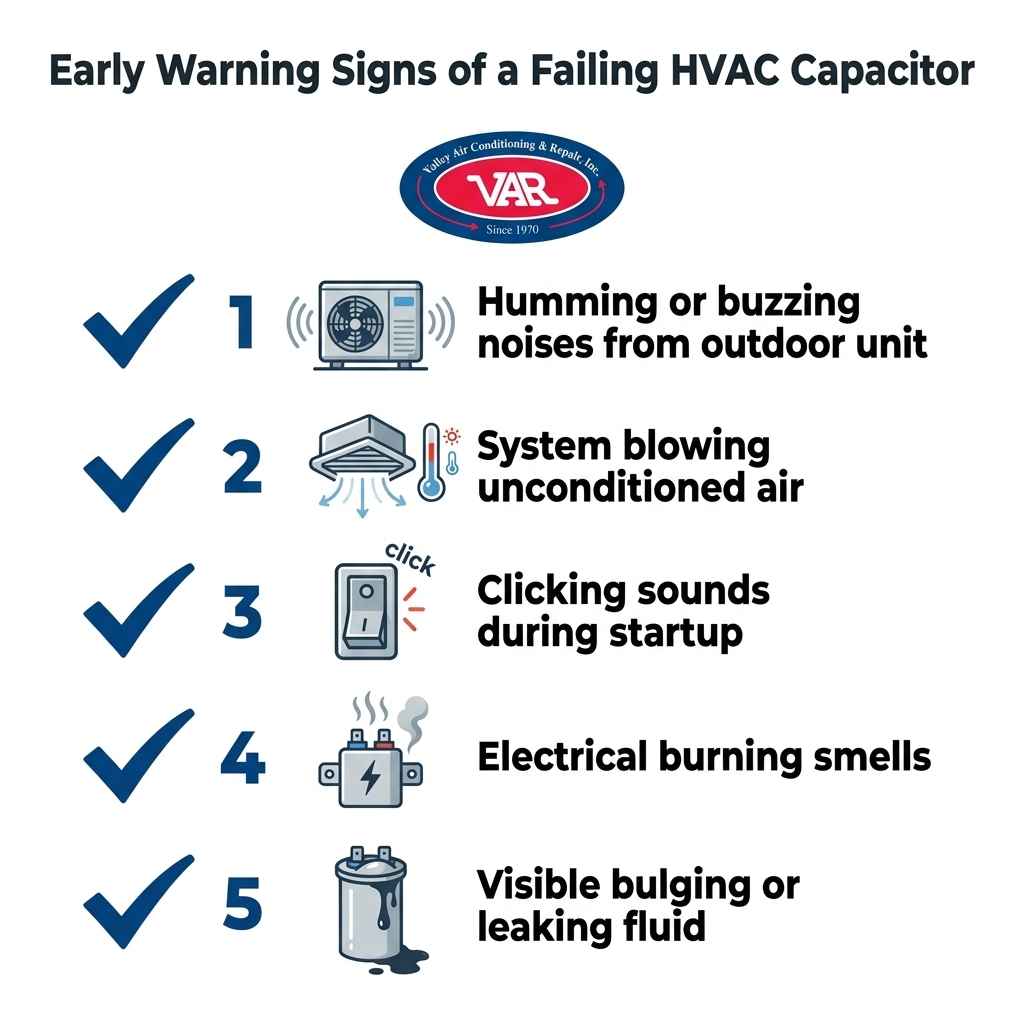
1. System struggling to start: The unit may stutter, hesitate, or require multiple attempts to finally kick on.
2. Humming or buzzing noises: You may hear an electrical hum from the outdoor unit while the fan blades remain completely still.
3. Blowing unconditioned air: The indoor blower pushes room-temperature or cold air out of the vents instead of the expected heat.
4. Unexpected shutdowns: The system turns on but shuts itself off almost immediately before reaching the target temperature.
5. Visible physical damage: If you look through the protective grate of the outdoor unit (without touching anything), you might see a capacitor that is swollen, bulging at the top like a bad canned good, or leaking oily fluid.
If you notice any combination of these issues, it is highly likely you are seeing the signs your AC capacitor is failing. To break this down further, let's look at how these symptoms typically present themselves.
Your HVAC system has a normal operational rhythm. When a capacitor begins to fail, that rhythm changes dramatically. The most distinct audible warning is the sound of a "hard start." Because the motor is not receiving the electrical boost it needs, it strains against its own weight. This often produces a rapid clicking noise as the system tries repeatedly to engage the motor, followed by a sustained, low-pitched electrical buzzing or humming. This hum is the sound of electricity flowing into a motor that cannot spin—a dangerous state that generates massive amounts of heat.
Sometimes, the outdoor fan motor might manage to start, but the compressor does not. In this scenario, your indoor blower motor will still activate and push air through your ductwork. However, because the compressor is not running to facilitate the heat transfer process, the air coming out of your vents will be completely unconditioned. You will feel cold air blowing during a heating cycle, leading many homeowners to mistakenly believe their thermostat is broken when the real culprit is sitting outside.
One of the most alarming experiences during an October heating-startup is turning on the system and immediately smelling something burning. For many homeowners, this triggers instant panic. However, it is vital to differentiate between harmless seasonal startup odors and dangerous electrical burning from a struggling motor.
The harmless dust burn-off: Throughout the long cooling season, dust, pet dander, and airborne particles settle on your furnace's heat exchanger or heating elements. When you turn on the heat for the first time in autumn, those components get extremely hot very quickly. The settled dust is instantly incinerated, producing a distinct "burning dust" smell that permeates the house. This is a completely normal part of the seasonal transition. The smell usually dissipates within 15 to 30 minutes as the dust is cleared away.
The dangerous electrical smell: An electrical burning smell is entirely different. It has an acrid, sharp, melting-plastic, or ozone-like odor. This happens when a weak capacitor fails to start a motor. The electricity continues to flow into the stalled motor, causing the copper windings inside to rapidly overheat and melt their protective insulation. If you smell melting plastic or ozone, and you are wondering why your AC is making a buzzing noise at the same time, you are likely dealing with a severe electrical failure, not just dusty heating elements.
• Odor Profile — Normal Dust Burn-Off: Smells like singed hair, dry dust, or a hot radiator. — Electrical Motor Overheating: Smells like melting plastic, ozone, or burning rubber.
• Duration — Normal Dust Burn-Off: Fades away completely within 15 to 30 minutes of startup. — Electrical Motor Overheating: Persists as long as the system is running; may get stronger.
• Accompanying Noises — Normal Dust Burn-Off: Normal blower and airflow sounds; no unusual noises. — Electrical Motor Overheating: Loud humming, buzzing, or clicking from the outdoor unit.
• Required Action — Normal Dust Burn-Off: Open a window to ventilate; monitor until the smell clears. — Electrical Motor Overheating: Turn the system off immediately at the thermostat and call a pro.
When a homeowner identifies a potential capacitor issue, the temptation to fix it themselves can be strong. However, dealing with HVAC electrical components is fundamentally different from changing a light switch or resetting a household breaker. The hidden dangers involved make DIY diagnostics extremely risky.
Capacitors are designed to store massive amounts of energy. A standard dual run capacitor can hold upwards of 400 volts of electricity. The most critical safety fact to understand is that this component retains its lethal high-voltage charge even after the main power to the HVAC unit has been completely shut off at the breaker panel. Touching the wrong terminals, even on an unplugged unit, can deliver a severe or fatal electrical shock. Department of Energy HVAC safety standards strongly advise that only licensed professionals handle high-voltage internal components.
Furthermore, simply swapping out a part without proper diagnostic tools often fails to solve the root problem. A capacitor might have blown because the fan motor itself is seizing up and drawing too much amperage. Fast, reliable diagnostic service from local Central Valley experts who understand how extreme heat impacts HVAC electrical components is the safest route. In one instance, our team at Valley Air Conditioning & Repair, Inc. responded to a customer who needed help on short notice on a Saturday when their initial DIY repair attempt revealed a deeper issue. Our lead technician arrived with advanced troubleshooting tools that successfully resolved the complex repair safely, proving the value of professional experience over guesswork.
Professionals use specialized multimeters to safely discharge the stored voltage, test the microfarad readings, and ensure the surrounding motors haven't been permanently damaged by the electrical strain.
When an AC capacitor goes bad, the compressor and fan motors lose their starting torque. Without this initial burst of energy, the motors cannot overcome their resting inertia to start spinning. This causes the system to either blow unconditioned, room-temperature air through your vents or fail to turn on entirely, leaving your home uncomfortable.
Yes, a failing capacitor can absolutely cause a burning smell. When the capacitor fails to start the motor, the electrical current continues to flow into the stalled component. This forces the motor to overheat rapidly, melting its internal wire insulation and emitting a sharp, acrid electrical burning smell that is distinctly different from normal seasonal dust burn-off.
A bad capacitor typically produces a distinct humming, buzzing, or rapid clicking noise from the outdoor unit. These sounds occur because the system's relays are trying to engage the motor, but without the capacitor's stored energy, the motor simply vibrates and hums in place as it struggles and fails to start spinning.
If your heat pump is blowing cold air in the fall, a failed capacitor is a highly likely culprit. Even though you are in heating mode, the outdoor compressor must still run to extract heat from the outside air. If the capacitor failed during the summer cooling season, the compressor won't engage when you switch to heat, resulting in cold air circulating through your home.
No, testing an HVAC capacitor yourself is not safe. These devices act like high-voltage batteries and can store 400 volts or more, retaining a dangerous electrical charge even when the main power to the unit is completely disconnected. Safe testing requires specialized multimeters and professional training to properly discharge and handle the component without risking severe shock.
Navigating the shift from summer cooling to fall heating doesn't have to involve guesswork or safety risks. If your October heating-startup is met with strange buzzing noises, cold air, or the alarming smell of burning plastic, the most important step you can take is to turn the system off to prevent further damage to your compressor. Recognizing these symptoms early allows you to address a relatively straightforward electrical issue before it cascades into a complete system failure.
Your comfort and safety should always come first. Rather than risking high-voltage shocks or misdiagnosing the root cause of the problem, let a professional evaluate the health of your system's motors and electrical components. Scheduling a thorough AC diagnostic service ensures your equipment is accurately tested, safely repaired, and fully prepared to keep your home warm and secure all season long.

As a business with many AC units, it is essential to have a responsive AC company. Valley Air Conditioning understands our needs. They are always responsive and our AC is up and running very quickly.
I had them do an AC check on the home I was buying, they were honest and quick. I hired them to do the summer and Fall maintenance for $149. Happy with this company!
100% recommend. I called, same day they came out and gave me estimate. Conley was honest and didn't try to recommend/sell us anything we didn't need. When I called him with questions before making a decision, he happily answered and was not annoyed by me contacting him. Conley and VAR
This is a group of good people. Very professional and knowledgeable. They take the time to listen and find the best solution that fits best for any situation. There's no way you can go wrong in choosing VAR.
We have used Valley Air for over fifteen years. The last two years ,Matt came to our house to service twice a year. Always on time, so polite and so professional. This is a very honest company and you can always depend on them and trust them. The office always treats everyone cheerfully and always want to do what you need done very fast YOU CAN COUNT ON THIS Company