


.webp)


Valley Air Conditioning Guide: Troubleshooting Your First Fall Furnace Startup
Why your heater smells like burning dust. Review these home maintenance tips and troubleshooting steps to know what is normal and when to call a professional.

Your furnace kicks on for the first time this fall, but instead of cozy warmth, you find yourself immediately searching for home maintenance tips and troubleshooting advice because your vents are pumping out a distinct burning smell. That strange odor is a classic hallmark of the typical October heating-startup, and it is enough to make any homeowner nervous. You wake up to a cold house, switch the thermostat over to 'Heat,' and within minutes, an alarming scent of burning dust spreads through your hallways.
If you are experiencing this right now, take a deep breath. A brief burning smell is incredibly common for HVAC systems that have been sitting dormant for months. Before you assume the worst, it helps to understand exactly what your furnace is doing behind the scenes. Here at Valley Air Conditioning & Repair, Inc., our team fields dozens of calls about this exact issue every October. For reliable Air Conditioning Services and heating support, knowing the difference between a harmless seasonal quirk and a serious safety hazard is your first line of defense. This guide will walk you through the exact sensory signs you need to look out for, helping you determine whether you just need to crack a window or immediately shut down your system and call our professionals.
To understand why your furnace smells so strongly on that first chilly morning, you have to look at what happened over the previous six months. During the long, hot summer months, your furnace essentially goes into hibernation while the cooling side of your HVAC system runs constantly. While the heating components sit completely dormant, they are not immune to the environment around them.
The Problem: Heavy Summer Accumulation
The extreme dry summer heat and intense agricultural activity in the Central Valley / Fresno area create heavier-than-average dust accumulation in local HVAC units. In our years of servicing homes across Fresno, we see firsthand how the air here carries high levels of particulate matter, specifically PM2.5 and PM10, along with fine dirt from nearby harvest operations. Even with a good air filter in place, microscopic particles inevitably make their way into your ductwork and settle deep inside the furnace cabinet.
The Cause: Settling on the Heat Exchanger
Over several months, this heavy layer of local dust settles directly onto the heat exchanger—the core metal component that gets incredibly hot to warm the air circulating through your home. Because the furnace is off, this dust simply builds up, layer by layer, undisturbed by any heat.
The Solution: Understanding the Burn-Off Process
When the burners finally ignite for the very first time in October, that accumulated dust does not just blow away. It instantly incinerates upon contact with the rapidly heating metal. This rapid incineration is exactly what creates that distinct burning odor. Because our regional dust load is heavier than in many other parts of the country, the resulting smell can be surprisingly pungent, leading many homeowners to fear an electrical fire when, in reality, it is simply the furnace cleaning its own heat exchanger.
While a burning dust smell is normal, it should never linger indefinitely. Establishing clear, actionable boundaries helps you evaluate the situation safely without unnecessary panic. The industry standard our technicians rely on for an October heating-startup is the 15-to-30 minute rule.
1. Monitor the time: Normal dust burn-off should completely dissipate within 15 to 30 minutes of the first heating cycle. Keep a close eye on the clock once the heat kicks on.
2. Ventilate the space: Open a few windows and turn on ceiling fans to help clear the initial harmless odor from your living spaces. This makes it easier to tell if the smell is actually fading or actively getting worse.
3. Identify the exact scent: Normal burn-off smells exactly like singed dust or a slightly overheated hair dryer. It should not smell chemical or metallic.
If the smell persists beyond that 30-minute window, you are no longer dealing with simple dust. You must also watch for specific danger signs. If the air smells like melting plastic, burning rubber, or an electrical fire, that is not normal dust burn-off. These odors indicate overheating wires, failing blower motors, or foreign objects melting inside the ductwork.
The strict rule for any dangerous odor is to shut the system off immediately at the thermostat. Do not wait to see if it improves. Once the system is powered down safely, it is time to rely on a professional HVAC Maintenance Plan to diagnose the underlying mechanical or electrical failure before attempting to run the heat again.
Smell is only one part of the sensory experience during a fall startup. Unusual noises often accompany the first heating cycle, and just like the burning odor, these sounds fall into two distinct categories: harmless physics and serious mechanical failure.
When metal components, especially the heat exchanger and the surrounding ductwork, are heated for the first time in months, they expand. This rapid thermal expansion causes normal pinging, popping, or light ticking sounds. As the metal cools down after the cycle finishes, you may hear the same clicking noises in reverse as the materials contract. This is entirely normal for systems in the Central Valley / Fresno area adjusting to the sudden temperature swing, and it is a pattern we see often during fall tune-ups.
However, you must contrast these normal expansion noises with dangerous sounds that require immediate attention. Never attempt to open the furnace cabinet to investigate these noises yourself, as doing so exposes you to high voltage and live gas lines. Rely on a licensed professional if you hear any of the warning signs below.
• Light pinging or ticking — Typical Cause: Metal expansion and contraction in ducts and heat exchanger — Safety Level: Harmless — Required Action: None; monitor to ensure it fades after the cycle.
• Loud metal-on-metal grinding — Typical Cause: Failing blower motor bearings or a loose fan belt — Safety Level: Serious — Required Action: Turn off system; schedule repair immediately.
• Continuous high-pitched screeching — Typical Cause: Worn out mechanical belts or severe motor friction — Safety Level: Serious — Required Action: Turn off system to prevent total motor failure.
• Loud "boom" or bang upon ignition — Typical Cause: Delayed gas ignition causing a miniature gas explosion — Safety Level: Dangerous — Required Action: Shut down instantly; this is a major safety hazard.
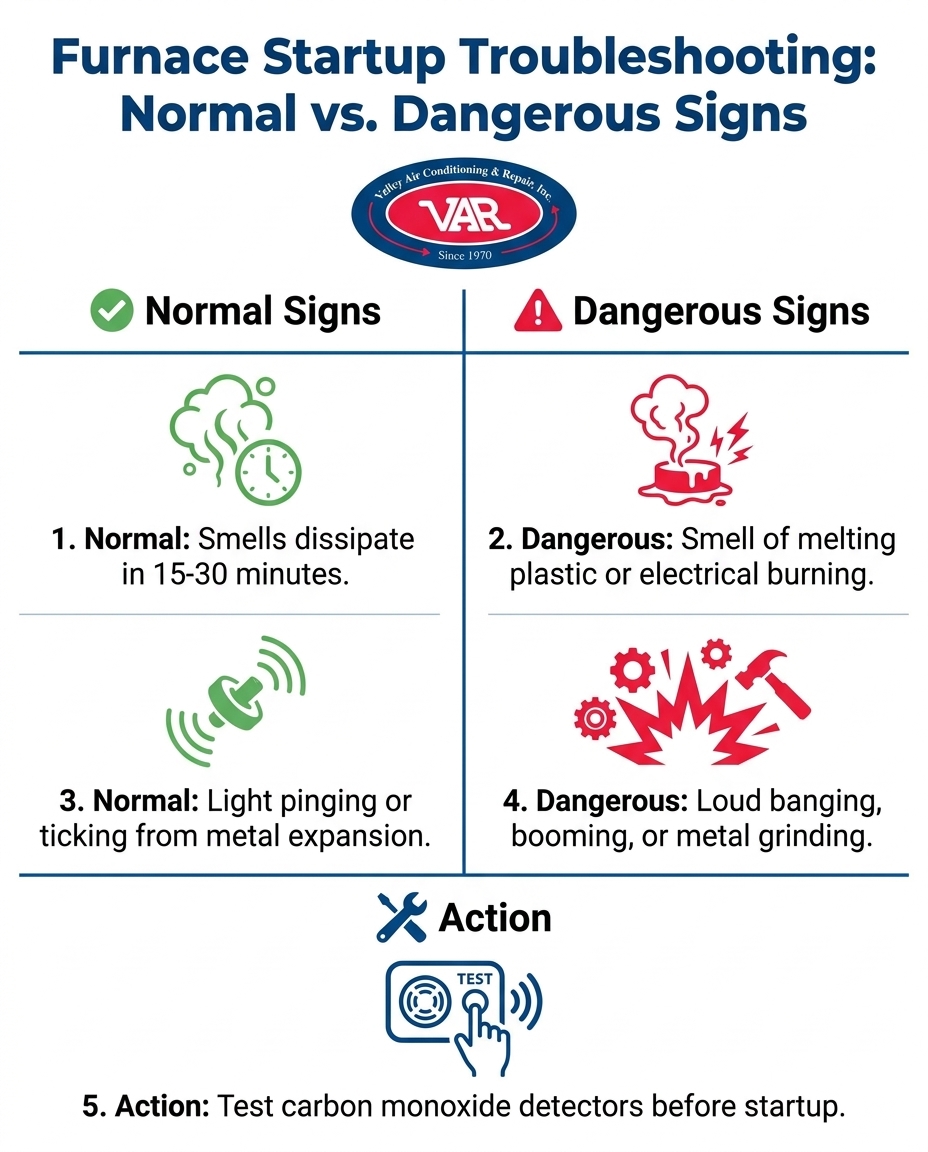
While a bit of dust burn-off and a few metal pops are expected during an October heating-startup, certain symptoms mean you must establish firm safety protocols. The most severe risk associated with an aging or malfunctioning furnace is a cracked heat exchanger. The heat exchanger acts as the only barrier between the toxic combustion gases (like carbon monoxide) and the clean air being blown into your living space. If this metal component cracks, it can leak dangerous carbon monoxide directly into your home's airflow.
The U.S. Consumer Product Safety Commission (CPSC) strongly recommends that all households have working carbon monoxide alarms installed outside every sleeping area. Because carbon monoxide is an odorless, colorless, and tasteless gas, you cannot rely on your senses to detect a leak. You must test your carbon monoxide detectors and replace the batteries before relying heavily on your heating system for the winter.
• Test alarms monthly: Ensure the audible beep is loud enough to wake you from a deep sleep.
• Never ignore a triggered alarm: If a CO alarm sounds during a heating cycle, take it seriously. It is not a false alarm.
• Evacuate and call professionals: Get everyone outside to fresh air immediately and call emergency services or a qualified technician if carbon monoxide is suspected.
Any suspected gas leak (often smelling like rotten eggs), continuous electrical burning smell, or persistent loud banging means turning off the system instantly. When a system is deemed fundamentally unsafe, prompt replacement or major repair is the only option. Our team recently helped a local family who experienced a complete HVAC system failure during a prolonged heat wave with temperatures over 100 degrees. They needed a reliable replacement immediately to keep their home safe. We handled the process smoothly from the initial paperwork to the final installation, complete with financing options and modern phone controls. Whether you face a summer cooling emergency or a dangerous winter heating failure, reliable Heating Repair and Installation ensures your home is restored to a safe condition without unnecessary stress.
A smooth transition from cooling to heating doesn't happen by accident. There are several safe, DIY-friendly tasks you can complete to support your system without violating safety constraints or risking injury. Taking these proactive steps helps minimize the burning smells and ensures proper airflow.
• Change the air filter: Before initiating the first heating cycle, pull out the old, dust-clogged summer filter and insert a fresh one. A clean filter ensures proper airflow, prevents the blower motor from overworking, and reduces the amount of loose dust circulating through the house.
• Inspect all vents and registers: Walk through every room in the house to ensure all supply vents and return registers are fully open and unblocked. Over the summer, it is easy to accidentally push a rug, a bookshelf, or a sofa over a floor register. Blocked vents cause severe air pressure imbalances that can overheat the furnace.
• Check thermostat settings: Ensure a smooth transition by verifying your thermostat is officially switched to 'Heat' mode and the fan is set to 'Auto.' Setting the fan to 'On' will blow cold air constantly, even when the burners are off.
• Clear the surrounding area: Ensure the space immediately around your indoor furnace cabinet is completely clear of boxes, cleaning supplies, and especially flammable liquids. The furnace needs room to draw in air safely.
We must explicitly state that any internal cabinet inspections, gas valve checks, or electrical testing must be left entirely to licensed professionals. Opening the cabinet exposes you to dangerous components. If you have completed the safe steps above and the system still struggles, consult an AC Troubleshooting Guide or heating manual to understand the symptoms, but leave the wrench work to our experts.
The best way to prevent the anxiety of a burning smell or a mid-winter breakdown is to schedule professional maintenance before the cold weather permanently sets in. A professional fall tune-up validates the integrity of your system and safely removes accumulated summer dust from the heat exchanger before it ever gets a chance to burn.
During an October heating-startup inspection, a licensed technician performs a comprehensive combustion analysis and safety check. This specialized testing is the only way to catch microscopic cracks in a heat exchanger early, long before they widen enough to leak dangerous levels of carbon monoxide into your home. Proactive maintenance ensures reliable performance when winter temperatures drop unpredictably, keeping your family safe and comfortable.
Working with a team that has deep local expertise means you receive tailored, comprehensive maintenance plans designed specifically to handle the unique demands of the region. Our local technicians understand exactly how the heavy agricultural dust impacts your specific make and model. By investing in Comprehensive HVAC Services with Valley Air Conditioning & Repair, Inc., you gain the peace of mind that your system has been thoroughly cleaned, calibrated, and safety-tested by professionals who know exactly what it takes to keep a Central Valley home comfortable.
Why does my heater smell like burning dust?
Your heater smells like burning dust because accumulated summer debris is incinerating on the heat exchanger. During the long cooling season, dust and airborne particles settle deep inside the dormant furnace. When you turn the heat on for the first time, the heat exchanger gets incredibly hot, instantly burning off that layer of settled dust and creating a distinct odor.
How long is it normal for a furnace to smell on startup?
It is normal for a furnace to smell for about 15 to 30 minutes during its first startup of the season. After this initial burn-off period, the smell should completely dissipate. If the burning odor lasts longer than half an hour, or if it returns during subsequent heating cycles, you should shut the system down and call a professional.
What furnace noises indicate a serious problem?
Loud banging, metal-on-metal grinding, and continuous screeching indicate serious mechanical problems. While light pinging or ticking is just normal metal expansion, a loud "boom" when the system kicks on points to delayed gas ignition, which is a severe safety hazard. Any grinding or screeching usually means a blower motor is failing and requires immediate repair.
What should I do before turning on my furnace for winter?
Our team recommends that you change your air filter, unblock all vents, and test your carbon monoxide detectors before turning on your furnace. Walk through your home to ensure furniture and rugs aren't covering any supply or return registers. Finally, clear any stored items or flammable materials away from the furnace cabinet to ensure safe, unobstructed airflow.
Is it normal for a heater to make a pinging noise when turning on?
Yes, light pinging or popping noises are completely normal when a heater turns on. These sounds are caused by thermal expansion as the metal heat exchanger and ductwork heat up and expand. You will likely hear similar ticking sounds when the cycle ends and the metal cools and contracts.
How can I tell if my heat exchanger is cracked?
You cannot visually confirm a cracked heat exchanger yourself without professional equipment. Warning signs include a triggered carbon monoxide alarm, a strong odor of formaldehyde, or soot buildup around the furnace cabinet. Because a cracked heat exchanger is a critical safety hazard, it must be diagnosed by a licensed technician performing a proper combustion analysis.
Navigating the transition from summer cooling to winter heating doesn't have to be a stressful event. By understanding the difference between harmless dust burn-off and genuine danger signs, you can keep your household safe and comfortable all season long. For more home maintenance tips and troubleshooting assistance, or to schedule your comprehensive pre-winter safety inspection, reach out to our team of local experts today.

As a business with many AC units, it is essential to have a responsive AC company. Valley Air Conditioning understands our needs. They are always responsive and our AC is up and running very quickly.
I had them do an AC check on the home I was buying, they were honest and quick. I hired them to do the summer and Fall maintenance for $149. Happy with this company!
100% recommend. I called, same day they came out and gave me estimate. Conley was honest and didn't try to recommend/sell us anything we didn't need. When I called him with questions before making a decision, he happily answered and was not annoyed by me contacting him. Conley and VAR
This is a group of good people. Very professional and knowledgeable. They take the time to listen and find the best solution that fits best for any situation. There's no way you can go wrong in choosing VAR.
We have used Valley Air for over fifteen years. The last two years ,Matt came to our house to service twice a year. Always on time, so polite and so professional. This is a very honest company and you can always depend on them and trust them. The office always treats everyone cheerfully and always want to do what you need done very fast YOU CAN COUNT ON THIS Company


