.webp)


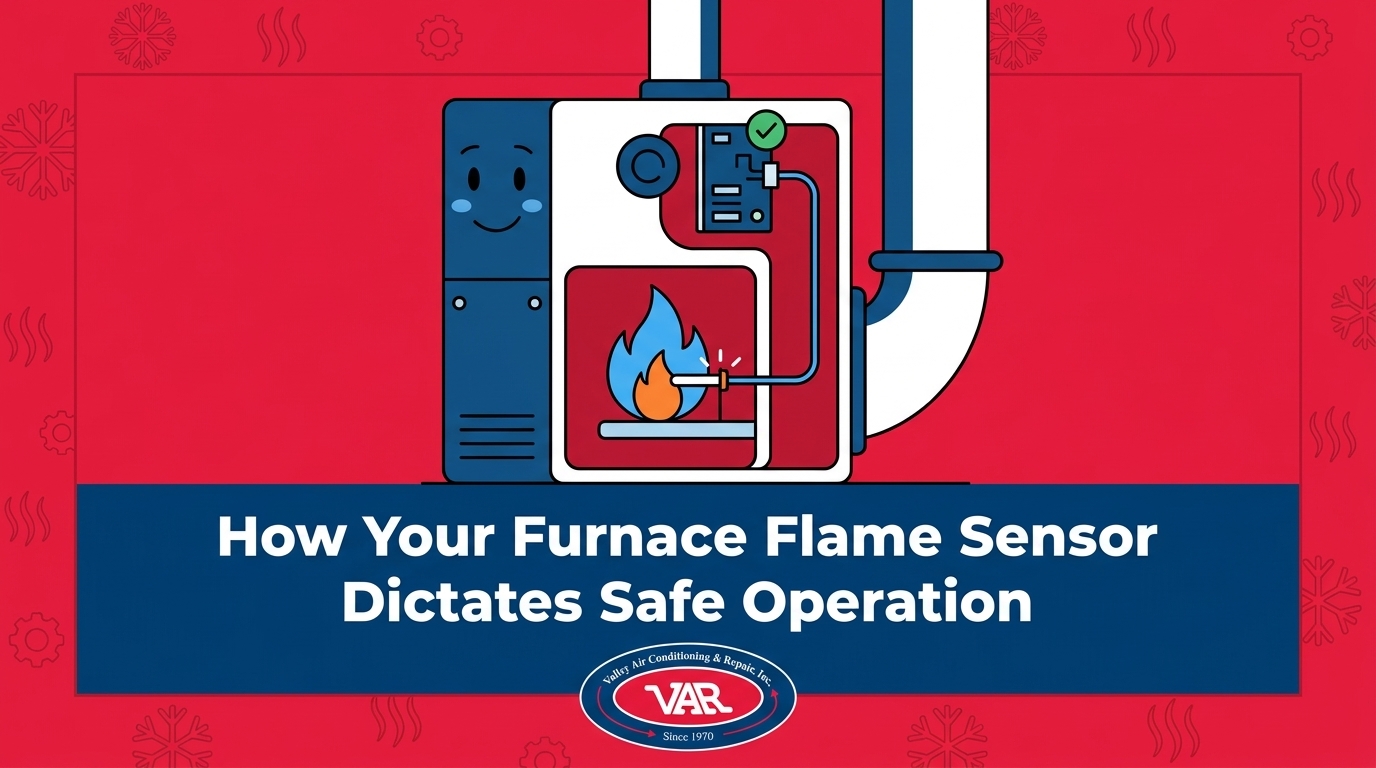
How Your Furnace Flame Sensor Dictates Safe Operation
If your heating system fires up only to shut down seconds later, a dirty flame sensor is likely to blame. See why this tiny rod triggers a strict safety lockout.
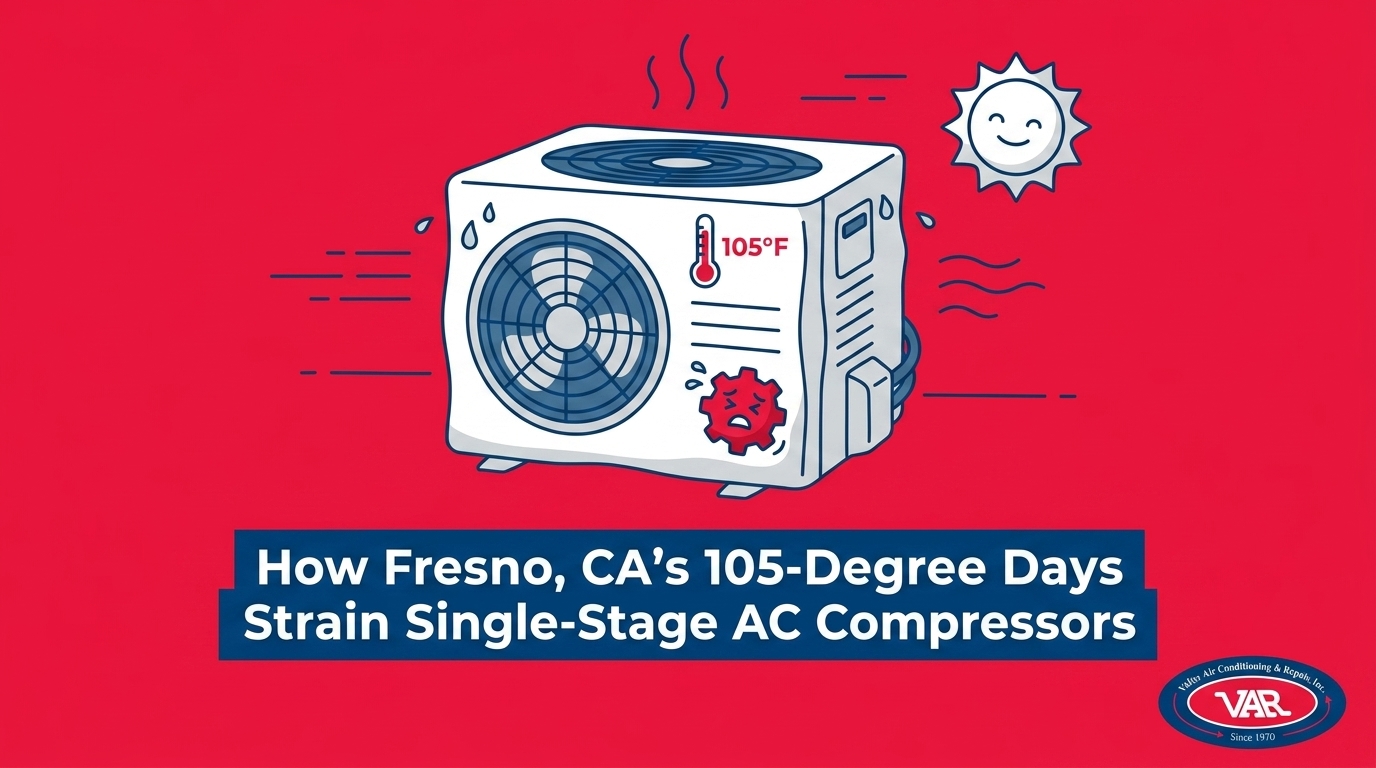
Here at Valley Air Conditioning & Repair, Inc., our dispatch team finds that nearly 80% of our emergency cooling calls during peak summer heatwaves happen when a homeowner realizes their thermostat is stuck at 82 degrees, which is why understanding how Fresno's 105-degree days strain single-stage AC compressors is the key to protecting your equipment. You walk past the hallway thermostat, tap the screen, and see that despite running continuously for the past six hours, the indoor temperature refuses to drop. The immediate reaction is usually frustration, followed quickly by the assumption that the air conditioner has suffered a catastrophic breakdown. Sweating indoors while listening to the outdoor unit drone on endlessly is a highly uncomfortable experience. However, as our technicians often have to reassure customers, a system that runs constantly without reaching your desired set point during an extreme heat event is not necessarily broken. In many cases, it is simply operating at its absolute maximum physical capacity.
If you are concerned about your system's performance, exploring our Air Conditioning Services and securing an active AC Maintenance Plan can help ensure everything is operating at peak efficiency before the worst weather arrives.
To understand why your system gets stuck in the low 80s, we have to look at the mathematical reality of residential HVAC engineering. Air conditioning systems are not sized by guesswork; they are carefully calculated using standards set by ASHRAE (the American Society of Heating, Refrigerating and Air-Conditioning Engineers). ASHRAE establishes what is known as a "1% cooling design temperature" for every specific geographic region. This number represents the outdoor temperature that a specific location will only exceed for 1% of the hours in a given year. For the Fresno area in July, that official ASHRAE design temperature is approximately 100.8 degrees Fahrenheit.
Because of this standard, the vast majority of standard residential cooling systems are engineered with a baseline outdoor design temperature of 95 degrees. Manufacturers build equipment to handle the standard heat loads expected in a normal summer. Therefore, when the Central Valley is hit with a punishing 105-degree ambient temperature, your air conditioner is being forced to operate well past its engineered design limits. The compressor is not failing to do its job; rather, the environmental heat load has mathematically exceeded the volume of heat the system was built to remove.
A common question homeowners ask us during consultations is why builders and technicians do not simply install massive, oversized air conditioners that can easily handle 110-degree weather. The short answer is that bigger is not always better in HVAC design. If a system is oversized to handle the three weeks of extreme triple-digit heat, it will be far too large for the other four months of the cooling season. An oversized unit cools the house too quickly and shuts off before it has a chance to dehumidify the air, leaving your home feeling cold but uncomfortably clammy. Understanding this delicate balance of sizing and design limits sets the stage for grasping the actual physics of how your system transfers heat.
To truly understand your system's mechanical limits, you need to understand a core concept that our HVAC technicians use every day out in the field: the temperature differential, commonly referred to as Delta T. In our years of servicing Fresno homes, we've found that explaining Delta T clearly helps our customers differentiate between a true mechanical failure and the natural boundaries of thermodynamics. Delta T is the exact measurement of the difference between the return air (the warm air being sucked into your indoor filter grilles) and the supply air (the chilled air blowing out of your ceiling or floor vents).
A healthy, perfectly functioning air conditioning system typically achieves a 20-degree temperature drop across the indoor evaporator coil. If the air entering the return grille is 80 degrees, the air blowing out of the vents should be roughly 60 degrees. This 20-degree drop is the gold standard for residential cooling performance. However, this is where the extreme local climate shifts the equation.
Let's apply this math to a scorching afternoon with a 105-degree ambient temperature. As the sun beats down on your roof, your attic temperature can easily soar past 140 degrees. This immense heat radiates down through your ceiling and walls, driving up the baseline temperature inside your living space. If the heat load is so intense that the ambient air inside your home reaches 85 degrees, your air conditioner pulls in that 85-degree air. The system does its job perfectly, applying the 20-degree Delta T, and pushes 65-degree air back into the room.
The problem is that 65-degree air is immediately fighting a losing battle against the continuous radiant heat entering through the windows, walls, and ceiling. The system is functioning flawlessly from a mechanical standpoint, but the physical reality of the heat transfer means an indoor temperature of 80 to 85 degrees is the absolute best the unit can achieve. Reassuringly, this lack of deep cooling in extreme conditions is a limitation of physics, not necessarily a sign that your compressor is failing.
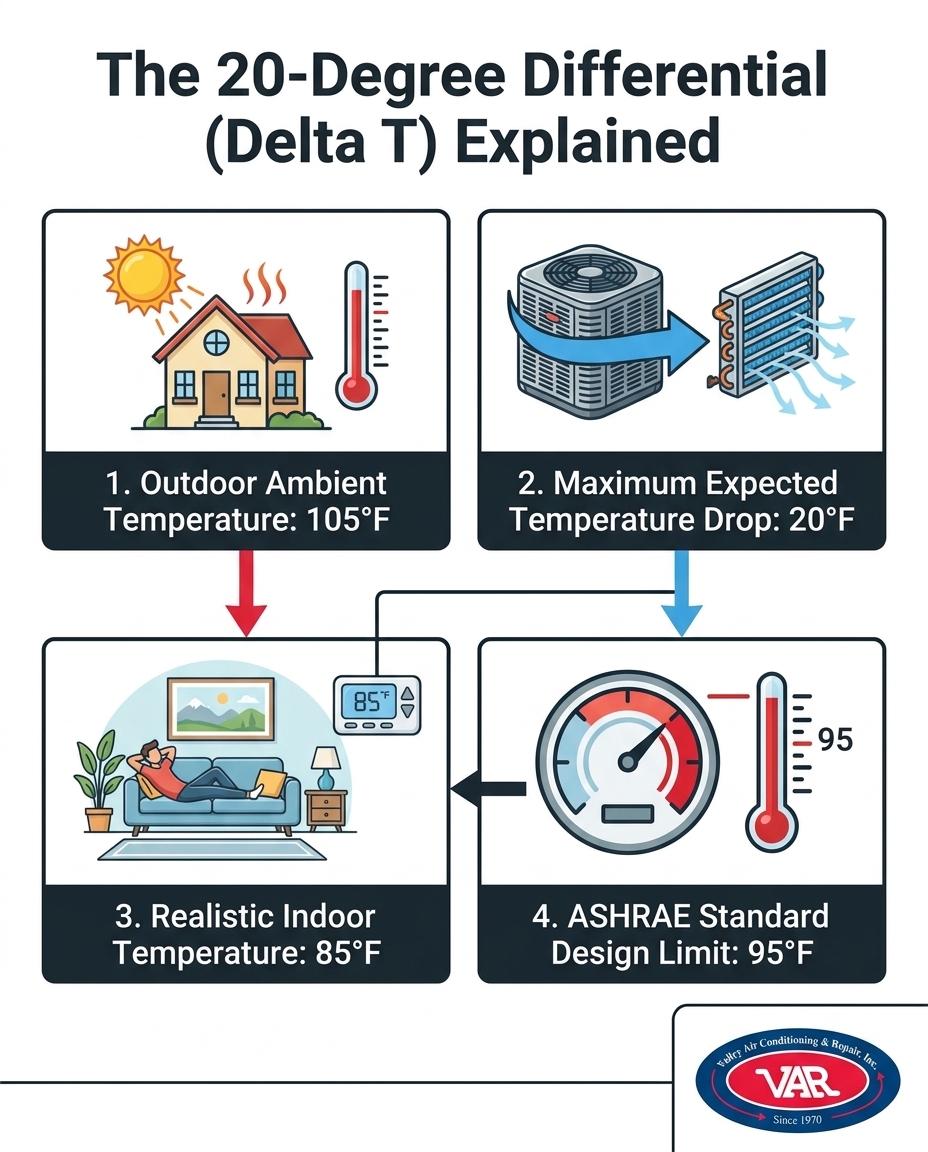
While the physics of heat transfer apply to all air conditioners, the specific mechanical nature of older systems makes them particularly vulnerable to extreme, prolonged heat. To understand this vulnerability, we must look at how the compressor—the heart of your outdoor condensing unit—actually operates. The vast majority of older residential systems we encounter in local neighborhoods feature a single-stage compressor. This means the motor has exactly one speed setting: 100% capacity. It is either completely on, running at full throttle, or completely off. There is no middle ground.
By contrast, modern variable-speed units act more like the gas pedal in your car. They can ramp up to 100% when it is exceptionally hot, but they can also cruise at 40% or 60% capacity to maintain the temperature efficiently. A single-stage unit lacks this flexibility. During peak summer heatwaves, the rigid, all-or-nothing nature of a single-stage system becomes a significant liability.
Because single-stage units lack the ability to ramp down and cruise, they are forced into continuous full-throttle operation during extreme ambient temperatures. When the thermostat is set to 75 degrees but the house cannot drop below 82 degrees, the thermostat never sends the signal to shut the system off. The single-stage compressor is forced to run at 100% capacity for ten, twelve, or even fourteen hours straight.
This continuous operation places immense mechanical strain on the system's electrical components. Heat is the natural enemy of electrical resistance. When the outdoor ambient temperature is 105 degrees, the internal temperature of the metal condenser cabinet sitting in direct sunlight can easily exceed 150 degrees. Operating a high-voltage electric motor continuously in this environment accelerates wear and tear rapidly.
The components most at risk are the run capacitor, the contactor, and the compressor windings themselves. A pattern we see often on service calls during Fresno's peak heat is a swollen, failed capacitor. The capacitor acts as a battery that provides the necessary jolt of energy to keep the motor spinning. Under continuous extreme heat, the dialectic fluid inside the capacitor begins to boil and expand, causing the part to swell and eventually fail. The contactor, which is the heavy-duty switch that pulls high voltage into the unit, suffers from pitted and burnt metal contacts due to the nonstop electrical current. Over time, this compounding thermal stress is one of the primary causes of AC compressor failure that our team is called out to repair.
The strain on your single-stage compressor is not just about the peak temperature of a single afternoon. The real danger comes from the compounding effect of consecutive extreme days. This introduces the concept of thermal mass. Your home is not just an empty box of air; it is constructed of heavy materials like wood framing, drywall, brick, roofing shingles, and dense insulation. All of these materials absorb and retain heat.
During a typical summer day, the sun beats down and saturates your home's thermal mass. In a normal weather pattern, the sun sets, the outdoor temperature drops into the low 60s, and the house has eight to ten hours to release that stored heat back into the cool night air. The thermal mass "resets," giving your air conditioner a fresh start the next morning.
However, as our technicians know firsthand, the Central Valley is notorious for weather patterns that prevent this reset. When you experience consecutive 105+ degree days in July, the overnight low temperature might only drop to 80 degrees. The heavy materials of your home never fully cool down. The compounding heat gain means that your AC starts each new day at a severe disadvantage.
• Day 1 (105°F) — Thermal Mass Status: Attic and walls begin absorbing radiant heat; partial overnight cooling. — System Impact: System runs long cycles but maintains a reasonable indoor temperature.
• Day 2 (106°F) — Thermal Mass Status: Materials retain heat from Day 1; overnight temperatures stay elevated. — System Impact: Single-stage compressor runs continuously from noon to midnight.
• Day 3+ (105°F+) — Thermal Mass Status: Complete thermal saturation; walls constantly radiate heat inward. — System Impact: System cannot catch up; indoor temps stall at 82-85°F despite 100% operation.
Once the thermal mass is fully saturated, your single-stage AC cannot overcome the continuous radiant heat entering the living space. The walls themselves act like giant radiators, constantly warming the air that the AC is trying to cool. This is why securing proper HVAC System Support is vital. A professional Valley Air Conditioning & Repair, Inc. technician can evaluate your ductwork, insulation levels, and system airflow to ensure your equipment has the best possible chance of fighting back against compounding heat gain.
When the forecast calls for a week of triple-digit temperatures, your goal shifts from maintaining perfect comfort to managing the heat load and protecting your equipment. Pushing a single-stage unit past its breaking point will leave you with no cooling at all. By implementing strategic heatwave management techniques, you can survive the peak summer heatwaves without destroying your compressor.
Based on our extensive experience repairing and maintaining AC systems across the Fresno area, here are the most effective strategies our team recommends for managing indoor temperatures during extreme heat:
1. Stop lowering the thermostat drastically: Advising against this is the most critical step. Setting the thermostat to 70 degrees when it is 105 outside will not make the air coming out of the vents any colder. It only forces the compressor to run endlessly without ever achieving the set point, dramatically increasing the risk of mechanical failure. Set your thermostat to a realistic 78 or 80 degrees during the peak heat of the day.
2. Implement early morning pre-cooling: Take advantage of the lowest ambient temperatures of the day. Between 5:00 AM and 9:00 AM, set your thermostat a few degrees lower than your normal preference (e.g., 72 degrees). The condenser can reject heat much easier in the cool morning air, allowing the system to thoroughly chill the home's thermal mass before the afternoon sun hits.
3. Aggressively manage your thermal mass: Block the radiant heat before it enters the home. Close all blinds, shades, and curtains on the south and west-facing windows by 10:00 AM. Utilize ceiling fans to create a wind-chill effect on your skin, making an 80-degree room feel significantly more comfortable.
4. Minimize internal heat generation: Avoid using heat-generating appliances during the afternoon. Ovens, stovetops, dishwashers, and clothes dryers release massive amounts of heat and humidity into your home, forcing the struggling AC to work even harder to remove it.
5. Prioritize airflow maintenance: A single-stage system operating at maximum capacity needs perfect airflow to prevent the evaporator coil from freezing. Check your air filters weekly during a heatwave and replace them the moment they look gray or dusty.
Managing your expectations and actively supporting the system prevents catastrophic compressor failure. Proactive steps, including scheduling Residential Pre-Season Preparation before the summer begins, ensure your coils are clean and your refrigerant levels are precise, giving your unit the best possible chance to survive the extreme heat.
Why does my AC struggle when it's over 100 degrees outside?
Standard residential cooling systems are engineered for a maximum outdoor design temperature of 95 degrees. When ambient temperatures exceed this limit, the environmental heat load mathematically outpaces the volume of heat the system is built to remove. Your air conditioner is likely functioning normally but has simply hit its physical capacity.
Is it normal for my AC to run all day during a Fresno heatwave?
Yes, continuous operation is completely expected during extreme heat events. Single-stage units must run constantly to counteract the intense, continuous radiant heat entering your home. As long as the air coming from the vents is cool, the system is doing its job.
How much can my AC realistically cool the house when it's 105 outside?
A healthy air conditioning system provides a 20-degree temperature drop from the return air it pulls in. If the intense heat raises your home's internal ambient temperature to 85 degrees, the system will blow 65-degree air, making 80 to 85 degrees a realistic indoor expectation during peak 105-degree weather.
Will setting my thermostat lower make my single-stage AC cool faster?
No, dropping the thermostat setting does not increase the speed or intensity of the cooling. A single-stage compressor only has one speed: 100% capacity. Setting the thermostat to 70 degrees during a heatwave only ensures the unit will never shut off, risking severe mechanical damage.
How do I know if my AC is just maxed out or actually broken?
Check the air blowing from your supply vents; if it feels significantly cooler than the surrounding room air, the system is actively cooling but maxed out by the heat load. If the air blowing from the vents is warm or room temperature, the compressor or refrigerant cycle has likely failed, and you need a professional repair.
Surviving the extreme summer heat doesn't have to mean pushing your equipment to the brink of failure. Now that you understand how Fresno's 105-degree days strain single-stage AC compressors, you can take proactive steps to manage your indoor climate safely. By understanding the physics of your single-stage unit and implementing smart heatwave management strategies, you validate that your system might just be maxed out rather than broken. If you want the ultimate assurance that your equipment is prepared for the hardest days of the Central Valley summer, enrolling in a professional AC Maintenance Plan with Valley Air Conditioning & Repair, Inc. provides the thorough cleaning and vital component checks needed to keep your home cool and safe.

As a business with many AC units, it is essential to have a responsive AC company. Valley Air Conditioning understands our needs. They are always responsive and our AC is up and running very quickly.
I had them do an AC check on the home I was buying, they were honest and quick. I hired them to do the summer and Fall maintenance for $149. Happy with this company!
100% recommend. I called, same day they came out and gave me estimate. Conley was honest and didn't try to recommend/sell us anything we didn't need. When I called him with questions before making a decision, he happily answered and was not annoyed by me contacting him. Conley and VAR
This is a group of good people. Very professional and knowledgeable. They take the time to listen and find the best solution that fits best for any situation. There's no way you can go wrong in choosing VAR.
We have used Valley Air for over fifteen years. The last two years ,Matt came to our house to service twice a year. Always on time, so polite and so professional. This is a very honest company and you can always depend on them and trust them. The office always treats everyone cheerfully and always want to do what you need done very fast YOU CAN COUNT ON THIS Company