.webp)


Preparing Clovis Commercial Properties for Fall Heating Demands
Transitioning commercial RTUs from summer cooling to fall heating requires proactive care. See how a September inspection prevents sudden tenant disruptions.
HVAC systems account for approximately 30-40% of energy usage in commercial buildings, meaning that when Preparing Clovis Commercial Properties for Fall Heating Demands, mechanical efficiency is a massive factor in overall operational costs. The sharp temperature changes typical of the San Joaquin Valley put immense stress on commercial mechanical systems. Transitioning units directly from heavy summer cooling to heating without a professional tune-up risks sudden, catastrophic failures right when tenants need reliable climate control. Scheduling proactive inspections during the critical September transition from peak cooling to early morning heating prevents early morning tenant discomfort and protects expensive equipment. If your facility requires expert attention, our team provides comprehensive commercial maintenance and repair and dedicated commercial heating services to keep your building operating smoothly.
The intense summer wear that Fresno and Clovis units endure makes the fall transition uniquely taxing. From May through early September, commercial units often run continuously to combat triple-digit heat, placing extreme wear on belts, motors, and electrical contactors. When the weather suddenly shifts, these fatigued components are immediately tasked with a completely different operational load. Thermal expansion and contraction occur rapidly within the unit's housing as the system cycles between chilly morning heating and warm afternoon cooling. Without a professional baseline assessment, minor wear and tear from the summer months can quickly cascade into major mechanical failures.
Facility managers who recognize the severity of this transition period are better positioned to protect their capital investments. A commercial building's thermal envelope reacts slowly to temperature changes, meaning that if a unit fails during an early morning cold snap, the interior space will remain uncomfortably cold for hours even after repairs are completed. Proactive seasonal switchovers ensure that mechanical components are calibrated, lubricated, and ready to handle the specific demands of autumn weather before the system is actually called upon to perform.
The Problem: Many facility managers assume that preparing a building for autumn is simply a matter of adjusting digital thermostat schedules from cooling mode to heating mode. While this changes the electronic command sent to the equipment, it does absolutely nothing to prepare the physical machinery for a different type of combustion and airflow operation.
The Cause: Commercial Rooftop Units (RTUs) require a physical, mechanical transition, not just a digital temperature adjustment. Prolonged extreme heat degrades internal components that are suddenly called upon to produce heat. The heat exchanger, which has sat dormant in high humidity and extreme heat for months, is particularly vulnerable. Metal fatigue, rust, and microscopic stress fractures can develop over the summer. When the thermostat triggers the heating cycle, a compromised heat exchanger becomes a severe safety hazard, potentially allowing combustion gases to enter the building's air supply. Because inspecting a heat exchanger requires specialized diagnostic tools and a licensed professional, this is not a task that can be handled by on-site maintenance staff.
The Solution: A comprehensive mechanical inspection and professional tune-up bridges the gap between summer wear and winter readiness. Routine check-ups keep even aging units operating reliably through demanding seasonal changes. A typical pattern we see involves older commercial equipment requiring focused attention. For instance, a 13-year-old HVAC unit on a local commercial building was struggling to maintain consistent performance, but through ongoing preventive maintenance and a thorough, professional clean-out of the heat exchanger, the system was kept running efficiently without the need for premature replacement.
Early morning cold snaps in September can severely impact the customer experience in retail spaces and disrupt workflow in professional environments. Clovis retail centers and office parks rely on consistent indoor climates to keep foot traffic high and employees productive. When a commercial heating system fails, the resulting operational downtime affects the bottom line of every tenant in the building. As the local commercial downtime-prevention experts, Valley Air Conditioning & Repair's specialized commercial expertise focuses on catching minor mechanical faults before they result in a total system lockout.
Office parks face significant productivity losses if indoor air quality and temperature fluctuate wildly. Studies consistently show that ambient temperatures directly impact employee focus and output. In a retail setting, a freezing showroom floor can drive shoppers away within minutes. Proactive facility management prevents these cascading mechanical and structural issues from impacting daily business operations. Taking a comprehensive approach to building maintenance reduces overall emergency service calls—much like preventing emergency commercial plumbing situations before they disrupt a facility.
• Reactive (Run-to-Fail) — Impact on Tenant Experience: High disruption; unexpected temperature drops during business hours. — Long-Term Financial Outcome: Costly emergency repairs, expedited parts shipping, and potential tenant turnover.
• Basic (Filter Changes Only) — Impact on Tenant Experience: Moderate disruption; airflow is maintained but mechanical failures still occur. — Long-Term Financial Outcome: Slightly extended equipment life, but high risk of major component failure.
• Proactive (Professional Tune-Up) — Impact on Tenant Experience: Zero disruption; seamless transition between cooling and heating modes. — Long-Term Financial Outcome: Maximized equipment lifespan, predictable maintenance budgets, and lower energy bills.
By shifting from a reactive mindset to a proactive strategy, property managers eliminate the frantic morning phone calls from shivering tenants. Consistent climate control is a baseline expectation for commercial leases, and maintaining that standard requires a mechanical partner who understands the specific demands of large-scale commercial real estate.
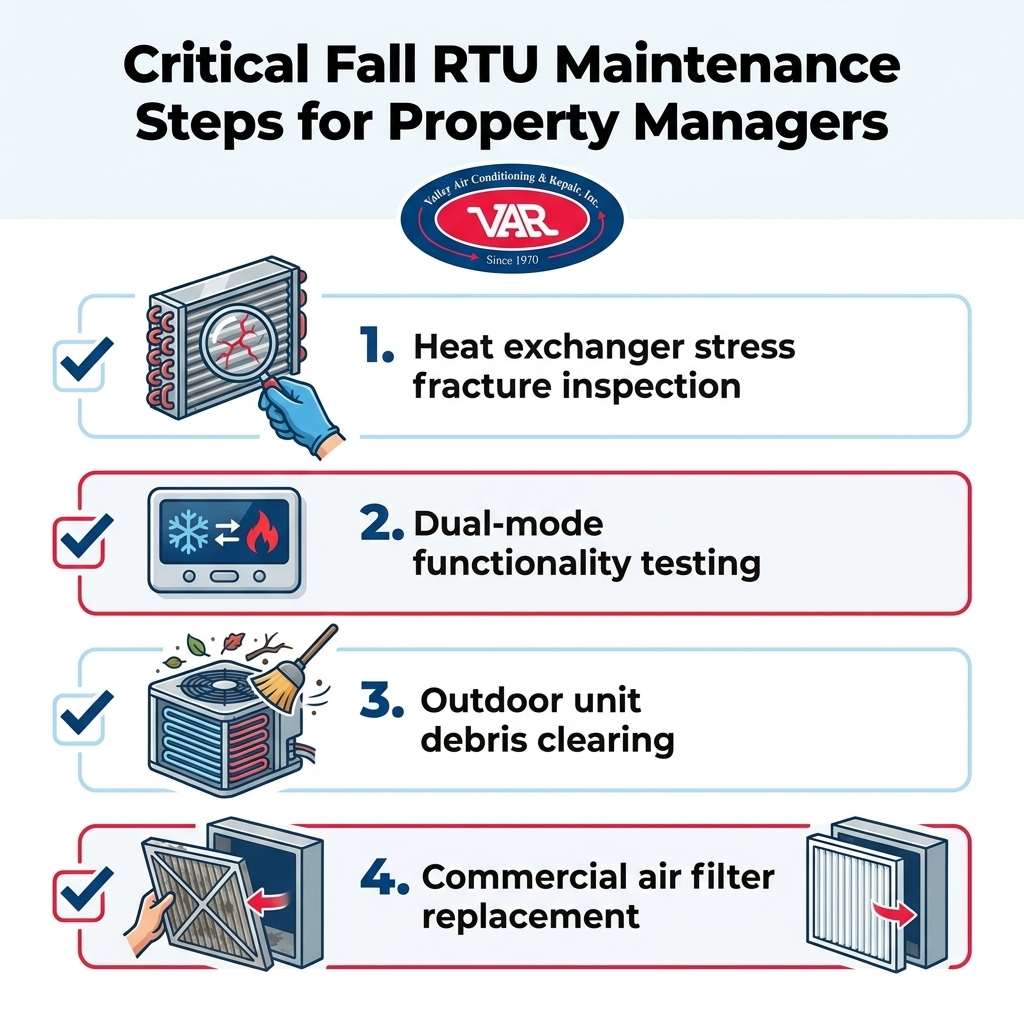
Preparing Commercial Rooftop Units (RTUs) for the heating season involves a rigorous checklist of mechanical, electrical, and airflow evaluations. The dusty, dry conditions of the San Joaquin Valley summer necessitate thorough coil and debris clearing before the heating elements are safely ignited. A professional commercial tune-up goes far beyond a visual inspection, focusing on the specific components that carry the heaviest operational loads.
• Evaluating the heat exchanger: Technicians check for stress fractures and corrosion that developed during the dormant summer months. A compromised heat exchanger is a critical safety failure that must be addressed before the unit operates.
• Testing dual-mode functionality: Early fall often requires heating in the morning and cooling in the afternoon. The system's reversing valves, sensors, and control boards must be tested to handle this rapid switching seamlessly.
• Clearing outdoor debris: High winds and dry conditions blow significant amounts of dust, leaves, and particulate matter into the RTU housing. Clearing this debris prevents fire hazards and restores optimal airflow.
• Verifying internal airflow: Technicians inspect the blower motor, fan belts, and ductwork integrity. Proper airflow prevents the system from short-cycling and ensures that heated air actually reaches the occupied spaces.
Commercial air filter replacements must be tailored to high-traffic environments. Standard residential filters cannot handle the volume of particulate matter generated in a busy retail store or office building. When the heating elements ignite for the first time in autumn, they often burn off settled dust, creating an unpleasant odor and circulating stagnant particles throughout the building. Upgrading to high-efficiency commercial filters and ensuring the internal cabinet is professionally cleaned prevents the circulation of this stagnant dust, protecting the indoor air quality for all occupants.
Industry data consistently shows that preventative maintenance can reduce unexpected commercial HVAC breakdowns by up to 75%. For property managers overseeing Clovis retail centers and office parks, this reduction in emergency service calls translates directly into protected operating budgets. Large commercial campuses require coordinated, ongoing maintenance to manage multiple units efficiently. When dozens of RTUs are operating simultaneously, a failure in one zone can force adjacent units to work harder, leading to a domino effect of mechanical strain.
Managing a large campus with multiple employees and numerous HVAC units presents unique logistical challenges. In one local example, establishing knowledgeable, ongoing heating maintenance and coordinated thermostat replacements kept a vast array of units functional across a sprawling facility. By partnering with a dedicated service provider, the facility manager ensured that every unit received the necessary attention, preventing widespread disruptions and keeping the entire workforce comfortable.
Predictable maintenance scheduling protects the bottom line from emergency repair costs and expedited shipping fees for heavy commercial parts. Structured agreements, such as a tailored preventative maintenance plan, streamline seasonal transitions and extend equipment lifespans. Capital expenditure planning becomes significantly easier when a professional technician provides detailed condition reports for every unit on the roof, allowing managers to budget for replacements years in advance rather than reacting to sudden breakdowns.
Commercial rooftop units often fail in the fall because they are suddenly forced to switch from heavy summer cooling to heating without a mechanical inspection. The September transition from peak cooling to early morning heating places immense stress on components that have degraded over the summer. Without proper lubrication, calibration, and cleaning, the sudden change in operation can cause fatigued motors, belts, or heat exchangers to break down completely.
A comprehensive fall tune-up for retail spaces includes a thorough inspection of the heat exchanger, testing of ignition systems, and calibration of dual-mode thermostats. Technicians will also clear summer debris from the outdoor cabinet, replace heavy-duty commercial air filters, and verify that all safety sensors are functioning correctly. This ensures the system can handle the high demands of a busy retail environment without failing during business hours.
Commercial HVAC systems in the San Joaquin Valley should be professionally serviced at least twice a year, specifically in the spring and early fall. The extreme summer heat and dusty conditions cause rapid wear and tear on mechanical components, making a pre-winter inspection absolutely necessary. Facilities with high foot traffic or specialized climate needs may require quarterly filter changes and belt inspections to maintain optimal performance.
Preparing a commercial building for winter requires a proactive mechanical assessment of all heating systems before the first major temperature drop. This involves scheduling a licensed professional to inspect RTUs, verify ductwork integrity, and test the building's automated climate controls. Facility managers should also ensure that any seasonal adjustments to ventilation schedules are properly programmed to account for changing occupancy patterns.
A heat exchanger inspection is critical because microscopic cracks can develop in the metal during the dormant summer months due to thermal stress and moisture. If a cracked heat exchanger is activated during the heating season, it can allow dangerous combustion gases to mix with the building's indoor air supply. A licensed professional uses specialized tools to verify the structural integrity of this component, ensuring the system operates safely and efficiently.
Successfully navigating the shift from summer cooling to fall heating requires a professional, mechanical transition for your commercial systems. Missing this critical September window puts Clovis retail centers and office parks at risk for sudden downtime and frustrated tenants. Partner with local commercial experts today to schedule your comprehensive pre-season inspection and secure your property's heating reliability.

As a business with many AC units, it is essential to have a responsive AC company. Valley Air Conditioning understands our needs. They are always responsive and our AC is up and running very quickly.
I had them do an AC check on the home I was buying, they were honest and quick. I hired them to do the summer and Fall maintenance for $149. Happy with this company!
100% recommend. I called, same day they came out and gave me estimate. Conley was honest and didn't try to recommend/sell us anything we didn't need. When I called him with questions before making a decision, he happily answered and was not annoyed by me contacting him. Conley and VAR
This is a group of good people. Very professional and knowledgeable. They take the time to listen and find the best solution that fits best for any situation. There's no way you can go wrong in choosing VAR.
We have used Valley Air for over fifteen years. The last two years ,Matt came to our house to service twice a year. Always on time, so polite and so professional. This is a very honest company and you can always depend on them and trust them. The office always treats everyone cheerfully and always want to do what you need done very fast YOU CAN COUNT ON THIS Company