Addressing Drafty Windows and Doors Before the Heating Season Begins
Addressing Drafty Windows and Doors Before the Heating Season Begins
Waking Up to the Chill: The Reality of Early Autumn Heat Loss
The September pre-heating season in the Central Valley brings a sudden, undeniable shift to the weather. The lingering, heavy summer heat finally gives way to brisk, crisp mornings, and you might notice that the floors feel noticeably colder than they did just a week ago. Addressing drafty windows and doors before the heating season begins is one of the most effective ways to protect your home's comfort and prevent your mechanical equipment from failing prematurely. When you feel that first morning chill creeping through the living room, your home's building envelope—the physical barrier separating the indoors from the outdoors—is signaling that it needs immediate attention.
The concept of the building envelope is crucial for understanding how your home retains heat. This envelope includes your roof, walls, insulation, windows, and doors. When this perimeter is tightly sealed, the warm air produced by your furnace stays inside, keeping your family comfortable. However, when the perimeter is compromised by gaps, cracks, and worn-out seals, that expensive heated air escapes directly outside. You are then faced with a clear decision point: you can either address these perimeter leaks now while the weather is still mild, or you can force your heating equipment to work twice as hard to compensate for the continuous heat loss all winter long.
Most homeowners naturally assume that a cold house simply means the furnace needs to run longer. While that is technically true, running your furnace continuously to fight a leaky building envelope is incredibly inefficient. It wastes energy, drives up utility costs, and puts unnecessary strain on internal components. By prioritizing your home's perimeter right now, you establish the foundation for a highly efficient, reliable, and long-lasting heating system.
How Extreme Summer Temperatures Sabotage Winter Comfort
You might be wondering why your windows and doors suddenly feel so drafty when they seemed perfectly fine last winter. The problem rarely starts in the fall; the true cause of compromised weather seals is the extreme summer weather you just endured. In places like Fresno CA, prolonged exposure to intense, 90-plus degree days takes a severe toll on the exterior materials of your home. The sun bakes your home's perimeter, actively degrading the materials designed to keep the elements out.
The problem: Rubber and foam weatherstripping around exterior doors dries out, flattens, and loses its elasticity after months of intense heat and UV exposure. Similarly, the caulking around exterior window frames shrinks, becomes brittle, and eventually cracks. Because you are running the air conditioner during the summer, you might not notice these tiny perimeter failures right away. The cool, conditioned air simply falls to the floor, and the drafts are masked by the general heat outside.
The cause: Thermal expansion and contraction play a massive role in this degradation. As the sun beats down on your home, window frames and door jambs expand. When the sun goes down, they contract. This daily cycle, combined with intense heat, physically breaks down rubber, silicone, and foam seals over the course of a few months. By the time the weather shifts, those seals are no longer capable of doing their job.
The solution: Recognizing this seasonal damage is the first step to fixing it. The realization of these compromised seals happens exactly when the cooler early fall weather arrives. The crisp morning air easily pushes through the newly formed cracks, making the thermal leaks obvious. Understanding how summer heat damages your home's exterior explains why checking your weather seals must be an annual autumn ritual.
• Intense UV exposure and baking heat — Material Affected: Exterior window caulking — Fall Comfort Consequence: Caulk shrinks and cracks, allowing cold winds to penetrate the window frame.
• Thermal expansion and contraction — Material Affected: Door jambs and frames — Fall Comfort Consequence: Frames warp slightly, creating uneven gaps that let heated air escape.
• Prolonged high temperatures — Material Affected: Rubber and foam weatherstripping — Fall Comfort Consequence: Seals dry out, flatten, and lose the elasticity needed to block drafts.
The Hidden Mechanical Toll: How Drafts Damage Your Furnace
Drafty windows and doors are often treated as minor annoyances—something that requires you to put on an extra sweater or grab a blanket. However, the true cost of a drafty perimeter goes far beyond your personal comfort. There is a direct, hidden mechanical relationship between a leaky building envelope and the wear-and-tear on your furnace. When you leave drafts unsealed, you are actively forcing your HVAC equipment to operate under conditions it was not designed to handle.
Draft-proofing should never be viewed merely as a tip for lowering energy bills. It is a critical component of HVAC equipment longevity. A furnace is sized and installed based on the assumption that the home will retain a certain amount of heat. When that heat escapes rapidly through compromised windows and doors, the mechanical toll on the system accelerates dramatically.
The Danger of Short-Cycling
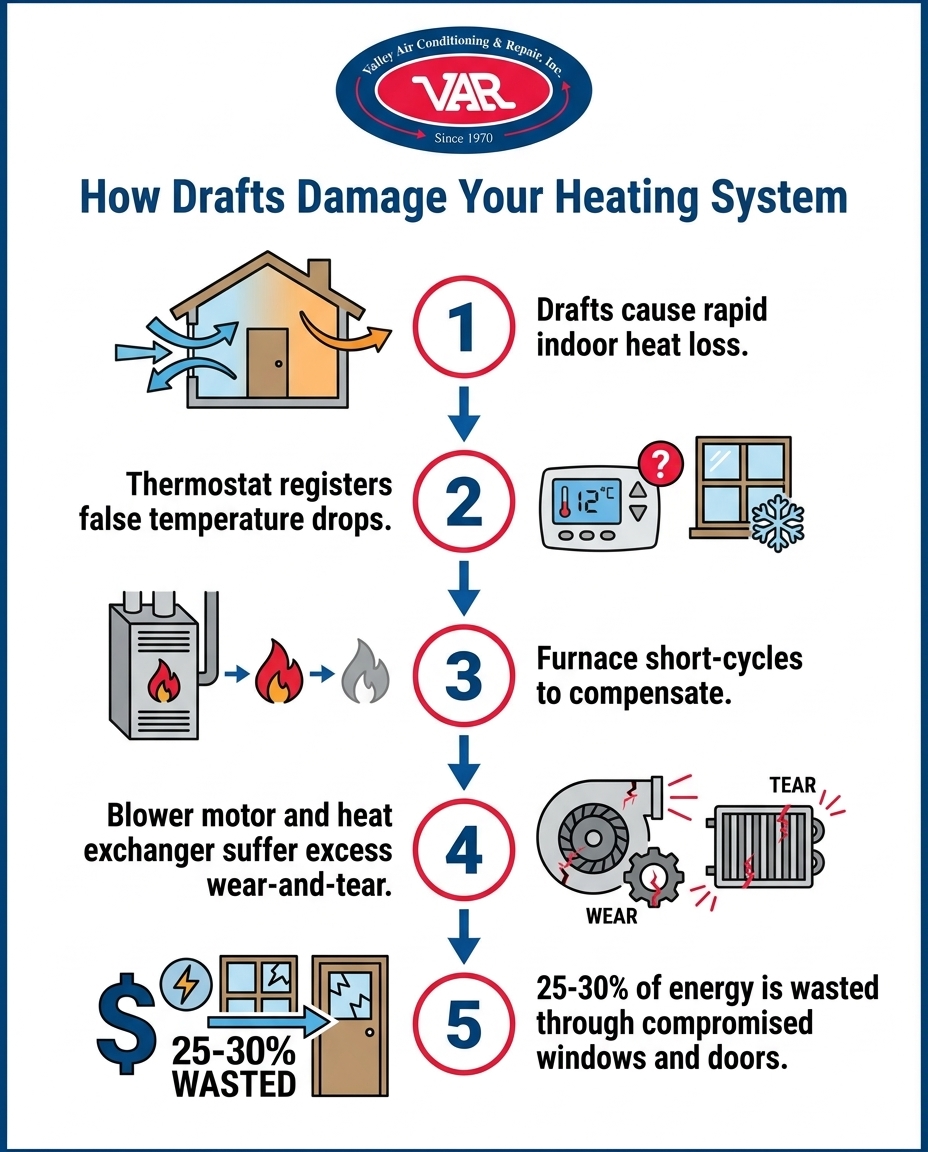
One of the most damaging consequences of a drafty home is a phenomenon known as short-cycling. When cold drafts infiltrate the living space, the indoor temperature drops rapidly. If a draft happens to hit the area near your thermostat, it can cause false temperature readings, tricking the system into thinking the entire house is freezing.
Frequent on/off cycles: In response to this rapid heat loss, the furnace turns on, runs for a short burst to satisfy the thermostat, and shuts off. A few minutes later, the draft cools the room again, and the furnace fires right back up. This constant, rapid on-and-off cycling wastes a tremendous amount of energy and puts massive stress on the ignition components, the flame sensor, and the gas valve. Furnaces are designed to run in longer, steady cycles; short-cycling forces them to work in a start-and-stop manner that leads to premature breakdowns.
Blower Motor and Heat Exchanger Fatigue
Beyond short-cycling, unsealed drafts force your system to run for extended periods just to maintain a baseline temperature. When the heated air is constantly escaping out the front door and windows, the furnace has to generate more heat to replace it.
Overheating risks: This extended run time places excess strain on the blower motor, which has to continuously push conditioned air into a leaky environment. Over time, the blower motor can overheat or burn out entirely. Furthermore, continuous, non-stop operation degrades the heat exchanger faster than normal seasonal use. The heat exchanger expands and contracts as it heats up and cools down; forcing it to do this excessively due to drafts can lead to metal fatigue and dangerous cracks.
How Drafts Damage Your Heating System
The 25 Percent Rule: Tracking Heat Loss Through the Building Envelope
It is easy to underestimate just how much warm air escapes through a small crack under a door or a deteriorated seal around a window pane. However, the data reveals a startling reality about residential energy waste. According to the U.S. Department of Energy, heat gain and heat loss through windows are responsible for 25% to 30% of residential heating and cooling energy use. This means that if your home's perimeter is compromised, nearly a third of the money you spend heating your home is literally going out the window.
Understanding how this happens requires looking at a concept called thermal bridging. Heat naturally moves toward cold. When the air outside is freezing and the air inside is warm, the heat in your home will actively seek out the weakest points in your building envelope to escape. Materials that are poor insulators—like old glass pane edges, uninsulated metal door frames, or gaps where caulking has failed—act as thermal bridges, creating a direct highway for your heat to leave the building.
At the same time, cold air infiltrates your living spaces through these same gaps due to pressure differences. As warm air rises and escapes through the upper levels of your home (the attic and upper-story windows), it creates a vacuum that sucks freezing outdoor air in through the gaps around your ground-floor doors and windows. This continuous cycle of energy drain forces your heating system to work at least 25% harder just to maintain a baseline level of comfort, severely impacting both your utility bills and the lifespan of the equipment.
Identifying Weak Points in Your Home's Perimeter
Before the cold weather sets in permanently, you need to conduct a thorough inspection of your home's perimeter. Catching these thermal leaks during the early fall transition gives you plenty of time to address them before your furnace is forced to run daily. Walk around your home, both inside and out, and pay close attention to the areas where different building materials meet.
Here is a practical checklist for identifying the weak points in your building envelope:
1. Inspect exterior window caulking: Look closely at the perimeter of every exterior window frame where it meets the siding or brick. Check for caulking that is cracking, peeling, shrinking, or missing entirely. If you can slide a piece of paper into the gap, air can get through.
2. Check the sweeps on exterior doors: Kneel down and look at the bottom of your front, back, and garage entry doors from the inside during the daytime. If you can see daylight shining through the bottom of the door, your weather sweep is compromised and needs replacement. You can also hold your hand near the bottom edge to feel for incoming drafts.
3. Evaluate the weatherstripping: Open your exterior doors and inspect the rubber or foam weatherstripping lining the door jamb. If the material feels hard, brittle, flat, or crumbles to the touch, it is no longer creating an airtight seal when the door is closed.
4. Assess older, single-pane windows: If you live in a historic neighborhood or an aging home, you likely have older windows. Single-pane glass offers very little thermal resistance, and the glazing putty holding the panes in place often deteriorates. You can learn more about common draft issues in older Fresno homes to see if your windows require special attention.
5. Check around utility penetrations: Look at the areas where pipes, dryer vents, and electrical conduits exit the home. The sealant around these penetrations often degrades, creating hidden pathways for cold air to enter.
Addressing these perimeter gaps is the essential first step before turning on the heat. Simple fixes like applying fresh exterior caulk or sliding a new sweep onto the bottom of a door take very little time but provide massive returns in mechanical efficiency.
Beyond Temperature: The Impact of Drafts on Your Breathing Environment
While the mechanical wear on your furnace and the chill in your living room are the most obvious consequences of a leaky perimeter, there is another critical factor to consider: indoor air quality. Gaps in your windows and doors do not just allow cold air to enter your home; they also provide a free pass for outdoor contaminants to bypass your home's defenses.
During the September pre-heating season in the Central Valley, the wind often picks up, carrying dust, agricultural allergens, pollen, and microscopic debris. When your building envelope is unsealed, these outdoor pollutants are blown directly into your living spaces. Once inside, they are pulled into your HVAC return vents and circulated throughout every room in the house.
Overworking your filters: This constant influx of outdoor particulate matter makes it significantly harder for your HVAC filters to keep up. A filter that is designed to last three months might become completely clogged in just four weeks if it is constantly battling dust blowing in from under the front door. A clogged filter restricts airflow, which further strains the blower motor and drastically reduces heating efficiency.
The simple truth is that a sealed home is a cleaner home. By stopping drafts at the source, you are also stopping airborne debris from entering your living spaces, directly benefiting your family's respiratory environment. If you find that your home gets dusty very quickly or your allergies flare up indoors during the fall, sealing your perimeter and exploring professional indoor air quality solutions should be a top priority.
The Holistic Approach to Pre-Season Preparation
Preparing your home for winter requires looking at the big picture. A perfectly tuned furnace sitting inside a leaky, drafty home is still an incredibly inefficient heating system. True comfort and mechanical longevity come from combining a sealed building envelope with professional equipment maintenance.
As part of a holistic approach to home comfort, the team at Valley Air Conditioning & Repair evaluates the entire home envelope, proving that we care about your long-term system health rather than just selling mechanical repairs. We know that if your perimeter is compromised, even the best mechanical tune-up won't stop your furnace from overworking. This comprehensive view ensures that your heating system operates in an environment that supports its efficiency, rather than fighting against it.
What a professional check entails: While you handle the caulking and weatherstripping around your windows and doors, a professional fall maintenance check handles the complex mechanical components inside the unit. A certified technician will thoroughly inspect the heat exchanger for any signs of metal fatigue or cracking caused by previous short-cycling. They will calibrate your thermostat to ensure it isn't being tricked by localized drafts, check the blower motor's amp draw to ensure it isn't straining, and clean the ignition components so the system fires smoothly.
Emphasizing the value of a comprehensive maintenance strategy means recognizing that the home and the HVAC system work as a single unit. Catching mechanical issues early during a dedicated fall inspection—while simultaneously sealing the drafts that cause those issues—is the smartest way to guarantee a warm, stress-free winter. By securing a routine HVAC maintenance plan, you ensure that both your equipment and your home's perimeter are evaluated and optimized before the freezing temperatures arrive.
Secure Your Comfort Before the Cold Settles In
Sealing drafts and scheduling a professional mechanical tune-up go hand-in-hand. You cannot achieve true energy efficiency or protect your furnace from premature wear-and-tear if you ignore the gaps around your windows and doors. The time to act is now, before the first major temperature drop forces your system into overdrive.
Take an afternoon to inspect your weatherstripping, apply fresh caulk where needed, and secure your home's perimeter. Once the building envelope is tight, ensure the mechanical side is just as prepared. Reach out to schedule your pre-season service and secure your comfort for the months ahead.
Frequently Asked Questions
How do drafty windows affect my furnace?
Drafty windows allow cold air to rapidly enter your home, which causes the indoor temperature to drop quickly. This forces your furnace to turn on more frequently and run for longer periods to replace the lost heat. Over time, this constant operation causes excessive wear-and-tear on critical components like the blower motor and heat exchanger.
Why is my furnace running constantly in the fall?
If your furnace is running constantly during the mild fall months, it is often a sign that your home's building envelope is leaking heat. Drafts from degraded weatherstripping or cracked window caulking allow the warm air to escape, meaning the furnace has to run non-stop to maintain the temperature set on the thermostat. Addressing these leaks usually resolves the constant running.
How much heat is lost through drafty windows?
According to the U.S. Department of Energy, heat gain and heat loss through windows account for 25% to 30% of residential heating and cooling energy use. Even tiny cracks around the window frames can act as thermal bridges, pulling a massive amount of heated air out of your living spaces and forcing your heating equipment to work much harder.
Do drafty windows increase heating bills?
Yes, drafty windows directly increase your heating bills. Because the warm air your furnace produces is constantly escaping outside, the system consumes more energy—whether that is natural gas or electricity—to constantly generate replacement heat. Sealing these drafts is one of the fastest ways to lower your monthly utility costs.
Does weatherstripping really make a difference for HVAC efficiency?
Weatherstripping makes a massive difference for HVAC efficiency by creating an airtight seal around exterior doors and operable windows. When this rubber or foam seal is intact, it stops cold air infiltration and prevents warm air from escaping. This stabilizes your indoor temperature and allows your HVAC system to run in normal, efficient cycles rather than short-cycling.
Why is early fall the best time to check my home's weather seals?
Early fall is the ideal time to check your weather seals because the extreme summer heat has likely degraded the caulking and rubber stripping around your home. Catching these compromised seals in September or October allows you to fix them before the freezing winter weather arrives, ensuring your furnace doesn't have to overwork during the first major cold snap.
As a business with many AC units, it is essential to have a responsive AC company. Valley Air Conditioning understands our needs. They are always responsive and our AC is up and running very quickly.
Brenda F.
I had them do an AC check on the home I was buying, they were honest and quick. I hired them to do the summer and Fall maintenance for $149. Happy with this company!
Gayle B.
100% recommend. I called, same day they came out and gave me estimate. Conley was honest and didn't try to recommend/sell us anything we didn't need. When I called him with questions before making a decision, he happily answered and was not annoyed by me contacting him. Conley and VAR
Erma C.
This is a group of good people. Very professional and knowledgeable. They take the time to listen and find the best solution that fits best for any situation. There's no way you can go wrong in choosing VAR.
Gabriel A.
We have used Valley Air for over fifteen years. The last two years ,Matt came to our house to service twice a year. Always on time, so polite and so professional. This is a very honest company and you can always depend on them and trust them. The office always treats everyone cheerfully and always want to do what you need done very fast YOU CAN COUNT ON THIS Company


.webp)