.webp)


AC Repair in Fresno, CA: Troubleshooting the Fall HVAC Transition After a Brutal Summer
Why we emphasize safe fall heating startups. Use these home maintenance tips and troubleshooting steps to decide with confidence when to call a pro.
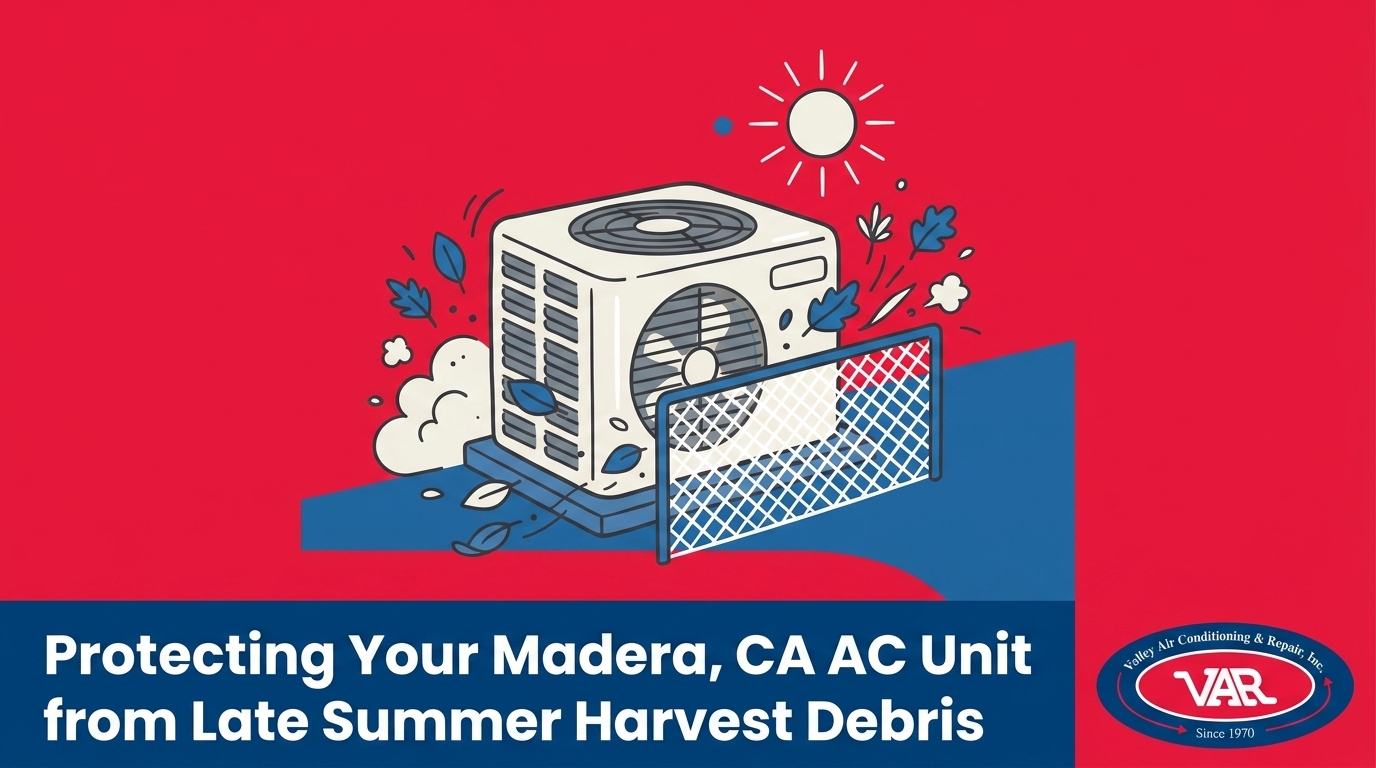
Your air conditioner is running nonstop, but the house still feels uncomfortably warm, and you notice a thick layer of fine dirt coating the outdoor cabinet. At Valley Air Conditioning & Repair, Inc., our team sees this specific issue peak every August. Protecting your Madera home's outdoor unit from late summer debris is one of the most critical steps you can take to prevent a sudden breakdown. As the intense heat drags on and local agriculture shifts into high gear, your cooling system faces an environmental assault that generic maintenance advice simply does not cover. If you need immediate help restoring your system's airflow, explore our air conditioning services or secure your cooling system's long-term reliability with a preventative maintenance plan.
Homeowners in the Central Valley face a unique set of challenges as the calendar turns toward the back-to-school season. Over our years serving Fresno and Madera, we've observed that by the time the August harvest season arrives, your air conditioning system has already endured months of heavy, continuous operation. The internal components are hot, the fan motors have logged hundreds of hours, and the system is operating near its maximum capacity just to maintain a baseline indoor temperature.
Simultaneously, the surrounding environment begins to change rapidly. The start of the harvest drastically increases the volume of airborne dust, dry yard waste, displaced topsoil, and organic particulate matter swirling through the air. Because your outdoor condenser unit requires a massive intake of ambient air to function, it acts like a giant vacuum cleaner, pulling all of that suspended harvest debris directly into its delicate aluminum fins.
This seasonal collision of extreme heat and heavy agricultural dust forces homeowners into an important decision point: knowing exactly what debris you can safely clear away yourself versus recognizing when the fine particulate matter has penetrated too deeply into the mechanical components.
Clearing a few dry leaves from the perimeter is a standard weekend chore, but dealing with the heavy, suffocating layer of field dust that coats the actual condenser coils requires a completely different approach. Ignoring this buildup is not an option. When the outdoor unit cannot breathe, it cannot release the heat it absorbed from inside your home, leading to skyrocketing energy bills, diminished comfort, and a significantly higher risk of a catastrophic system failure right when you need cooling the most.
Our technicians pull maintenance panels off units throughout Fresno and Madera every day, and we can tell you firsthand: not all dirt is created equal. Generic national HVAC advice often treats outdoor unit debris as a simple matter of sweeping away fallen leaves or brushing off loose topsoil. However, as local cooling experts, we know that Central Valley agricultural zones produce a highly specific type of particulate matter that behaves entirely differently when it interacts with mechanical cooling equipment.
During the late summer harvest, the San Joaquin Valley Air Pollution Control District historically records significant spikes in PM10—coarse dust particles that are 10 micrometers or less in diameter. To put that in perspective, these particles are a fraction of the width of a human hair.
When heavy agricultural machinery churns up the dry earth, it launches these ultra-fine particles into the wind currents. Unlike heavy sand or standard backyard dirt, which simply falls to the ground, PM10 dust remains suspended in the air for extended periods, drifting effortlessly across property lines and directly into the intake vents of residential air conditioning units.
The true danger of harvest dust lies in its chemical and physical reaction to moisture. Your outdoor condenser unit naturally generates a small amount of condensation as it operates. When the ultra-fine, highly alkaline agricultural dust gets pulled into the damp environment of the condenser coil, a troubling transformation occurs.
The dry PM10 dust mixes with the moisture to form a stubborn, clay-like paste. Instead of sitting loosely on the surface where it could be blown away by a strong breeze, this paste bakes onto the hot copper tubing and aluminum fins. As the unit cycles on and off under the intense late-summer sun, the paste hardens into a cement-like barrier that clings aggressively to the delicate heat transfer surfaces.
• Particle Size — Standard Yard Dirt: Large, heavy, settles quickly — Central Valley Harvest Dust: Microscopic (PM10), remains airborne
• Moisture Reaction — Standard Yard Dirt: Turns to loose mud, washes off easily — Central Valley Harvest Dust: Forms a dense, baked-on, cement-like paste
• Coil Penetration — Standard Yard Dirt: Sits on the outer cabinet grill — Central Valley Harvest Dust: Gets pulled deep between the aluminum fins
• Removal Difficulty — Standard Yard Dirt: Low (often blows away naturally) — Central Valley Harvest Dust: High (requires professional chemical dissolution)
To understand why this baked-on harvest dust is so dangerous, it helps to understand the core mechanics of how your air conditioner actually cools your home. Your system does not "create" cold air; rather, it absorbs heat from inside your living space, pumps it outside via chemical refrigerant, and releases that heat into the outdoor air through the condenser coil.
When the delicate aluminum fins of your outdoor unit are coated in a thick layer of agricultural dust paste, the heat transfer process is severely disrupted. The dirt acts as a heavy insulating blanket. The hot refrigerant arrives at the outdoor coil, but the heat cannot escape through the insulated fins. At Valley Air Conditioning & Repair, Inc., we refer to this condition as "suffocation."
Because the heat cannot dissipate, the refrigerant returns inside your home still partially warm. The air blowing out of your indoor vents feels lukewarm, and your thermostat never reaches its target temperature. Consequently, the system runs continuously, pulling excessive amounts of electricity without actually cooling your living space.
This suffocation triggers a dangerous domino effect across your entire HVAC system during the peak of the August harvest season. The first component to suffer is the compressor, which is the expensive "heart" of your air conditioner. Forced to run nonstop against high pressures, the compressor overheats and draws more amperage, leading to spiked utility bills and premature wear.
Simultaneously, restricted airflow forces the AC condenser fan motor to work overtime. The fan blades struggle to pull adequate air through the clogged fins, causing the motor to run hotter than its design limits allow. Eventually, the thermal overload switch may trip, or the motor may burn out entirely.
The risk of catastrophic failure is highest when the system is already under maximum load. Last late summer, our dispatch team received an urgent call during a brutal heat wave when temperatures spiked to 110 degrees. Their system failed entirely, leaving an elderly family member with health conditions at serious risk. Our technician was dispatched quickly, diagnosed a severe strain issue caused by restricted airflow and overworked components due to caked-on harvest dust, and completed the repair within an hour to cool the home back down. This scenario highlights exactly why keeping the outdoor unit breathing freely is a matter of safety, not just efficiency.
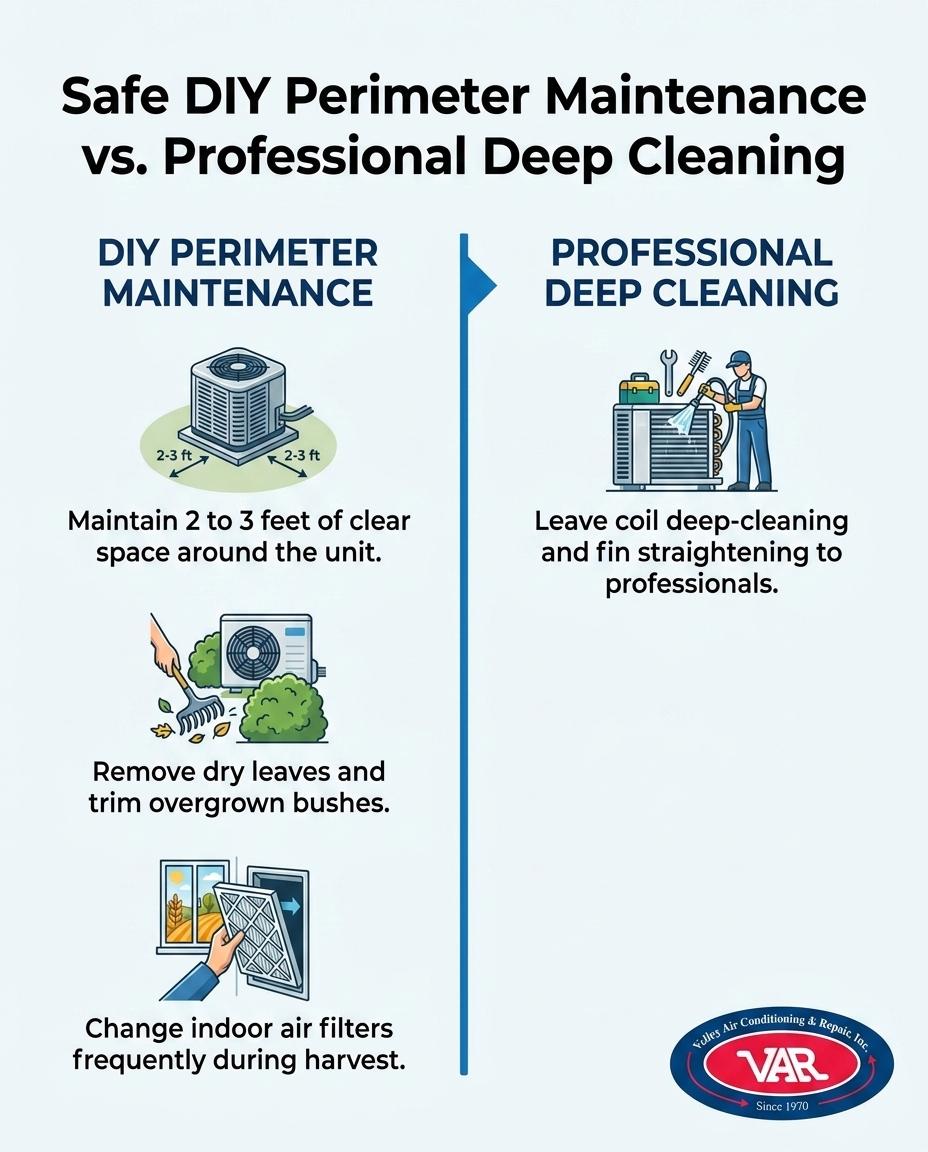
While the internal cleaning of a suffocated condenser coil requires specialized intervention, there is a substantial amount of preventive maintenance that homeowners can—and should—perform themselves. Establishing a clean, clear perimeter around your outdoor unit is your first line of defense against the heavy debris generated across Madera and surrounding Central Valley agricultural zones.
The U.S. Department of Energy strictly recommends maintaining a minimum of 2 to 3 feet of completely clear space around all sides of your outdoor air conditioning unit. This clearance zone ensures that the fan can pull in an adequate volume of ambient air without excessive resistance. When bushes, tall grass, or stacked yard items encroach on this zone, they create a micro-climate of stagnant, debris-filled air that is immediately sucked into the system.
As the late summer harvest approaches, implement this safe perimeter clearing routine every few weeks to protect your investment:
• Rake back dry leaves and grass clippings: Keep the immediate ground area bare or covered in clean gravel. Yard waste that decomposes near the unit easily breaks down into small particles that get pulled into the fins.
• Trim overgrown landscaping: Cut back bushes, hedges, and low-hanging branches so they sit at least 36 inches away from the metal cabinet. Ensure no vegetation is blocking the top exhaust fan.
• Remove physical obstructions: Relocate garden hoses, children's toys, trash cans, and outdoor furniture that may have migrated too close to the unit over the summer.
• Upgrade indoor air filters: Change your indoor air filters more frequently—often every 30 days—during heavy harvest months. A clean indoor filter supports overall system airflow, reducing the total strain on the outdoor components.
It is vital to clearly define the boundary of homeowner maintenance. Clearing the surrounding yard, trimming bushes, and ensuring the cabinet has room to breathe are all perfectly safe tasks that support your system's health across all service areas including Madera. However, the moment the maintenance involves opening the metal cabinet, removing safety grilles, or interacting directly with the fragile fins, you have crossed the line from safe DIY into high-risk territory.
When homeowners notice a thick layer of dust coating their outdoor unit, the natural instinct is to grab a tool and clean it off. Unfortunately, the internet is filled with dangerous DIY advice that can instantly cause irreversible damage to your cooling system. Attempting to deep-clean the internal components without professional training almost always does more harm than good.
The most common and destructive misconception we encounter is that homeowners can simply take a garden hose and blast the dirt away from their outside AC unit. Because the August harvest season creates a highly specific, alkaline dust that reacts with moisture, spraying the unit with a standard hose often triggers a disaster.
Instead of washing the dirt away, the low-pressure water simply wets the thick layer of agricultural dust, turning it into a heavy mud. As the water flows downward, it pushes this mud deeper into the microscopic crevices between the aluminum fins. When the sun comes out and bakes the unit, that hidden mud hardens into a solid block, permanently restricting airflow and forcing the compressor to work against an impenetrable wall.
The fins on your condenser coil are made of incredibly thin, highly conductive aluminum. They are designed to transfer heat rapidly, but they are physically fragile. They can be bent simply by pressing a finger against them.
When well-meaning homeowners attempt to scrub the caked-on dust using stiff-bristled brushes, brooms, or high-pressure washer nozzles, they inevitably crush and flatten the fins. A flattened fin blocks airflow entirely. Once a large section of fins is crushed shut, the unit loses a massive percentage of its cooling capacity, and repairing the damage requires a professional to painstakingly comb the fins back open—if they haven't snapped off completely.
Applying over-the-counter chemical degreasers or foaming coil cleaners without proper training is equally dangerous. Many commercial cleaners are highly acidic or caustic. If they are not diluted to the precise ratio or rinsed away completely within a specific timeframe, the chemicals will literally eat through the aluminum fins and the copper tubing. This acidic corrosion leads to catastrophic refrigerant leaks, turning a simple maintenance task into a massive, system-destroying repair.
Because the agricultural dust found in Madera and surrounding Central Valley agricultural zones is so stubborn and chemically reactive, removing it safely requires specialized intervention. Recognizing the warning signs early allows you to schedule professional maintenance before the strain causes a major component failure.
If you have already cleared the 3-foot perimeter around your unit but are still experiencing performance issues, it is time to call in a technician. Look for these clear indicators that your condenser coil is suffocating:
• Constant operation: The system runs for hours without shutting off, struggling to reach the temperature set on the thermostat.
• Lukewarm air: The air coming from your indoor vents feels room-temperature rather than crisp and cold.
• Unexplained energy spikes: Your monthly utility bill jumps significantly compared to the same month in previous years, despite similar usage patterns.
• Visible caking: You can see a solid, unbroken layer of gray or brown paste packed tightly between the metal fins of the outdoor cabinet.
When you rely on our professional HVAC services, the deep cleaning process looks entirely different from a DIY attempt. Our licensed technicians arrive equipped with specialized, non-corrosive chemical foaming agents specifically formulated to dissolve dense agricultural paste without harming the fragile aluminum.
These foaming agents are applied from the inside of the unit pushing outward, lifting the deep-seated dirt out of the crevices rather than driving it further in. The technician then uses finely calibrated, low-pressure water systems to safely rinse the dissolved debris away. If any fins were previously bent by flying yard debris, the technician will use a specialized fin comb to carefully realign them, restoring optimal airflow.
Connecting this deep cleaning process to long-term efficiency is vital. Consistent, professional preventive maintenance can keep even older units running optimally for years. For example, our ongoing preventive maintenance and regular heat exchanger cleaning recently helped keep one Madera customer's 13-year-old AC unit running highly efficiently through the end-of-season heat, proving that professional attention extends lifespan and protects your investment.
Protecting your Madera home's outdoor unit from late summer debris is the key to enduring the rest of the cooling season comfortably. By handling the safe perimeter clearing yourself and leaving the complex coil restoration to the experts at Valley Air Conditioning & Repair, Inc., you ensure your system remains efficient, reliable, and safe from unnecessary breakdowns.
The best way to protect your outside AC unit is to maintain a clear 2 to 3-foot perimeter around the entire cabinet. Regularly rake away dry leaves, trim back overgrown bushes, and remove tall grass that can block airflow. During heavy harvest seasons, sweeping the immediate area prevents loose particulate matter from being easily sucked into the intake fins. For deeper protection, schedule an annual professional maintenance visit to ensure internal components remain clean.
No, you should never use a standard garden hose to spray down your outside AC unit, especially during heavy dust seasons. Low-pressure water mixes with fine agricultural dust to create a heavy mud that gets pushed deeper into the microscopic crevices of the condenser coil. Once the sun bakes the unit, this mud hardens into a solid, cement-like paste that completely blocks airflow and requires professional chemical removal to fix.
The U.S. Department of Energy recommends a minimum of 2 to 3 feet of completely clear space on all sides of the outdoor air conditioning unit. Additionally, there should be at least 5 feet of unobstructed vertical clearance above the unit to allow the exhaust fan to blow hot air away from the house. Blocking this required clearance forces the system to pull in stagnant, debris-filled air, which drastically reduces cooling efficiency.
Yes, heavy dust severely affects the AC condenser by acting as a thick insulating blanket over the delicate aluminum fins. When the fins are coated in dirt, the hot refrigerant inside the coils cannot successfully release its heat into the outdoor air. This suffocation forces the compressor to run hotter and longer, leading to spiked energy bills, reduced indoor comfort, and a high risk of premature system failure.
If your AC is running constantly in late summer, it is usually because the outdoor condenser coil is suffocated by a buildup of harvest dust and yard debris. Because the system cannot release heat efficiently, it has to run continuously just to maintain a baseline indoor temperature. This constant operation is a major warning sign that your system is under severe strain and requires a professional deep cleaning to restore proper airflow.
In the Central Valley, AC coils should be professionally cleaned at least once a year, ideally as part of a comprehensive spring or early summer maintenance plan. However, homes located directly adjacent to active agricultural fields may require a secondary inspection or cleaning after the heavy August harvest season concludes. A licensed technician can assess the specific dust load on your property and recommend the best schedule to keep your system running safely.

As a business with many AC units, it is essential to have a responsive AC company. Valley Air Conditioning understands our needs. They are always responsive and our AC is up and running very quickly.
I had them do an AC check on the home I was buying, they were honest and quick. I hired them to do the summer and Fall maintenance for $149. Happy with this company!
100% recommend. I called, same day they came out and gave me estimate. Conley was honest and didn't try to recommend/sell us anything we didn't need. When I called him with questions before making a decision, he happily answered and was not annoyed by me contacting him. Conley and VAR
This is a group of good people. Very professional and knowledgeable. They take the time to listen and find the best solution that fits best for any situation. There's no way you can go wrong in choosing VAR.
We have used Valley Air for over fifteen years. The last two years ,Matt came to our house to service twice a year. Always on time, so polite and so professional. This is a very honest company and you can always depend on them and trust them. The office always treats everyone cheerfully and always want to do what you need done very fast YOU CAN COUNT ON THIS Company