.webp)


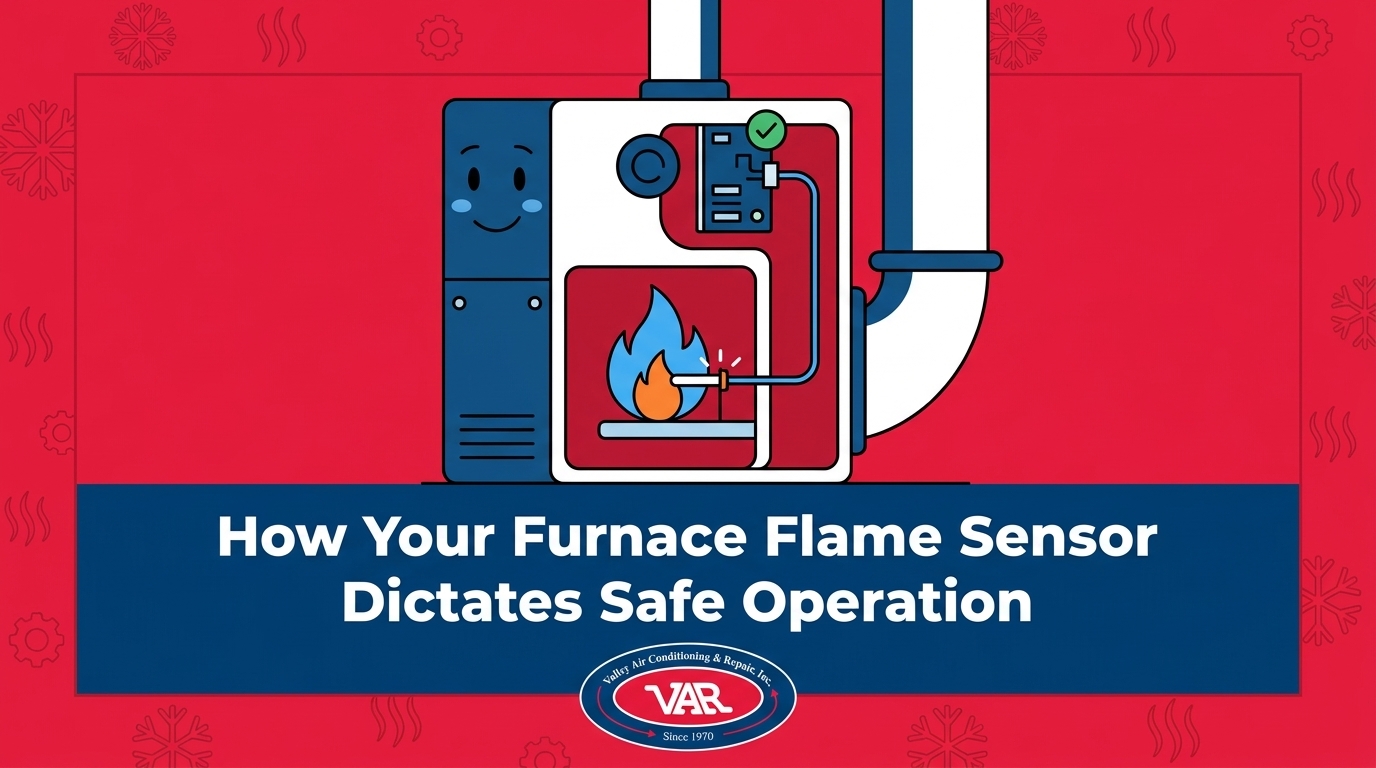
How Your Furnace Flame Sensor Dictates Safe Operation
If your heating system fires up only to shut down seconds later, a dirty flame sensor is likely to blame. See why this tiny rod triggers a strict safety lockout.
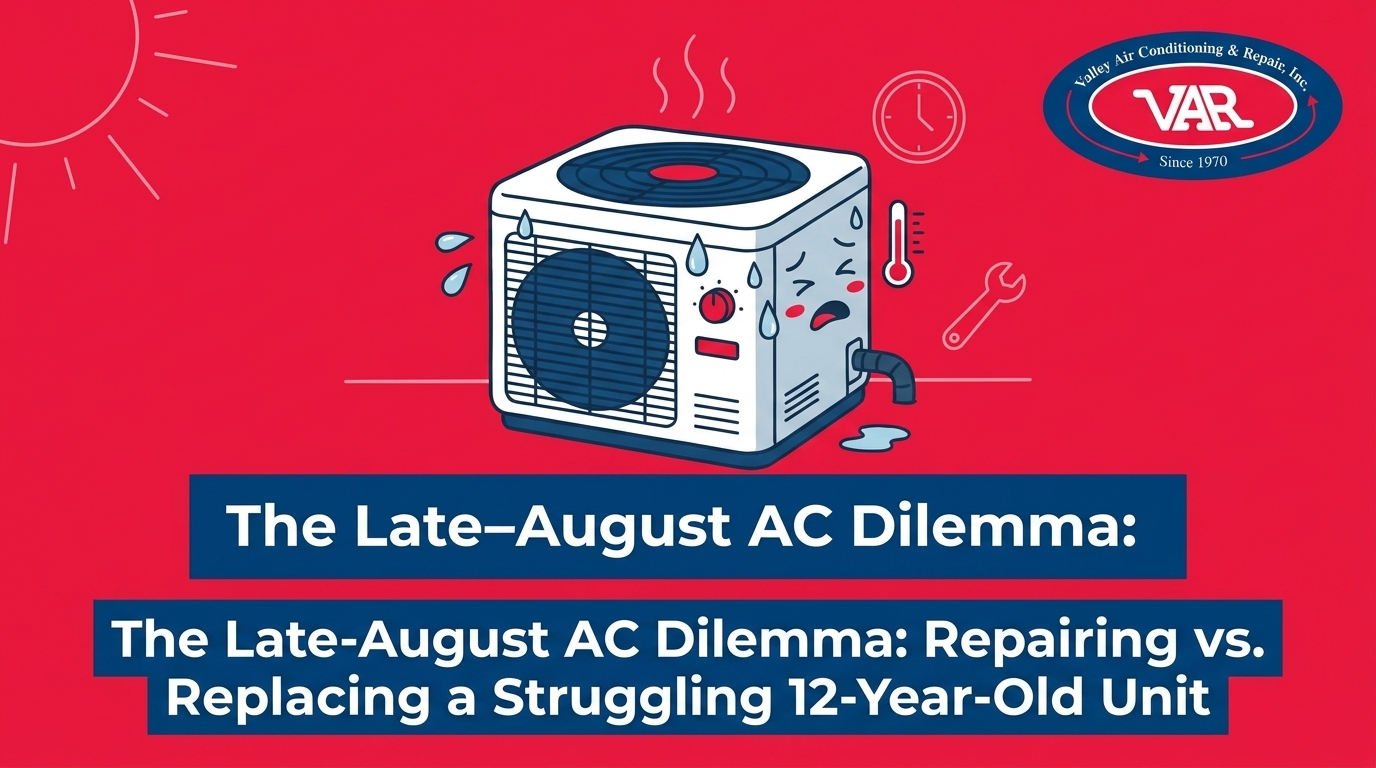
Your cooling system is running nonstop, but the house still feels warm, forcing you into the difficult position of repairing vs. replacing a struggling 12-year-old AC unit in late August. When the thermostat creeps upward and the air coming from your vents feels lukewarm at best, the frustration is immediate. At Valley Air Conditioning & Repair, our team frequently fields panicked calls during the back-to-school transition, as breakdowns at this stage of the year present a unique challenge. You are caught between the desire to simply survive the remaining hot weeks and the logical need to make a wise, long-term investment for your home.
Navigating this decision requires looking at the big picture of your HVAC systems. While the calendar says autumn is approaching, our technicians know firsthand that the reality of Fresno's late-summer weather means the current cooling season is far from over. Investing in a temporary patch might seem like the path of least resistance, but it often serves as a costly band-aid on a much larger problem. On the other hand, committing to an air conditioning replacement provides a fresh start, but it requires careful consideration.
This guide provides an objective, straightforward framework for making the best long-term choice. By examining the realities of aging equipment, the physical toll of extreme heat, and the mathematical formulas our industry professionals use to evaluate viability, you can approach this end-of-season dilemma with confidence.
Air conditioners are not designed to last forever, and the environment they operate in plays a massive role in their overall lifespan. In moderate climates, a well-maintained cooling system might reliably run for up to 15 years. However, based on our extensive experience servicing neighborhoods throughout Fresno, our team considers a 12-year-old AC unit in our region to be well past its prime.
Fresno's extreme late-summer heat forces a limping unit to run constantly, accelerating the failure of aging components compared to milder regions. When afternoon temperatures consistently break the 100-degree mark, your system rarely gets a chance to cycle off and cool down. This relentless demand requires significantly higher operational hours per season. Over a dozen years, that equates to thousands of extra hours of wear and tear on critical internal components.
• Compressor strain: The heart of your cooling system works overtime to compress refrigerant. After 12 years of extreme heat, the mechanical parts inside the compressor are often worn thin.
• Motor fatigue: Blower motors and condenser fan motors degrade faster when forced to run continuously against high static pressure and blistering outdoor temperatures.
• Electrical degradation: Constant heat exposure causes wiring insulation to become brittle and electrical contacts to pit and burn out more frequently.
Beyond physical wear, a 12-year-old system is technologically obsolete. Systems manufactured over a decade ago operate on outdated efficiency standards. Today's modern SEER2 standards mandate significantly higher performance, meaning older units consume vastly more electricity to produce the same amount of cooling.
Furthermore, we frequently remind our customers that a system of this age is well past its typical manufacturer warranty period. This means all the financial risk of a breakdown falls entirely on your shoulders. Every part that fails, every pound of refrigerant that leaks, and every hour of labor required to keep it running comes directly out of your pocket, with no safety net to fall back on.
When you are sweating through a late August / end-of-season breakdown, emotions can easily cloud your judgment. To cut through the frustration, our Valley Air Conditioning & Repair professionals often rely on a conceptual mathematical framework known as the "5,000 Rule." This formula helps homeowners evaluate repair viability objectively, without getting bogged down in the stress of the moment.
The concept behind the 5,000 Rule is simple: you multiply the age of your equipment by the estimated cost of the repair. If the resulting number exceeds 5,000, the mathematical consensus dictates that replacing the system is the wiser financial decision.
The underlying logic:
• Diminishing returns: Pouring significant resources into an obsolete machine rarely yields a good return on investment. The older the unit, the lower the threshold for acceptable repair costs.
• The probability of secondary failures: Fixing one broken part on a 12-year-old system does not reset the clock on the rest of the components. The next breakdown is often just around the corner.
• Efficiency gains: The rule factors in the hidden cost of operating an inefficient system. A new unit lowers your monthly energy consumption, which helps offset the initial investment over time.
Beyond the math, there is a significant psychological toll to nursing a failing unit through continuous heatwaves. Wondering if your air conditioner will turn on every time you adjust the thermostat creates unnecessary anxiety in your own home. Before making a final call, we always advise homeowners to troubleshoot your AC issues to ensure the problem isn't something as simple as a clogged filter or a tripped breaker. But if the core components are failing, the 5,000 Rule provides a clear signal that it is time to move on.
Despite the advanced age of a 12-year-old system, there are specific, limited scenarios where applying a temporary patch is the most logical choice to survive the remaining heat. Not every malfunction requires an immediate system overhaul.
If our diagnostic reveals a minor, isolated failure that does not indicate a systemic collapse, a quick fix is often justified. Common examples include a blown dual-run capacitor, a pitted contactor, or a faulty thermostat. These are relatively straightforward mechanical swaps that can get your system back online without requiring a massive investment. If the compressor is still pulling the correct amperage and the refrigerant charge is completely intact, replacing a small electrical component makes sense.
Sometimes, the decision is dictated by immediate necessity rather than long-term strategy. Our team recently responded to a Central Valley homeowner during a brutal late-summer heat wave when afternoon temperatures spiked to 110 degrees. With an elderly family member in the house who had underlying health conditions, the situation escalated from uncomfortable to a genuine health crisis. Because the issue was an isolated component failure, one of our technicians arrived in under an hour, diagnosed the problem, and completed the repair in thirty minutes. In extreme 100°F+ afternoon temperatures, restoring cooling rapidly to protect vulnerable family members takes precedence over long-term planning.
A temporary patch also makes sense if you simply need to buy time to plan a more comprehensive upgrade next spring. If a minor repair can reliably limp your system through the final weeks of September, it gives you the winter months to research equipment, evaluate different SEER2 ratings, and make a measured decision without the pressure of an actively sweltering house. However, it is vital to remember that patches on aging units are inherently temporary. The goal is to bridge the gap, not to pretend the system is permanently cured.
While minor fixes have their place, our technicians look for certain red flags that indicate a repair is nothing more than a waste of resources. When a system is fundamentally compromised, delaying the inevitable only leads to repeated frustration and compounding expenses.
Temporary patches are highly likely to fail quickly under the intense strain of continuous 100-degree days. If your system requires more than just a quick electrical swap, it is time to cut your losses. Major warning signs include:
• Compressor failure: The compressor is the most critical and expensive component of your system. When a 12-year-old compressor grounds out or locks up, replacing it is almost never recommended.
• Major refrigerant leaks: If your evaporator coil or condenser coil has developed a significant leak, patching it is often impossible. Continuously recharging a leaking system is an endless cycle of frustration.
• R-22 obsolescence: If your 12-year-old unit still utilizes R-22 (Freon) refrigerant, a leak is a definitive death sentence. R-22 has been completely phased out of production, making it incredibly scarce and impractical to service.
Replacing the unit now guarantees reliable comfort for the rest of the current season and many years to come. One of our Fresno customers recently endured a grueling stretch of 100°F temperatures that lasted for 30 consecutive days. Their aging system finally gave out under the relentless strain. Rather than pouring resources into a doomed temporary patch in late August / end-of-season, they opted for a complete replacement with our installation team. By utilizing modern financing options, including flexible promotional terms, the unexpected upgrade became entirely manageable. Today, they enjoy reliable, high-efficiency cooling that they can easily control directly from their smartphone.
Working with an honest advisor is crucial during this process. Valley Air Conditioning & Repair provides transparent, objective evaluations, ensuring homeowners have the facts they need to avoid wasting resources on doomed end-of-season repairs. An honest assessment allows you to confidently walk away from a failing system and invest in your home's future.
To help synthesize this information, it is helpful to look at the two options side-by-side. When dealing with a 12-year-old AC unit, the contrast between a temporary fix and a complete replacement is stark.
• Reliability — Limping Through (Temporary Patch): Provides short-term relief, but remains highly vulnerable to the next heatwave. — Starting Fresh (Full Replacement): Guarantees long-term reliability and consistent indoor temperatures.
• Future Risk — Limping Through (Temporary Patch): High risk of secondary breakdowns; all repair costs fall entirely on the homeowner. — Starting Fresh (Full Replacement): Total peace of mind backed by a comprehensive, multi-year manufacturer warranty.
• Energy Usage — Limping Through (Temporary Patch): High energy consumption due to outdated technology and worn-out mechanical parts. — Starting Fresh (Full Replacement): Maximum efficiency utilizing modern SEER2 standards, lowering monthly utility usage.
• Mental Toll — Limping Through (Temporary Patch): Constant monitoring and stress, wondering if the unit will survive the afternoon. — Starting Fresh (Full Replacement): Set-it-and-forget-it comfort, allowing you to relax in your own home.
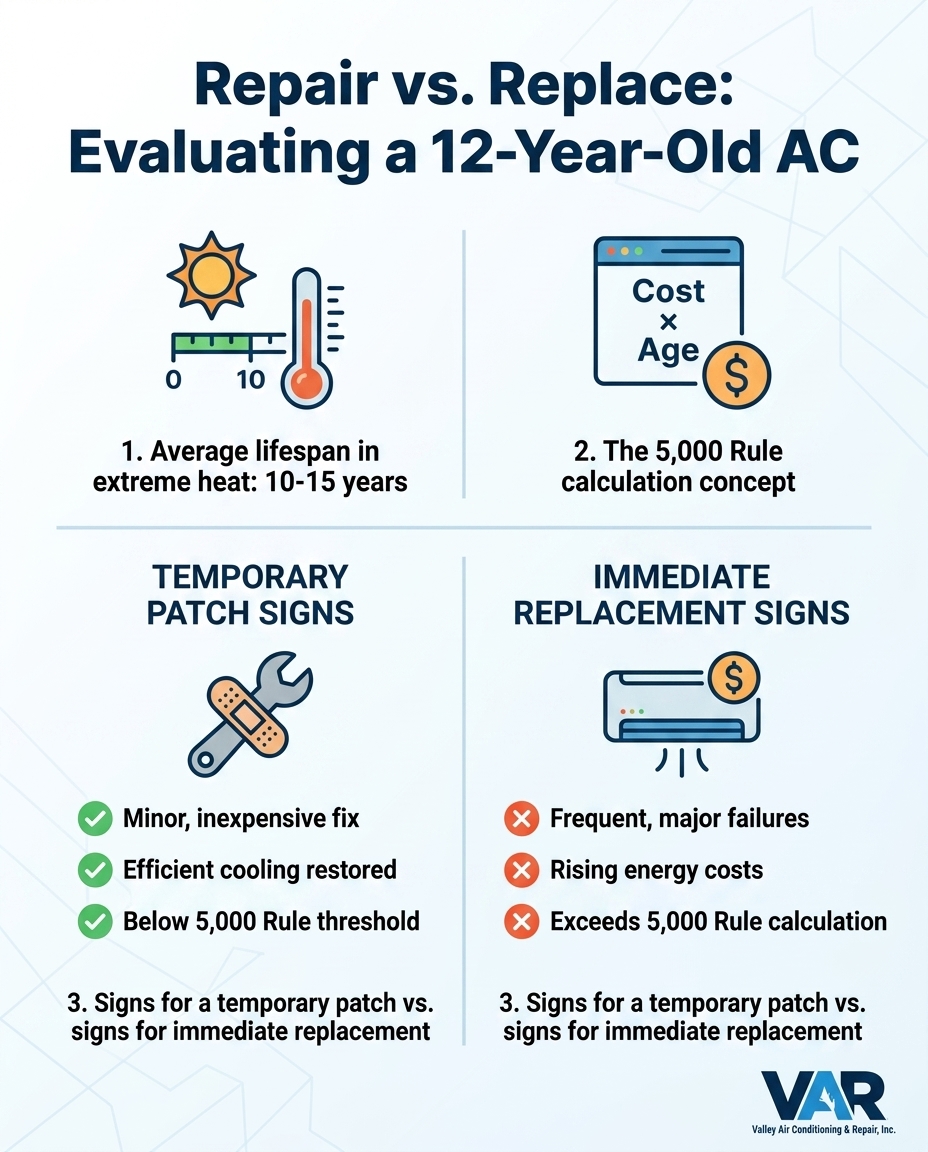
The decision you make in late August / end-of-season extends far beyond the next few weeks. Whether you choose to apply a temporary fix or invest in a new system, this choice dictates your home's comfort, energy efficiency, and overall reliability for the next decade.
A fresh start eliminates the anxiety of wondering if the AC will turn on during the next inevitable heatwave. When spring rolls around next year, you will not have to scramble to schedule an emergency diagnostic while the house heats up. Instead, you can transition into the warmer months with complete confidence, knowing your high-efficiency SEER2 equipment is fully prepared to handle whatever the Central Valley climate delivers.
Regardless of whether you are nursing a 12-year-old unit through its final days or breaking in a brand-new installation, ongoing care is the key to maximizing the lifespan of your equipment. Proactive decisions prevent emergency scrambles. By enrolling in our preventative maintenance plan, you ensure that vital components are cleaned, calibrated, and inspected before the heavy usage season begins. Routine maintenance keeps warranties valid, catches minor issues before they become catastrophic failures, and ensures your system operates at peak efficiency year after year.
Surviving the blistering 100°F+ afternoon temperatures should never mean wasting your hard-earned resources on a failing, obsolete system. You deserve a home that provides a reliable sanctuary from the heat, without the constant stress of impending breakdowns.
If your aging air conditioner is struggling to cross the finish line this season, do not settle for guesswork. Seek a transparent, professional evaluation to weigh your options logically. Schedule a consultation with our experienced Valley Air Conditioning & Repair team today, and let us help you resolve your cooling crisis with a solution that makes sense for your home and your future.
Is it worth repairing a 12-year-old AC?
In most cases, we do not recommend major repairs on a 12-year-old unit due to diminishing returns. Because extreme heat accelerates wear and tear, a system of this age is highly prone to secondary failures. However, if the issue is a minor, isolated electrical component like a capacitor, our technicians might justify a quick repair to help you limp through the rest of the season.
Should I wait until spring to replace my AC?
Waiting until spring is only viable if your current system can reliably maintain safe indoor temperatures right now. If your unit has completely failed during a late-summer heatwave, waiting means enduring weeks of extreme discomfort and potential health risks. Replacing the system immediately secures your comfort now and ensures you are fully prepared when the heat returns next year.
How long do AC units last in extreme heat?
Air conditioning systems operating in extreme heat climates like ours typically last between 10 and 15 years. The intense demand of continuous 100-degree days forces the compressor and fan motors to run significantly longer cycles than they would in milder regions. Regular preventative maintenance is essential to help a unit reach the higher end of that lifespan bracket.
Will a temporary AC patch last through a Central Valley summer?
There is no guarantee that a temporary patch will hold up under the relentless strain of continuous high temperatures. While replacing a minor part might fix the immediate symptom, it does not reverse the overall degradation of an aging system. Homeowners should view a patch as a brief bridge to a permanent solution, rather than a long-term cure.
What are the signs my aging AC is beyond repair?
Your system is likely beyond repair if it requires a new compressor, has developed a major coil leak, or still relies on obsolete R-22 refrigerant. Additionally, if you find yourself calling for service multiple times in a single season, the system is demonstrating systemic collapse. Applying the 5,000 Rule can also provide a clear mathematical indicator that replacement is the wiser choice.

As a business with many AC units, it is essential to have a responsive AC company. Valley Air Conditioning understands our needs. They are always responsive and our AC is up and running very quickly.
I had them do an AC check on the home I was buying, they were honest and quick. I hired them to do the summer and Fall maintenance for $149. Happy with this company!
100% recommend. I called, same day they came out and gave me estimate. Conley was honest and didn't try to recommend/sell us anything we didn't need. When I called him with questions before making a decision, he happily answered and was not annoyed by me contacting him. Conley and VAR
This is a group of good people. Very professional and knowledgeable. They take the time to listen and find the best solution that fits best for any situation. There's no way you can go wrong in choosing VAR.
We have used Valley Air for over fifteen years. The last two years ,Matt came to our house to service twice a year. Always on time, so polite and so professional. This is a very honest company and you can always depend on them and trust them. The office always treats everyone cheerfully and always want to do what you need done very fast YOU CAN COUNT ON THIS Company