


.webp)


Why Is My AC Blowing Warm Air? Fall HVAC Troubleshooting & Startup Smells
Smelling burning dust this fall? Get clear answers with our home maintenance tips and troubleshooting to know when to call a pro for your heating system.
As August rolls in and families begin the back-to-school transition, the last thing you want is a cooling issue. At Valley Air Conditioning & Repair, our dispatch team frequently fields calls from customers wondering, "Is it safe to run my AC if the insulation on the refrigerant line is torn?" When you step outside into the sweltering late-summer heat and notice degraded black foam on the suction line of your outdoor unit, panic can quickly set in. The copper pipe is suddenly exposed, sweating heavily, and your system seems to be working overtime. The short answer is yes, it is generally safe to run your air conditioner temporarily. Finding exposed copper pipes during peak summer heat is alarming, but it will not cause an immediate, catastrophic system failure. However, a pattern we see often is that leaving that line completely bare forces your compressor to work much harder and steadily drains your overall energy efficiency.
If you are concerned about how missing insulation is impacting your air conditioning system, scheduling a professional inspection with our team or enrolling in an AC maintenance plan is the best way to protect your equipment and keep your utility bills in check.
The immediate reality of bare refrigerant lines:
• Short-term survival: Your system will continue to produce cold air, allowing you to survive an end-of-season heat wave safely.
• Long-term consequences: Running the system for weeks or months without a thermal barrier accelerates wear and tear on vital, expensive components.
• The efficiency drain: Your unit must run longer cooling cycles to achieve the same indoor temperature, which directly increases your energy consumption.
While our technicians will tell you that you do not need to shut off your cooling entirely, treating torn insulation as a minor cosmetic issue is a mistake. Professional attention is required to restore proper efficiency and protect the lifespan of your compressor as we finish out the hardest days of summer.
To understand why that degraded black foam matters, you first need to understand the mechanical purpose of the pipes connecting your indoor and outdoor equipment. Your air conditioner uses two primary copper lines to circulate refrigerant. The smaller line, called the liquid line, carries warm refrigerant to the indoor coil. The larger pipe is the suction line, and it is responsible for carrying cold refrigerant gas back outside to the compressor.
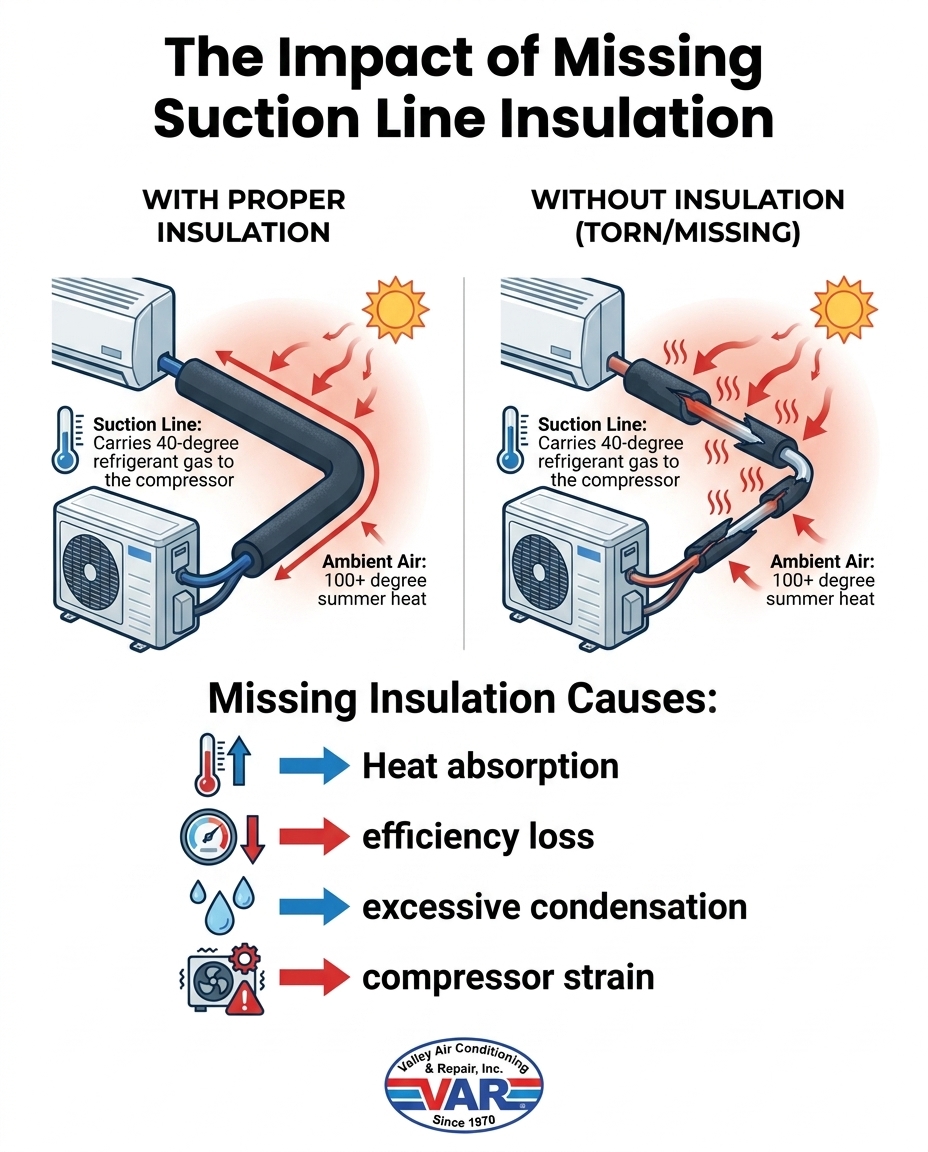
The suction line is the pipe wrapped in black foam, and that insulation serves a critical mechanical purpose. As refrigerant travels back to your outdoor unit, it sits at a chilly 40 degrees Fahrenheit. The insulation acts as a heavy-duty thermal barrier, preventing this freezing gas from absorbing ambient heat from the outdoor air.
Problem: The Heat Exchange Threat
When the insulation is torn or missing, the cold copper pipe is directly exposed to hot summer air. Heat naturally moves toward cold. Without a barrier, the 40-degree refrigerant absorbs massive amounts of heat before it ever reaches the compressor.
Cause: Condensation and Ambient Exposure
As the cold pipe meets warm, humid outdoor air, heavy condensation forms instantly. The foam is designed to stop this humid air from contacting the freezing pipe, preventing excessive sweating and moisture buildup around your unit.
Solution: Maintaining the Cooling Cycle
Keeping the returning refrigerant cold is absolutely vital for the compressor's cooling cycle. The compressor relies on that cool returning gas to prevent itself from overheating during operation. Proper insulation ensures the refrigerant stays cold, the compressor stays protected, and the system operates exactly as the manufacturer intended.
In our experience servicing homes throughout the Central Valley, the consequences of torn insulation scale directly with the outdoor temperature. August late-summer heat often pushes well past 100 degrees, creating a massive temperature delta between your 40-degree suction line and the ambient air. This extreme heat turns a minor insulation issue into a major efficiency drain.
When the refrigerant warms up excessively before reaching the outdoor unit, your system's overall cooling capacity drops significantly. The air coming out of your vents may not feel as crisp, and your thermostat will struggle to reach your target temperature. To compensate for this loss of capacity, the air conditioner is forced to run much longer cycles.
Just last season, our crew helped a Fresno homeowner who experienced the brutal reality of 100°F temperatures for 30 days straight. They ultimately needed a full system replacement during that extreme heat, but with prompt service, excellent communication, and a seamless installation process, our team fully restored their home's comfort. While missing foam won't immediately kill a brand-new unit, we constantly warn customers that subjecting an older system to those same 30 days of triple-digit heat with bare refrigerant lines places immense, unnecessary strain on an aging compressor.
At Valley Air Conditioning & Repair, we have a deep understanding of how Central Valley climate stresses impact HVAC equipment longevity. We see firsthand how longer run times directly translate to higher utility bills by the end of the cooling season. When your system runs continuously just to overcome the heat absorbed by a bare pipe, you are paying for wasted energy while simultaneously wearing out your compressor.
A scenario our technicians encounter frequently is homeowners discovering torn insulation because they notice a large puddle forming near their outdoor condenser. Seeing water pooling around electrical equipment is naturally alarming, and many homeowners immediately assume their system is leaking vital refrigerant fluids.
It is important to differentiate between condensation and a true chemical leak. Just like a cold glass of ice water sitting on a patio table on a hot day, your exposed cold copper pipe draws moisture out of the warm air. This process is called sweating. The puddle you see under a bare suction line is almost always just water condensation dripping off the copper. Refrigerant, on the other hand, operates under high pressure; if it leaks out of the copper line, it instantly evaporates into a gas when exposed to the atmosphere—it does not form a liquid puddle on the ground.
If you are troubleshooting common AC issues, this table can help you understand what you are looking at:
• Visual Evidence — Sweating Pipe (Condensation): Clear water dripping from bare copper, pooling on the concrete pad. — Actual Refrigerant Leak: Oily residue on the pipes or valves; bubbling if soapy water is applied.
• Auditory Signs — Sweating Pipe (Condensation): Quiet dripping sounds as water hits the ground. — Actual Refrigerant Leak: A faint hissing or bubbling sound coming from the copper lines.
• System Impact — Sweating Pipe (Condensation): Slightly warmer indoor air, longer cooling cycles, higher energy usage. — Actual Refrigerant Leak: System completely fails to cool the house; indoor evaporator coil freezes solid into a block of ice.
While a puddle of water is certainly better than a chemical leak, our team warns that excessive condensation is not harmless. Constant dripping near your foundation can cause soil erosion, attract pests, or create slipping hazards. If the water pools near the electrical disconnect box or the condenser's wiring, it can lead to shorts and corrosion over time. Replacing the insulation stops the sweating at the source.
If your system is more than a few years old, you might wonder why the insulation disappeared in the first place. In our many years working on local air conditioning units, we've found the primary culprit behind degraded black foam is intense ultraviolet (UV) radiation from the sun. Late-summer UV exposure in the Central Valley specifically accelerates foam rot by August, baking the material day after day.
The degradation process is gradual but inevitable. Standard polyethylene foam begins to lose its flexibility under constant sunlight. Over time, the material becomes incredibly brittle. It starts to shrink away from the joints, develops deep cracks, and eventually crumbles into pieces. Once the structural integrity is compromised, weather exposure finishes the job. High winds, heavy rain, and physical disturbances—such as aggressive weed whacking or animals brushing against the unit—will knock the remaining sun-rotted chunks off the pipe.
During a pre-purchase home inspection our team conducted this past spring, a potential buyer asked for an honest AC check and discovered completely degraded, crumbling insulation on the outdoor unit. After our thorough evaluation of the system's overall health, they were satisfied with the transparency of the inspection and hired us for ongoing seasonal maintenance to ensure the system remained protected year-round.
When it comes to residential AC preparation, replacing torn foam is a vital step, but it must be done with proper materials. We see too many homeowners use standard foam tubes from a local hardware store, which often lack the UV resistance needed for long-term outdoor durability. Our professional technicians use specialized, UV-rated elastomeric foam (often referred to as Armaflex or Rubatex) and secure it with highly durable, weather-resistant tape to ensure the new barrier survives future summers.
If your AC pipe insulation is missing, the system loses efficiency because the returning refrigerant absorbs outdoor heat before reaching the compressor. This forces the air conditioner to run longer cooling cycles to achieve your desired indoor temperature. Over time, these extended cycles increase your energy consumption, raise your utility bills, and put unnecessary wear and tear on the compressor motor. Additionally, the bare copper pipe will sweat heavily, creating large condensation puddles around your outdoor unit.
Yes, the larger suction line must be insulated to maintain cooling efficiency and prevent heavy condensation. This line carries cold refrigerant gas, and the insulation acts as a crucial thermal barrier against the hot outdoor air. However, the smaller liquid line, which carries warm refrigerant, generally does not require insulation and is usually left bare by design.
Your outside AC pipe is sweating because the cold suction line causes moisture in the warm outdoor air to condense rapidly on its surface. This is the exact same physical reaction that causes a cold glass of water to sweat on a hot summer day. Proper, intact insulation creates a thermal barrier that prevents the warm, humid air from ever touching the freezing copper, completely eliminating the sweating issue.
Our team strongly advises against using duct tape because it breaks down very quickly when exposed to UV light and outdoor weather. The adhesive will dry out, crack, and trap unwanted moisture against the copper pipe. To properly seal or repair insulation, you must use properly rated UV-resistant insulation tape or have a professional install replacement elastomeric foam designed specifically for outdoor HVAC applications.
Outdoor AC insulation should be replaced whenever it shows clear signs of cracking, shrinking, becoming brittle, or missing sections entirely. Depending on the amount of direct sunlight your unit receives, standard insulation may begin to degrade in just a few years. Routine professional maintenance allows our technicians to catch this degradation early, replacing the foam before it negatively impacts your system's efficiency.
While discovering degraded black foam on your suction line might cause a moment of panic, we want to reassure you that it is completely safe to run your system to survive the immediate heat. However, missing insulation is a silent efficiency killer. Leaving the copper line exposed forces your compressor to work harder, wastes energy, and leads to messy condensation puddles around your foundation.
Addressing torn insulation promptly protects the heart of your system and lowers your monthly energy waste. Instead of letting the Central Valley sun dictate your comfort, rely on our local professionals at Valley Air Conditioning & Repair to inspect your equipment and replace the damaged foam with proper, UV-rated materials. Take action today by scheduling a comprehensive check-up or joining our AC maintenance plan to ensure your air conditioner runs efficiently and reliably for years to come.

As a business with many AC units, it is essential to have a responsive AC company. Valley Air Conditioning understands our needs. They are always responsive and our AC is up and running very quickly.
I had them do an AC check on the home I was buying, they were honest and quick. I hired them to do the summer and Fall maintenance for $149. Happy with this company!
100% recommend. I called, same day they came out and gave me estimate. Conley was honest and didn't try to recommend/sell us anything we didn't need. When I called him with questions before making a decision, he happily answered and was not annoyed by me contacting him. Conley and VAR
This is a group of good people. Very professional and knowledgeable. They take the time to listen and find the best solution that fits best for any situation. There's no way you can go wrong in choosing VAR.
We have used Valley Air for over fifteen years. The last two years ,Matt came to our house to service twice a year. Always on time, so polite and so professional. This is a very honest company and you can always depend on them and trust them. The office always treats everyone cheerfully and always want to do what you need done very fast YOU CAN COUNT ON THIS Company


