.webp)


AC Repair in Fresno, CA: Troubleshooting the Fall HVAC Transition After a Brutal Summer
Why we emphasize safe fall heating startups. Use these home maintenance tips and troubleshooting steps to decide with confidence when to call a pro.
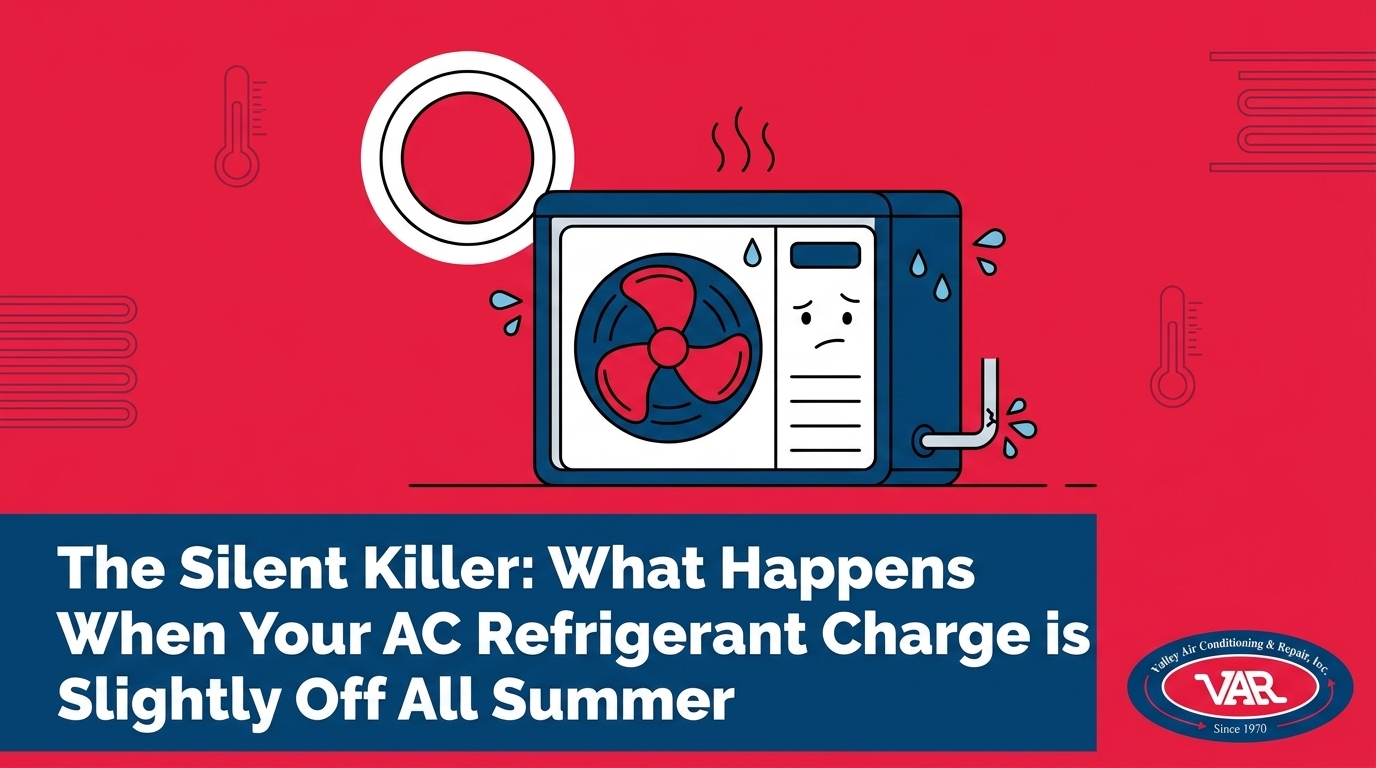
August in the Valley means your cooling system has been running hard for months. If you are wondering what happens when your AC refrigerant charge is slightly off all summer, you are not alone. Many homeowners notice their system running constantly, yet the house still feels uncomfortably warm. By late summer (August) after 3 months of wear, what started as a minor drop in cooling power can quietly turn into a major mechanical emergency.
For professional air conditioning services or to establish a routine AC maintenance plan, our team is always ready to help you protect your investment.
A slight refrigerant undercharge acts as a silent killer for your air conditioner. Because the system does not fail immediately, it is easy to ignore the warning signs. You might just bump the thermostat down another degree and assume the extreme heat is to blame. However, running your system with even a slightly low charge forces the compressor to work overtime. By the time you reach the end of the cooling season, that undetected slow leak has caused massive, cumulative wear and tear on your equipment.
Common signs your system is struggling:
• Nonstop cycling: The unit runs continuously but never reaches your target temperature.
• Lukewarm air: The air coming from your vents feels cool, but not cold.
• Spiking bills: Your energy usage is significantly higher than it was at this time last year.
• Humid indoors: The air inside your home feels heavy, sticky, and uncomfortable.
There is a widespread myth that air conditioners naturally "use up" or "burn through" refrigerant over time, much like a car consumes gasoline. Here is the truth: your AC operates on a closed-loop system. The refrigerant absorbs heat from inside your home and releases it outside, traveling back and forth in a continuous cycle. It never gets consumed. If your refrigerant levels are low, it always means one thing—you have a leak.
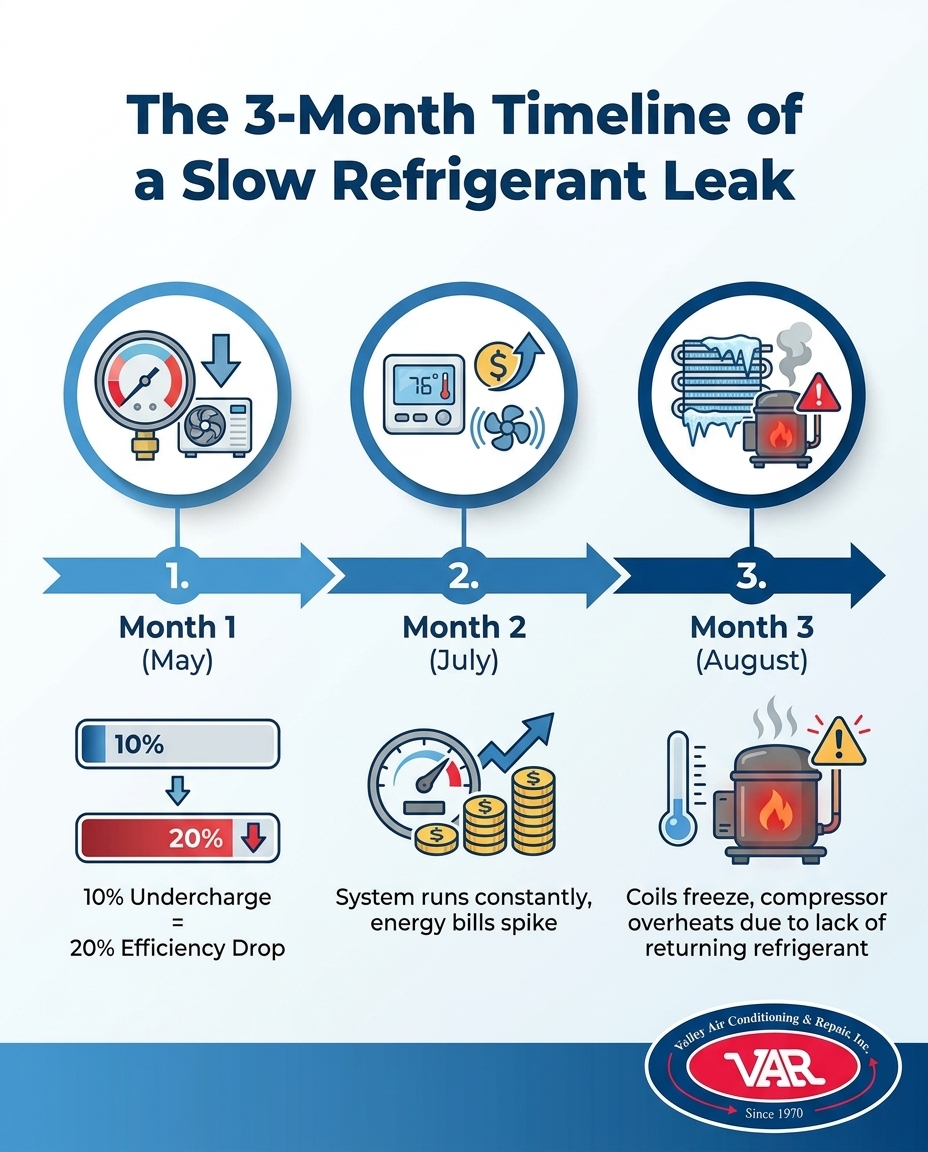
Even a tiny micro-leak creates an immediate drop in efficiency. According to Department of Energy data, an undercharge of just 10% can reduce your system's operating efficiency by 20% or more. In a place like Fresno CA, where the heat is relentless, that 20% drop translates to an air conditioner that simply cannot keep up with the afternoon sun.
When your system lacks the proper volume of refrigerant, it cannot absorb enough heat from your indoor air. To compensate, the system runs longer cycles, consuming far more electricity. Having a solid grasp on understanding AC refrigerant leaks early in the season is the best way to avoid massive utility bills and unnecessary mechanical strain.
The damage caused by low refrigerant does not happen overnight. It compounds over time. When you reach late summer (August) after 3 months of wear, the cumulative stress on your compressor reaches a critical threshold. Here is how a slow leak progresses throughout the cooling season:
1. May and June (The Start): A microscopic leak begins to vent refrigerant. The system loses a small percentage of its charge. You might not notice a change in comfort, but the AC starts running slightly longer cycles to cool the house. Your energy bills creep up, but you likely attribute it to the changing weather.
2. July (The Strain): The system is now noticeably undercharged. It begins running almost constantly during the day. The compressor is working overtime, and the internal components are starting to run hotter than they were designed to. Your energy bills spike significantly.
3. August (The Breaking Point): The cumulative wear takes its toll. The compressor has been deprived of proper cooling and lubrication for months. The system struggles to drop the indoor temperature below 78 degrees, and the risk of catastrophic compressor failure is at its absolute highest.
Every single hour your system runs with a low charge compounds the stress on the motor. Ignoring the issue early in the summer guarantees a much larger problem by the time the hottest weeks arrive.
To understand why an undercharge is so destructive, you have to look at how the compressor actually survives the summer. Refrigerant does not just cool the air inside your home; the returning cold refrigerant is also responsible for cooling the compressor motor itself. When the charge is low, the refrigerant returning to the outdoor unit is too warm to adequately cool the motor.
This mechanical reality becomes a massive liability when the weather heats up. With Fresno's frequent 100-degree-plus days, the ambient temperature outside is already pushing your equipment to its limits. When you combine those 100°F+ afternoon temperatures with a lack of internal cooling from the refrigerant, the compressor motor begins to severely overheat.
One typical pattern we see often—such as during a pre-purchase home inspection when a buyer requests an honest and quick AC check—is a system that appears to work fine in the morning but is secretly starved for refrigerant. It might pass a basic visual inspection, but the moment those extreme afternoon temperatures hit, that minor deficit becomes a major liability. Thirty or more days of this extreme heat acts as a multiplier, rapidly accelerating the wear on an undercharged system.
Running an air conditioner without enough refrigerant triggers a destructive chain reaction throughout the entire system. It is not just about the air feeling warmer; it is about the internal physics of the equipment breaking down.
• Frozen Evaporator Coils — The Mechanical Cause: Low refrigerant causes a massive pressure drop inside the indoor coil, forcing condensation to freeze into solid ice. — The Required Solution: Turn the system off immediately to let the ice thaw, then have a professional locate and repair the leak.
• Warm Air from Vents — The Mechanical Cause: The block of ice on the coil restricts all airflow, meaning the blower motor is just circulating warm, unconditioned indoor air. — The Required Solution: Restore proper refrigerant levels and verify the blower motor hasn't been damaged by the airflow restriction.
• Compressor Failure — The Mechanical Cause: Refrigerant carries essential lubricating oil back to the compressor. Low charge traps the oil in the lines, causing metal-on-metal grinding. — The Required Solution: Advanced diagnostics to fix the leak before the lack of lubrication permanently destroys the compressor motor.
Seeing ice on your refrigerant lines or your indoor coil in the middle of summer is a classic sign of low pressure. A typical pattern we see often—like when a homeowner's system completely stopped working during a brutal 110-degree heatwave while they were homebound—is that the root cause traces back to a frozen coil that finally triggered a total shutdown. Running the system while it is frozen forces the compressor to pump liquid refrigerant instead of vapor, which can easily destroy the internal valves. If you see ice, turn the thermostat off immediately.
By the time late summer (August) after 3 months of wear rolls around, many homeowners are desperate for a quick fix. When a technician confirms the system is low on refrigerant, the most common question is, "Can't you just top it off?"
This is the late-summer "top-off" trap. Adding refrigerant without finding and fixing the leak means the system will simply leak again. Depending on the size of the hole, that expensive new refrigerant could vanish in a matter of weeks, or even days. Furthermore, the Environmental Protection Agency (EPA) has strict regulations regarding the intentional venting of refrigerants into the atmosphere due to their environmental impact. Licensed professionals are required to handle these chemicals responsibly.
A cheap, rushed "top-off" mentality almost always costs more in the long run. You are essentially paying to put a band-aid on a gaping wound, while the underlying compressor damage continues to compound. The smartest financial move is to invest in finding the actual leak. Enrolling in a routine AC maintenance plan is one of the most effective ways to monitor your system's pressures year over year and catch these micro-leaks before they cause catastrophic failure.
Standard gauge checks during a rushed service call might easily miss a slow, microscopic leak. To truly protect your system, you need advanced diagnostics that remove the guesswork. Professional HVAC technicians use highly specialized tools to track down exactly where the refrigerant is escaping.
Professional leak detection methods include:
• Electronic Sniffers: Highly sensitive wands that detect the chemical presence of refrigerant in the air near the coils and copper lines.
• UV Dye Testing: A specialized fluorescent dye is injected into the system. As it circulates, it seeps out of the leak, glowing brightly under a UV flashlight.
• Nitrogen Pressure Testing: The remaining refrigerant is safely recovered, and the system is pressurized with dry nitrogen. Technicians listen for hissing and watch for pressure drops on their digital gauges to pinpoint the exact location of the failure.
At Valley Air Conditioning & Repair, our precision diagnostic capabilities catch slow, hidden leaks before they destroy a compressor. By finding the source of the problem in a place like Fresno CA, we can restore your system's cooling capacity and extend its lifespan. The absolute best time to catch these issues is during residential pre-season preparation, ensuring your charge is perfectly balanced before the extreme heat ever arrives.
Yes, running your system with low refrigerant is one of the fastest ways to destroy a compressor. The refrigerant is responsible for cooling the compressor motor and carrying lubricating oil through the lines. Without enough of it, the motor overheats, the oil gets trapped, and the internal parts grind together until they fail completely.
You should never intentionally run an air conditioner that is low on refrigerant. While the system might physically turn on and blow air for weeks or even months, every hour it runs undercharged causes cumulative mechanical damage. During 100°F+ afternoon temperatures, running an undercharged system can cause permanent failure in a matter of days.
No, you cannot just add refrigerant without addressing the underlying issue. Because your AC is a closed-loop system, a low charge means there is a leak somewhere in the coils or copper lines. Adding more refrigerant without fixing the leak is a waste of money, as the new chemical will simply leak out again.
The most common symptoms include the system running constantly without cooling the house, slightly warmer air blowing from the vents, unexpectedly high energy bills, and ice forming on the indoor evaporator coil or outdoor copper lines. You might also hear a faint hissing or bubbling sound near the AC unit.
When refrigerant levels drop, the pressure inside the indoor evaporator coil drops as well. This lower pressure causes the temperature of the coil to plummet below freezing. As warm, humid air blows across the super-chilled coil, the condensation instantly freezes into a solid block of ice, blocking all airflow into your home.
Ignoring a slight undercharge turns a minor repair into a major headache. What happens when your AC refrigerant charge is slightly off all summer is that your compressor is forced to work harder, run hotter, and operate without proper lubrication. By the time late summer (August) after 3 months of wear arrives, your system is on the brink of total failure.
Remember that refrigerant issues always require licensed professionals to handle safely and legally. Do not settle for a temporary top-off that leaves your system vulnerable to the next heatwave. Invest in precision diagnostics to find the leak, repair the root cause, and ensure your cooling system runs efficiently and reliably for years to come.

As a business with many AC units, it is essential to have a responsive AC company. Valley Air Conditioning understands our needs. They are always responsive and our AC is up and running very quickly.
I had them do an AC check on the home I was buying, they were honest and quick. I hired them to do the summer and Fall maintenance for $149. Happy with this company!
100% recommend. I called, same day they came out and gave me estimate. Conley was honest and didn't try to recommend/sell us anything we didn't need. When I called him with questions before making a decision, he happily answered and was not annoyed by me contacting him. Conley and VAR
This is a group of good people. Very professional and knowledgeable. They take the time to listen and find the best solution that fits best for any situation. There's no way you can go wrong in choosing VAR.
We have used Valley Air for over fifteen years. The last two years ,Matt came to our house to service twice a year. Always on time, so polite and so professional. This is a very honest company and you can always depend on them and trust them. The office always treats everyone cheerfully and always want to do what you need done very fast YOU CAN COUNT ON THIS Company