.webp)


Common Homeowner Questions Answered: Why Does My Heater Smell Like It's Burning?
Is that burning smell normal? We have your common homeowner questions answered. See why fall dust burn-off happens and when to call a professional.
When our team at Valley Air Conditioning & Repair looks at the most common homeowner questions answered during the fall transition, one panicked inquiry always tops the list: "Why does my heater smell like it's burning?" You switch your thermostat to "heat" on the first cold morning of the year, and within minutes, a strange, earthy odor fills your hallways. Your mind immediately jumps to the worst-case scenario, worrying that a mechanical failure is about to cause a house fire.
This anxiety is completely understandable. Heating equipment fires are a legitimate safety concern, and any burning smell inside your home deserves immediate scrutiny. However, as our technicians frequently reassure customers, the odor you experience during a late October heating startup is usually a harmless, temporary process known as dust burn-off. To understand why this happens, you have to look at what your heating system has been doing for the past six months: absolutely nothing.
After relying heavily on your air conditioning services all summer, your furnace's heat exchanger has been sitting completely dormant in the dark. The heat exchanger is a series of metal coils or tubes that get incredibly hot to warm the air circulating through your vents. While the AC was running, the blower motor constantly moved indoor air—and microscopic airborne particles—across these dormant heating components.
Over the course of a long summer, a fine layer of household dust, pet dander, and microscopic debris settles directly onto the cold metal of the heat exchanger. When you finally trigger that first heating cycle, the burners ignite, the metal rapidly heats up to hundreds of degrees, and that accumulated layer of dust instantly incinerates. The resulting smell is pushed directly into your ductwork and distributed into every room of your house simultaneously, making the odor seem much more severe than it actually is.
While dust burn-off happens everywhere in the country, the severity of the smell is highly dependent on your local climate. Homeowners in the Fresno / Central Valley area experience a much more intense version of this autumn phenomenon due to our unique regional geography and long, dry agricultural summers.
According to data from the San Joaquin Valley Air Pollution Control District, our region experiences uniquely high levels of airborne particulate matter—specifically PM2.5 and PM10—during the dry summer months. Because the Central Valley sits in a geographic bowl, stagnant high-pressure systems trap agricultural dust, dry soil particles, and harvest-season debris close to the ground. Even with a high-quality air filter in place, microscopic particulate matter inevitably makes its way into your HVAC system over a six-month cooling season.
This heavy regional dust load means that the layer of debris coating your heat exchanger is thicker and more complex than what someone in a wetter, coastal climate might experience. When you initiate that late October heating startup, you are not just burning off standard household lint; you are incinerating months of compacted Central Valley agricultural dust. This creates a highly distinct, pungent odor that can easily alarm someone who isn't expecting it.
Understanding exactly how this regional climate impacts your HVAC equipment is a core part of our local expertise. In our years of servicing Fresno homes, we see firsthand how agricultural dust accelerates wear and tear on blower motors and heavily coats internal heating components. Just as you might need professional AC repair in Fresno to clean impacted evaporator coils in July, our team stresses that your furnace requires the same level of attention to manage heavy dust accumulation before the fall heating season begins.
Knowing that dust burn-off is a normal part of the fall transition helps ease the mind, but you still need clear, time-bound safety thresholds to know exactly when a smell crosses the line from normal to dangerous. For anxious homeowners calling our dispatch center during their first late October heating startup, we advise using a strict 15-to-30 minute rule based on what we typically see in the field.
If the odor is strictly related to seasonal dust accumulation, the smell should peak within the first five minutes of operation and completely dissipate within half an hour. Here is the step-by-step process you should follow when turning on your heater for the first time:
1. Check the clock immediately: Note the exact time you switch the thermostat to "heat." Do not rely on guessing how much time has passed, as five minutes can feel like an hour when you are worried about a fire.
2. Ventilate the home proactively: Before the system even kicks on, open a few windows at opposite ends of the house. This creates cross-ventilation, allowing the initial burst of burnt-dust odor to escape rather than lingering in your living room and triggering smoke detectors.
3. Monitor the vents: Stand near a supply register and pay attention to the smell. It should smell distinctly like dusty, dry earth or warm lint. The intensity should begin fading noticeably after the first complete heating cycle (usually 10 to 15 minutes).
4. Assess the 30-minute mark: If the system has been running for half an hour and the smell is completely gone, your system has successfully cleared its summer dust buildup. You can safely close the windows and resume normal operation.
If the smell persists beyond this 30-minute window, or if it returns every single time the furnace kicks on throughout the day, it elevates from a normal seasonal occurrence to a potential mechanical issue. A persistent burning smell indicates that dust is actively being pulled into the heat exchanger (likely due to a severely clogged filter) or that a component is continually overheating.
While the 15-to-30 minute rule applies to the smell of burning dust, there are certain odors that you should never wait out. Distinguishing between harmless dust and a dangerous electrical or combustion issue is the most important skill a homeowner can learn before winter arrives.
According to National Fire Protection Association (NFPA) heating safety statistics, heating equipment is a leading cause of home fire deaths. This makes it critical to shut your system down at the thermostat immediately if you detect any abnormal warning signs. Just as our technicians emphasize that a rattling compressor requires a prompt AC diagnostic service during the summer, heating anomalies require immediate professional intervention.
The problem: Electrical components, wiring insulation, and blower motors can overheat or short-circuit, creating a severe fire hazard inside the furnace cabinet.
The cause: Aging equipment, loose electrical connections, failing capacitors, or a seized blower motor can draw excessive amperage, causing the protective plastic coating on wires to melt. Alternatively, a cracked heat exchanger or a blocked flue pipe can cause dangerous combustion gases to spill into the home.
The solution: Turn the thermostat to "off" immediately. Do not attempt to open the furnace cabinet to investigate the source of the smell yourself. Call a licensed HVAC technician to inspect the system safely.
To help you quickly identify when to take action, use this comparison guide for furnace odors:
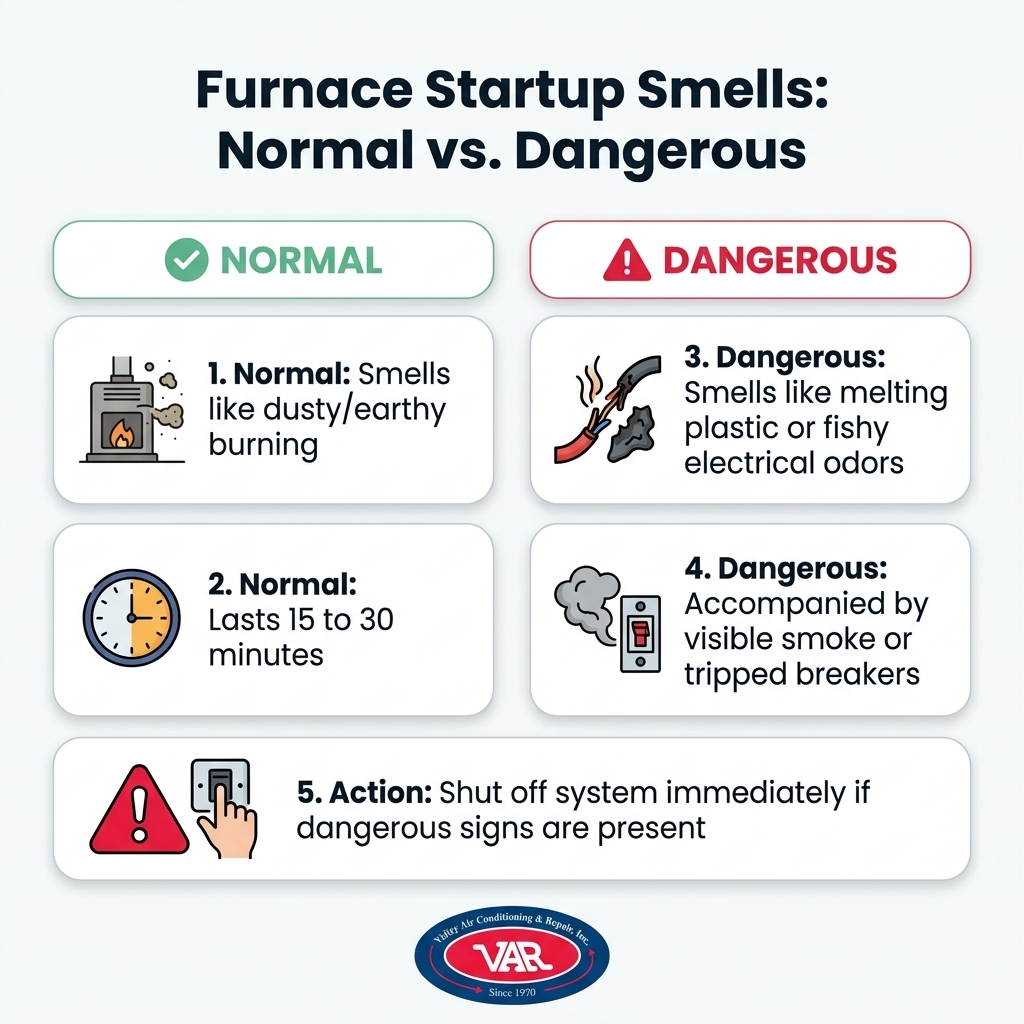
• Dry, earthy, or warm lint smell — Likely Cause: Normal summer dust burn-off on the heat exchanger. — Required Action: Monitor for 15-30 minutes. Open windows to ventilate.
• Acrid, melting plastic, or burning rubber — Likely Cause: Overheating electrical wires, melting insulation, or a failing capacitor. — Required Action: Shut system down immediately. Call a professional.
• Sharp, metallic, or "fishy" electrical smell — Likely Cause: A seized blower motor or severe electrical short circuit. — Required Action: Shut system down immediately. Check for tripped breakers.
• Rotten eggs or sulfur — Likely Cause: A natural gas leak near the furnace or gas valve. — Required Action: Evacuate the home immediately. Call the gas company.
In addition to odors, visual and auditory warnings demand immediate action. If you see visible smoke coming from your vents, hear loud electrical popping noises, or notice that the furnace repeatedly trips your electrical circuit breaker, do not try to reset the system. A tripping breaker is a critical safety mechanism doing its job to prevent an electrical fire.
The best way to handle the anxiety of a late October heating startup is to prevent the heavy dust burn-off altogether. Transitioning your HVAC system from cooling to heating shouldn't be a dramatic event. By taking a few proactive steps before the temperature drops, you can ensure a smooth, odor-free start to the winter season.
First and foremost, change your air filter before you turn the heater on for the first time. Over the summer, your filter has been working overtime to trap Fresno / Central Valley agricultural dust. Starting the heating season with a clogged filter severely restricts airflow. When the blower motor cannot push enough air over the heat exchanger, the metal gets much hotter than it was designed to, baking the accumulated dust even harder and making the burning smell much worse. A fresh filter ensures proper airflow and reduces the strain on the entire system.
Secondly, consider the value of professional fall preparation. During a comprehensive fall tune-up, a technician physically cleans the burner assembly, wipes down the accessible areas of the heat exchanger, and tightens all electrical connections. They also test the safety limit switches that prevent the furnace from overheating. Having a professional clear away the summer dust buildup means there is very little left to burn off when you finally switch the thermostat to heat. Additionally, if your system is aging, this is a great time to explore upgrades, as generic federal tax credits and local utility incentive programs may apply to qualifying high-efficiency installations (always verify current programs with your utility or tax professional).
In our daily service routes across Fresno, we often draw a direct parallel between unexpected fall heating issues and sudden summer cooling failures. Homeowners who skip spring maintenance often face sudden AC breakdowns in July. Similarly, those who skip fall maintenance are the ones most likely to experience alarming odors, tripping breakers, or complete furnace failures on the first freezing night of the year. Enrolling in a routine maintenance plan guarantees that your equipment is cleaned, inspected, and safely prepared for the heavy lifting of the season ahead.
Before we address the specific heating questions below, remember that many of these seasonal transition principles apply year-round. Just as you might urgently search for what to do if your AC is not turning on during a summer heatwave, a furnace failure in late autumn requires the same prompt, educated response. Here are direct, authoritative answers from our experienced Valley Air Conditioning & Repair technicians to the most common concerns we hear during the fall transition.
The smell of burning dust is caused by the accumulation of microscopic debris on your furnace's heat exchanger over the summer months. Because the heating components sit dormant while you use your air conditioner, household lint and airborne particles settle on the cold metal. When you turn the heater on for the first time, the heat exchanger rapidly warms up, incinerating that layer of dust and pushing the odor through your vents.
A normal dust burn-off smell typically lasts between 15 and 30 minutes. The odor will be strongest during the first five minutes of operation and should steadily dissipate as the heating cycle continues. The smell should not persist for hours, nor should it return strongly on subsequent heating cycles throughout the week.
You should worry if the burning smell lasts longer than 30 minutes, or if the odor profile changes from dry dust to something synthetic. If your furnace smells like melting plastic, burning rubber, or hot electrical wires, it indicates a serious mechanical or electrical failure. Additionally, if the smell is accompanied by visible smoke or a tripped circuit breaker, shut the system down immediately.
Yes, it is generally safe to run your furnace for the first 15 to 30 minutes of the season if the smell is strictly related to burning dust. Opening a few windows will help clear the air quickly. However, it is never safe to run the furnace if you detect electrical odors, chemical smells, smoke, or the scent of rotten eggs (which indicates a gas leak).
An electrical fire or overheating component in a furnace produces a sharp, acrid odor that is distinctly different from the dry, earthy smell of burning dust. It often smells like melting plastic, burning rubber, or even has a strange "fishy" scent, which is caused by the chemical breakdown of wire insulation and plastic casing under extreme heat.
Experiencing a burning smell during your late October heating startup is understandably stressful, but knowing the difference between normal dust burn-off and a true emergency puts you back in control. Remember that a brief, dusty odor lasting 15 to 30 minutes is simply your system clearing its throat after a long summer in the Fresno / Central Valley heat.
However, safety should always remain your top priority. If an odor feels wrong, persists too long, or smells electrical, never hesitate to shut the equipment off. By staying vigilant, changing your filters, and relying on local experts for routine inspections, you can ensure your heating system is clean, safe, and fully prepared to keep your home comfortable all winter long.

As a business with many AC units, it is essential to have a responsive AC company. Valley Air Conditioning understands our needs. They are always responsive and our AC is up and running very quickly.
I had them do an AC check on the home I was buying, they were honest and quick. I hired them to do the summer and Fall maintenance for $149. Happy with this company!
100% recommend. I called, same day they came out and gave me estimate. Conley was honest and didn't try to recommend/sell us anything we didn't need. When I called him with questions before making a decision, he happily answered and was not annoyed by me contacting him. Conley and VAR
This is a group of good people. Very professional and knowledgeable. They take the time to listen and find the best solution that fits best for any situation. There's no way you can go wrong in choosing VAR.
We have used Valley Air for over fifteen years. The last two years ,Matt came to our house to service twice a year. Always on time, so polite and so professional. This is a very honest company and you can always depend on them and trust them. The office always treats everyone cheerfully and always want to do what you need done very fast YOU CAN COUNT ON THIS Company