Can I Use My Evaporative Cooler and Central Heating on the Same Day?
Can I Use My Evaporative Cooler and Central Heating on the Same Day?
Navigating Extreme Temperature Swings with Dual HVAC Systems
You wake up to a chilly house, grabbing a sweater just to walk into the kitchen. But fast forward eight hours, and that same house feels like an oven as the afternoon sun beats down on the roof. Here at Valley Air Conditioning & Repair, we frequently get asked by homeowners navigating these wild daily temperature shifts: Can I use my evaporative cooler and central heating on the same day? The short answer is yes, you absolutely can use both systems safely within a single 24-hour period. However, doing so requires strict discipline regarding your home's airflow and window management.
During the September early fall transitions, it is common to experience a 30- to 40-degree temperature swing from dawn to dusk. You might see morning lows in the 50s and afternoon highs pushing well into the 90s. This creates a unique operational conflict for homeowners. One system requires a tightly sealed environment to function, while the other demands constant, open airflow to push hot air out. If you rely on an evaporative cooler to handle the afternoon heat, mastering this daily transition is essential to staying comfortable without wasting energy.
Operating these two systems back-to-back is entirely safe, provided you follow a strict daily timeline. The secret lies in understanding the physical requirements of each unit and never allowing their operational windows to overlap. By establishing a clear morning, midday, and afternoon routine, you can conquer the shoulder season's unpredictable weather.
Why Evaporative Cooling and Central Heating Have Conflicting Airflow Rules
To understand why transitioning between these systems requires manual intervention, you have to look at the physics of how they condition the air inside your home. They operate on completely opposite principles. In our years of servicing HVAC systems across the Fresno Central Valley, we've seen firsthand that failing to respect these differences during weather shifts will lead to massive energy waste, poor indoor air quality, and deep discomfort.
When you run a central heating system, you are relying on a closed loop. The system pulls existing indoor air through return vents, heats it over a heat exchanger, and pushes it back into the rooms. Conversely, an evaporative cooler (often called a swamp cooler) is an open-loop system. It constantly pulls fresh, hot air from outside, passes it through water-saturated pads to drop the temperature, and blows that newly humidified air into the house. Because it constantly introduces new air, the old air must have a way to escape.
• Evaporative Cooler — Airflow Requirement: Open / Exhaust Path — Consequence of Incorrect Window Setup: Severe humidity buildup, condensation, zero cooling effect.
The Sealed Envelope Requirement for Furnaces
Your furnace is designed to heat a fixed volume of air. Once the air inside your home reaches the target temperature, the furnace shuts off, and the insulation in your walls and attic keeps that heat trapped inside. This is known as maintaining the thermal envelope.
If you leave windows open while the furnace is running, that heated air immediately escapes outdoors. Worse, the negative pressure created by the blower can actually pull freezing outdoor air inside. Your thermostat will register the constant drop in temperature, forcing the furnace to run continuously. This puts immense strain on the blower motor and heat exchanger while sending your utility bills skyrocketing.
The Exhaust Requirement for Swamp Coolers
Evaporative cooling works by adding moisture to the air, which can drop ambient indoor temperatures by 15 to 40 degrees depending on the outdoor humidity. However, this process requires massive air displacement. The cooler is essentially acting as a giant fan pushing a continuous stream of damp air into your living space.
If your windows are closed while the swamp cooler is running, that incoming air has nowhere to go. The house will quickly pressurize, and the cooling effect will stop entirely. Instead of feeling a refreshing breeze, the indoor environment will become stagnant, clammy, and oppressively humid. Over time, our technicians have seen that running a swamp cooler in a sealed house can even cause condensation to form on walls and damage drywall or wood floors. You must provide an exhaust path for the humid air to leave the home.
Morning Protocol: Sealing the Home for Efficient Heating
When the sun comes up during the September early fall transitions, the outside air is often biting and cold. This is the time when your furnace needs to do the heavy lifting to bring your home up to a comfortable baseline temperature. To do this efficiently, you must physically prepare the house before the thermostat calls for heat.
We recommend following these specific steps every morning to ensure your heating cycle is efficient and effective:
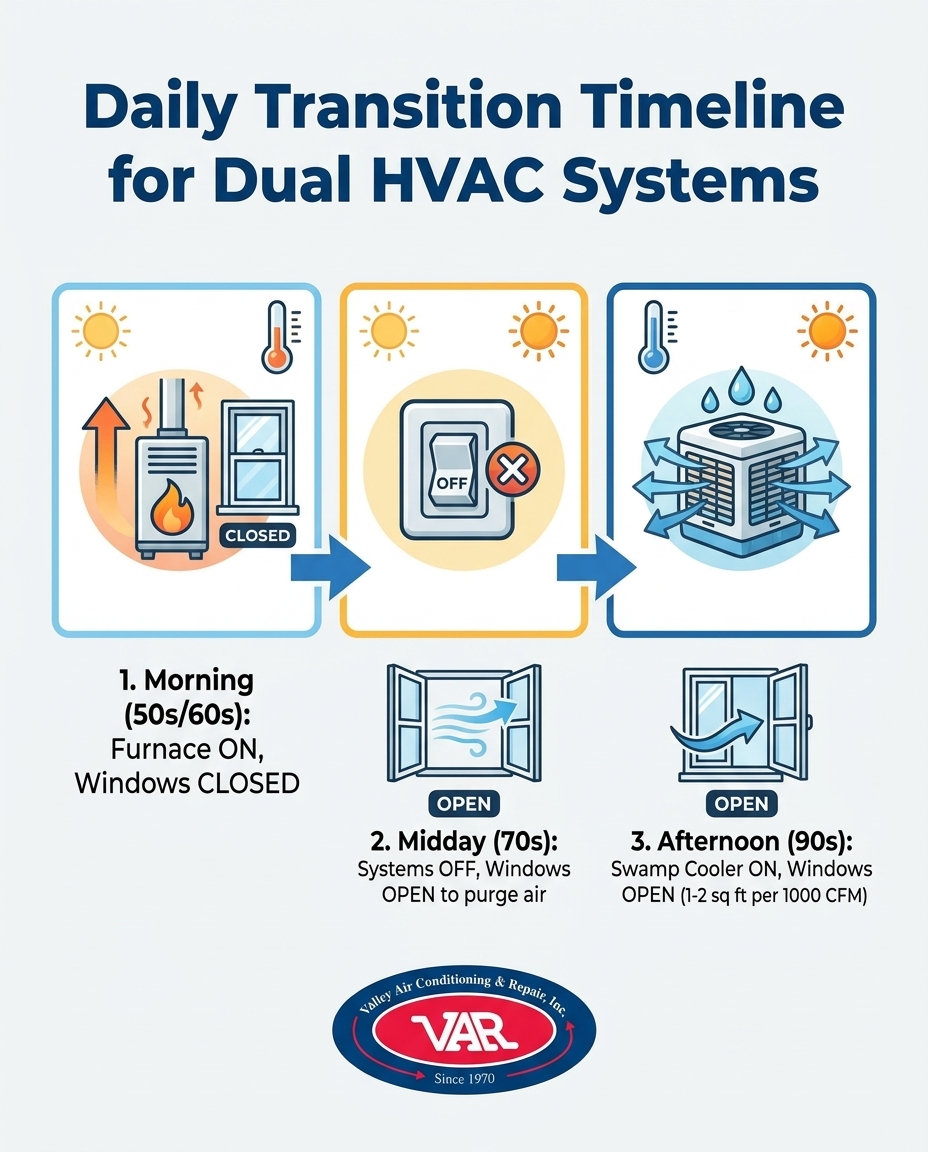
1. Close and latch all windows: Do not just slide the windows shut; physically engage the latches. Latching pulls the window sashes tightly together and compresses the weatherstripping, creating the airtight seal your furnace needs to operate efficiently.
2. Shut the evaporative cooler damper: If your swamp cooler is mounted on the roof and connected to ductwork, it acts as a giant hole to the outside. Ensure the manual or automatic damper is closed. If cold air drops down the cooler duct while the furnace is running, the two systems will fight each other, and you will feel cold drafts in the hallway.
3. Set a conservative target temperature: Because the sun will soon warm the house naturally, avoid cranking the thermostat up to 72 degrees. Set it just high enough to take the chill out of the air—around 66 to 68 degrees.
4. Monitor the sunrise effect: Open your east-facing and south-facing curtains. Let the solar heat gain naturally warm your living spaces, which allows the furnace to cycle off much earlier in the morning.
By strictly enforcing this morning lockdown, your furnace will only need to run for a short period. Once the house reaches a comfortable baseline, the system will shut down, and the sealed envelope will hold that warmth inside.
The Midday Shift: Purging Air Between Heating and Cooling Cycles
As the morning progresses, the rapid mid-morning warm-up typical of the region begins. By 10:00 AM or 11:00 AM, the outside temperature usually matches the indoor temperature. This creates a critical transition phase where neither heating nor cooling is required. Managing this midday shift correctly is the secret to maintaining indoor air quality.
During the Fresno Central Valley transition seasons, you cannot simply switch the thermostat from "Heat" to "Cool" and walk away. You must perform an air purge. A home that has been sealed tight all night and heated by a furnace contains stale air, lingering odors, and trapped carbon dioxide. Before you introduce the high-velocity airflow of an evaporative cooler, you need to equalize the home.
The purge process: First, verify that the central heating system is switched completely to the "OFF" position at the thermostat. Next, open several windows across the house to create cross-ventilation. Allow the natural midday breeze to sweep through the rooms for 30 to 60 minutes. This flushes out the stale, heated air and prepares the home's airflow paths for the upcoming evaporative cooling cycle. It also prevents the sudden shock of pushing damp cooler air into a dry, statically heated environment.
Daily Transition Timeline for Dual HVAC Systems
Afternoon Protocol: Window Management for Effective Swamp Cooling
By mid-afternoon, the outside temperature has peaked, and the house is beginning to feel uncomfortably warm. It is time to transition to cooling. Because evaporative coolers rely on constant air displacement, the success of your afternoon protocol depends entirely on how you manage your windows.
During the September early fall transitions, the dry afternoon heat is perfect for evaporative cooling, but you must balance the exhaust airflow perfectly. The golden rule of swamp cooler operation is providing 1 to 2 square feet of open window space for every 1,000 Cubic Feet per Minute (CFM) of air the cooler produces. For example, if you have a 4,000 CFM cooler, you need roughly 4 to 8 square feet of open window space spread throughout the house.
1. Select the target zones: Decide which rooms you want to cool. The air from the swamp cooler will always take the path of least resistance toward the open windows. If you want the living room and kitchen cool, open the windows in those specific rooms.
2. Crack the windows strategically: Do not throw one window wide open. That will cause all the cooled air to rush out a single exit, leaving the rest of the house hot. Instead, crack multiple windows open about 4 to 6 inches. This forces the cooled air to spread evenly throughout the home before exhausting outside.
3. Adjust based on door pressure: A great way to test if your windows are opened correctly is the door test. Stand in a bedroom with the door slightly ajar. If the door slams shut violently, you need to open the window in that room a bit more. If the air feels stagnant and humid, open the windows wider.
4. Power down at dusk: As the sun sets and the outside air begins to cool off rapidly, turn the swamp cooler off. Leaving it running after the sun goes down will quickly make the house feel damp and chilly, forcing you to use the furnace earlier the next morning.
One of the biggest risks of running two independent HVAC systems in the same house is the potential for mechanical and electrical conflicts. Evaporative coolers and central heating systems should never be controlled by a single, un-zoned standard thermostat setting. If left to run on autopilot, they will inevitably fight each other.
During our fall tune-up visits across the Fresno Central Valley, a common mistake our technicians see is homeowners leaving a programmable thermostat set to "Auto" while operating a swamp cooler manually. If the swamp cooler drops the indoor temperature rapidly, the programmable thermostat might register a temperature drop and automatically trigger the furnace to turn on. This creates a catastrophic "system overlap." The furnace will be burning fuel to heat the house while the windows are wide open, and the swamp cooler is simultaneously blowing cold, damp air inside.
The manual switchover checklist:
• Hard OFF switch: Before opening windows for the swamp cooler, physically switch the central heating thermostat to the "OFF" position. Do not just lower the temperature setting; turn the system off entirely.
• Separate controls: Ideally, your evaporative cooler should be operated by a completely separate wall switch or a dedicated digital controller, keeping it electrically isolated from the central furnace.
• Smart thermostat configurations: If you use a smart thermostat, disable any geofencing or automatic scheduling features during the shoulder seasons. You want absolute manual control over when the heat kicks on.
Keeping Both Systems Ready for Rapid Weather Changes
The transition season is notoriously hard on HVAC equipment because both systems are being pushed into service daily. Fall requires your heating and cooling equipment to be in peak condition simultaneously. You cannot afford to have a furnace failure on a 50-degree morning or a swamp cooler breakdown on a 95-degree afternoon.
During the September early fall transitions, your maintenance routines must overlap. While you are checking the evaporative cooler's water lines, float valve, and pads for mineral buildup, you also need to be checking the furnace's heat exchanger, burners, and air filters. Running a furnace with a clogged air filter will cause it to short-cycle, while running a swamp cooler with degraded aspen pads will result in poor cooling and musty odors.
Professional oversight is critical during this period. Our team at Valley Air Conditioning & Repair has a deep understanding of Central Valley microclimates, and our local experts know exactly how to prep dual-system homes for these specific seasonal demands. Scheduling specific tune-ups that address the unique needs of dual-system households ensures that the rapid switching back and forth doesn't cause undue wear and tear on blower motors or electrical relays. Proper pre-season preparation protects your investment in both systems.
Frequently Asked Questions About Running Dual HVAC Systems
Managing two different climate control methods can feel complicated. Here are the most common questions homeowners in the Fresno Central Valley ask us about balancing their systems.
When should I switch from my swamp cooler to my heater?
You should switch to your heater when outdoor temperatures drop below 60 degrees, which typically happens in the late evening or early morning. Never run the swamp cooler when it is cold outside, as it will just blow damp, chilly air into the house. Ensure all windows are tightly closed and the home is sealed before turning the thermostat to heat.
Do I need to close my windows when the heater comes on?
Yes, absolutely. Leaving windows open while the furnace runs wastes massive amounts of energy and prevents the home from reaching your target temperature. A central heating system relies on a sealed thermal envelope to retain the warmth it generates. Open windows allow heat to escape and force the system to run continuously.
Why is my house so humid when using a swamp cooler?
Humidity builds up rapidly when there isn't enough exhaust airflow for the incoming damp air to escape. To fix this, you must open your windows wider. A good rule of thumb is ensuring you have 1 to 2 square feet of open window space per 1,000 CFM of cooler output to push the moisture outside.
Can you run a swamp cooler and AC at the same time?
No, you should never run them simultaneously. Similar to central heating, refrigerated air conditioning requires closed windows and a sealed home to operate efficiently. Running a swamp cooler requires open windows. Operating them together will ruin the efficiency of the AC and trap humidity inside the ductwork.
How cold is too cold for a swamp cooler?
Evaporative coolers lose their practical benefit and can make a home feel uncomfortably clammy when outside temperatures drop below 70 degrees. At lower temperatures, the air cannot hold as much moisture, meaning the cooling effect diminishes and you are simply blowing cold, wet air into your living space.
Master Your Home's Climate Control This Fall
Successfully navigating the extreme daily temperature swings of the September early fall transitions comes down to disciplined window management and strict thermostat control. By sealing the house for morning heat, purging stale air midday, and opening windows strategically for afternoon cooling, you can stay perfectly comfortable without wasting energy.
Remember that operating two distinct systems daily puts extra strain on your equipment. Keeping both units clean, calibrated, and ready for action is the best way to avoid unexpected breakdowns. If you need help optimizing your home's unique setup, consulting with our local experts for a comprehensive HVAC maintenance plan will ensure clear, practical, and efficient transitions all season long.
As a business with many AC units, it is essential to have a responsive AC company. Valley Air Conditioning understands our needs. They are always responsive and our AC is up and running very quickly.
Brenda F.
I had them do an AC check on the home I was buying, they were honest and quick. I hired them to do the summer and Fall maintenance for $149. Happy with this company!
Gayle B.
100% recommend. I called, same day they came out and gave me estimate. Conley was honest and didn't try to recommend/sell us anything we didn't need. When I called him with questions before making a decision, he happily answered and was not annoyed by me contacting him. Conley and VAR
Erma C.
This is a group of good people. Very professional and knowledgeable. They take the time to listen and find the best solution that fits best for any situation. There's no way you can go wrong in choosing VAR.
Gabriel A.
We have used Valley Air for over fifteen years. The last two years ,Matt came to our house to service twice a year. Always on time, so polite and so professional. This is a very honest company and you can always depend on them and trust them. The office always treats everyone cheerfully and always want to do what you need done very fast YOU CAN COUNT ON THIS Company


.webp)