.webp)


The Importance of Checking Carbon Monoxide Detectors Before Furnace Season
Firing up a dormant gas furnace without verifying your CO monitors is a massive household risk. Take five minutes to ensure your safety before the first chilly autumn night.
As summer winds down in the Central Valley, understanding the importance of checking carbon monoxide detectors before furnace season is the most critical step in your home's fall preparation. Soon those triple-digit afternoons will give way to crisp, chilly evenings, and you will be walking over to the thermostat to switch your system from cooling to heating for the first time in months. Before you hear that first click and whoosh of warm air, there is a crucial safety step you must take. Firing up a dormant gas furnace without verifying that your home's detectors are functional, properly placed, and unexpired is a massive risk to your household. Taking just five minutes to test these devices right now is the most important decision you can make for your family's safety during the September pre-heating transition.
When you are ready to ensure your entire system is safe, explore our heating services and secure your preventative maintenance plan.
Many homeowners assume that because their heating system worked perfectly last winter, it is automatically safe to operate this year. This is a dangerous misconception. Over the long spring and summer months, your gas furnace has been sitting completely idle. Dust settles, components experience subtle shifts from temperature changes, and metal parts remain cold. When you suddenly demand intense heat from that dormant system, you are putting it under immediate mechanical stress.
Your carbon monoxide detector is your absolute first line of defense against any hidden failures within that system. While professional technicians focus heavily on the mechanical integrity of your heating equipment, the simple plastic device mounted on your hallway wall is the only thing standing between your family and an invisible threat. If that detector has dead batteries, is placed in the wrong location, or has quietly passed its internal expiration date, it cannot protect you when you need it most.
The goal of the September shift is to be proactive rather than reactive. By dedicating a few moments to your carbon monoxide alarms right now, you eliminate the guesswork. You ensure that when the first genuine cold snap arrives, you can heat your home with complete peace of mind, knowing your early warning system is fully active and ready to do its job.
To understand why carbon monoxide leaks happen, you have to look at the physical mechanics of your heating system. Gas furnaces generate heat by burning fuel inside a sealed metal chamber called a heat exchanger. The toxic combustion gases—including carbon monoxide—remain safely contained inside this metal chamber and are vented out of your home through a flue pipe. Meanwhile, your blower motor pushes clean indoor air over the outside of the hot metal chamber, warming the air before circulating it through your vents.
When your furnace sits unused for half the year, the metal heat exchanger remains cold and contracted. In the Fresno Central Valley, the abrupt transition from intense summer heat to chilly winter nights means your heating system goes from zero usage to high demand almost overnight. This sudden demand forces the cold metal to heat up rapidly.
As the furnace fires up, the heat exchanger is blasted with intense flames. The metal expands quickly under the heat and then contracts again when the heating cycle ends. Over years of operation, this constant expansion and contraction causes metal fatigue. Eventually, the stress becomes too much, and microscopic cracks begin to form in the heat exchanger walls. These micro-cracks are incredibly dangerous because they breach the sealed system.
When a heat exchanger cracks, the toxic gases inside are no longer fully contained. As the blower fan kicks on to circulate air through your house, the change in air pressure can pull carbon monoxide out of the cracked chamber and push it directly into your living spaces. Because these micro-cracks are often invisible to the naked eye, they require professional detection. This is why thorough residential pre-season preparation is so critical. A trained technician can inspect the integrity of the metal, while your wall-mounted detector serves as the immediate safety net if a crack develops mid-season.
Carbon monoxide (CO) has earned the grim nickname of the "silent killer" for a very specific reason: it is entirely undetectable by human senses. It is a colorless, odorless, and tasteless gas. Unlike a natural gas leak, which utility companies treat with a chemical additive that smells like rotten eggs, carbon monoxide gives off absolutely no warning signs in the air. You cannot see a haze, you cannot smell a chemical odor, and you cannot taste it in the back of your throat.
Because human senses fail to detect it, the only way most people realize they are being exposed to carbon monoxide is when physical symptoms begin to appear. Unfortunately, these symptoms are notoriously deceptive.
• Mild exposure: Causes dull headaches, mild dizziness, fatigue, and slight nausea.
• Moderate exposure: Leads to severe throbbing headaches, confusion, vomiting, and a rapid heart rate.
• Severe exposure: Results in unconsciousness, permanent neurological damage, and can be fatal.
The danger is compounded by the time of year. Because furnaces are turned on during the fall and winter, these symptoms are almost always mistaken for the seasonal flu or a common cold. A family might assume they just caught a bug, take some medicine, and go to sleep—which is the absolute worst thing to do when carbon monoxide is present in the home. Pets and small children often show symptoms first due to their smaller body mass and faster respiratory rates.
This is exactly why electronic detection is a non-negotiable requirement for any home that utilizes gas-heating appliances, water heaters, or fireplaces. While upgrading your indoor air quality solutions can dramatically improve your home's overall health and comfort, a dedicated carbon monoxide detector is the only device designed specifically to alert you to this life-threatening gas before physical symptoms ever have a chance to develop.
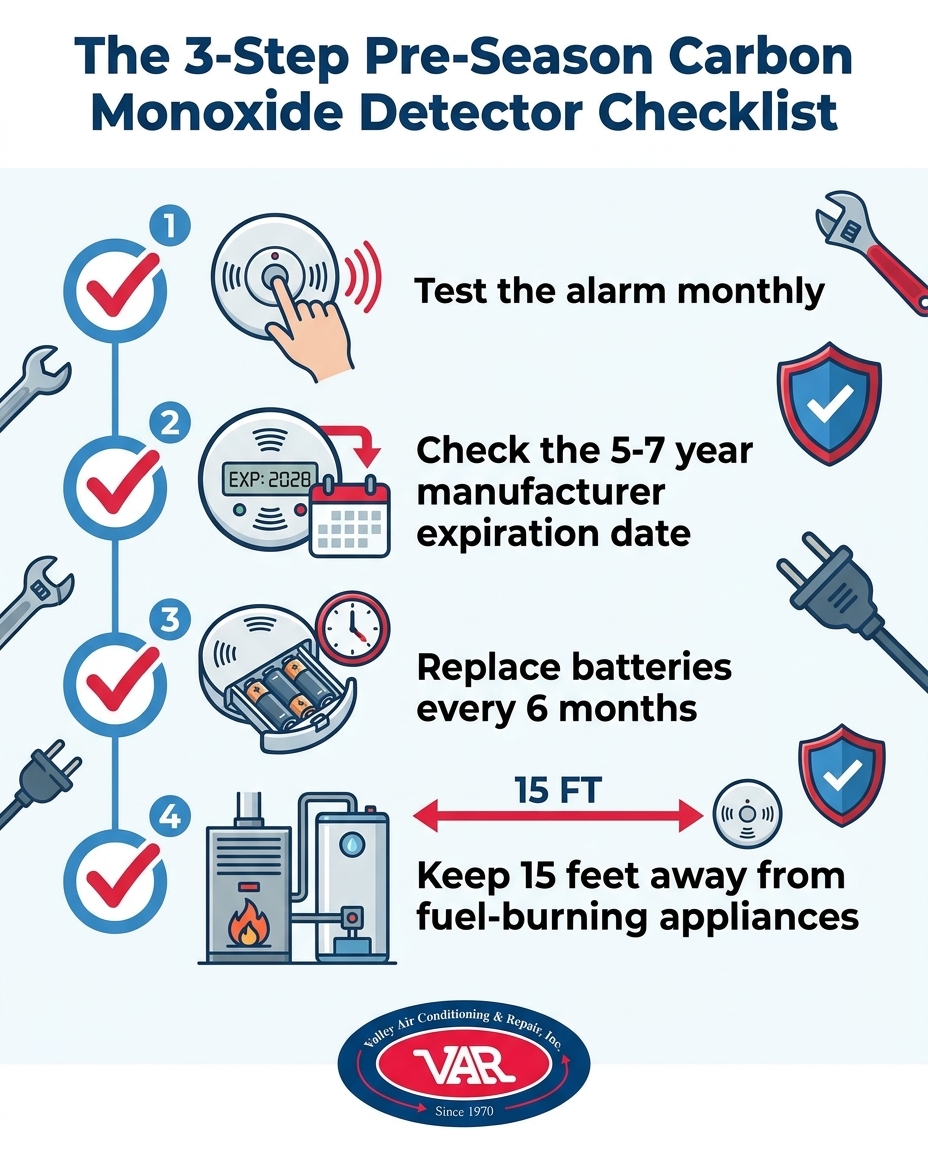
Preparing your home for the heating season does not have to be complicated, but it does need to be thorough. The September pre-heating transition is the ideal time to walk through your house and verify that every detector is fully operational. Follow this simple three-step checklist to ensure your early warning system is ready for the months ahead.
• Step 1: Test the alarm mechanism. Press and hold the "Test" button on the front of the unit. You should hear a loud, piercing pattern of four beeps, followed by a pause, and then four more beeps. This confirms that the internal circuitry and the speaker are functioning correctly.
• Step 2: Check the expiration date. Remove the detector from its mounting bracket and look at the back. You will find either a "Manufactured On" date or a "Replace By" date printed on the sticker. If the unit is past its lifespan, it must be replaced immediately, regardless of whether it still beeps when tested.
• Step 3: Replace the backup batteries. Even if your home has hardwired carbon monoxide detectors that tie directly into your electrical system, they contain backup batteries. These batteries ensure the device continues to monitor the air during winter power outages. Swap them out with fresh batteries every single fall.
Timing matters when it comes to heating safety. Completing this checklist before you turn on your furnace ensures that your safety net is active during that crucial first heating cycle, which is when dormant dust and potential mechanical stresses are most likely to cause issues. Furthermore, checking your units early gives you plenty of time to purchase replacement detectors or fresh batteries without rushing around on a freezing night when you desperately want to turn the heat on.
During our fall maintenance visits across the Central Valley, our technicians at Valley Air Conditioning & Repair, Inc. routinely find expired CO detectors still mounted on walls, giving homeowners a false sense of security. One of the most dangerous myths among homeowners is the belief that a carbon monoxide detector will last forever as long as the batteries are changed. This is entirely false. Unlike basic smoke detectors, which can sometimes last a decade, carbon monoxide detectors have a strict 5-7 year manufacturer expiration date. Understanding why this expiration date exists is critical to your family's safety.
The core component of a CO alarm is the electrochemical sensor. Inside this sensor is a specific chemical solution that reacts with carbon monoxide gas to generate a small electrical current. When the current reaches a certain threshold, the alarm sounds. Over the course of 5 to 7 years, that chemical solution naturally degrades and dries up. As it dries out, the sensor loses its sensitivity. Eventually, it becomes completely blind to carbon monoxide.
The terrifying part is that an expired detector will still beep loudly when you press the test button, because the battery and the speaker still work. You might think you are protected, but the internal sensor is actually dead.
Most modern units are designed to warn you when they reach the end of their lifespan, but homeowners often confuse this warning with a low battery.
• Low Battery Chirp: Typically a single chirp every 60 seconds, accompanied by a flashing light.
• End-of-Life Chirp: Often a double chirp every 30 seconds, or a specific error code on the digital display (such as "ERR" or "END").
Never ignore an end-of-life chirp, and never assume fresh batteries will fix an expired unit. To find out exactly how old your detector is, twist it off its base and look at the manufacturer sticker on the back. If it is older than seven years, throw it away and install a new one immediately.
Buying the best carbon monoxide detector on the market won't do you much good if it is installed in the wrong place. Carbon monoxide mixes evenly with indoor air, meaning it doesn't necessarily rise to the ceiling like smoke or sink to the floor like certain heavy chemicals. Because of this, strategic placement is all about intercepting the gas before it reaches your family.
Follow these placement rules to ensure maximum coverage across your home:
1. Install one on every level: Your home should have at least one detector on every floor, including finished and unfinished basements. This ensures that a leak originating in the basement doesn't have to fill the entire house before triggering an alarm on the second floor.
2. Place them outside sleeping areas: The most vulnerable time for CO exposure is when you are asleep. Install a detector within 10 feet of every bedroom door so the alarm is loud enough to wake you up through a closed door.
3. Keep a 15-foot distance from appliances: Do not place a detector directly inside the furnace room or right next to a gas stove. Fuel-burning appliances often emit a tiny, harmless puff of carbon monoxide when they first ignite. If the detector is too close, it will trigger nuisance alarms, which trains homeowners to ignore the device.
4. Avoid dead air spaces and drafts: Do not install detectors in the sharp peaks of vaulted ceilings, directly next to open windows, or right beside exterior doors. Drafts can blow the carbon monoxide away from the sensor, delaying the alarm.
5. Keep them out of humid rooms: Bathrooms and laundry rooms generate excessive moisture and humidity, which can damage the delicate electrochemical sensor and cause premature failure.
Maintaining a safe heating system requires a partnership between the homeowner and a licensed HVAC professional. It is important to understand where your responsibilities end and where professional expertise must take over. Testing your carbon monoxide monitors and replacing batteries is a safe, necessary DIY task. However, inspecting the internal mechanics of a gas furnace is strictly professional territory.
At Valley Air Conditioning & Repair, Inc., our dedication to comprehensive family safety means we look far beyond just getting the system to turn on. In our experience servicing Fresno homes, we know exactly where to look for the hidden dangers that threaten your home environment. One local homeowner recently reached out to us regarding their 13-year-old system. They realized the value of ongoing preventive maintenance, and our technician performed a thorough cleaning and inspection of the heat exchanger to keep the aging unit running safely and efficiently. That level of professional, firsthand care is what prevents dangerous situations from developing in the first place.
• Carbon Monoxide Safety — Homeowner DIY Responsibility: Testing alarms monthly, replacing batteries every 6 months, and replacing expired units after 5-7 years. — Professional Technician Responsibility: Measuring ambient CO levels near the furnace and ensuring proper ventilation of the flue pipe.
• Heat Exchanger Integrity — Homeowner DIY Responsibility: Monitoring the home for strange smells or listening for the CO alarm to sound. — Professional Technician Responsibility: Using specialized inspection cameras to look for invisible micro-cracks and metal fatigue deep inside the unit.
• System Combustion — Homeowner DIY Responsibility: Changing the standard air filter to ensure proper airflow to the system. — Professional Technician Responsibility: Performing a combustion analysis to ensure the gas is burning cleanly and efficiently.
A professional pre-season tune-up involves specialized tools that a homeowner simply does not have. Technicians use combustion analyzers to measure the exact makeup of the gases inside the flue, and they use flexible inspection cameras to visually verify the integrity of the heat exchanger walls. Understanding how your furnace flame sensor dictates safe operation is just one piece of the puzzle. Ongoing preventive maintenance for aging units is the only way to catch mechanical wear and tear before it turns into a hazardous carbon monoxide leak.
Do carbon monoxide detectors expire?
Yes, carbon monoxide detectors have a strict expiration date, typically between 5 and 7 years from the date of manufacture. The internal electrochemical sensor that detects the gas naturally degrades over time and eventually loses its ability to sense carbon monoxide. You should always check the date printed on the back of the unit and replace it immediately if it has expired.
How often should you check carbon monoxide detectors?
You should test your carbon monoxide detectors at least once a month by pressing the test button to ensure the circuitry and alarm are functioning. Additionally, you should replace the backup batteries every six months, typically when you change your clocks for daylight saving time. A comprehensive check of expiration dates should be done every fall before furnace season begins.
Where should carbon monoxide detectors be placed in a house?
Detectors should be placed on every level of the home, including the basement, and within 10 feet of all sleeping areas to ensure the alarm wakes you up. They should be kept at least 15 feet away from fuel-burning appliances to avoid false alarms from normal startup drafts. Avoid placing them in humid areas like bathrooms or near drafty windows and exterior doors.
Can a cracked furnace heat exchanger cause carbon monoxide poisoning?
Yes, a cracked heat exchanger is one of the leading causes of residential carbon monoxide leaks. The heat exchanger is meant to keep toxic combustion gases sealed away from your breathing air, but a crack allows those gases to escape into the blower stream. The blower then pushes the carbon monoxide directly through your vents and into your living spaces.
What is the difference between a smoke detector and a carbon monoxide detector?
A smoke detector senses airborne particles created by a fire, while a carbon monoxide detector uses a chemical sensor to detect invisible, odorless CO gas. While they often look similar and both mount to the ceiling or wall, they perform entirely different safety functions. Some modern units are dual-sensor alarms, meaning they can detect both smoke and carbon monoxide in a single device.
Why is my carbon monoxide detector chirping every 30 seconds?
A consistent chirp every 30 seconds is usually the detector's end-of-life warning, indicating that the internal sensor has expired and the entire unit must be replaced. This is different from a low-battery warning, which typically chirps once every 60 seconds. Always check the back of the unit for the expiration date and the manufacturer's guide to decipher the specific chirp pattern.
The importance of checking carbon monoxide detectors before furnace season is the foundation of a safe and comfortable winter. Don't wait for the first freezing night to discover your early warning system is expired or your furnace is struggling. Take five minutes to test your alarms today, and then secure your family's peace of mind by scheduling a comprehensive check of your heating equipment. Ensure your home is fully protected by enrolling in a preventative maintenance plan before the cold weather truly sets in.

As a business with many AC units, it is essential to have a responsive AC company. Valley Air Conditioning understands our needs. They are always responsive and our AC is up and running very quickly.
I had them do an AC check on the home I was buying, they were honest and quick. I hired them to do the summer and Fall maintenance for $149. Happy with this company!
100% recommend. I called, same day they came out and gave me estimate. Conley was honest and didn't try to recommend/sell us anything we didn't need. When I called him with questions before making a decision, he happily answered and was not annoyed by me contacting him. Conley and VAR
This is a group of good people. Very professional and knowledgeable. They take the time to listen and find the best solution that fits best for any situation. There's no way you can go wrong in choosing VAR.
We have used Valley Air for over fifteen years. The last two years ,Matt came to our house to service twice a year. Always on time, so polite and so professional. This is a very honest company and you can always depend on them and trust them. The office always treats everyone cheerfully and always want to do what you need done very fast YOU CAN COUNT ON THIS Company