.webp)


AC Repair in Fresno, CA: Troubleshooting the Fall HVAC Transition After a Brutal Summer
Why we emphasize safe fall heating startups. Use these home maintenance tips and troubleshooting steps to decide with confidence when to call a pro.
As Fresno families prepare for the back-to-school transition and before the late-summer heat breaks, you open your mailbox and find yourself asking: Why Is My Energy Bill Higher This August Despite Same Thermostat Settings? You haven't touched the dial since June, yet the cost to cool your home has suddenly surged. This unexpected spike forces a critical decision point for many homeowners: is this simply the unavoidable cost of August end-of-summer cooling, or is it a symptom of hidden system degradation that requires professional intervention?
The frustration is completely valid. When you maintain strict control over your indoor climate, a massive jump in your utility costs feels entirely unjustified. Most homeowners logically assume that if the thermostat remains static, the energy consumption should remain relatively stable. However, an air conditioning system does not operate in a vacuum. Cumulative system degradation, longer daily run times, and the relentless outdoor environment all conspire to drain efficiency as the season progresses. Understanding the mechanics behind this jump is the first step in regaining control over your comfort and your budget. For comprehensive Air Conditioning Services, our team at Valley Air Conditioning & Repair knows that diagnosing the root cause goes beyond just looking at the weather report; it requires a deep dive into how your equipment handles prolonged stress.
In our years of servicing local homes, we've found your energy bill is a reflection of total power consumed, not just the temperature you requested. When August arrives, your system is battling a combination of extreme ambient temperatures and its own internal wear and tear. A unit that efficiently cooled your home in May might now be struggling to push air through loaded filters or reject heat through insulated coils. This means the compressor—the component that draws the most electricity—stays on significantly longer during each cycle. Over the course of a 30-day billing cycle, those extra minutes of operation compound into a massive energy draw, leaving you with a shocking utility bill despite your diligent thermostat management.
The Problem: You set your thermostat to 75 degrees in May, and your bill was manageable. You set it to 75 degrees in August, and your bill skyrockets. The natural assumption is that something is wrong with the billing or the meter, because the settings haven't changed.
The Cause: A thermostat is essentially a simple switch, not a throttle. It measures the indoor temperature, but it does not dictate how much physical energy the system must exert to reach that number. Maintaining a comfortable 75 degrees when it is 85 degrees outside requires significantly less energy than maintaining that exact same 75 degrees when the extreme peak heat of July and August pushes outdoor temperatures deep into the triple digits. The difference between the outdoor temperature and your desired indoor temperature is known as the "heat load." As the heat load increases, your air conditioner's run cycles lengthen. The system is simultaneously battling the relentless outdoor heat infiltrating your home and its own internal mechanical fatigue.
The Solution: Recognizing that a static thermostat setting requires dynamic energy usage is crucial. The hotter it gets outside, the longer the system must run to remove the heat from inside.
• Average Run Cycle — Early Summer (May/June): 10 to 15 minutes per cycle — Late Summer (August): 20 to 45+ minutes per cycle
• System Fatigue — Early Summer (May/June): Fresh components, clean coils — Late Summer (August): 90+ days of continuous wear
• Heat Load — Early Summer (May/June): Moderate ambient temperatures — Late Summer (August): Extreme, prolonged peak heat
• Energy Consumption — Early Summer (May/June): Baseline electrical draw — Late Summer (August): Maximum sustained amperage
Our technicians see this daily: because the system in the Fresno Central Valley must run almost continuously during daylight hours by late summer, the energy consumed to hit that "same setting" is exponentially higher.
By the time August rolls around, your air conditioner has likely been running constantly for three straight months. That is over 90 days of continuous mechanical operation. Just like a vehicle driven across the country without a pit stop, an HVAC system experiences significant mechanical fatigue when subjected to sustained heat exposure.
This cumulative summer wear is a massive, hidden efficiency killer. Electrical components like capacitors, which help jump-start the heavy motors, begin to lose their ability to store energy after prolonged exposure to high heat. Blower motors and compressor bearings experience increased friction as lubricants break down. Belts (in older systems) can stretch or crack. Every minor inefficiency forces the system to draw slightly more electricity to perform the same amount of work. What starts as a microscopic drop in performance in June snowballs into a major energy drain by the time you are relying on the system for August end-of-summer cooling.
A pattern our Valley Air Conditioning & Repair team sees often involves older units that have been pushed to their absolute limits. For example, during a routine spring checkup, a homeowner with a 13-year-old AC unit opted for ongoing preventive maintenance rather than waiting for a mid-summer breakdown. By thoroughly cleaning out the heat exchanger and addressing cumulative mechanical fatigue early, that aging unit continues to run like new, efficiently handling the peak August heat without the massive energy spikes associated with neglected systems. If you suspect your system is suffering from this type of late-season fatigue, reviewing a thorough AC Troubleshooting Guide can help you identify which specific components might be dragging down your efficiency.
Common signs of cumulative mechanical fatigue include:
• Extended run times: The system rarely shuts off during the afternoon.
• Louder operation: Grinding or humming noises from the outdoor unit.
• Delayed starts: The system hesitates or dims the house lights when kicking on.
• Weak airflow: The air coming from the vents feels sluggish compared to early summer.
To understand why your late-summer bills are so high, we always tell our customers to look at the outdoor unit. The condenser coil's primary job is to release the heat that the system has absorbed from inside your home. However, the prolonged dry season in the Fresno Central Valley maximizes the amount of airborne dust, agricultural debris, and particulate matter settling on these outdoor units. By August, those delicate aluminum fins are often caked in a thick layer of grime.
This dirt acts as a powerful thermal insulator. According to the Department of Energy, dirty coils can reduce overall system efficiency by up to 15 percent. When the coils are insulated by dust, the heat cannot easily escape into the outside air. The system's compressor is then forced to run longer, work harder, and draw significantly more electricity to achieve the same cooling effect. You are essentially paying for your air conditioner to fight through a blanket of dirt before it can even begin to cool your home.
Air conditioning does not actually "create" cold air; it moves heat from inside to outside. The refrigerant absorbs heat indoors and travels to the outdoor condenser, where the fan blows ambient air over the coils to dissipate that heat. If those coils are blocked by months of Central Valley agricultural dust, the heat transfer process breaks down. The refrigerant returns to the house still carrying heat, making the indoor coil less effective, which means the thermostat stays unsatisfied longer. It is a vicious cycle that directly impacts your utility meter.
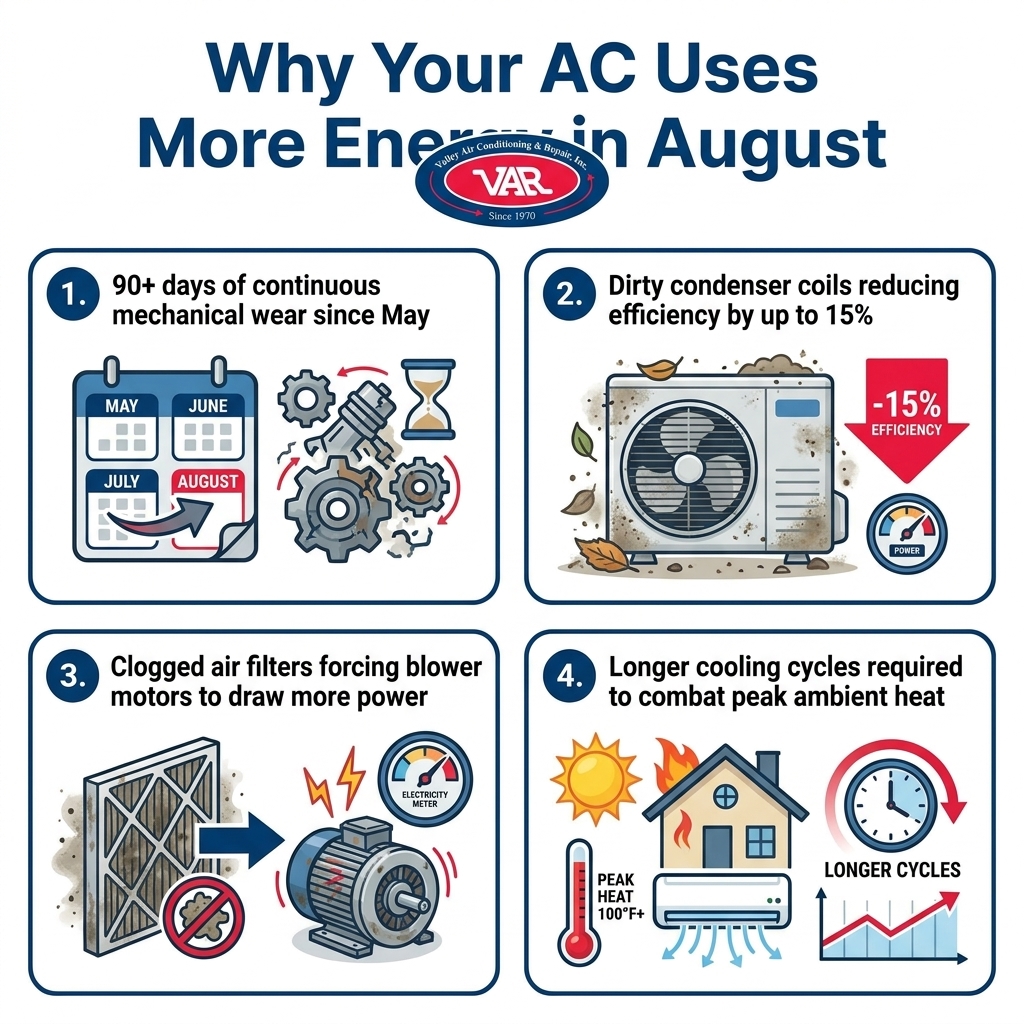
While the outdoor unit battles dust, the indoor unit is fighting its own battle against restricted airflow. The air filter that you installed fresh in June is likely heavily loaded with dust, pet dander, and household particulates by August. When a filter becomes clogged, it creates immense static pressure within the ductwork. The blower motor must work exponentially harder to pull air through that restrictive barrier.
The physics of restricted airflow dictate that as resistance increases, the motor draws more amperage to maintain the necessary volume of air. Furthermore, if the air cannot flow freely over the indoor evaporator coil, the coil cannot absorb enough heat from the house. This leads to extended cooling cycles and, in severe cases, can cause the indoor coil to freeze solid. Every extra minute the system runs to compensate for this lack of airflow directly spikes your utility bill.
Consider a scenario our crew frequently encounters during late-summer real estate transactions. A prospective buyer requested an honest, quick AC check on a home they were purchasing. The inspection revealed that a seemingly minor issue—a heavily loaded filter restricting airflow and a dirty blower wheel—was severely limiting the system's output. Recognizing the value of this early detection, the new homeowner immediately hired our team for ongoing seasonal maintenance. Proactive steps, like scheduling Residential Pre-Season Preparation, are vital to stopping this snowball effect before it results in a massive August end-of-summer cooling bill.
Your thermostat only measures the indoor temperature; it does not control how much energy is required to reach it. System degradation, dirty components, and significantly hotter outdoor temperatures require the unit to run much longer cycles to achieve that same temperature. The longer the compressor runs, the more electricity you consume, regardless of the static number on your dial.
Longer run times are typically caused by a loss of efficiency due to dirty condenser coils, restricted airflow from loaded air filters, or low refrigerant levels. Additionally, general mechanical fatigue from months of continuous operation in the Fresno Central Valley means the system simply cannot cool the air as quickly as it did in early spring. The unit has to stay on longer to remove the same amount of heat.
Yes, dirt acts as a highly effective thermal insulator. When the outdoor condenser is coated in dust and debris, it prevents the system from expelling heat efficiently into the outside air. This forces the compressor to draw more power and run for extended periods, causing a direct and noticeable increase in your monthly electricity usage.
A dirty air filter forces the indoor blower motor to work significantly harder to pull air through the system. According to energy experts, this restriction can reduce overall system efficiency by up to 15 percent. This lack of airflow leads to longer cooling cycles and noticeable bill spikes, especially during the peak heat of late summer.
Our technicians recommend homeowners safely clear away loose debris like leaves, twigs, and tall grass from around the base of the outdoor unit. However, the deep cleaning of delicate condenser fins and the inspection of high-voltage electrical components require a licensed professional. Attempting to power-wash or disassemble the unit yourself can bend the fins, force dirt deeper into the coils, or result in costly electrical damage.
August represents the culmination of peak outdoor heat and over 90 days of continuous system wear. By this time of year, your system has experienced maximum dust accumulation on outdoor components and significant filter loading indoors. It is the point in the season where all the minor, unaddressed maintenance issues compound into major performance struggles.
When faced with a high August utility bill, the critical decision point is knowing whether your system is just dealing with normal high-heat usage or if it is actively failing and in need of expert attention. At Valley Air Conditioning & Repair, our trusted local expertise in diagnosing hidden late-summer inefficiencies safely and accurately means you don't have to guess. Our professionals can differentiate between a system that is running long cycles due to 105-degree weather and one that is running long cycles because a failing capacitor or a clogged coil is strangling its efficiency.
Ignoring the signs of system fatigue can lead to a total breakdown precisely when you need the cooling the most. Addressing these hidden issues now can extend the life of the system, improve your daily comfort, and bring your energy usage back down to a reasonable level.
Signs you need to call a professional immediately:
• The air conditioning unit never shuts off, running continuously from noon until midnight.
• The air coming from the supply vents is lukewarm or barely flowing.
• You notice ice forming on the indoor coil or the outdoor refrigerant lines.
• The outdoor unit is making aggressive buzzing, grinding, or screeching noises.
If a technician evaluates your system and determines that it is severely aged, inefficient, and beyond the point of cost-effective repair for the heavy August end-of-summer cooling load, exploring flexible HVAC Financing Options—and checking if generic federal tax credits or local utility incentives apply to qualifying high-efficiency upgrades—might be the most logical next step to restore efficiency to your home.
An unexpected August bill spike isn't something you just have to accept as a reality of living in the Fresno Central Valley. While the outdoor temperatures certainly play a role, the hidden culprits of dirty coils, clogged filters, and cumulative mechanical wear are entirely correctable. By taking action now, you can restore your air conditioner's lost efficiency and prevent minor fatigue from turning into a major mid-heatwave breakdown.
Scheduling a professional evaluation with our team allows a licensed technician to safely clean critical components, optimize airflow, and ensure your system isn't working harder than it needs to. Enrolling in a comprehensive HVAC Maintenance Plan ensures that your equipment receives the ongoing care necessary to prevent these late-summer surprises in the future, providing you with a clear, logical path to reliable comfort and manageable energy bills.

As a business with many AC units, it is essential to have a responsive AC company. Valley Air Conditioning understands our needs. They are always responsive and our AC is up and running very quickly.
I had them do an AC check on the home I was buying, they were honest and quick. I hired them to do the summer and Fall maintenance for $149. Happy with this company!
100% recommend. I called, same day they came out and gave me estimate. Conley was honest and didn't try to recommend/sell us anything we didn't need. When I called him with questions before making a decision, he happily answered and was not annoyed by me contacting him. Conley and VAR
This is a group of good people. Very professional and knowledgeable. They take the time to listen and find the best solution that fits best for any situation. There's no way you can go wrong in choosing VAR.
We have used Valley Air for over fifteen years. The last two years ,Matt came to our house to service twice a year. Always on time, so polite and so professional. This is a very honest company and you can always depend on them and trust them. The office always treats everyone cheerfully and always want to do what you need done very fast YOU CAN COUNT ON THIS Company