Why We Recommend Two-Stage Heating for Homes with Vaulted Ceilings
Why we recommend upgrading if your vaulted ceilings trap heat. Compare two stage vs single stage heating performance and see how to eliminate cold spots today.

Are you tired of freezing on the living room couch while the upper loft of your home feels like an oven? For many homeowners, analyzing two stage vs single stage heating performance is the key to solving this frustrating problem. At Valley Air Conditioning & Repair, our technicians frequently hear this complaint during fall maintenance calls. When you turn on your thermostat during a crisp evening, you expect consistent warmth throughout your living space. Instead, you might find that your heater runs constantly, yet you are still wrapping yourself in blankets while the air ten feet above your head is sweltering.
This uneven heating is a notorious challenge for Fresno homes with vaulted ceilings. In our experience, standard furnaces are simply not designed to handle the massive volume of air in these uniquely shaped rooms. They blast hot air that immediately rises to the highest point in the room, completely bypassing the areas where you actually sit, sleep, and live. The result is a home that never truly feels comfortable, no matter how high you set the thermostat.
As we approach the October pre-winter heating startup, right now is the perfect time to evaluate whether your current system is truly meeting your needs. If you are scheduling heating services to get your equipment ready for the colder months, it is worth asking if a system upgrade could permanently eliminate those stubborn cold spots before winter arrives in full force.
To understand why your living room feels like an icebox while your ceiling is roasting, you have to look at the basic science of airflow. Heat stratification is a natural physical process where warm air, which is less dense than cold air, rapidly rises to the highest point in an enclosed space. When our team evaluates older HVAC systems, we see homeowners constantly fighting against this natural law of physics, making your residential pre-season heating preparation much more difficult.
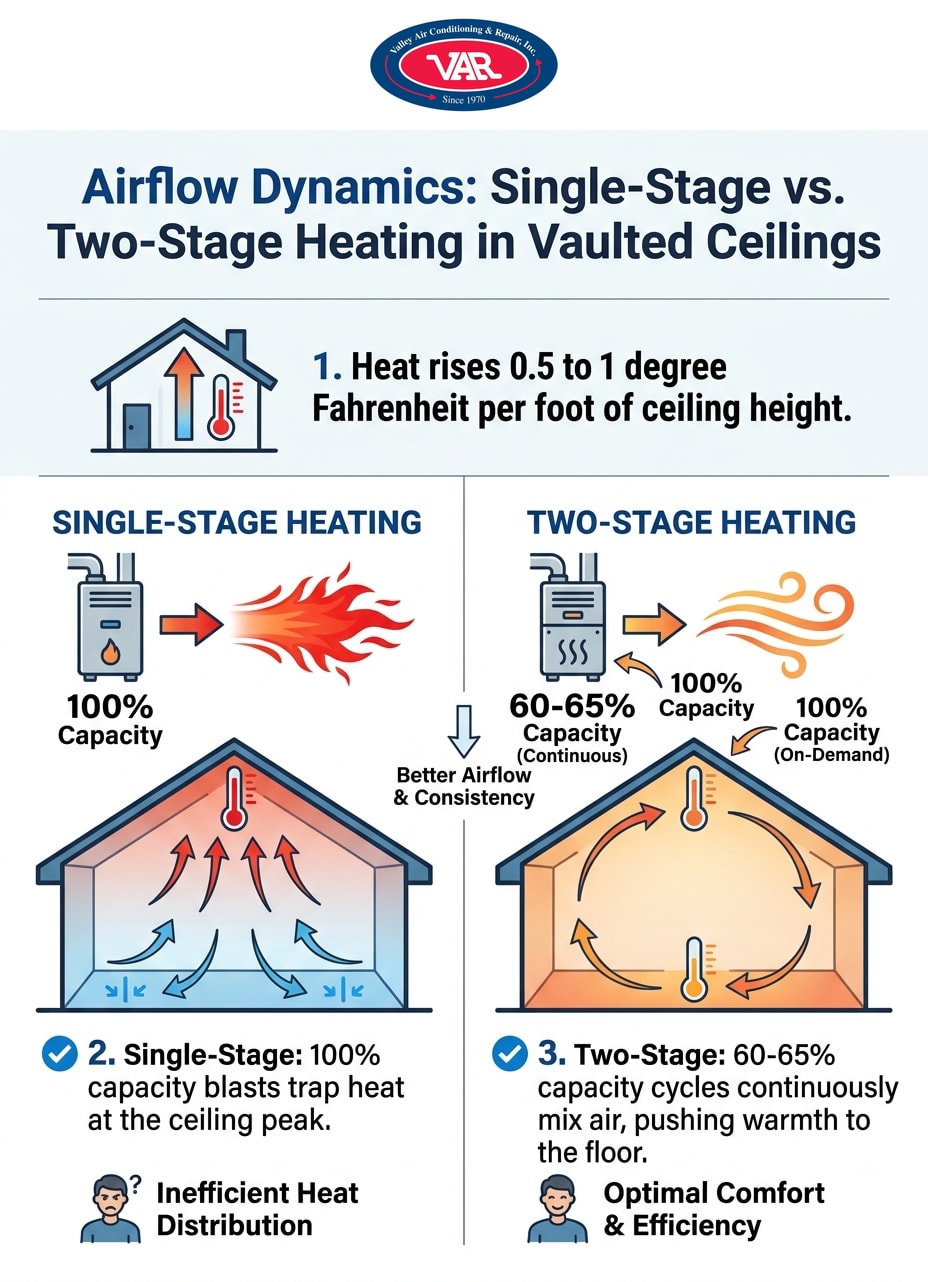
A traditional, single-stage system operates like a light switch: it is either completely off, or it is blasting hot air at 100% capacity. When that massive wave of high-velocity heat enters a room with tall architecture, it shoots straight up to the peak of the ceiling. The thermostat, which is usually located in a hallway with a standard eight-foot ceiling, quickly registers that the house is warm and shuts the entire system down. Meanwhile, the heavy, cold air remains trapped exactly where you are sitting.
Our HVAC professionals at Valley Air Conditioning & Repair often refer to the 1-degree per foot rule when dealing with tall architecture. In a poorly circulated room, the temperature will rise by roughly 0.5 to 1 degree Fahrenheit for every foot of ceiling height.
• The floor-level chill: At floor level, the air might be a brisk 65 degrees.
• The mid-level misread: At thermostat height (around five feet), it reads a comfortable 70 degrees.
• The ceiling trap: At the peak of a 15-foot vaulted ceiling, the trapped air can easily reach 80 degrees or more.
Because the thermostat only measures the air immediately surrounding it, it has no idea that the floor is freezing or that the ceiling is hoarding all the expensive heat.
This rapid blast of maximum-capacity heat leads to a frustrating mechanical issue known as short cycling. Because the single-stage furnace pumps out so much heat so quickly, it satisfies the thermostat in a matter of minutes. The system abruptly shuts off before the blower fan has any opportunity to push that warm air back down into the lower living space. You are left with constant, jarring temperature swings—the heater roars to life, blasts you with noise, shuts off, and leaves you shivering ten minutes later.
The solution to heat stratification lies in changing how the air is delivered. We recommend two-stage heating technology over single-stage setups because it completely changes the dynamic of indoor climate control. Instead of operating at a single, overwhelming speed, a two-stage furnace has a gas valve and blower motor that can operate at two distinct levels: a low stage for mild weather and continuous mixing, and a high stage for extreme temperature drops.
By running at a lower capacity—typically around 60% to 65% of its total power—for the vast majority of the time, the system produces a gentler, steadier stream of warmth. These longer heating cycles give the blower fan the time it needs to continuously mix the indoor air, physically pushing the trapped heat down from the vaulted ceilings and blending it with the cooler air near the floor.
• Operating Capacity — Single-Stage Heating: Always 100% (On or Off) — Two-Stage Heating: 60-65% (Low) and 100% (High)
• Cycle Length — Single-Stage Heating: Short, rapid bursts (5-10 minutes) — Two-Stage Heating: Long, steady cycles (15-30+ minutes)
• Air Mixing Ability — Single-Stage Heating: Poor; shuts off before air circulates — Two-Stage Heating: Excellent; continuous fan operation blends air
• Vaulted Ceiling Comfort — Single-Stage Heating: Heat trapped at the ceiling peak — Two-Stage Heating: Even temperatures from floor to ceiling
The true magic of a two-stage system happens during that first stage. Because the unit is only running at roughly 60% capacity, it uses less fuel and operates much more quietly. It acts like a marathon runner pacing themselves, rather than a sprinter burning all their energy at once. The second stage (100% capacity) is kept in reserve and only kicks in during severe cold snaps when the first stage cannot keep up with the thermostat setting. If you are weighing the benefits of upgrading to a dual-fuel system vs. sticking with a traditional gas furnace, our technicians consider understanding this staging process a critical piece of the puzzle.
Longer run times mean the blower fan is constantly moving air through your ductwork. This continuous circulation acts like a gentle whisk, equalizing the temperature throughout the entire volume of the room. It actively reduces those miserable cold zones near large windows, sliding glass doors, and open-concept living spaces, ensuring every square foot of your Fresno home with vaulted ceilings remains comfortable.
Living in the Central Valley means dealing with unique winter weather patterns that drastically affect indoor comfort. Having serviced local systems through decades of damp winters, we know exactly how heavy Tule fog in the late fall and winter traps damp, cold air close to the ground. This specific type of weather creates a bone-chilling dampness that feels significantly more penetrating than dry cold.
When the air inside your home is stagnant, that damp chill settles into your bones. A single-stage heater that only turns on for five minutes at a time does nothing to combat this heavy, stagnant air. The short bursts of heat evaporate moisture near the vents, but leave the rest of the house feeling clammy and uncomfortable.
The continuous circulation advantage: Because a two-stage system runs longer cycles, it continuously pulls that heavy, damp air through your return vents and across your filtration system. This constant movement prevents the air from feeling stagnant and actively improves your perceived comfort. Moving air feels fresher and more conditioned, which is why our team stresses having this technology ready during the October pre-winter heating startup. You want your system prepared to handle the heavy fog season before the overnight temperatures drop into the freezing range.
One of the biggest mistakes we see homeowners make when replacing a furnace is relying solely on the square footage of their floor plan. In our experience, a one-size-fits-all approach to HVAC installation almost always fails in homes with unique architectural features. A 2,000-square-foot home with standard eight-foot ceilings requires a vastly different heating strategy than a 2,000-square-foot home with 18-foot vaulted ceilings in the main living area.
Proper load calculations must account for the total cubic volume of air in a room, not just the floor space. Valley Air Conditioning & Repair specializes in customizing HVAC solutions for specific local architectural features, ensuring optimal efficiency and comfort rather than just dropping in a generic unit. By calculating the exact volume of air that needs to be heated and circulated, our team can recommend a system that has the right staging capabilities and blower strength to push air from the ceiling all the way back down to the floor.
For some homes, exploring high-efficiency heat pump systems offers an incredible alternative. Heat pumps naturally provide the long, steady, continuous-run benefits that eliminate cold spots, making them an excellent match for Fresno homes with vaulted ceilings that struggle with air stratification.
When an aging heating system finally gives out, the immediate reaction is often to find the fastest, most basic replacement available. A pattern we see often is a total furnace failure during a harsh winter cold snap. While our technicians are always ready to carefully diagnose the issue and return after hours to make emergency repairs, proactively upgrading an aging unit during the October pre-winter heating startup prevents these stressful winter crises entirely.
Upgrading to two-stage technology requires an initial investment, but the long-term benefits in both comfort and efficiency are substantial. Here is what we recommend you consider when evaluating the upgrade:
• Lower startup spikes: Single-stage units require a massive surge of power every time they kick on. Two-stage units avoid these massive power spikes by starting in their lower, more efficient stage.
• Better fuel utilization: Longer run times at a lower capacity actually consume less energy overall than constantly stopping and starting a massive burner.
• Reduced wear and tear: Fewer on-and-off cycles mean less stress on the blower motor, heat exchanger, and internal components, extending the lifespan of the equipment.
• Premium comfort: The elimination of cold spots and temperature swings provides a quality of life improvement that standard systems simply cannot match.
When looking at new systems, pay close attention to the AFUE (Annual Fuel Utilization Efficiency) ratings. High-efficiency two-stage systems often carry excellent AFUE ratings because they extract more usable heat from the fuel they consume. Furthermore, generic federal tax credits and local utility rebates may apply to qualifying high-efficiency installations. Always consult your utility provider or a tax professional regarding current incentive programs to see how they can offset your initial investment.
Navigating the initial investment versus long-term utility savings is much easier when you have flexible payment options. Exploring HVAC system financing options makes upgrading to premium two-stage comfort highly accessible. Evaluating these choices now ensures peace of mind, knowing your high-ceiling home will remain perfectly warm all winter long.
Does a two stage furnace run all the time?
No, as our technicians explain to customers, a two-stage furnace does not run constantly, but it does run for longer periods than a standard furnace. It operates at a lower capacity (around 60%) for the majority of its cycles, which means it stays on longer to provide a steady, even stream of heat. It will eventually shut off once the thermostat reaches the desired temperature.
Is a 2 stage furnace worth it for high ceilings?
Yes, we highly recommend it for homes with vaulted or high ceilings. The longer heating cycles keep the blower fan running, which continuously mixes the air in the room. This physical mixing pushes the warm air that naturally rises to the ceiling back down into the lower living areas, completely eliminating cold spots.
What is the disadvantage of a 2 stage furnace?
The primary disadvantage is the initial upfront cost, as two-stage systems require more advanced internal components than basic single-stage models. Additionally, if the ductwork in your home is poorly designed or heavily restricted, the lower airflow of the first stage might struggle to reach the furthest rooms, meaning proper installation and sizing by a professional team is critical.
How does a 2 stage furnace work with a single stage thermostat?
If paired with a single-stage thermostat, the furnace's internal control board takes over the staging process using a built-in timer. The furnace will always start in the low stage and run for a predetermined amount of time (usually 10 to 15 minutes); if the thermostat is not satisfied by then, the control board automatically kicks the furnace into the high stage.
Can a two-stage heating system improve indoor air quality during fog season?
Yes, the longer run times of a two-stage system significantly improve indoor air quality. Because the blower fan operates for extended periods, the damp, stagnant air common during fog season is continuously pulled through your home's air filters, removing more dust, allergens, and airborne particles than a system that frequently shuts off.
If you are tired of wearing heavy sweaters in your own living room while the ceiling traps all the heat, it is time to rethink your home's airflow. Understanding two stage vs single stage heating performance gives you the confidence to choose the right system for your home's unique architecture. Reach out to our team at Valley Air Conditioning & Repair today to evaluate your current setup and discover how a customized, high-efficiency heating solution can finally deliver the consistent, wall-to-wall warmth your family deserves.

As a business with many AC units, it is essential to have a responsive AC company. Valley Air Conditioning understands our needs. They are always responsive and our AC is up and running very quickly.
I had them do an AC check on the home I was buying, they were honest and quick. I hired them to do the summer and Fall maintenance for $149. Happy with this company!
100% recommend. I called, same day they came out and gave me estimate. Conley was honest and didn't try to recommend/sell us anything we didn't need. When I called him with questions before making a decision, he happily answered and was not annoyed by me contacting him. Conley and VAR
This is a group of good people. Very professional and knowledgeable. They take the time to listen and find the best solution that fits best for any situation. There's no way you can go wrong in choosing VAR.
We have used Valley Air for over fifteen years. The last two years ,Matt came to our house to service twice a year. Always on time, so polite and so professional. This is a very honest company and you can always depend on them and trust them. The office always treats everyone cheerfully and always want to do what you need done very fast YOU CAN COUNT ON THIS Company