


.webp)


Why Is My AC Blowing Warm Air? Fall HVAC Troubleshooting & Startup Smells
Smelling burning dust this fall? Get clear answers with our home maintenance tips and troubleshooting to know when to call a pro for your heating system.
With the intense summer heat finally beginning to break, your focus is likely shifting from staying cool to preparing for the cooler months ahead. Understanding exactly why September is the ideal window for heat pump reversing valve checks is critical before the first real chill sets in. Heat pumps that have run exclusively in cooling mode for months are at a high risk of harboring a stuck reversing valve, a hidden mechanical threat that often goes unnoticed until you desperately need warm air.
As the seasons transition, homeowners face a distinct decision point: proactively verify the operation of this crucial component right now, or risk discovering a total heating failure during the first freezing night of late fall. By taking action during this mild transitional period, you can ensure your equipment is ready for the changing weather. Securing the performance of your heat pump systems requires more than just a simple filter change; it demands a targeted assessment of the mechanical parts that have been locked in a single position all summer.
To understand why seasonal transitions are so hard on your HVAC equipment, it helps to look inside the system. The reversing valve, often referred to as a 4-way valve, is the sole mechanism that allows a heat pump to switch between heating and cooling modes. Unlike a standard air conditioner, a heat pump can physically reverse the flow of refrigerant through its coils, absorbing heat from the outside air and moving it indoors. This entire process relies on the flawless mechanical operation of the reversing valve.
The reversing valve assembly consists of a main brass body containing a sliding mechanism, and a smaller pilot valve controlled by an electrical solenoid coil. When your thermostat calls for heat, it sends a voltage signal to the solenoid. The solenoid magnetically shifts the pilot valve, which then redirects high-pressure discharge gas from the compressor to one side of the main slider block. The resulting pressure differential forces the slider to physically move across the valve body, reversing the refrigerant flow.
The problem: When a heat pump operates in a single mode for an extended period, the internal slider mechanism remains completely stationary. The cause: Over several months of continuous cooling, the lubricating oils inside the refrigerant lines can settle, and the constant pressure on one side of the valve can cause the internal Teflon or synthetic seals to temporarily bind to the brass housing. The solution: Actuating the valve during the September cooling-to-heating transition introduces movement and lubrication back into the mechanism before the binding becomes permanent.
These mechanical stresses are not just theoretical; they are a primary factor when diagnosing persistent system cycling or operational failures. In fact, when our team is troubleshooting HVAC short cycling issues, we often look straight at the reversing valve to ensure it is fully seating in the correct position. If the valve is partially stuck, high-pressure and low-pressure refrigerants can mix, causing the compressor to overheat and the system to short-cycle defensively.
The regional climate plays a massive role in the wear and tear of HVAC components. Here at Valley Air Conditioning & Repair, our technicians see firsthand the immense stress placed on local systems after a brutal Fresno summer. Dozens of days over 100 degrees force the reversing valve to sit completely idle in cooling mode for three to four months straight. During this time, the system often runs at a 100% duty cycle, meaning the compressor is constantly pumping hot, high-pressure gas through a valve that never changes position.
This intense thermal load causes microscopic expansion and contraction in the brass and copper fittings. While the system may have successfully survived the brutal summer, the transition period is when the accumulated mechanical stress finally reveals itself. The prolonged lack of actuation makes the internal slider highly susceptible to sticking exactly when you finally switch the thermostat to heat.
Accurate diagnostics after such intense summer workloads are vital. In one instance during a routine maintenance visit, our team encountered a customer who had previously been advised by another party that their hard-working system had a severe leak and required total replacement. However, our thorough second opinion revealed no such leak—just a stuck component. This proves that careful, objective evaluation of heavily taxed components by experienced professionals is essential. Misdiagnosing a stuck reversing valve as a catastrophic compressor failure or a massive refrigerant loss is a common error when systems are pushed to their limits by extreme summer heat.
Timing is everything when it comes to preventative maintenance. The September cooling-to-heating transition offers a brief, strategic seasonal window where both modes can be safely tested without causing extreme indoor discomfort. Testing a furnace or heat pump in the middle of a 105-degree July afternoon is impractical and hard on the equipment, just as testing an air conditioner during a January freeze can damage the compressor. September provides the perfect ambient conditions for a full system run-through.
1. Early September: Morning temperatures begin to dip, providing a safe opportunity for a technician to engage the heating cycle for 15 to 20 minutes. This forces the reversing valve to actuate, breaking any initial stiction that developed over the summer.
2. Mid-September: As the transitional shift continues, systems often cycle off entirely at night. This downtime allows for accurate electrical testing of the solenoid coil without interrupting the home's primary cooling needs.
3. Late September: Evening heating demand begins in earnest. By this point, the mechanical shift has been verified, preventing sudden system shocks when temperatures drop rapidly.
Proactive testing during this specific month is the single most important preventative step for heat pump owners. By forcing the mechanical shift now, a licensed professional can identify sluggish valve movement, unusual pressure equalization noises, or electrical delays before they turn into complete operational failures. Because this process involves manipulating high-voltage components and reading complex refrigerant pressures, it must always be performed by a qualified technician rather than attempted as a weekend project.
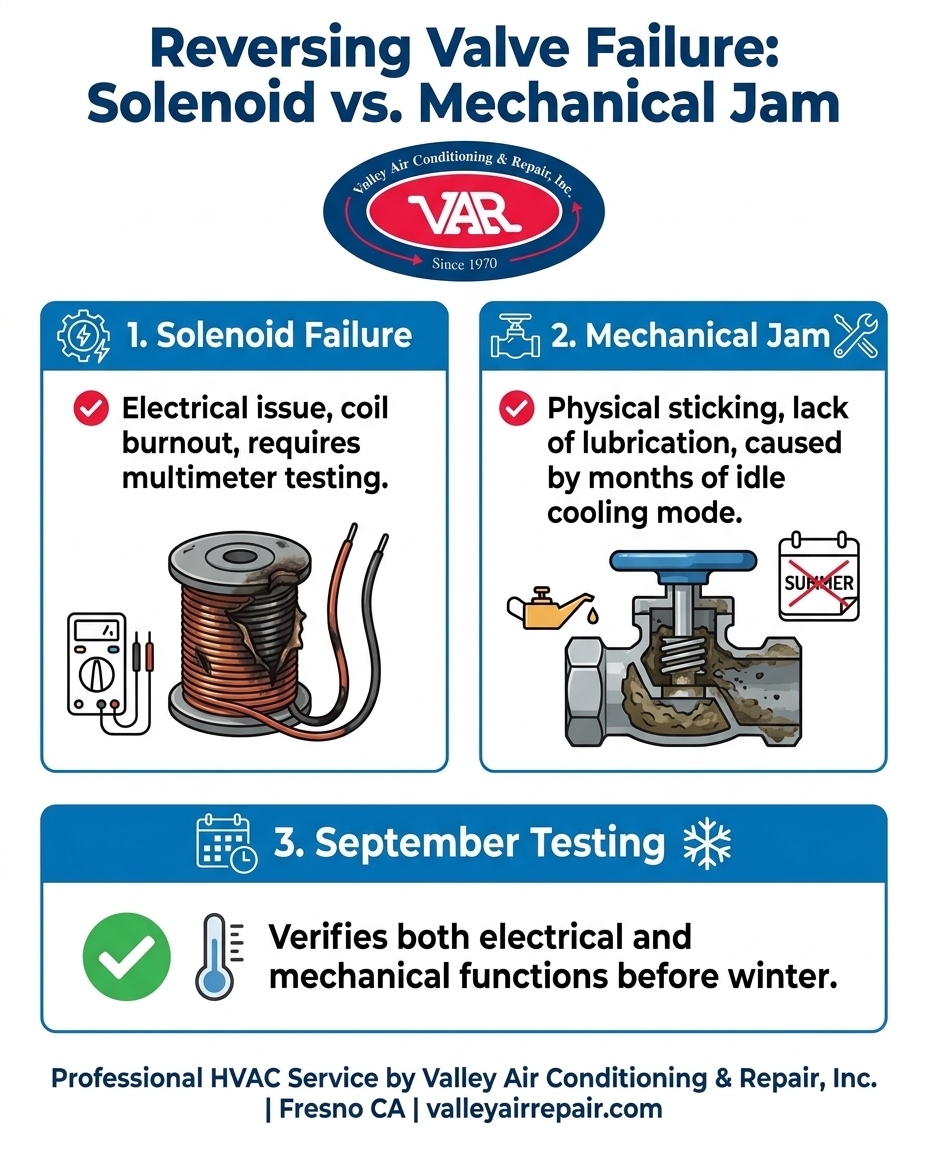
When a heat pump refuses to switch from cooling to heating, we generally find the failure falls into one of two categories: an electrical solenoid failure or a mechanical jamming of the valve body itself. Understanding the distinction between the two is crucial for a proper repair, as the diagnostic steps and ultimate solutions are vastly different.
• Electrical Solenoid Failure — Root Cause: Coil burnout, broken wiring, or loss of control voltage from the defrost board. — Diagnostic Indicators: No magnetic pull when energized; infinite resistance (open circuit) on a multimeter. — Professional Action Required: Replacing the external electromagnetic coil (does not require opening the refrigerant circuit).
• Mechanical Jamming — Root Cause: Lack of lubrication, internal debris, or pressure differential issues causing the slider to stick. — Diagnostic Indicators: Solenoid energizes properly, but the valve does not shift; abnormal temperature readings across the valve body. — Professional Action Required: Recovering the refrigerant, unbrazing the old valve, brazing in a new valve, and recharging the system.
• Pilot Valve Clog — Root Cause: Contaminants in the refrigerant blocking the tiny capillary tubes that control the slider. — Diagnostic Indicators: System attempts to shift but gets stuck halfway, causing a constant "hissing" sound. — Professional Action Required: Replacing the entire reversing valve assembly and installing new liquid line filter driers.
Our technicians use specific diagnostic tools to determine which failure has occurred without invasive dismantling. By applying a multimeter to the solenoid leads, we can verify if the coil is receiving the correct voltage and if it has continuity. If the electrical side is sound, professionals will measure the temperature differential across the four pipes connecting to the main valve body. A properly functioning valve will show distinct temperature differences between the suction and discharge lines; a stuck or leaking valve will show temperatures bleeding together.
Because these diagnostics require handling pressurized refrigerants and 240-volt electrical circuits, neither of these issues can be safely addressed through DIY methods. A professional assessment ensures the root cause is identified accurately, preventing unnecessary parts replacement.
Delaying seasonal maintenance often transforms minor mechanical sticking into a major emergency. The scenario of a heat pump permanently stuck in AC mode during the first freezing night of late fall is a common and highly uncomfortable reality for homeowners who skip their September checks. When the temperature drops near freezing, a heat pump blowing 55-degree air into the home quickly creates an unlivable environment.
Emergency diagnostics during peak heating season lead to extended discomfort and urgent service requirements. When the first major cold front hits, service schedules fill up instantly. A failure that could have been identified and resolved during a routine September visit suddenly becomes an after-hours emergency call in November. Furthermore, if the valve itself needs to be replaced, the process of recovering the refrigerant, brazing in a new valve, and pulling a deep vacuum takes several hours—a highly disruptive process during freezing weather.
We've seen how the value of proactive intervention scales with the size of the property. For example, our team's proactive maintenance across a large commercial campus has consistently kept numerous HVAC units functional through the seasonal transition, demonstrating that early intervention prevents widespread, cascading outages. The peace of mind that comes from verifying your residential system's heating capability well before it is desperately needed cannot be overstated. By testing the reversing valve during the September cooling-to-heating transition, you eliminate the anxiety of the unknown.
A proper pre-season check moves far beyond simply swapping out a dirty air filter. Comprehensive fall maintenance is designed to evaluate the entire mechanical and electrical health of the system. Ongoing, structured maintenance keeps older units running efficiently and prevents compounding mechanical failures from shortening the lifespan of the equipment. Consistent, proactive care is exactly what our technicians used to keep one Fresno customer's 13-year-old unit running like new, proving that routine attention pays off in long-term reliability.
A comprehensive fall maintenance visit should include:
• Thermostat calibration: Ensuring the control system accurately commands the shift from cooling to heating.
• Reversing valve actuation: Explicitly forcing the mechanical shift from cooling to heating multiple times to verify smooth operation and proper seating.
• Defrost control board testing: Verifying that the system can properly initiate a defrost cycle, which relies on the reversing valve to melt frost off the outdoor coil during winter.
• Refrigerant charge assessment: The reversing valve requires a specific pressure differential to physically move the slider; a low refrigerant charge can prevent the valve from shifting even if the solenoid is working perfectly.
• Electrical connection tightening: Preventing voltage drops that could cause the solenoid coil to overheat and fail.
To ensure these vital steps are never missed, many homeowners choose to enroll in a routine maintenance plan. A structured agreement automates these critical seasonal checks, taking the burden of scheduling off your shoulders. Valley Air Conditioning & Repair's specialized residential pre-season preparation is positioned specifically as a proactive measure that tests transition components like the reversing valve, ensuring your system is fully prepared for the upcoming weather shift.
Do not wait for the first freezing night to find out if your heat pump can still produce warm air. Taking action now protects your equipment from sudden mechanical shocks and ensures your home remains comfortable regardless of what the weather does next. Understanding why September is the Ideal Window for Heat Pump Reversing Valve Checks gives you the strategic advantage you need. Reach out to schedule your residential pre-season preparation today, and step into the fall season with absolute confidence in your heating system.
Why is my heat pump stuck in cooling mode?
Your heat pump is likely stuck in cooling mode due to a malfunctioning reversing valve or a failed solenoid coil. The reversing valve is responsible for changing the direction of the refrigerant flow. If the electrical solenoid that controls it loses power, or if the internal slider mechanism becomes physically jammed after months of continuous summer use, the system will remain locked in its default cooling position.
Can a heat pump reversing valve get stuck?
Yes, a heat pump reversing valve can easily get stuck, especially during seasonal transitions. Because the internal slider mechanism sits in one position for months during the summer, lack of lubrication and constant pressure can cause the internal seals to bind to the brass housing. Actuating the valve during routine fall maintenance helps prevent this stagnation and ensures the valve moves freely.
How do you know if your reversing valve is bad?
A bad reversing valve often presents distinct symptoms, such as the system blowing cool air when set to heat, or producing a constant hissing sound from the outdoor unit. Professionals diagnose a failing valve by checking the electrical continuity of the solenoid coil and measuring the temperature differences across the refrigerant lines connected to the valve body. If the temperatures bleed together, the internal slider is likely leaking or stuck.
What happens when a reversing valve fails?
When a reversing valve fails, your heat pump loses its ability to switch between heating and cooling, leaving you stuck in whatever mode the valve failed in. Additionally, if the valve gets stuck halfway, it causes high and low-pressure refrigerants to mix. This drastically reduces the system's efficiency, prevents proper heating or cooling, and can ultimately cause the compressor to overheat and shut down.
Does testing the reversing valve cause unnecessary wear and tear?
No, testing the reversing valve actually prevents wear and tear by breaking up mechanical stagnation. Forcing the valve to shift during mild transition weather redistributes lubricating oils and ensures the slider mechanism has not seized. Proactive testing is a vital part of seasonal maintenance that protects the component from failing when placed under heavy winter demand.

As a business with many AC units, it is essential to have a responsive AC company. Valley Air Conditioning understands our needs. They are always responsive and our AC is up and running very quickly.
I had them do an AC check on the home I was buying, they were honest and quick. I hired them to do the summer and Fall maintenance for $149. Happy with this company!
100% recommend. I called, same day they came out and gave me estimate. Conley was honest and didn't try to recommend/sell us anything we didn't need. When I called him with questions before making a decision, he happily answered and was not annoyed by me contacting him. Conley and VAR
This is a group of good people. Very professional and knowledgeable. They take the time to listen and find the best solution that fits best for any situation. There's no way you can go wrong in choosing VAR.
We have used Valley Air for over fifteen years. The last two years ,Matt came to our house to service twice a year. Always on time, so polite and so professional. This is a very honest company and you can always depend on them and trust them. The office always treats everyone cheerfully and always want to do what you need done very fast YOU CAN COUNT ON THIS Company


