


.webp)


Why Is My AC Blowing Warm Air? Fall HVAC Troubleshooting & Startup Smells
Smelling burning dust this fall? Get clear answers with our home maintenance tips and troubleshooting to know when to call a pro for your heating system.
That strange, loud sudden whooshing noise heat pump units make in the middle of a cold night usually sends new owners straight into a panic. Here at Valley Air Conditioning & Repair, our dispatchers field these frantic calls every fall, but getting the mechanics of heat pump defrost cycles explained for Fresno homeowners is the first step to knowing your system is actually working perfectly. You step outside on a chilly evening, expecting quiet, and instead, your outdoor unit sounds like a jet engine preparing for takeoff. To make matters worse, you might even see a thick cloud of white steam rising directly out of the top of the machine. It is completely natural to assume the worst—that your motor is burning out, a pipe has burst, or the entire system is on the verge of catching fire.
Before you rush to the phone to schedule an emergency repair in the middle of the night, you need to understand the built-in protective features of your system. What you are witnessing is very likely a normal, necessary function designed to keep your equipment alive during cooler weather. Rather than a mechanical failure, this dramatic display is just the system taking care of itself. For those transitioning away from traditional furnaces, understanding how heat pump systems operate differently is crucial to enjoying a stress-free winter.
The defrost cycle is a temporary, self-cleaning mode that every modern heat pump uses to shed ice buildup. Without this loud, steaming process, your outdoor unit would quickly turn into a solid block of ice, leaving your house freezing and your equipment severely damaged. Let's break down exactly what is happening inside that metal cabinet so you can rest easy the next time your unit starts roaring in the dark.
To understand why your system needs to defrost, you first have to understand how it heats your home. Unlike a gas furnace that burns fuel to create heat, a heat pump extracts existing ambient heat from the outdoor air and moves it inside. Even when the air outside feels cold to you, there is still thermal energy present. The outdoor coil absorbs this heat, but doing so causes the surface temperature of the coil to drop significantly—often well below freezing.
This is where local climate plays a massive role. Over our years servicing HVAC systems throughout the Central Valley, our team has seen firsthand how Fresno's Mediterranean climate is characterized by cool, damp nights as we move into late fall and winter. When incoming Tule fog rolls in, it creates a high-humidity environment. As the outdoor coil pulls heat from this damp air, the airborne moisture immediately condensates onto the freezing metal fins of the condenser. Within minutes, that condensation turns into a layer of white frost.
A thin layer of frost might not look threatening, but it acts as a powerful insulator. It blocks the air from actually touching the metal coil. If left unchecked, this frost forces the system to work twice as hard to extract heat, severely dropping your heating efficiency and driving up your energy bills. Eventually, the frost would build into a thick wall of solid ice, suffocating the unit completely.
The relationship between the outdoor dew point and your coil temperature dictates how fast this ice forms. Because the refrigerant inside the coil is much colder than the ambient air, frost can easily form even when the outside temperature in Fresno is sitting comfortably above freezing—sometimes as high as 38°F or 40°F.
The perfect storm for frost:
• High humidity: Foggy, damp nights provide endless moisture for the coil to pull from the air.
• Low ambient temperatures: When the air is already cold, the coil has to drop its temperature even lower to absorb any remaining heat.
• Long run times: As your home demands more heat, the outdoor unit runs longer, giving ice more time to accumulate.
When the system detects that frost is choking its airflow, it initiates a defrost cycle. This is a temporary mode where the heat pump essentially runs in reverse to melt the accumulated ice. Instead of pulling heat from the outside and moving it indoors, the system temporarily pulls heat from inside your house and sends it to the outdoor unit.
The loud sudden whooshing noise heat pump owners hear is the sound of pressurized refrigerant rapidly changing direction. By forcing hot refrigerant gas directly into the frozen outdoor coil, the system rapidly raises the metal's temperature, melting the frost from the inside out. To speed up this melting process, the outdoor fan motor shuts off entirely. If the fan kept running, it would blow freezing winter air across the coil, fighting the melting process.
The heart of this operation is a small but critical component called the reversing valve. You can think of it as the system's traffic controller. When the defrost board triggers the cycle, an electrical solenoid shifts a physical slider inside the valve. This mechanical shift redirects the flow of hot, high-pressure gas.
By shifting this valve, the outdoor unit temporarily becomes a heater, and the indoor coil temporarily becomes an air conditioner. This brilliant piece of engineering allows the system to clean itself without requiring any external heating elements on the outdoor unit.
Because the system is temporarily acting like an air conditioner to send heat outside, you might notice the air coming from your indoor vents feels lukewarm or even slightly cool. This is a normal part of the process.
To prevent your house from getting uncomfortably cold during this 5-to-15-minute window, most systems are equipped with backup electric heat strips in the indoor air handler. These strips automatically turn on during the defrost cycle to temper the air, ensuring your living room stays comfortable while the outdoor unit does its heavy lifting.
At Valley Air Conditioning & Repair, we prefer to educate our neighbors about their equipment. Our technicians would much rather help you understand your system's normal operational noises than have you schedule an unnecessary emergency service call just to be told your unit is working perfectly. In fact, our team frequently walks homeowners through these exact sounds over the phone to save them stress.
Here is a breakdown of the specific sensory experiences you will encounter during a normal defrost cycle:
• The 'Whoosh': That loud sudden whooshing noise heat pump units make is simply the reversing valve shifting the highly pressurized refrigerant. It sounds like a sharp exhale of air or a brief hissing sound, lasting only a second or two.
• The Silence: Immediately after the whoosh, the loud outdoor fan motor will stop spinning. The unit will not be completely silent, however; you will still hear the low, steady hum of the compressor working hard to pump the hot gas.
• The Steam: As the hot refrigerant hits the frozen coil, the ice melts rapidly. In the cold outdoor air, this rapid evaporation creates a visible plume of water vapor. It looks like smoke, but it is entirely odorless and dissipates quickly into the air.
• The Water: As the ice melts, a significant amount of water will drain off the coil and form a puddle around the base of the outdoor unit. This is why proper drainage around the concrete pad is so important.
Setting the right expectations for how often this process happens can prevent a lot of anxiety, especially during the September pre-heating transition when you might be turning the system on for the first time in months. A sudden overnight temperature drop can trigger frequent cycles that catch new owners off guard.
1. Typical Duration: A normal cycle is relatively short. It usually lasts between 5 and 15 minutes. The cycle ends automatically once the sensors on the outdoor coil detect that the temperature has risen enough to confirm all the ice has melted.
2. Typical Frequency: How often it happens depends entirely on the weather. On a dry, mild night, it might not happen at all. On a damp, foggy Fresno night hovering around 35°F, your system might need to defrost every 30, 60, or 90 minutes of active heating.
3. The Return to Normal: When the cycle finishes, you will hear a second "whoosh" as the reversing valve shifts back to heating mode. The outdoor fan will kick back on, often blowing away a final puff of steam, and warm air will resume flowing steadily from your indoor vents.
If you notice your system is shifting into this mode every ten minutes, or if it never seems to stay in heating mode long enough to warm the house, you might be dealing with a larger issue. Frequent, rapid cycling is hard on the compressor and wastes energy. If you suspect this is happening, troubleshooting short cycling issues with a professional is highly recommended.
Older units often use a simple time-temperature board. If the coil is below a certain temperature, the board blindly triggers a defrost cycle every 60 minutes, regardless of whether there is actual ice on the fins. Modern, high-efficiency systems use demand-based sensors. These advanced boards measure the exact temperature difference between the air and the coil, only triggering a cycle when frost is physically obstructing the airflow. This smart technology saves a significant amount of energy over the course of a winter.
While steam and whooshing sounds are perfectly fine, there are specific visual and auditory cues that indicate a genuine mechanical failure. Diagnosing these issues requires specialized tools and training. Attempting DIY electrical or refrigerant repairs on a high-voltage HVAC system is extremely dangerous and can void your manufacturer warranty. Always rely on a licensed technician for true heating failures.
Our team sees these issues firsthand every winter. In our years of providing residential heating services across Fresno, we've replaced countless components that failed simply because warning signs were ignored. Catching a failing part early—like a sticking reversing valve or a faulty sensor—prevents a massive freeze-up that could otherwise destroy your compressor.
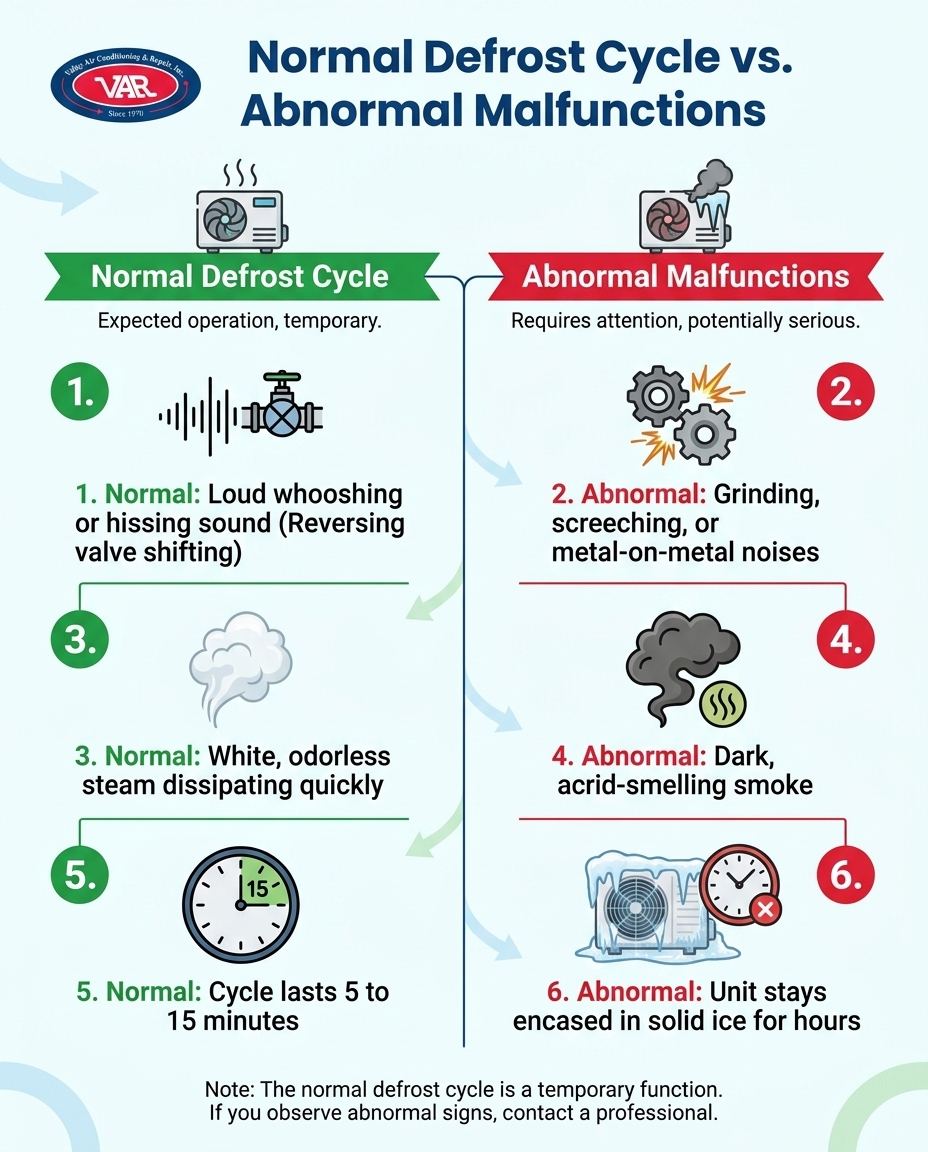
• Visual Output — Normal Defrost Cycle: White, odorless water vapor that dissipates into the air within seconds. — Genuine Malfunction (Call a Pro): Dark or grey smoke with an acrid, burning electrical smell that persists.
• System Noises — Normal Defrost Cycle: A brief whoosh or hiss, followed by the steady hum of the compressor. — Genuine Malfunction (Call a Pro): Sustained metal-on-metal grinding, violent shaking, or continuous screeching.
• Ice Accumulation — Normal Defrost Cycle: A light to moderate layer of white frost that melts away completely within 15 minutes. — Genuine Malfunction (Call a Pro): A thick, solid block of hard ice encasing the entire unit for hours without melting.
• Indoor Airflow — Normal Defrost Cycle: Briefly lukewarm or cool air for 5-15 minutes, then returning to warm heat. — Genuine Malfunction (Call a Pro): Blowing cold air continuously for hours, or the indoor blower motor stops completely.
If you notice a solid block of ice that refuses to melt, it often points to a failing defrost control board, a bad sensor, or low refrigerant levels. When these components fail, the system loses its ability to clean itself. If you spot these warning signs, shut the system off to prevent compressor damage and reach out for professional heating services right away.
The best way to ensure your system handles the defrost cycle smoothly is through proactive care. As we enter the September pre-heating transition, our technicians highly recommend taking a few simple steps to save yourself from a mid-winter breakdown. A well-maintained system provides reliable comfort and keeps your energy bills predictable throughout the colder months.
First, keep the outdoor unit clean. Dirty condenser coils covered in dust, pollen, and yard debris freeze much faster than clean metal. Dirt traps moisture against the fins, accelerating frost buildup and forcing the system to defrost more frequently. Furthermore, make sure the area around the outdoor unit is clear. Rake away fall leaves, trim back overgrown bushes, and ensure there is at least two feet of clearance on all sides. The system needs unrestricted airflow to extract heat, and it needs a clear path for the melted ice water to drain away.
Finally, the most effective preparation is scheduling a professional pre-heating season tune-up with our team. During a comprehensive fall inspection, our technicians will test the reversing valve to ensure it shifts smoothly without sticking. We will verify the defrost sensors are calibrated correctly and check the refrigerant charge. Low refrigerant is a primary cause of severe freeze-ups. Enrolling in a preventative maintenance plan ensures these vital components are tested every year before the cold weather truly sets in.
That loud sudden whooshing noise heat pump units make is the reversing valve shifting pressurized refrigerant. When the system needs to melt ice off the outdoor coil, it abruptly changes the direction of the refrigerant flow. This sudden shift causes a loud hiss or whoosh, followed by the outdoor fan turning off. It is a completely normal sound and indicates your system is actively protecting itself from freezing.
Yes, seeing steam rise from the outdoor unit during cold weather is completely normal. As the system sends hot refrigerant to the frozen outdoor coil, the ice melts rapidly. This rapid melting in cold outdoor air creates water vapor, which looks exactly like white smoke. As long as the vapor is odorless and dissipates quickly, there is no need for concern.
The frequency depends heavily on the outdoor temperature and humidity levels. On a damp, cold night, your system might need to defrost every 30 to 90 minutes of active running time. Modern systems use smart sensors to detect exactly when frost is blocking airflow, so they will only run this cycle when it is absolutely necessary to maintain efficiency.
During a defrost cycle, the system temporarily reverses its operation, pulling heat from inside your home to melt the outdoor ice. This can cause the indoor vents to blow lukewarm or slightly cool air for a few minutes. Most systems engage backup electric heat strips during this time to keep your home comfortable until the cycle finishes and normal heating resumes.
A normal cycle lasts between 5 and 15 minutes, produces white, odorless steam, and ends with the outdoor fan turning back on to provide warm air indoors. If your unit is making violent grinding noises, producing dark smoke with an electrical smell, or remains encased in a solid block of ice for hours, it is malfunctioning. In those cases, turn the system off and call a professional.
Absolutely. When dirt, grime, and yard debris coat the outdoor condenser fins, they trap moisture against the metal and block proper airflow. This causes the coil to drop in temperature much faster, leading to rapid, heavy ice buildup. Keeping the coil clean through regular maintenance ensures the system doesn't have to work as hard or defrost as often.
Transitioning into the cooler months doesn't have to be a stressful experience. Now that you understand why your system makes that loud whoosh and produces steam, you can confidently recognize these signs as your equipment actively protecting itself from freezing over. The mechanics might seem dramatic, but they are the exact reason your home stays consistently warm despite the chilly Fresno nights.
Understanding these normal operations is the key to a stress-free winter. However, if you ever notice a solid block of ice that won't melt, or if you hear grinding noises that go beyond a simple hiss, it is always better to be safe. If you are ever unsure whether a sound is a normal cycle or a sign of trouble, reaching out to our experts for professional heat pump service in Fresno ensures your system stays healthy, efficient, and ready to handle whatever the season brings.

As a business with many AC units, it is essential to have a responsive AC company. Valley Air Conditioning understands our needs. They are always responsive and our AC is up and running very quickly.
I had them do an AC check on the home I was buying, they were honest and quick. I hired them to do the summer and Fall maintenance for $149. Happy with this company!
100% recommend. I called, same day they came out and gave me estimate. Conley was honest and didn't try to recommend/sell us anything we didn't need. When I called him with questions before making a decision, he happily answered and was not annoyed by me contacting him. Conley and VAR
This is a group of good people. Very professional and knowledgeable. They take the time to listen and find the best solution that fits best for any situation. There's no way you can go wrong in choosing VAR.
We have used Valley Air for over fifteen years. The last two years ,Matt came to our house to service twice a year. Always on time, so polite and so professional. This is a very honest company and you can always depend on them and trust them. The office always treats everyone cheerfully and always want to do what you need done very fast YOU CAN COUNT ON THIS Company


