.webp)


Fibreglass vs. Pleated Filters for Fall Heating Efficiency
Buying the most expensive air filter isn't always an upgrade. High-MERV pleated filters can actually suffocate your furnace blower, reducing efficiency and risking premature failure.
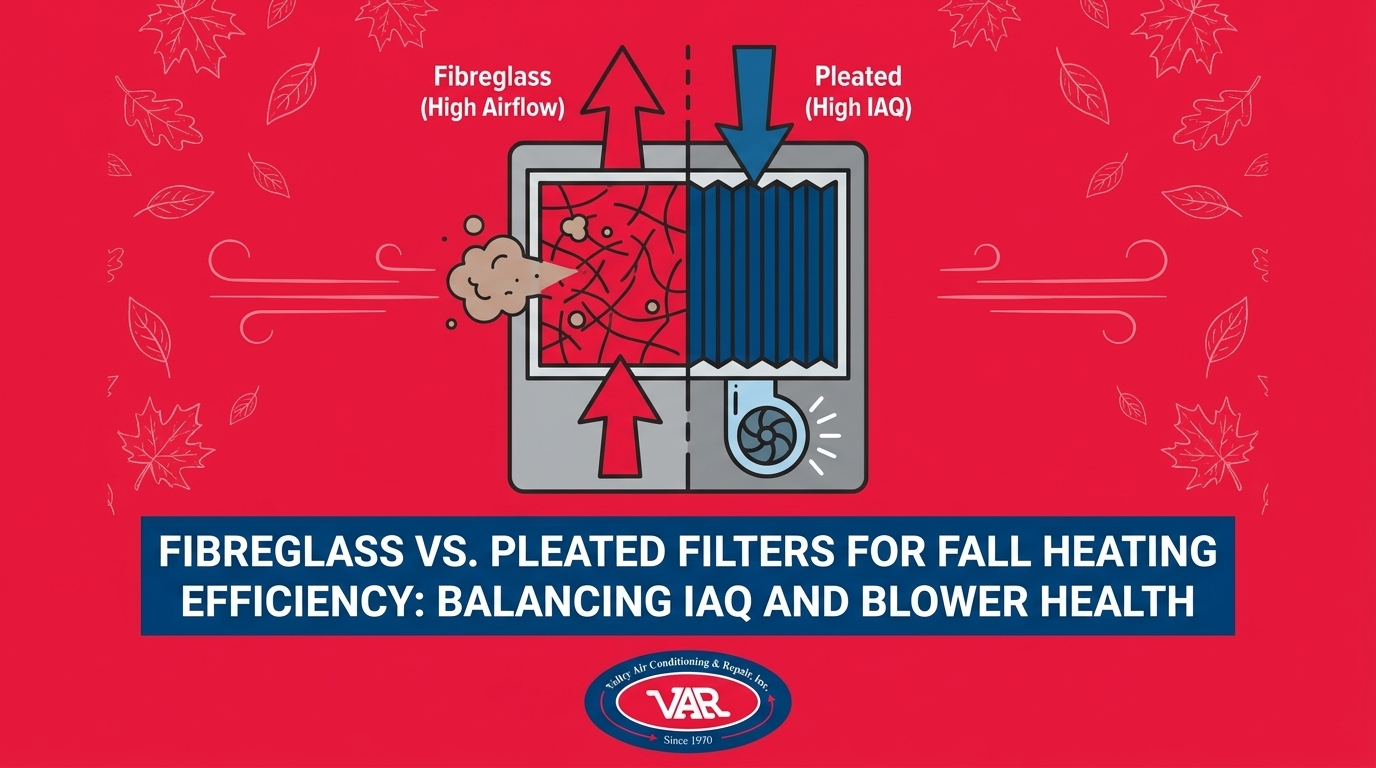
Buying the most expensive air filter at the hardware store doesn't mean you are doing your heating system a favor. In fact, it might be doing the exact opposite. When comparing Fibreglass vs. Pleated Filters for Fall Heating Efficiency, our team often finds that most homeowners don't realize blindly upgrading to a high-MERV filter can accidentally suffocate the furnace blower. A filter designed to trap microscopic particles often acts like a piece of solid cardboard in your return duct, starving the system of the air it desperately needs to operate. Choosing the right filter is a critical mechanical decision that requires balancing your family's indoor air quality needs with your maximum allowable furnace blower static pressure.
If you are evaluating your heating systems this fall, scheduling a comprehensive HVAC maintenance plan with our experienced technicians is the safest way to start.
In our years of serving Fresno area homes, our team frequently sees homeowners assume that higher numbers on a filter package automatically translate to a healthier home. Marketing materials push the idea that a MERV 11 or MERV 13 filter is a direct upgrade over a basic model. However, HVAC systems are engineered to move a specific volume of air per minute. When you place a highly restrictive barrier in the path of that airflow, you force the mechanical components to work against immense resistance. This creates a concrete problem we repair all the time: your furnace overheats, your energy bills rise, and your indoor comfort actually decreases because the warm air cannot reach the furthest rooms in your house.
The underlying issue: A heating system is a breathing machine. If you restrict its intake, it cannot exhale properly. Understanding this relationship is the first step in making an educated decision about your fall maintenance routine.
To truly understand why filter choice matters so much, you have to understand the invisible force governing your entire HVAC system: furnace blower static pressure. Think of static pressure like blood pressure in the human body. Just as high blood pressure forces the heart to work harder to pump blood through restricted arteries, high static pressure forces your blower motor to work harder to push air through restricted ducts and filters.
Static pressure is the measurement of resistance to airflow within your heating and cooling system. It is measured in inches of water column (in. w.c.). Every component in your ductwork—from the supply vents and return grilles to the evaporator coil and the air filter—adds a certain amount of resistance. The blower motor is designed to overcome this resistance, but only up to a very specific limit.
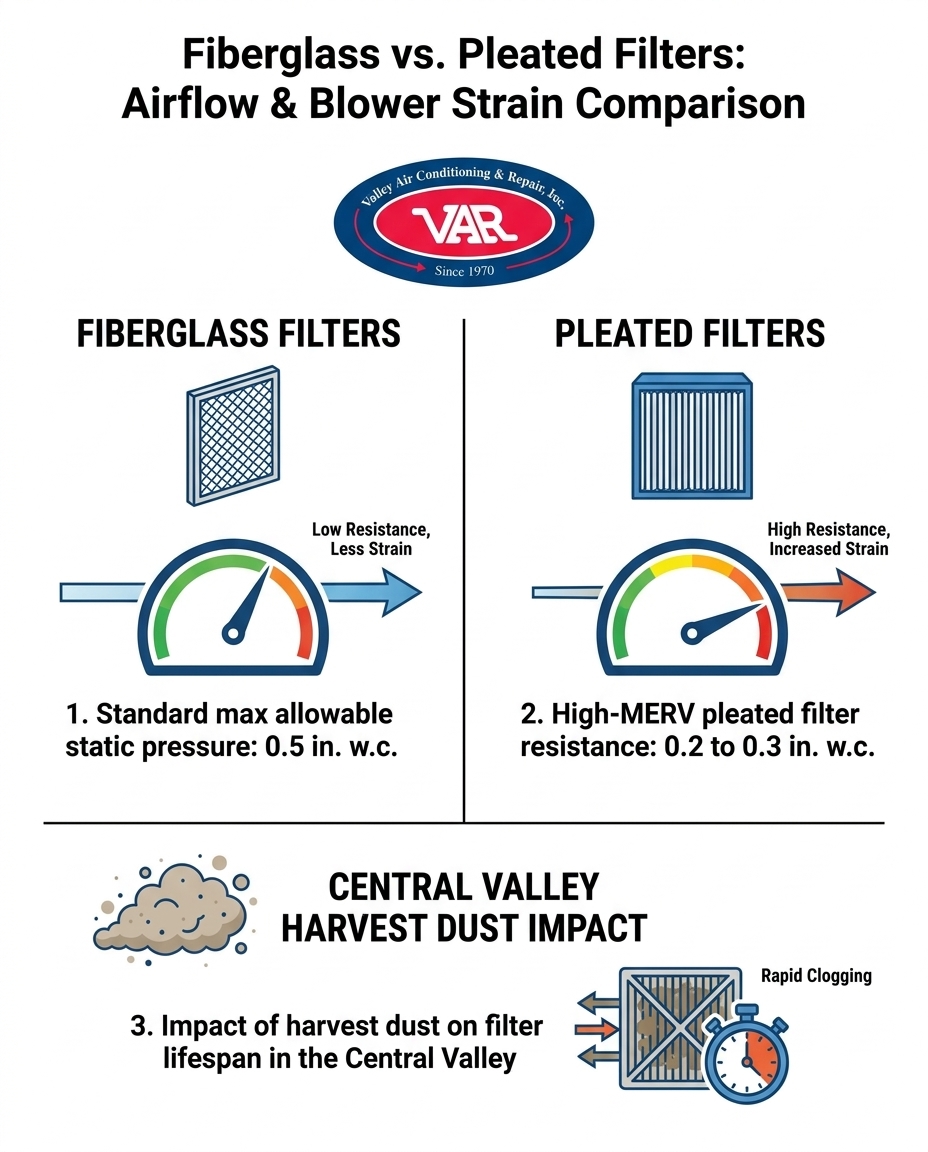
Most residential furnaces are engineered to operate at a maximum total external static pressure of 0.5 in. w.c. If the total resistance of your ductwork, coils, and filter exceeds this number, the system enters a danger zone. Unfortunately, our technicians routinely encounter homes with ductwork that pushes this 0.5 limit before a filter is even installed. When a restrictive filter is added to an already strained system, the static pressure spikes dramatically.
In our experience, ignoring your furnace blower static pressure leads to severe mechanical consequences. When we are called out to repair a struggling system, we often see several things happen when the blower motor struggles against high resistance:
• Reduced heating efficiency: The system runs longer cycles but delivers less warm air to your living spaces.
• Frequent overheating: A lack of airflow causes the heat exchanger to retain too much heat, frequently tripping the high-limit safety switch and shutting the furnace down abruptly.
• Premature blower motor failure: The motor pulls more electrical current to overcome the resistance, causing it to run hot and eventually burn out years before its expected lifespan.
• Increased energy consumption: Because the system works harder and runs longer, your monthly utility bills climb needlessly.
Standard spun-glass filters—often referred to as fiberglass filters—are the most basic option on the market. Because they are inexpensive and look relatively flimsy, they are frequently dismissed as inferior. However, from a purely mechanical standpoint, we often recommend fiberglass filters because they offer significant advantages for your heating system.
Fiberglass filters are constructed from spun glass fibers layered over a cardboard or wire frame. Their primary function is not to purify the air you breathe, but rather to protect the internal components of your furnace from large debris. They are designed to catch the "boulders" of the HVAC world: pet hair, large dust bunnies, lint, and significant dirt particles that could otherwise coat the blower motor or clog the evaporator coil.
The greatest benefit of a fiberglass filter is its incredibly low resistance to airflow. Because the spun glass fibers are loosely packed, air passes through them with almost zero effort. This keeps your furnace blower static pressure well within safe limits, ensuring that the motor operates smoothly and the heat exchanger receives the exact volume of air it was designed to handle.
The quick takeaway: If your primary goal is mechanical health and maximum airflow, fiberglass is the undisputed winner.
Despite their benefits for airflow, fiberglass filters have a major drawback: they typically have a very low MERV rating (usually MERV 1 to 4). This means they capture very few microscopic particles, making them entirely ineffective for filtering out pollen, pet dander, smoke, or severe allergens.
Our team suggests fiberglass filters are the right choice if:
• You have an older heating system with a standard PSC blower motor that cannot handle high resistance.
• Your home has undersized ductwork that already creates a high static pressure environment.
• No one in your household suffers from severe allergies, asthma, or respiratory conditions.
• You rely on dedicated, standalone air purifiers for your indoor air quality needs rather than your furnace filter.
Pleated filters are the most popular upgrade for homeowners looking to improve their indoor air quality. Made from denser synthetic materials like polyester or cotton blends, the fabric is folded into accordion-like pleats to increase the surface area. While they are excellent at trapping microscopic pollutants, they introduce a significant mechanical hurdle for your heating system.
The dense synthetic fibers of a pleated filter are designed to catch tiny particles that fiberglass filters miss, including mold spores, fine dust, pollen, and even some bacteria. This naturally raises their MERV rating, typically ranging from MERV 8 up to MERV 13 for residential use. The pleats provide more surface area for air to pass through, which is intended to offset the density of the material.
While the air quality benefits are clear, the mechanical strain is a pattern we see often. Brand new, high-MERV pleated filters can add 0.2 to 0.3 in. w.c. of resistance to your system. Recall that most residential furnaces have a maximum allowable static pressure of 0.5 in. w.c. This means a restrictive pleated filter can consume over half of your system's total allowable static pressure before the air even enters the ductwork!
If your ductwork already accounts for 0.4 in. w.c. of resistance, adding a 0.3 in. w.c. filter pushes your total static pressure to 0.7 in. w.c.—far above the safe limit. This restriction decreases heating efficiency by starving the system of the air volume needed to distribute heat effectively throughout the home.
You do not have to sacrifice your furnace's mechanical health to achieve clean indoor air. If your system cannot handle the furnace blower static pressure of a high-MERV pleated filter, we offer alternative indoor air quality solutions that clean the air without restricting airflow.
• Electronic Air Cleaners: These systems use an electrical charge to trap particles with minimal airflow resistance.
• UV Light Purifiers: Installed directly inside the ductwork, UV lights neutralize biological contaminants like mold and bacteria without impeding the air path.
• Media Filter Cabinets: A professional modification that installs a much wider, 4-inch or 5-inch thick pleated filter. The massive surface area allows for high-MERV filtration with significantly lower static pressure drops compared to standard 1-inch pleated filters.
Filter performance isn't just about the material; it is heavily influenced by our local environment. Here in Fresno and the surrounding areas, the autumn transition brings a unique set of challenges that our team knows can drastically alter how your heating system performs.
The Central Valley is an agricultural powerhouse, and the fall harvest season kicks up an immense amount of airborne particulate matter (PM10). From September through November, tractors, nut harvesting equipment, and dry winds combine to fill the air with fine agricultural dust. This dust inevitably makes its way into your home and, consequently, into your HVAC return vents.
During a September pre-heating season tune-up, our technicians frequently observe the rapid impact of this harvest dust firsthand. A filter's resistance increases as it fills with dirt—a process known as "loading." In the Central Valley, a slightly restrictive pleated filter can turn into a total airflow blockage much faster during the harvest season than in other months. A MERV 11 filter that might last 90 days in the spring could become completely suffocated in just three to four weeks during peak harvest in October.
Because of this localized environmental factor, standard manufacturer replacement guidelines (like "change every 3 months") often fail in the Central Valley during autumn. To protect your system's furnace blower static pressure, we advise our customers to adjust their habits:
• Check filters bi-weekly: During the harvest months, pull your filter out every two weeks and hold it up to a light. If you cannot see light shining through, it is time to replace it.
• Downgrade temporarily: Some homeowners choose to run less restrictive fiberglass filters during the peak dust weeks to ensure maximum airflow, switching back to moderate pleated filters once the harvest dust settles and the winter rains begin.
• Consult regional guides: Understanding the best filter options for dry climates and dusty agricultural zones can help you tailor your approach to the local environment.
Choosing the right filter requires weighing three main factors: how easily air moves through it, how well it cleans the air, and how much strain it puts on your equipment. The table below breaks down the core differences so you can make an informed decision for your fall heating efficiency.
• Airflow Resistance — Standard Fiberglass Filters (MERV 1-4): Very Low (Excellent for airflow) — Standard Pleated Filters (MERV 8-13): Moderate to High (Restricts airflow)
• IAQ Capability — Standard Fiberglass Filters (MERV 1-4): Poor (Only catches large debris) — Standard Pleated Filters (MERV 8-13): Excellent (Catches microscopic particles)
• Furnace Strain — Standard Fiberglass Filters (MERV 1-4): Minimal (Keeps static pressure low) — Standard Pleated Filters (MERV 8-13): Moderate to Severe (If not monitored closely)
• Central Valley Harvest Impact — Standard Fiberglass Filters (MERV 1-4): Fills slowly, maintains airflow longer — Standard Pleated Filters (MERV 8-13): Clogs rapidly, requires frequent changes
• Best Use Case — Standard Fiberglass Filters (MERV 1-4): Older systems, undersized ductwork — Standard Pleated Filters (MERV 8-13): Modern systems with verified low static pressure
There is no universal "best" filter. If your system has historically struggled with overheating or weak airflow at the vents, a fiberglass filter is the safest choice to protect your furnace blower static pressure. If your system has been professionally tested by our team and has the capacity to handle extra resistance, a pleated filter will provide superior air quality.
Guessing which filter your system can handle is a gamble with your blower motor's lifespan. You cannot determine a system's static pressure simply by looking at the ductwork or listening to the furnace run. It requires precise, professional measurement.
Many homeowners cycle through different filter brands, hoping to find the perfect balance through trial and error. Unfortunately, the "error" part of that process often results in a tripped high-limit switch on the coldest night of the year, or a burnt-out blower motor that requires an expensive replacement.
We recently had a local customer reach out to our team for an annual pre-season tune-up to ensure their older system was ready for the cold. Because our technicians provided reliable, respectful, and thorough service—including a proper assessment of their system's airflow capabilities—their specific needs for ongoing tune-ups and repairs were met without the costly guesswork of trial-and-error filter upgrades.
This is where our technical expertise makes all the difference. At Valley Air Conditioning & Repair, we do not just guess which filter is best; we measure it. During a proper September pre-heating season tune-up, our technicians perform a static pressure test.
Here is how our process works:
1. Our technician drills small, easily plugged test ports into the supply and return plenums of your ductwork.
2. A specialized digital manometer is inserted into the ports while the system is running.
3. The tool measures the exact furnace blower static pressure in inches of water column.
4. We compare this real-world data against the manufacturer's maximum allowable rating for your specific furnace.
By using this exact reading, our professionals can recommend the precise MERV rating your specific ductwork and blower can safely handle. If your static pressure is already at 0.45 in. w.c. with a clean fiberglass filter, our technician will advise against upgrading to a pleated filter, saving your motor from premature failure. Consistent, professional residential pre-season preparation is the only way to ensure an aging system continues to perform efficiently without undue mechanical stress.
Yes, pleated filters naturally restrict airflow more than standard fiberglass filters. Because they are made from denser synthetic materials designed to trap microscopic particles, the blower motor has to work harder to pull air through them. If your ductwork is already restrictive, this added resistance can severely impact your system's efficiency.
Mechanically speaking, fiberglass filters are much better for furnace blowers because they offer the least resistance to airflow. By allowing air to pass through easily, they keep the furnace blower static pressure low, preventing the motor from overheating or burning out prematurely. However, they do not provide high-level air purification for the home.
Furnace static pressure is the measurement of resistance to airflow within your HVAC system, similar to blood pressure in the human body. It matters because every furnace has a maximum allowable limit (usually 0.5 in. w.c.). Exceeding this limit by using overly restrictive filters or undersized ducts causes overheating, poor heating efficiency, and early equipment failure.
The safe MERV rating depends entirely on your specific system's static pressure capacity. While many modern systems can handle MERV 8 to MERV 11, older systems or homes with restrictive ductwork may only safely accommodate MERV 1 to MERV 4 fiberglass filters. The only way to know for sure is to have one of our technicians measure your static pressure.
During the fall harvest season in the Central Valley, airborne agricultural dust (PM10) increases dramatically. A pleated filter that normally lasts 90 days can become completely clogged in just three to four weeks. We strongly advise homeowners to check their filters bi-weekly during September and October to prevent sudden airflow blockages.
Absolutely. When a restrictive filter pushes the static pressure beyond the system's design limits, the blower motor must draw more electrical current to force air through the barrier. This causes the motor to run excessively hot, degrading its internal components and leading to failure years before its expected lifespan.
Choosing the right filter shouldn't be a guessing game that puts your furnace at risk. By understanding how furnace blower static pressure impacts your system, you can make a choice that protects both your indoor air quality and your equipment. If you are unsure what your system can handle, scheduling your September pre-heating season tune-up with Valley Air Conditioning & Repair will give you the exact data you need to stay comfortable all winter.

As a business with many AC units, it is essential to have a responsive AC company. Valley Air Conditioning understands our needs. They are always responsive and our AC is up and running very quickly.
I had them do an AC check on the home I was buying, they were honest and quick. I hired them to do the summer and Fall maintenance for $149. Happy with this company!
100% recommend. I called, same day they came out and gave me estimate. Conley was honest and didn't try to recommend/sell us anything we didn't need. When I called him with questions before making a decision, he happily answered and was not annoyed by me contacting him. Conley and VAR
This is a group of good people. Very professional and knowledgeable. They take the time to listen and find the best solution that fits best for any situation. There's no way you can go wrong in choosing VAR.
We have used Valley Air for over fifteen years. The last two years ,Matt came to our house to service twice a year. Always on time, so polite and so professional. This is a very honest company and you can always depend on them and trust them. The office always treats everyone cheerfully and always want to do what you need done very fast YOU CAN COUNT ON THIS Company