


.webp)


Why Is My AC Blowing Warm Air? Fall HVAC Troubleshooting & Startup Smells
Smelling burning dust this fall? Get clear answers with our home maintenance tips and troubleshooting to know when to call a pro for your heating system.
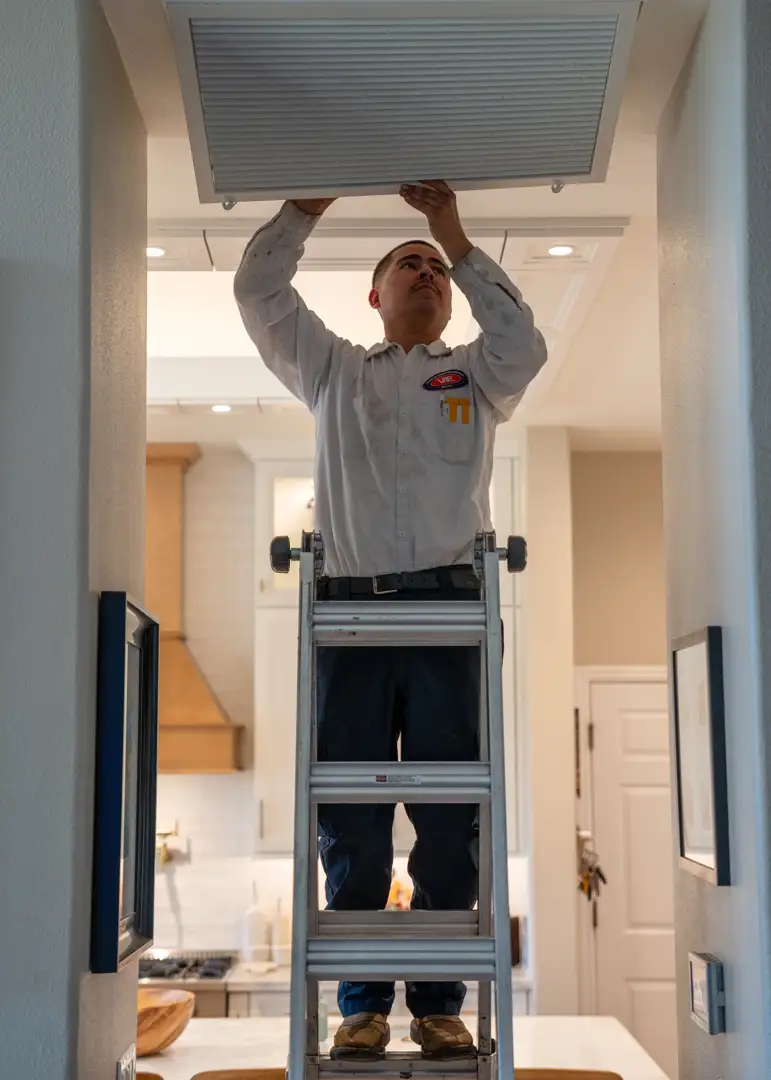
The best AC filter options for Arizona homes (and similarly hot, dusty regions like California's Central Valley) are not the same ones you'd grab off a shelf in cooler, wetter climates. Homeowners in Fresno, Clovis, Modesto, and surrounding areas deal with a uniquely punishing combination: extreme summer heat that runs AC units almost nonstop, fine agricultural dust, wildfire smoke, and high pollen counts. Standard manufacturer advice — "replace every 60 to 90 days" — simply was not written with Central Valley summers in mind.
Here is a quick-reference breakdown of the best AC filter choices for local homes:
| Filter Type | MERV Rating | Best For | Replace Every |
|---|---|---|---|
| Fiberglass (basic) | 1-4 | Minimal protection only | 30 days |
| Pleated (standard) | 8 | Most local homes | 30-60 days |
| Pleated (upgraded) | 11 | Pets, allergies, high-dust season | 30-45 days |
| Pleated (high-efficiency) | 13 | Allergies, newer systems only | 30-45 days |
| Thick media (4-5 inch) | 11-13 | Systems designed for them | Up to 6 months |
The short answer: For most homes in the Fresno and Modesto areas, a pleated MERV 8 to MERV 11 filter strikes the right balance between filtering valley dust and keeping enough airflow to protect your system. Going higher than MERV 13 is generally not recommended for residential units unless your system was specifically built for it.
The challenge is that roughly 80 to 85 percent of homes have ductwork that was undersized for their HVAC units to begin with. Add a high-resistance filter into that equation, and you can end up with frozen coils, a strained compressor, and an unexpected repair bill. Choosing the right filter is genuinely a system-level decision — not just a quick trip to the hardware store.
This guide walks you through everything you need to know: what filter types actually work in hot, dusty conditions, how MERV ratings affect your specific system, how often to swap filters during peak dust seasons, and when a filter change alone is not enough to solve the problem.
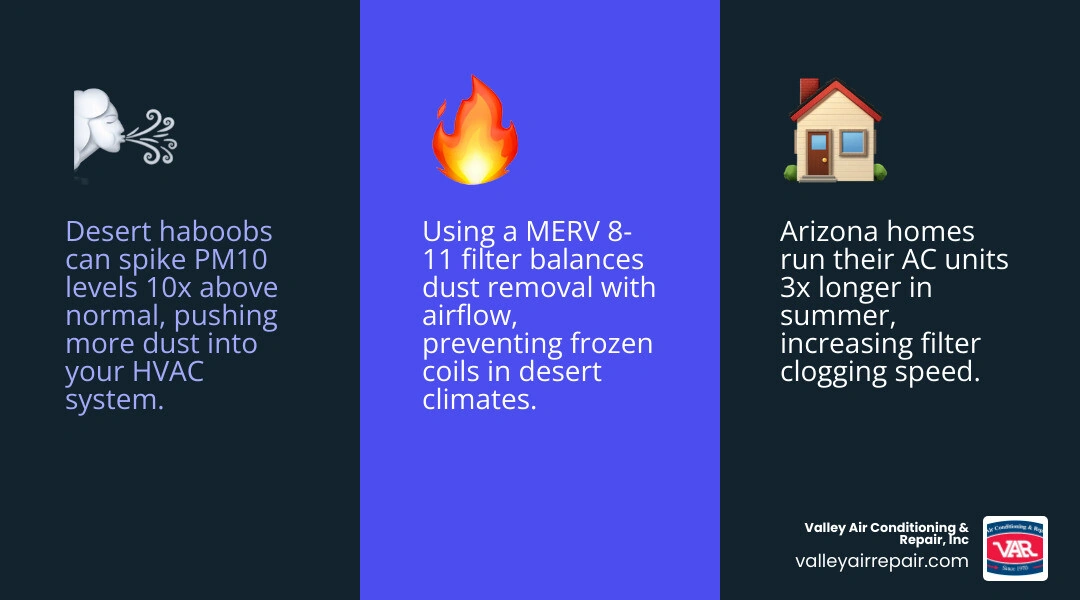
Best ac filter options for arizona homes terms explained:
The Central Valley environment is beautiful, but its hot, dry summers are notoriously tough on mechanical systems. In places like Fresno, Clovis, Modesto, and Madera, an air filter is not just a passive screen; it is the first line of defense protecting an expensive air conditioning system from a constant barrage of airborne debris.
During the peak summer months, outdoor temperatures in the valley regularly soar past 100 or 105 degrees Fahrenheit. This intense heat forces residential air conditioners to run for 12 hours or more per day, circulating massive volumes of air. At the same time, agricultural activities and dry valley winds keep fine dust particles constantly airborne.
The situation escalates during the harvest season and dry summer months. Large-scale agricultural operations and windstorms can cause outdoor air pollution and particulate matter (specifically PM10, or particles 10 microns and smaller) to spike dramatically in a matter of minutes. This outdoor dust quickly infiltrates homes through small cracks, open doors, and window seals.
Unlike standard household dust, which is mostly composed of organic fibers and skin flakes, valley dust contains a high concentration of microscopic soil and silica particles. This dust is incredibly fine, sharp, and dense. When it enters your HVAC system, it doesn't just rest loosely on the filter fibers; it packs tightly into the filter media, quickly sealing off the gaps that allow air to pass through.
Additionally, the extreme heat of a Central Valley attic or garage can warp flimsy filter frames, allowing unfiltered air to bypass the filter entirely and deposit dirt directly onto your sensitive evaporator coils. To understand how these extreme conditions put pressure on every component of your air conditioner, check out our detailed guide on How Desert Dust Heat and Monsoons Affect Your AC System.
Choosing the best ac filter options for Arizona homes (which also apply perfectly to our similarly hot and dusty Central Valley climate) requires understanding the different types of filter media available and how they perform under heavy dust loads.
These are the inexpensive, flat-panel filters with a cardboard border and a thin, see-through layer of spun fiberglass. In the HVAC industry, we often call these "grass catchers" because they are only effective at trapping very large particles like pet hair, lint, and large pieces of debris. They typically carry a rating of MERV 1 to 4.
Pleated filters are constructed by folding polyester or cotton-blend media into a series of accordion-like folds. This design vastly increases the surface area of the filter, allowing it to trap smaller particles without immediately cutting off airflow. These typically range from MERV 5 to MERV 13.
These filters use self-charging cotton or paper fibers that naturally attract airborne particles like a magnet. They are available in both disposable and washable versions.
True HEPA filters are designed to capture 99.97% of particles down to 0.3 microns. They are incredibly dense and are typically rated MERV 17 to 20.
To help you visualize how these different options compare, we have put together a breakdown of the most common residential filter classes:
| Filter Type & Rating | Target Particles Captured | Airflow Impact | Ideal Central Valley Use Case |
|---|---|---|---|
| Fiberglass (MERV 1-4) | Large dust, lint, hair | Extremely Low | Temporary use only during construction |
| Standard Pleated (MERV 8) | Pollen, dust mites, mold spores, coarse dust | Low to Moderate | Standard homes without pets or severe allergies |
| Upgraded Pleated (MERV 11) | Pet dander, fine dust, car emissions, spores | Moderate | Homes with pets, mild allergies, or near dusty agricultural terrain |
| High-Efficiency Pleated (MERV 13) | Smoke, smog, bacteria, microscopic dust | Moderate to High | Newer systems with verified duct capacity; severe allergy sufferers |
| Thick Media (4-5 Inch, MERV 11-13) | All fine particles and allergens | Low (due to massive surface area) | Homes retrofitted with media cabinets; requires less frequent changes |
If you want to optimize your entire heating and cooling configuration for maximum reliability and efficiency in our harsh climate, take a look at our expert recommendations on the Best HVAC Setup for the Arizona Desert.
If you or your family members suffer from seasonal allergies, asthma, or respiratory sensitivities, standard filtration may not keep your indoor air comfortable. The Central Valley has exceptionally high pollen counts from local orchards and crops, and approximately 40% of local households share their living space with pets.
When pet dander, microscopic mold spores, and fine outdoor dust accumulate indoors, they can severely impact your health. To combat this, upgrading to a MERV 11 or MERV 13 pleated filter is highly beneficial.
However, because these filters are denser, they fill up with valley dust much faster. If you upgrade to a higher MERV rating for health reasons, you must commit to inspecting the filter every 30 days.
The biggest mistake homeowners make is buying the highest-rated filter on the shelf, assuming that "more filtration is always better." In reality, your air conditioner requires a specific volume of air passing through it to operate safely.
Think of your AC system like a pair of lungs: if you try to run a marathon while breathing through a thick wool scarf, you will quickly find yourself gasping for air. The same thing happens to your air handler when you install an overly restrictive filter.
This issue is amplified in our region. An estimated 80 to 85 percent of ductwork in Central Valley homes is inadequate or undersized for the HVAC units installed. When ductwork is too small, the system already struggles with high static pressure (resistance to airflow). Adding a dense, high-MERV filter creates a severe bottleneck.
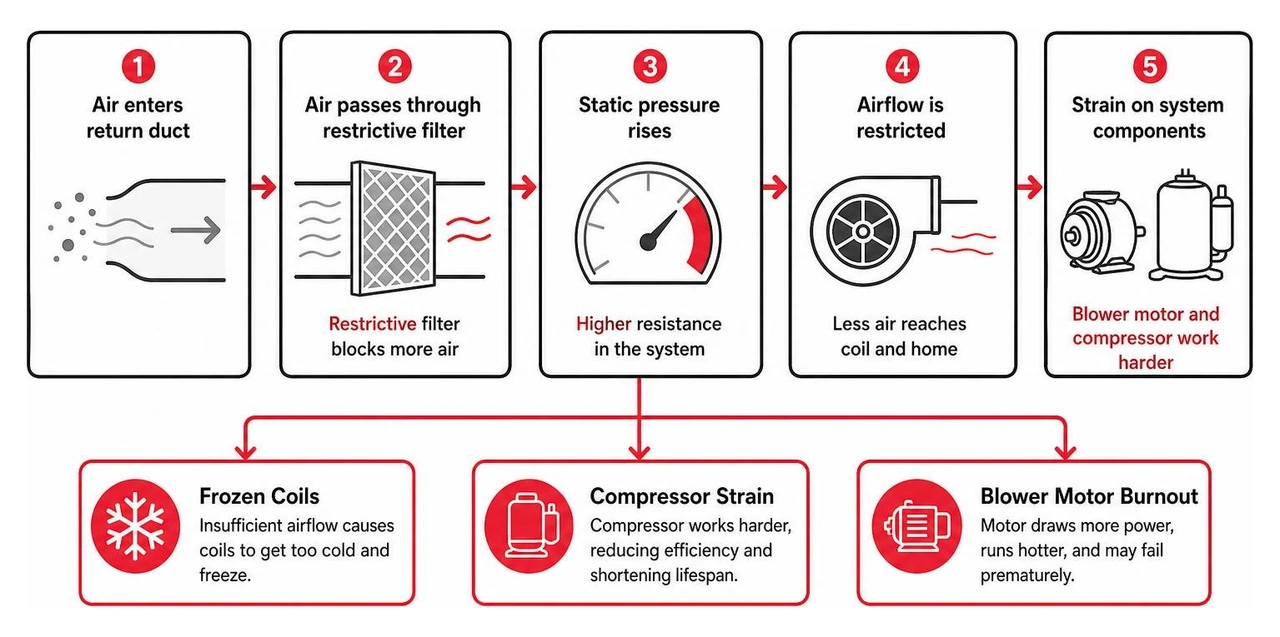
This restriction causes several problems:
To prevent these issues, it is vital to balance filtration with system health. If you want to see exactly how a restricted filter can lead to a catastrophic system breakdown, read our in-depth article on How Dirty Air Filters Destroy Your AC in Dusty Climates.
In many parts of the country, changing an air filter is a seasonal chore done every three months. In the Central Valley, waiting 90 days during the summer is a recipe for system failure.
We recommend a customized maintenance schedule tailored to our hot, dusty climate:
Several factors will shorten your filter's lifespan:
To establish a proper routine and protect your equipment, check out our companion guides on AC Filter Replacement and How Often to Change Your AC Filter in Dusty Desert Conditions.
While changing your filter is the easiest DIY maintenance task, it is not a cure-all. Sometimes, a dirty filter has already caused deeper issues, or the performance problem lies elsewhere in the system.
If you notice any of the following warning signs, a simple filter change will not solve the issue:
When these symptoms appear, it is important to evaluate whether your system is still viable. Read our expert analysis on Is It Worth Fixing an Old AC Unit in the Desert to help you decide your next steps.
While washable electrostatic filters seem like a great way to reduce waste, we generally do not recommend them for homes in the Fresno and Modesto areas. Because valley dust is exceptionally fine and dense, it packs tightly into the washable mesh. Over time, it becomes incredibly difficult to wash out completely, leading to a permanent reduction in airflow.
Furthermore, you must let a washable filter dry 100% before reinstalling it. Putting a damp filter back into your dark, warm air handler creates the perfect breeding ground for mold and bacteria, which will quickly blow throughout your home.
Air filters are designed with a specific structural direction. On the side of the filter frame, you will find an arrow indicating the direction of airflow. The filter media is reinforced on the back side (often with a wire mesh or cardboard grid) to prevent the air pressure from bending or collapsing the filter into the air handler.
If you install the filter backwards:
To find your filter size, look at the cardboard edge of your current filter. You will see "nominal dimensions" printed on it (for example, 20x25x1). This is the standard label used by stores.
However, if you measure the filter with a tape measure, you will find the "actual dimensions" are slightly smaller (usually by about a quarter to a half-inch). This is intentional so the filter can slide easily into the slot.
Never use a filter that is "close enough" in size. If a filter is too small, gaps around the edges will allow air to bypass the filter entirely. This "air bypass" carries raw agricultural dust straight onto your air conditioner's wet evaporator coils, quickly clogging them and reducing system efficiency.
Choosing the best ac filter options for Arizona homes (and similarly demanding climates like California's Central Valley) is one of the simplest yet most critical decisions you can make to protect your home's comfort and your pocketbook. In our demanding valley climate, a filter is not just about keeping the air clean — it is about keeping your air conditioner breathing freely so it can survive the relentless summer heat.
By matching your filter's MERV rating to your household needs, checking it every 30 days during the peak of summer, and avoiding overly restrictive options, you can prevent unexpected breakdowns and extend the life of your system.
However, even the best filter cannot replace the value of professional, hands-on care. Regular preventative maintenance is the key to catching minor issues before they turn into major mid-summer emergencies. To learn more about keeping your system running at peak performance, read our guide on Proper HVAC Maintenance for Desert Climate.
When you need expert advice, professional diagnostic services, or a system tune-up in Fresno, Clovis, Modesto, Sanger, Selma, or surrounding areas, our team at Valley Air Conditioning & Repair, Inc. is here to help. We have served our Central Valley community since 1970 with a customer-first philosophy built on trust and honest service.
Don't wait for the heat to catch you by surprise — Schedule Professional HVAC Maintenance with us today to keep your home cool, clean, and comfortable all year long!

As a business with many AC units, it is essential to have a responsive AC company. Valley Air Conditioning understands our needs. They are always responsive and our AC is up and running very quickly.
I had them do an AC check on the home I was buying, they were honest and quick. I hired them to do the summer and Fall maintenance for $149. Happy with this company!
100% recommend. I called, same day they came out and gave me estimate. Conley was honest and didn't try to recommend/sell us anything we didn't need. When I called him with questions before making a decision, he happily answered and was not annoyed by me contacting him. Conley and VAR
This is a group of good people. Very professional and knowledgeable. They take the time to listen and find the best solution that fits best for any situation. There's no way you can go wrong in choosing VAR.
We have used Valley Air for over fifteen years. The last two years ,Matt came to our house to service twice a year. Always on time, so polite and so professional. This is a very honest company and you can always depend on them and trust them. The office always treats everyone cheerfully and always want to do what you need done very fast YOU CAN COUNT ON THIS Company


