.webp)


AC Repair in Fresno, CA: Troubleshooting the Fall HVAC Transition After a Brutal Summer
Why we emphasize safe fall heating startups. Use these home maintenance tips and troubleshooting steps to decide with confidence when to call a pro.
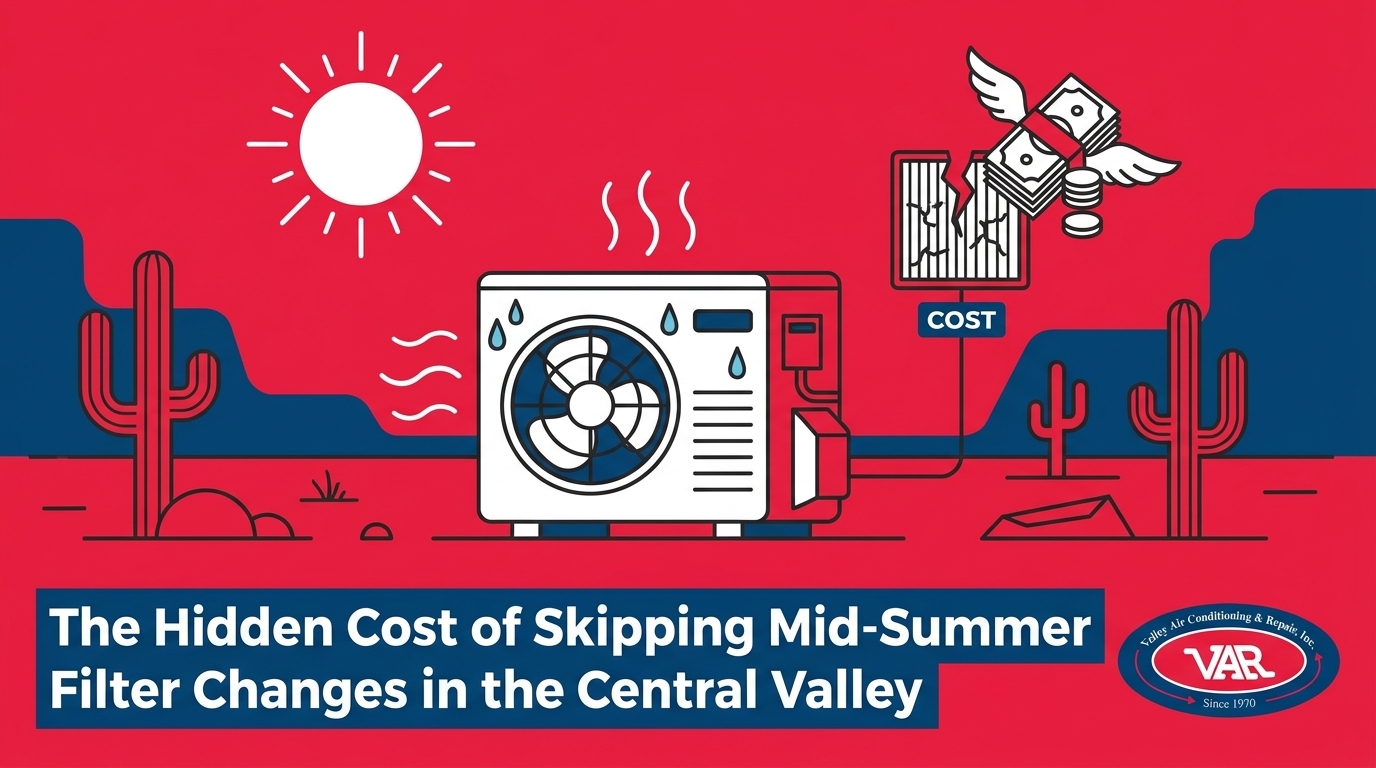
Late August brings a relentless kind of heat to Fresno, and at Valley Air Conditioning & Repair, we see the hidden cost of skipping mid-summer filter changes in the Central Valley reveal itself on the absolute hottest days of the year, right as families are managing the busy back-to-school transition. You walk into your home expecting a wave of cool relief, but instead, the air feels heavy, stagnant, and uncomfortably warm. When you check your thermostat, it reads well above your set temperature, even though the system is running non-stop. The real shock comes when you inspect the indoor unit or the outdoor copper lines and find them encased in a thick block of solid ice.
In our years of servicing local HVAC units, we've found that most homeowners assume a frozen air conditioner means a catastrophic mechanical failure or a massive refrigerant leak. While those issues are certainly possible, the most common culprit our team finds behind a late-summer freeze-up is surprisingly simple. An inexpensive, forgotten air filter from July has become so clogged with dust and debris that it has suffocated your system. By the time end-of-season cooling demands roll around, the cumulative restriction causes the entire cooling process to collapse.
When you are staring at a block of ice on your HVAC equipment, you face an immediate decision. Do you call for an emergency repair right away, or do you attempt to thaw the system and swap the filter safely first? Making the right choice depends on understanding exactly what went wrong. If you want to avoid this situation entirely in the future, upgrading your air conditioning systems or enrolling in a routine AC maintenance plan can keep your equipment running smoothly through the harshest heatwaves.
Most filter manufacturers print a standard recommendation right on the packaging: "Replace every 90 days." If you live in a mild climate with clean air, that advice might hold up. But our technicians constantly warn that relying on a generic national schedule is a dangerous gamble in Fresno during July and August. The unique environment of the Central Valley accelerates filter clogging at a rapid pace, rendering standard guidelines completely inadequate.
The San Joaquin Valley features a unique bowl-like topography, surrounded by mountain ranges that naturally trap air. During the late-summer months, this geological basin captures smog, vehicle exhaust, and massive amounts of agricultural dust. As harvest season ramps up, the San Joaquin Valley Air Pollution Control District consistently records significant increases in airborne particulate matter (both PM10 and PM2.5). Every time your air conditioner kicks on, it acts as a giant vacuum, pulling all of that suspended dust and harvest debris straight into your return vents.
Compounding the dust issue is the sheer volume of air moving through your home. Prolonged periods of 100+ degree heat force HVAC systems to run almost non-stop to maintain indoor comfort. A system running for 12 hours a day in Fresno filters exponentially more air—and traps exponentially more dirt—than a system running for just 4 hours a day in a coastal city.
• Average Daily High (August) — National Average Climate: 80°F - 85°F — Central Valley Summer Reality: 95°F - 105°F+
• System Runtime — National Average Climate: Intermittent cycling — Central Valley Summer Reality: Nearly continuous operation
• Airborne Particulates — National Average Climate: Moderate / Normal dust — Central Valley Summer Reality: Heavy agricultural dust & trapped smog
• Safe Filter Lifespan — National Average Climate: 60 to 90 days — Central Valley Summer Reality: 30 days (often less during peak harvest)
By the time August arrives, a filter installed in early July has likely reached its maximum holding capacity. The media is completely caked with a thick layer of gray grime. If you haven't scheduled your pre-season AC preparation and you forget to swap that July filter, your system is forced to pull air through a solid wall of dirt, setting the stage for a severe mechanical breakdown.
To understand why a dirty filter causes ice to form in the middle of a scorching summer, you have to look at how an air conditioner actually works. As HVAC professionals, we often explain that air conditioners do not "create" cold air. Instead, they remove heat from the air inside your home and transfer it outside.
Inside your indoor air handler or furnace sits the evaporator coil—a network of copper tubes filled with incredibly cold, low-pressure liquid refrigerant. For the system to stay balanced, the blower motor must constantly push warm, unconditioned indoor air over this freezing coil. As the warm air passes over the metal, the refrigerant absorbs the heat, boils into a gas, and travels outside to be cooled down again. The newly chilled air is then pushed through your ductwork.
When a filter becomes heavily clogged, it acts like a piece of cardboard blocking your return vent. The blower motor strains, but it simply cannot pull enough warm air across the evaporator coil. Without that constant supply of heat from your home's air, the temperature of the copper coil plummets rapidly, dropping well below 32°F.
As the coil gets colder, the normal condensation that forms on the metal (much like water droplets on a cold glass of iced tea) begins to freeze. A thin layer of frost forms first. Because ice acts as an insulator, it further blocks heat transfer, causing more frost to form. Within a matter of hours, that condensation turns into a solid block of ice, encasing the components entirely and completely stopping the cooling process. If you are ever stuck troubleshooting an AC that won't turn on, a frozen coil is one of the first physical symptoms our technicians look for.
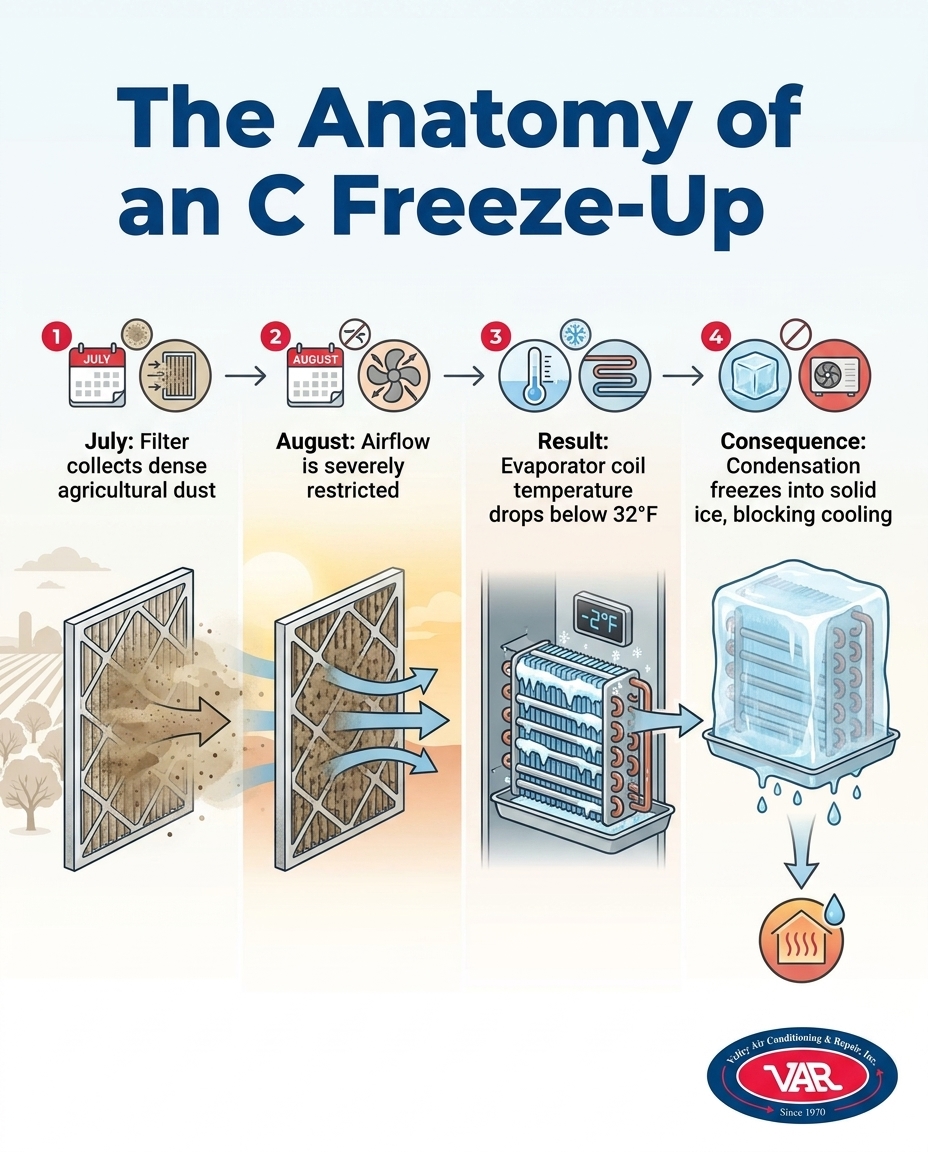
An air conditioner rarely freezes over instantly. The restriction builds over weeks, causing the system to struggle long before it completely fails. Learning to recognize the early symptoms of airflow restriction can save you from a complete breakdown during extreme heat.
1. Noticeably weak or diminished airflow: Hold your hand over a supply vent in your living room. If the air feels like a weak trickle rather than a strong, steady breeze, your blower motor is likely fighting against a clogged filter or a frozen coil.
2. Blowing warm or room-temperature air: If your thermostat is set to cool, but the air coming out of the vents feels lukewarm, the heat transfer process has failed. The system is running, but the refrigerant is no longer absorbing heat.
3. Visible ice formation: Take a look at the outdoor unit (the condenser). If you see a thick layer of white frost or solid ice on the larger copper refrigerant line running into the house, your indoor coil is almost certainly frozen solid as well.
4. Unexplained spikes in summer energy consumption: When a filter is clogged, the compressor and blower motor have to work twice as hard to move air. This extended runtime will cause a sharp, sudden increase in your monthly electricity usage.
Our team recently helped a local Fresno homeowner who experienced exactly how quickly this can escalate during a brutal late-summer heatwave. With temperatures outside reaching 110 degrees and the family under a strict Covid quarantine, their air conditioner completely stopped blowing cold air. A vulnerable elderly family member was in the home, making the situation critical. Fortunately, we dispatched one of our technicians in under an hour, diagnosed the suffocated system, and completed the necessary repair within 30 minutes, restoring the airflow and providing immediate relief from the dangerous indoor heat.
If you discover that your air conditioner has frozen up, your first instinct might be to panic. However, there are safe, immediate steps you can take as a homeowner to mitigate the problem without violating safety protocols or damaging the equipment.
The most crucial step is to stop the compressor from running. Go to your thermostat and switch the primary setting from "Cool" to "Off." If you allow the system to keep demanding cold air while the coil is frozen, liquid refrigerant can flow backward into the outdoor compressor—a condition known as "slugging." Compressors are designed to pump gas, not liquid, and slugging will destroy the compressor's internal valves instantly.
Once the cooling cycle is disabled, switch the fan setting on your thermostat from "Auto" to "On." This forces the indoor blower motor to run continuously, pulling warm ambient air from your house and pushing it over the frozen coil. This is the safest and most effective way to accelerate the thawing process naturally.
While the system is thawing, locate your return air filter. Pull it out and inspect it. If it is entirely coated in dust, pet hair, and dirt, throw it away. Install a clean, new filter immediately so the system can breathe once it is ready to run again.
It can take anywhere from 4 to 24 hours for a heavily frozen coil to thaw completely. During this time, never attempt to scrape, chip, or melt the ice with tools, knives, or heat guns. The copper coils and aluminum fins inside your unit are incredibly delicate and hold highly pressurized chemical refrigerant. Puncturing a coil with a screwdriver will instantly release toxic gases into your home and turn a simple filter issue into an incredibly expensive system replacement. You must let the ice melt naturally into the condensate drain pan.
Sometimes, a dirty filter is just a symptom of a much larger problem. If you have completely thawed the system, installed a clean filter, and turned the air conditioner back on, pay close attention over the next 24 hours. If the copper lines begin to frost over again, or if the airflow remains weak, you must turn the system off and call for professional help immediately.
A recurring freeze-up points to complex mechanical failures that require licensed diagnostics. The most common culprit is a dangerous refrigerant leak. If your system is low on refrigerant, the pressure drops, causing the temperature of the coil to plummet below freezing—exactly like a clogged filter, but far more serious. Alternatively, you could be dealing with a failing blower motor that is unable to push air, or a collapsed return duct hidden in your attic.
Ignoring these signs puts your outdoor compressor at massive risk of catastrophic failure. Forcing a suffocating system to run is the single most expensive mistake a homeowner can make. At Valley Air Conditioning & Repair, our team understands the specific, intense HVAC challenges of living in Fresno. Our deep local expertise means we know exactly how the Central Valley's agricultural dust and extreme heat impact your equipment, and our rapid response capabilities are designed specifically for end-of-season emergency breakdowns.
We recently worked with a Fresno customer who faced this exact scenario when the region was hit with 100-degree temperatures for 30 consecutive days. Their severely strained system suffered a complete failure, requiring our crew to perform a total replacement during the peak of the heatwave. Our team handled everything from the initial paperwork to a flawless installation—even advising them on generic utility incentive programs and federal tax credits that may apply to qualifying high-efficiency installations—providing flexible financing options that made managing the unexpected breakdown stress-free. The new system was up and running quickly, allowing the homeowner to easily control their indoor climate right from their phone.
If your system is showing signs of a deeper issue, reaching out for comprehensive HVAC services is the only way to accurately diagnose a refrigerant leak or motor failure safely.
Yes, a severely dirty filter is one of the leading causes of a frozen air conditioner. When the filter becomes clogged with dirt and dust, it restricts the amount of warm indoor air flowing over the evaporator coil. Without that warm air to absorb the cold, the coil's temperature drops below freezing, turning normal condensation into a solid block of ice.
August freeze-ups are incredibly common because the system has been running constantly for months, and the filter has likely reached its maximum capacity for holding dust. In the Central Valley, July's agricultural dust and smog accumulate rapidly on the filter media. By late August, the restricted airflow combined with extreme outdoor temperatures causes the system to overwork and eventually ice over.
A completely frozen air conditioning system typically takes between 4 and 24 hours to thaw entirely. The exact time depends on the ambient temperature of your home and the thickness of the ice. You can speed up this process safely by turning the thermostat to "Off" and switching the fan to "On," which blows warm indoor air continuously over the frozen components.
Leaving the same filter in your system for three months during a Fresno summer almost guarantees severe airflow restriction. The high volume of agricultural dust, combined with the fact that the AC runs almost non-stop in 100-degree heat, means filters clog much faster here than the national average. This neglect leads to higher energy bills, poor cooling performance, and eventual system freeze-ups.
The very first thing you must do is turn the cooling cycle off at the thermostat to protect the compressor from permanent damage. Next, turn the fan setting to "On" to help melt the ice naturally. Finally, check and replace your air filter if it is dirty. Never try to chip the ice away with tools, as this can puncture the pressurized refrigerant lines.
During the peak heat and harvest months of July and August, you should check your air filter every 30 days. Because of the heavy particulate matter in the air and the continuous operation of the HVAC system, standard 90-day filters often become completely clogged in just three to four weeks. Frequent changes are the easiest way to protect your equipment.
In our experience, understanding the direct mechanical link between a forgotten filter and a frozen coil empowers you to protect your system when the weather is at its worst. By keeping a close eye on your airflow and changing your filter every 30 days during the peak of summer, you can prevent the vast majority of unexpected freeze-ups as you transition into the back-to-school season. If you do find ice on your system, following safe thawing procedures prevents costly accidental damage to your delicate equipment.
However, if changing the filter and thawing the unit doesn't restore your cooling, time is of the essence. Scheduling a professional inspection with our team is the safest way to survive the rest of the summer heat without risking a total compressor failure. Enrolling in a routine AC maintenance plan ensures that a licensed technician is regularly checking your refrigerant levels and blower motor performance, giving you total confidence that your home will stay cool no matter how hot the Central Valley gets.

As a business with many AC units, it is essential to have a responsive AC company. Valley Air Conditioning understands our needs. They are always responsive and our AC is up and running very quickly.
I had them do an AC check on the home I was buying, they were honest and quick. I hired them to do the summer and Fall maintenance for $149. Happy with this company!
100% recommend. I called, same day they came out and gave me estimate. Conley was honest and didn't try to recommend/sell us anything we didn't need. When I called him with questions before making a decision, he happily answered and was not annoyed by me contacting him. Conley and VAR
This is a group of good people. Very professional and knowledgeable. They take the time to listen and find the best solution that fits best for any situation. There's no way you can go wrong in choosing VAR.
We have used Valley Air for over fifteen years. The last two years ,Matt came to our house to service twice a year. Always on time, so polite and so professional. This is a very honest company and you can always depend on them and trust them. The office always treats everyone cheerfully and always want to do what you need done very fast YOU CAN COUNT ON THIS Company