.webp)


How Your Furnace Flame Sensor Dictates Safe Operation
If your heating system fires up only to shut down seconds later, a dirty flame sensor is likely to blame. See why this tiny rod triggers a strict safety lockout.
If you are dealing with a heating system that fires up only to turn off a few seconds later, understanding exactly how your furnace flame sensor dictates safe operation is the first step toward getting your home warm again. You turn on the thermostat during the September pre-heating transition, expecting a steady flow of warm air. Instead, you hear the inducer motor spin up, the satisfying click of the gas valve opening, and the rumble of the burners igniting. But just three to five seconds later, the flames vanish, and the system goes completely silent.
In our years of restoring heat to local homes, our team at Valley Air Conditioning & Repair has found that this rapid shutdown is one of the most frustrating experiences for a homeowner, but it is rarely a sign of a catastrophic mechanical failure. In almost every case, this behavior is a deliberate safety lockout initiated by the furnace's internal computer. Modern heating systems are designed with strict safety protocols to prevent raw natural gas from flooding your home if a fire fails to sustain itself.
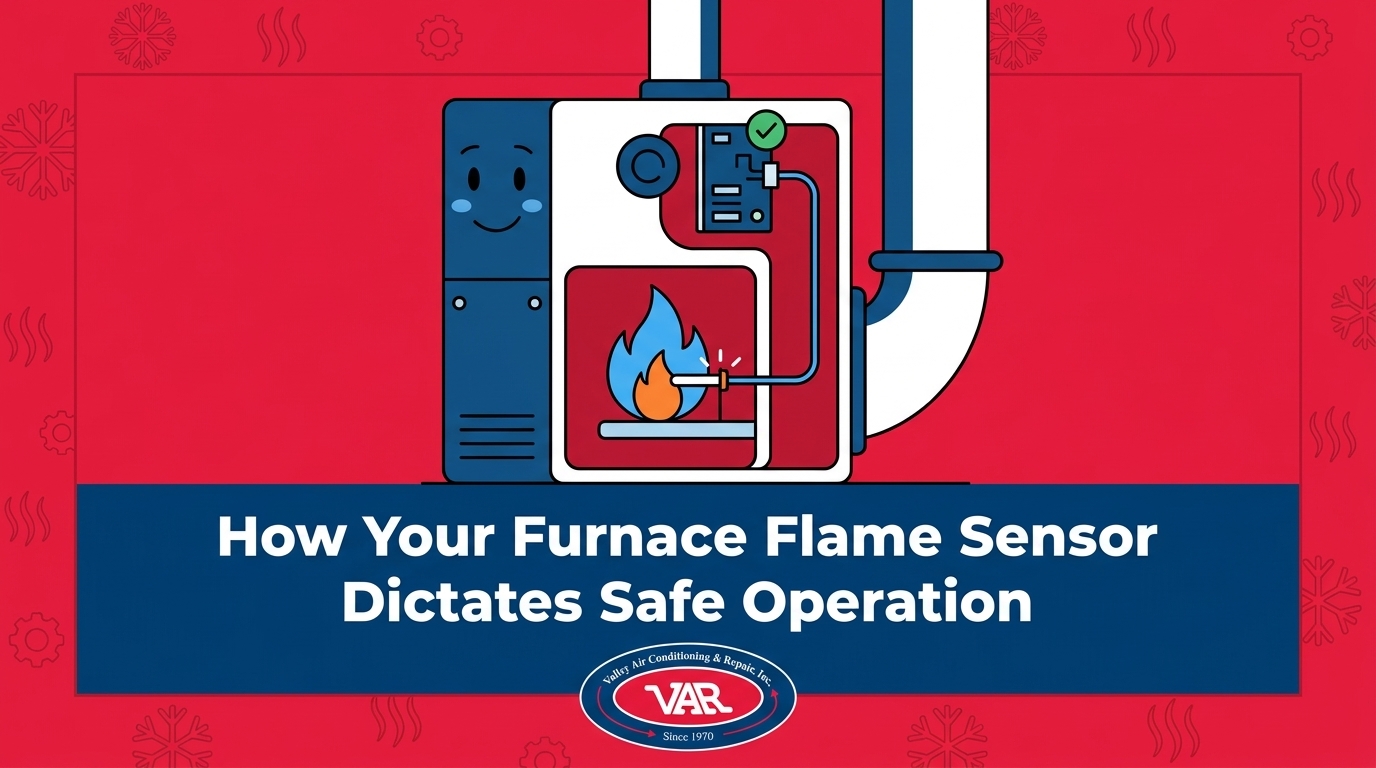
The component responsible for monitoring this process is the furnace flame sensor. This small, metallic rod sits directly in the path of the burner flames, acting as the primary line of defense against gas leaks. When the sensor fails to register a strong, steady flame, it immediately cuts the power to the gas valve. Recognizing that this lockout is caused by a disrupted electrical signal—rather than a broken blower motor or a cracked heat exchanger—is a critical decision point. It means the issue requires professional HVAC services to perform electrical diagnostics, rather than guesswork or unnecessary parts replacement.
To understand why a furnace shuts down so abruptly, you have to look past the visible flames and understand the microscopic electrical currents working behind the scenes. Flame sensors do not detect heat, and they do not detect light. Instead, they rely on a fascinating scientific principle known as flame rectification.
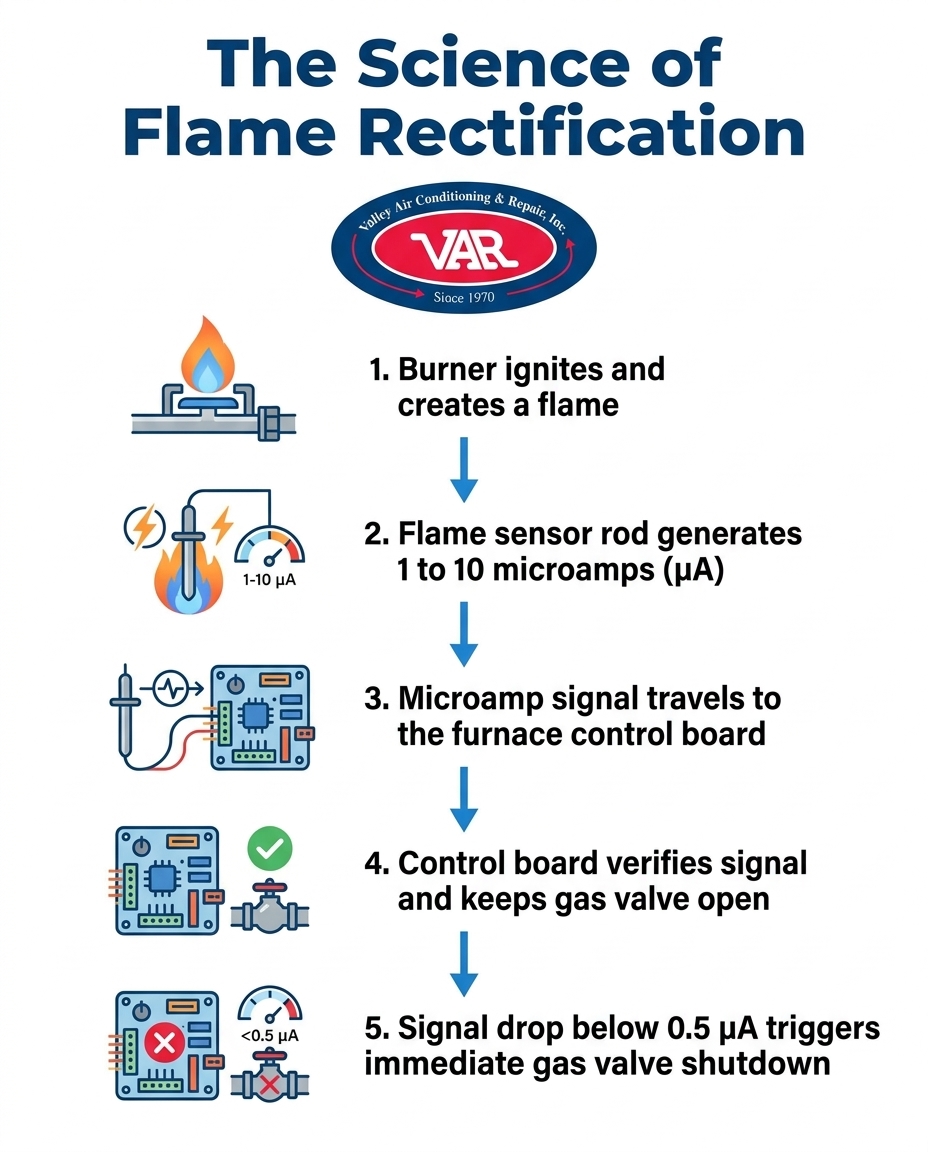
Flame rectification is the process of using the actual fire to conduct electricity. While we normally think of air as an insulator, the intense chemical reaction of a natural gas flame creates ionized gases. These ionized gases can carry a tiny electrical charge from the sensor rod, through the flame, and into the grounded metal of the burner assembly. This invisible process happens in a matter of milliseconds and follows a very specific sequence:
1. The Burner Ignites: The thermostat calls for heat, the gas valve opens, and the igniter lights the main burners. The flame immediately engulfs the metallic rod of the flame sensor.
2. The Sensor Generates Current: As the alternating current (AC) electricity from the control board hits the ionized flame, the flame acts as a rectifier, converting the AC power into a direct current (DC). This generates a microscopic electrical signal—typically between 1 and 10 microamps (µA).
3. The Control Board Verifies the Signal: The sensor sends this microamp signal directly back to the furnace control board through a single wire. The computer continuously monitors this incoming current.
4. The Gas Valve Stays Open: As long as the control board receives a steady, uninterrupted microamp signal, it knows a fire is actively burning. It keeps the gas valve open, ensuring continuous combustion.
If that signal drops below a specific threshold, the communication loop is broken. Because dealing with raw gas is incredibly dangerous, the control board will not wait to see if the flame comes back. It instantly shuts the system down. This is why a targeted heating system repair focuses so heavily on testing this exact electrical pathway rather than just looking at the mechanical parts.
Many homeowners wonder why a flame sensor works perfectly in March but fails on the very first chilly morning of the fall. The answer lies in what happens to your furnace while it sits completely idle during the off-season. Summer dormancy is one of the hardest phases on a heating system, primarily due to the buildup of environmental contaminants.
Our technicians see this pattern every single fall: during the long, dry, dusty Fresno Central Valley summer, airborne particulate matter is constantly circulating. Even if your furnace is not running, your ductwork and the natural airflow of your home allow microscopic dust, pet dander, and agricultural particles to settle deep inside the furnace cabinet. Over several months, this debris coats the internal components, including the delicate metallic rod of the flame sensor.
When the furnace finally fires up in the fall, those settled particles are instantly subjected to intense heat. The dust and debris bake directly onto the surface of the sensor, creating a microscopic layer of carbon and oxidation. Because the flame sensor relies on conducting a tiny electrical current through the fire, this baked-on carbon acts as a highly effective electrical insulator. It creates a physical barrier between the metal rod and the ionized gases of the flame.
This insulating barrier is exactly what causes a microamp (µA) signal drop. The flame is burning perfectly fine, but the carbon buildup prevents the electricity from flowing. When the signal drops below the critical 0.5 to 1 µA threshold, the control board assumes the fire has gone out. It instantly shuts off the gas valve to prevent a dangerous situation. Restoring the system requires removing this invisible barrier to re-establish the conductive pathway, a task that must be handled with extreme precision.
We frequently receive calls from homeowners who searched online for solutions to a furnace short-cycling and followed tutorials advising them to remove the flame sensor and scrub it clean. Many of these guides recommend using abrasive materials like sandpaper, steel wool, or heavy-duty scouring pads. While this might seem like a quick, cost-effective fix, in our experience, it is one of the most damaging things you can do to your heating system.
The technical danger of abrasives: Flame sensors are manufactured from specialized alloys designed to withstand extreme temperature fluctuations while maintaining a perfectly smooth surface. When you use sandpaper or steel wool to scrape away carbon buildup, you leave behind microscopic scratches and deep grooves in the metal. To the naked eye, the rod might look shiny and clean, but under magnification, the surface has been heavily gouged.
Altered surface area and ruined readings: These microscopic scratches permanently alter the surface area of the sensor. Because the microamp signal relies on a precise surface geometry to conduct electricity through the flame, changing the texture of the metal can ruin its ability to generate an accurate reading. Even if the furnace runs temporarily, the sensor's conductivity has been compromised, leading to an eventual microamp (µA) signal drop.
Trapping future carbon: Furthermore, those scratches act like tiny canyons that trap dust and carbon at an accelerated rate. A sensor that has been scratched by sandpaper will become insulated and fail much faster than a factory-smooth rod. Proper cleaning requires specialized, non-abrasive techniques that remove the oxidation while perfectly preserving the smooth metallic finish required for accurate flame rectification. This is why we consistently see DIY cleaning lead to complete component failure shortly after.
Resolving a safety lockout involves much more than just a visual inspection or wiping down a metal rod. Because the electrical currents involved are invisible and incredibly small, a technician cannot simply look at a flame sensor and know if it is functioning correctly. Restoring a furnace to safe operation requires verifying the invisible electrical current through precision testing.
Wiring specialized multimeters in series: To measure the exact microamp flow during ignition, technicians must break the electrical circuit and wire a specialized multimeter in series with the sensor. This forces the electrical current to flow directly through the meter before reaching the control board. By watching the meter during the three-second ignition window, the technician can see exactly how many microamps are being generated. Valley Air Conditioning & Repair technicians don't just guess at the problem—they understand and test these precise microamp readings to guarantee the furnace control board is responding correctly and that the gas valve is operating safely.
Diagnosing the microamp (µA) signal drop: If the meter shows a reading of 2.5 µA, the technician knows the sensor is healthy and the lockout is being caused by a different issue, such as a failing control board or a grounding problem. If the meter shows a reading of 0.3 µA, they know the sensor is either heavily insulated by carbon or physically failing. Verifying this exact signal drop eliminates guesswork.
Long-term reliability through consistent care: This level of technical diagnostic work is what keeps older heating systems running safely year after year. For example, our team recently worked with a local homeowner who relied on our professional maintenance for a 13-year-old unit that required ongoing care. By performing careful preventive maintenance, testing electrical signals, and thoroughly cleaning components like the heat exchanger, the older system was kept running like new. Scheduling a proper residential pre-season heating preparation ensures these microscopic electrical issues are calibrated and resolved long before the winter cold sets in.
While a dirty flame sensor is a common cause for a safety lockout, it is rarely an isolated issue. In most cases, a sensor heavily coated in dust and carbon is a symptom of broader system neglect. If enough debris has bypassed the filter to insulate the sensor rod, that same debris has likely coated the blower motor, the burners, and the heat exchanger.
A comprehensive inspection evaluates the entire combustion process, not just a single electrical component. When our Valley Air Conditioning & Repair technicians evaluate your system, we look at how every part interacts to create safe, efficient heat.
• Burner alignment and cleanliness: Ensuring the gas flows evenly across all burner tubes so the flame properly engulfs the sensor.
• Blower motor amp draw: Testing the electrical load on the fan to ensure it is pushing enough air over the heat exchanger to prevent overheating.
• Venting and exhaust clearance: Confirming that carbon monoxide and other combustion byproducts are being safely routed out of the home.
• Airflow restrictions: Checking for heavily clogged filters that strangle the system and cause the internal temperature limits to trip.
The long-term benefits of scheduled care go far beyond preventing a sudden shutdown. Ensuring proper airflow and ventilation keeps your energy bills manageable by allowing the system to heat the home with less effort. Verifying the integrity of the heat exchanger protects your family from carbon monoxide exposure. Testing all safety limits and electrical connections guarantees that if something does go wrong, the furnace will fail safely rather than dangerously.
There is a stark contrast between waiting for a lockout and taking proactive measures. Relying on a routine maintenance plan means these issues are caught when they are minor adjustments, rather than midnight emergencies.
• Furnace shuts down abruptly on the first cold morning. — Proactive Pre-Season Preparation: System is cleaned and tested weeks before the cold arrives.
• Requires emergency scheduling and diagnostic testing. — Proactive Pre-Season Preparation: Scheduled at your convenience during the fall transition.
• Sensor may be permanently damaged from repeated short-cycling. — Proactive Pre-Season Preparation: Sensor is safely cleaned with non-abrasive techniques.
• Ignores other hidden issues like dirty burners or weak capacitors. — Proactive Pre-Season Preparation: Addresses the entire combustion and airflow process.
Investing in comprehensive fall heating maintenance is the most effective way to protect your home. It shifts the focus from simply fixing what is broken to preserving the safety and efficiency of the entire system.
Why does my furnace ignite and then immediately shut off?
This rapid shutdown is almost always a safety lockout initiated by the furnace control board. When the internal sensors fail to detect a steady, continuous flame after the gas valve opens, the system shuts down to prevent raw natural gas from accumulating in your home. The most common culprit for this specific behavior is a dirty or failing flame sensor.
What exactly does a furnace flame sensor do?
A furnace flame sensor acts as a critical safety monitor by utilizing a process called flame rectification. It sits directly in the path of the burner flames and generates a microscopic electrical current when exposed to fire. By sending this continuous electrical signal back to the control board, it proves that the gas is actively burning and that it is safe to keep the gas valve open.
Can a furnace run without a flame sensor?
No, a modern furnace cannot and will not run without a functioning flame sensor. It is a mandatory safety device hardwired into the system's ignition sequence. If the sensor is bypassed, broken, or missing, the control board will not receive the necessary electrical verification and will permanently lock out the gas valve to protect the home.
How do I know if my flame sensor is causing a safety lockout?
The most distinct symptom of a flame sensor issue is a very specific short-cycling pattern. You will hear the furnace click on, the burners will light and produce heat for exactly three to five seconds, and then the flames will abruptly cut out. The furnace will usually attempt this sequence three times before going into a hard safety lockout that requires a system reset.
What is a normal microamp reading for a furnace flame sensor?
A healthy furnace flame sensor typically generates a steady electrical current between 1 and 10 microamps (µA) when fully engulfed in a flame. If that microamp reading drops below the critical threshold of 0.5 to 1 µA, the control board will no longer recognize the signal. This immediate drop is what triggers the gas valve to close and the system to shut down.
Understanding exactly how your furnace flame sensor dictates safe operation gives you a clear advantage as the seasons change. Instead of waiting for a sudden, frustrating shutdown on a freezing morning, you can take control of your home's comfort. Recognizing that a microscopic layer of dust can disable your entire heating system highlights exactly why a professional pre-season tune-up is the safest, most reliable solution. Schedule your comprehensive fall maintenance today to ensure your system is tested, calibrated, and ready to keep your family warm all winter long.

As a business with many AC units, it is essential to have a responsive AC company. Valley Air Conditioning understands our needs. They are always responsive and our AC is up and running very quickly.
I had them do an AC check on the home I was buying, they were honest and quick. I hired them to do the summer and Fall maintenance for $149. Happy with this company!
100% recommend. I called, same day they came out and gave me estimate. Conley was honest and didn't try to recommend/sell us anything we didn't need. When I called him with questions before making a decision, he happily answered and was not annoyed by me contacting him. Conley and VAR
This is a group of good people. Very professional and knowledgeable. They take the time to listen and find the best solution that fits best for any situation. There's no way you can go wrong in choosing VAR.
We have used Valley Air for over fifteen years. The last two years ,Matt came to our house to service twice a year. Always on time, so polite and so professional. This is a very honest company and you can always depend on them and trust them. The office always treats everyone cheerfully and always want to do what you need done very fast YOU CAN COUNT ON THIS Company