.webp)


Guide
Why Knowing How to Apply for Energy Rebates in Arizona vs. California Can Save You Thousands
If you have been researching how to apply for energy rebates in Arizona, you might be looking for ways to combat rising utility bills and extreme temperatures. However, if you are a homeowner in the Central Valley of California—serving communities like Fresno, Clovis, Madera, and Sanger—you have access to a completely different, highly lucrative set of local and state incentives designed to make energy-efficient upgrades affordable.
Here is a quick overview of how to get started with energy rebates in our California service area:
- Check your eligibility for California state programs like TECH Clean California or Golden State Rebates
- Partner with a licensed contractor who is registered with local utility programs
- Gather your documents — including your PG&E utility bill, proof of income, and homeownership details
- Select your energy-efficient upgrades — such as a high-efficiency heat pump or smart thermostat
- Confirm pre-approval requirements before purchasing equipment or starting any installation work
- Complete your upgrade through a qualified local professional
- Claim your savings — which are often applied as instant point-of-sale discounts or direct invoice deductions
Central Valley homeowners can access thousands of dollars in savings through state-sponsored initiatives, local utility rebates from providers like PG&E, and federal tax credits that can reduce your annual tax liability. Renters in our service area can also qualify for portable appliance upgrades and smart home incentives.
The most important rule to remember: always verify program requirements before starting any work. Many rebates cannot be applied retroactively to completed projects.
Major Energy Rebate Programs in California's Central Valley

Navigating home energy incentives can feel overwhelming, but once you break down the options, you will find that California offers some of the most robust financial incentives in the country. These programs are designed to help Central Valley residents transition to high-efficiency systems, lower their monthly bills, and keep their homes comfortable all year long.
If you are looking to upgrade your home comfort systems in Fresno, Clovis, or Madera, understanding these programs is your ticket to massive savings. More info about HVAC services can help you understand how modern heating and cooling systems fit into these energy-saving initiatives.
TECH Clean California and Golden State Rebates
The cornerstone of California's current electrification incentive landscape includes statewide initiatives aimed at reducing greenhouse gas emissions and helping families transition to clean energy:
- TECH Clean California: This initiative focuses on helping families transition away from fossil-fuel appliances to clean, electric alternatives. It provides significant incentives for high-efficiency heat pump HVAC systems and heat pump water heaters. These incentives are typically claimed directly by your qualified contractor and passed on to you as an instant discount.
- Golden State Rebates: This program offers instant coupons for smart thermostats, room air conditioners, and heat pump water heaters. It is a quick and easy way to save money on smaller, "plug-and-play" efficiency upgrades.
Your eligibility and the amount you can claim through these programs often depend on your household income and your specific utility provider:
- Equity Incentives: Low-to-moderate-income households in the Central Valley may qualify for enhanced incentive rates, covering a larger portion of the installation costs for heat pumps and electrical panel upgrades.
- Standard Incentives: Moderate-and-above-income households are still eligible for substantial standard rebates, which can be combined with federal tax credits.
Utility-Specific Rebates (PG&E)
In addition to state-managed funds, major utility providers in the Central Valley offer their own incentives. These utility rebates are incredibly popular because they have fewer income restrictions and can be combined with other savings.
- Pacific Gas and Electric (PG&E): PG&E provides a variety of residential rebates. Homeowners can receive incentives for installing energy-efficient smart thermostats, upgrading to high-efficiency electric heat pump water heaters, and performing home energy audits. PG&E also offers specialized programs for low-income customers, such as the Energy Savings Assistance (ESA) program, which provides no-cost home improvements to help lower energy bills.
How to Apply for Energy Rebates in Arizona and California: A Step-by-Step Guide
Now that you know what programs are out there, let’s walk through the actual application process. Whether you are researching how to apply for energy rebates in Arizona or looking to secure savings right here in the Central Valley of California, the most important thing to keep in mind is that patience pays off. If you buy equipment or hire a contractor before getting your official approvals, you could completely disqualify yourself from receiving certain rebates.
Here is the exact step-by-step process to secure your savings in California:
- Verify Program Availability: Start by visiting the official TECH Clean California or PG&E rebate portals to see which incentives are currently active in your zip code.
- Find a Participating Contractor: For major upgrades like heat pumps, you must work with a licensed contractor who is registered with the rebate program.
- Get a Home Assessment: Have your qualified contractor look at your home to identify where you are losing energy and verify what equipment needs to be replaced.
- Submit Pre-Approval (If Required): Your contractor will often handle the pre-approval process and reserve the rebate funds on your behalf.
- Execute the Project: Have your approved contractor install the qualified high-efficiency system.
- Close Out and Save: Submit the final invoices and proof of installation to release the funds or finalize your point-of-sale discount.
Preparing Your Documentation: How to Apply for Energy Rebates in Arizona
To make the application process as smooth as possible, we highly recommend gathering all your paperwork beforehand. Whether you are comparing regional guidelines or preparing your local California application, having a digital folder ready on your computer will prevent you from scrambling mid-application.
Here is what you will typically need to apply:
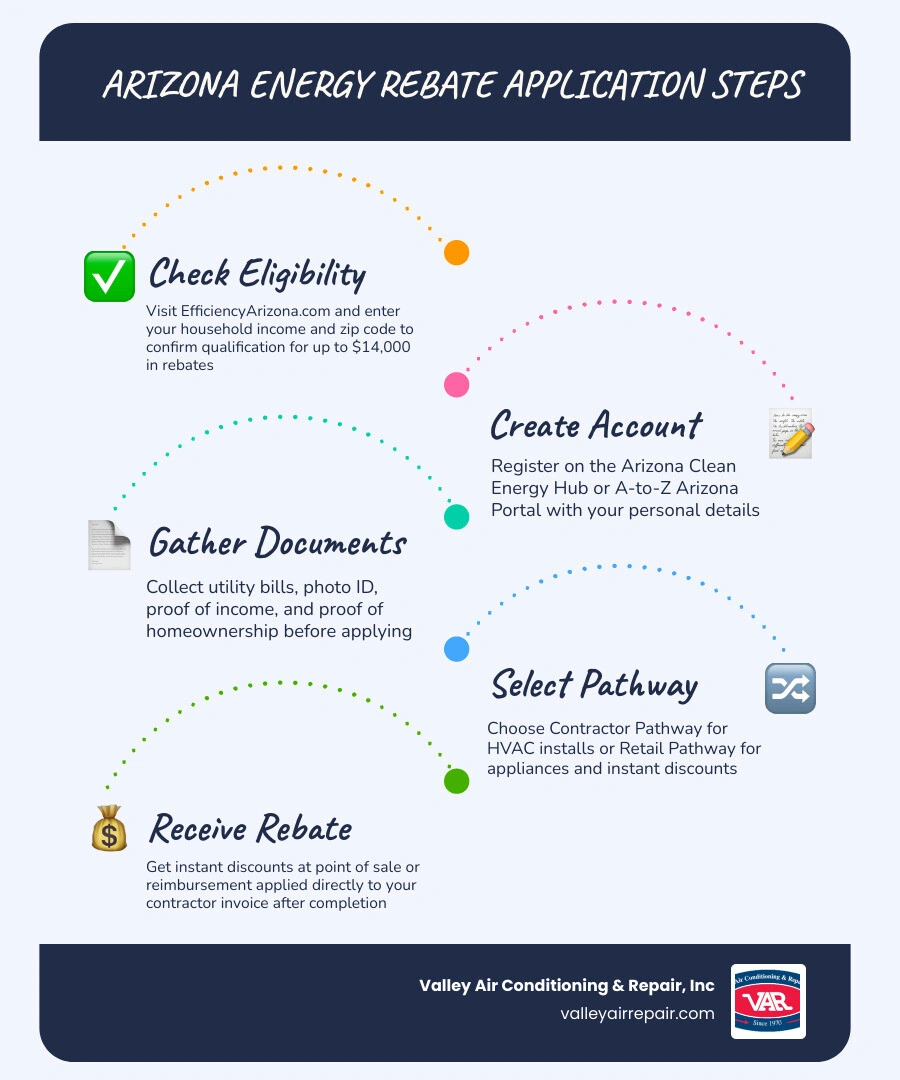
- Proof of Income: You must provide documentation for all adult household members if applying for income-qualified tiers. This includes recent tax returns, consecutive pay stubs, or official award letters from public assistance programs.
- Recent Utility Bills: Grab your most recent electric or gas bill (such as PG&E). Make sure your account number, service address, and name are clearly visible.
- Photo Identification: A valid driver's license, state ID, or passport.
- Proof of Homeownership: A property tax statement, deed, or recent mortgage statement. (If you are renting, you will need a copy of your lease agreement and a signed landlord permission form).
Choosing Your Pathway: How to Apply for Energy Rebates in Arizona
When applying for state-level rebates, you will navigate through one of two distinct pathways:
- The Contractor Pathway: This is designed for larger, complex home upgrades such as central heat pump installations, duct sealing, and whole-home insulation. Under this pathway, you must work with an approved contractor. Once your application is approved, the rebate amount is applied directly as a discount on the contractor's invoice. You only pay the remaining out-of-pocket balance, meaning you don't have to wait months for a check in the mail.
- The Retail Pathway: This pathway is perfect for "plug-and-play" appliances like smart thermostats. Once your eligibility is verified through the online portal, you will receive an instant digital coupon or voucher. You can redeem this voucher directly at participating retailers to get your discount right at the cash register.
Stacking Rebates and Federal Tax Credits for Maximum Savings
One of the best-kept secrets of home energy upgrades is incentive stacking. By combining state rebates, utility incentives, and federal tax credits, you can dramatically lower the net cost of your project.
However, you must follow the correct order of operations when calculating your final tax credits. Government rules dictate that any upfront rebates or utility incentives you receive must be subtracted from the total project cost before you calculate your federal tax credits.
Here is how the federal credits break down:
- The 25C Energy Efficient Home Improvement Credit: This allows you to claim a 30% tax credit on qualifying energy-efficient upgrades, up to an annual limit of $3,200. Within this limit, you can claim up to $2,000 per year for heat pumps and heat pump water heaters, and up to $1,200 for insulation, energy-efficient doors, and windows.
- The 25D Residential Clean Energy Credit: This provides an uncapped 30% tax credit for clean energy installations, such as residential solar PV systems, wind energy devices, and battery storage systems.
To see how stacking works in the real world, let's look at a quick comparison of the maximum benefits available:
| Upgrade Type | TECH Clean California Rebate | Federal 25C Tax Credit | PG&E Utility Rebate |
|---|---|---|---|
| Heat Pump HVAC | Up to $3,000+ (Incentives vary) | 30% of remaining cost (Up to $2,000) | Varies by program |
| Heat Pump Water Heater | Up to $1,000+ (Incentives vary) | 30% of remaining cost (Up to $2,000) | Varies by program |
| Insulation / Air Sealing | Varies by program | 30% of remaining cost (Up to $1,200) | Varies by program |
| Electric Panel Upgrade | Up to $2,000+ (With heat pump) | 30% of remaining cost (Up to $600) | N/A |
Note: While you can stack utility rebates and federal tax credits with state rebates, you cannot claim multiple state-level rebates for the exact same piece of equipment.
Frequently Asked Questions about Arizona and California Energy Rebates
Can renters apply for energy rebates in California?
Yes! Renters are absolutely eligible for several energy rebate programs in California. If you are renting a home in the Central Valley, you can easily apply for the Retail Pathway rebates to purchase portable appliances, such as smart thermostats or energy-efficient room air conditioners, which you can take with you when you move.
However, if you want to make permanent upgrades to the property — such as installing a central heat pump, upgrading the insulation, or sealing the ducts — you must obtain written permission from your landlord. The landlord will need to sign off on the application, and the property owner's information must be verified during the approval process.
Can I get a rebate for replacing an existing heat pump?
According to strict program guidelines, you typically cannot receive a rebate to replace an existing, functioning heat pump.
Most electrification programs are specifically designed to promote fuel switching and reduce greenhouse gas emissions. Therefore, these rebates are reserved for homeowners who are replacing fossil-fuel systems (such as gas furnaces or propane heaters) with clean electric heat pumps, or upgrading standard, inefficient central air conditioners that rely on older heating elements.
How long does it take to receive my rebate payment?
The timeline for receiving your money depends entirely on the pathway you use:
- Retail Pathway: Savings are instant. You receive a digital voucher to use at the point of sale, so you save money the second you check out.
- Contractor Pathway: The rebate is applied directly to your contractor's invoice upon project completion. This means you get instant relief on your bill and do not have to wait for a reimbursement check.
- Utility Rebates (PG&E): If you apply for a post-purchase utility rebate directly through PG&E, the processing time typically takes 4 to 8 weeks from the date your application and receipts are submitted.
Conclusion
Taking the time to learn how to apply for energy rebates in Arizona or right here in California is a highly rewarding investment. With thousands of dollars available in state electrification rebates, utility incentives, and federal tax credits, there has never been a better time to upgrade your home’s energy efficiency.
At Valley Air Conditioning & Repair, Inc., we have spent decades building our reputation on trust, honorable intentions, and a strict customer-first philosophy. Since 1970, our business has grown through warm word-of-mouth recommendations because we treat our customers like family. While navigating complex rebate programs can feel overwhelming, you don't have to go it alone.
If you are ready to make your home more comfortable, lower your energy bills, and maximize your savings in Fresno, Clovis, Madera, Sanger, or Selma, reach out to us today. More info about HVAC services is just a click away, and our expert team is always here to help you find the perfect, high-efficiency solutions for your home.
Recent Posts
Customer Testimonials

As a business with many AC units, it is essential to have a responsive AC company. Valley Air Conditioning understands our needs. They are always responsive and our AC is up and running very quickly.
I had them do an AC check on the home I was buying, they were honest and quick. I hired them to do the summer and Fall maintenance for $149. Happy with this company!
100% recommend. I called, same day they came out and gave me estimate. Conley was honest and didn't try to recommend/sell us anything we didn't need. When I called him with questions before making a decision, he happily answered and was not annoyed by me contacting him. Conley and VAR
This is a group of good people. Very professional and knowledgeable. They take the time to listen and find the best solution that fits best for any situation. There's no way you can go wrong in choosing VAR.
We have used Valley Air for over fifteen years. The last two years ,Matt came to our house to service twice a year. Always on time, so polite and so professional. This is a very honest company and you can always depend on them and trust them. The office always treats everyone cheerfully and always want to do what you need done very fast YOU CAN COUNT ON THIS Company
Blogs
Stay updated with our latest blog posts.