


.webp)


Why Is My AC Blowing Warm Air? Fall HVAC Troubleshooting & Startup Smells
Smelling burning dust this fall? Get clear answers with our home maintenance tips and troubleshooting to know when to call a pro for your heating system.
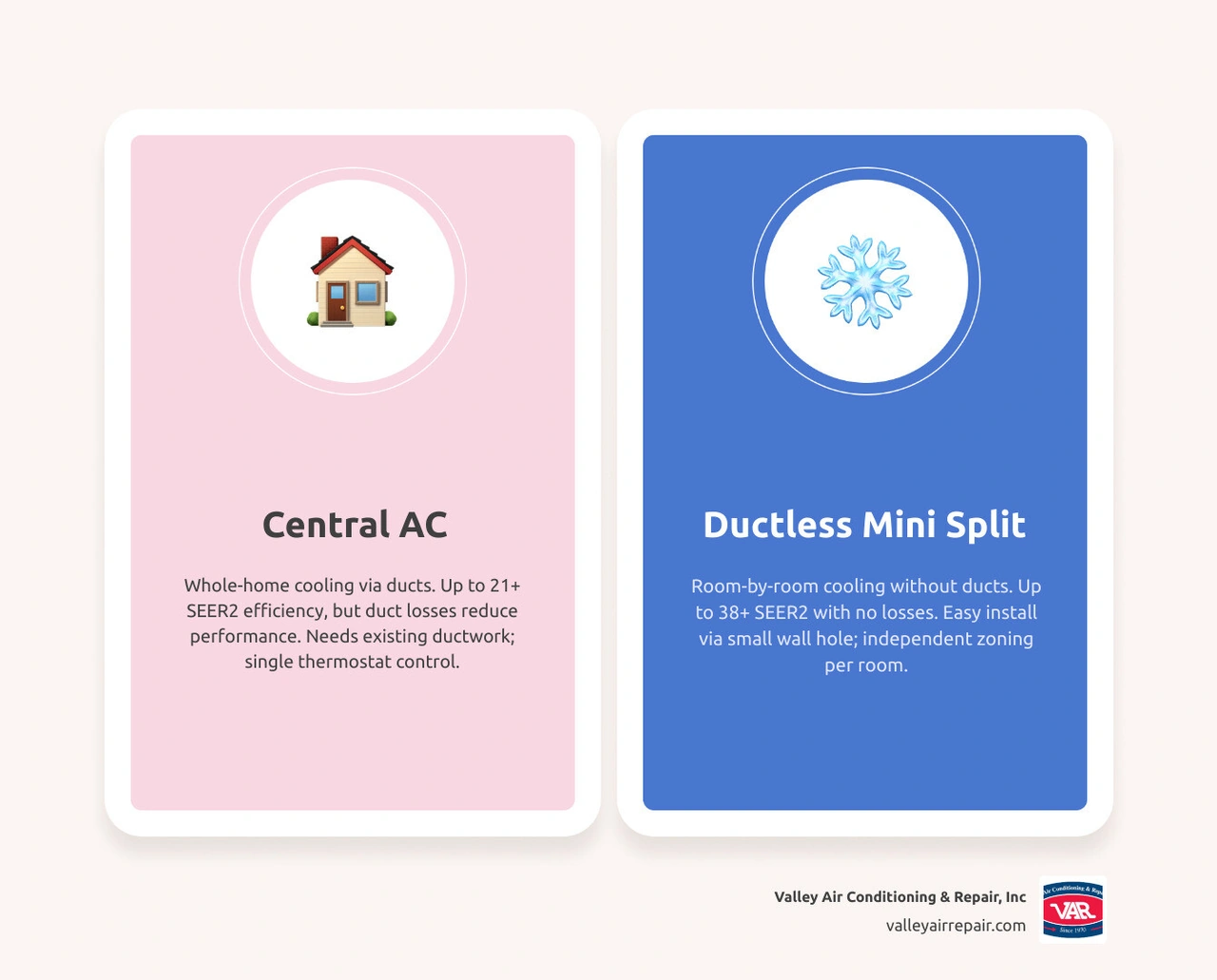
When making a central AC vs ductless mini split comparison, the honest answer is: it depends on your home. Here's a quick breakdown to help you decide at a glance:
| Factor | Central AC | Ductless Mini Split |
|---|---|---|
| Best for | Larger homes with existing ductwork | Homes without ducts, additions, or problem rooms |
| Energy efficiency | Up to 21+ SEER2 (minus duct losses) | Up to 38+ SEER2 with no duct losses |
| Installation | Requires ductwork; more invasive | Small wall hole; faster and less disruptive |
| Zoning | Single thermostat for whole home | Independent control per room or zone |
| Heating | Cooling only (needs separate furnace) | Built-in heat pump for year-round comfort |
| Noise | Noticeable vent airflow and startup sounds | As quiet as 19 decibels indoors |
| Lifespan | 15–20 years average | Up to 20–30 years with proper care |
If you already have well-sealed, quality ductwork, central AC can be a smart, cost-effective solution for whole-home cooling. But if your ducts are leaky, your home lacks ductwork entirely, or you want room-by-room control, a ductless mini split is often the stronger choice.
Central Valley summers in and around Modesto are no joke. Months of intense heat put serious demands on any cooling system, and choosing the wrong setup can mean uneven temperatures, high energy bills, and a system that struggles to keep up. In 2026, with updated SEER2 efficiency standards now reflecting real-world operating conditions, the gap between a well-matched system and a poorly chosen one is wider than ever.
Whether you're cooling an older home in Ceres that never had ductwork, finishing a basement in Turlock, or just trying to end the thermostat wars in a multi-story house in Manteca, the right system depends on factors specific to your home — not a one-size-fits-all answer.
To understand which system fits your lifestyle, we first have to look at how they move air. Central AC is a "forced air" system. It uses a large indoor air handler to push cooled air through a network of hidden ducts, exiting through vents in each room. It is designed for whole-home distribution, making it the traditional choice for larger properties in areas like Clovis or Fresno.
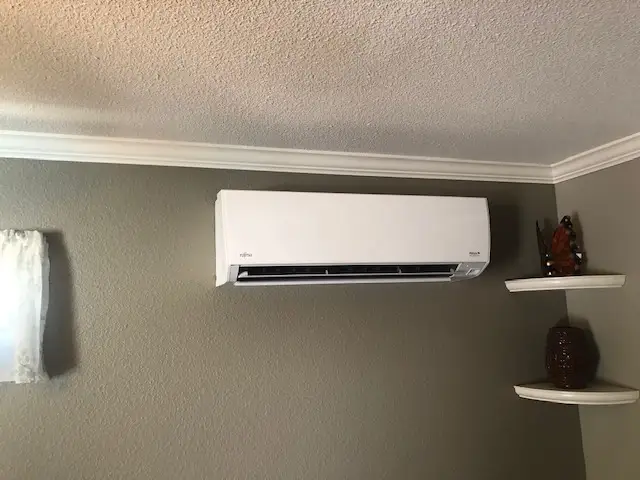
On the other hand, a ductless mini split provides point-of-use cooling. Instead of one central unit, you have small indoor "heads" mounted directly on the walls or ceilings of the rooms you want to cool. These are connected to an outdoor condenser via thin refrigerant lines. This setup eliminates the need for bulky ductwork entirely.
When we perform a central ac vs ductless mini split comparison for our neighbors in the Valley, we often find that the "best" system is the one that matches the home's existing architecture. If your home was built with ducts, upgrading your Air Conditioning unit is often straightforward. But for homes with slab foundations or historic layouts in places like Madera, adding ducts can be a logistical nightmare that makes ductless systems much more attractive.
In May 2026, efficiency is the name of the game. Both systems use SEER2 (Seasonal Energy Efficiency Ratio 2) ratings to measure how much cooling they provide per watt of electricity. However, the raw numbers don't tell the whole story.
Mini splits use inverter technology, which works like a dimmer switch for your cooling. Instead of the "all-or-nothing" approach of a traditional central unit that clunks on and off, a mini split’s variable-speed compressor scales its power up or down to maintain a precise temperature. This prevents the energy spikes associated with frequent startups.
| Efficiency Metric | Central AC | Ductless Mini Split |
|---|---|---|
| Max SEER2 Rating | ~21+ | 38+ |
| Energy Loss Source | Duct Leaks (25–30%) | None |
| Compressor Type | Often Single/Two-Stage | Variable-Speed Inverter |
One of the biggest advantages of the mini split is that it is almost always a Heat Pump. In our region, from Reedley to Kerman, we experience chilly winter nights alongside our scorching summers. A heat pump doesn't "create" heat; it moves it. In the summer, it moves heat out of your house. In the winter, a reversing valve flips the process, pulling heat from the outdoor air to warm your home.
While central AC systems can also be heat pumps, many traditional setups in the Valley still rely on a separate gas furnace for heating. Choosing a ductless system often means you are getting a two-for-one solution that provides year-round comfort without needing two separate pieces of equipment.
As of 2026, the industry has moved toward much stricter efficiency requirements. This is where the central ac vs ductless mini split comparison gets interesting. Even a high-end central AC unit with a 21 SEER2 rating can suffer from "thermal bypass" and duct leakage.
Research shows that typical duct systems lose 25% to 30% of their cooling energy through leaks, poor insulation, or gaps in the attic. This means if you are paying to cool your home in Sanger, nearly a third of that money might be cooling your attic instead of your living room. Because ductless systems have no ducts, they avoid this 30% energy penalty entirely.
When you choose Residential Air Conditioning services today, you’re looking at mini splits that can achieve ratings of 38+ SEER2. That is significantly higher than the limits of even the most advanced ducted systems.
The long-term savings of a ductless system come from more than just the SEER2 rating; they come from targeted cooling. Think of your central AC like a single light switch that turns on every light in your house at once. If you’re only using the home office in Selma, why cool the guest bedrooms and the dining room?
Ductless systems allow you to turn off units in unoccupied rooms. This "zoning" capability can reduce cooling costs by 30% to 40% compared to an older, non-zoned central unit. It also ends the "thermostat wars" — if one family member likes the bedroom at 68 degrees while another prefers 74, both can be happy simultaneously.
The physical layout of your home in the Valley often dictates the winner of the central ac vs ductless mini split comparison.
Central AC requires significant space for ducts. In many older homes in areas like Fowler or Kingsburg, there simply isn't room in the walls or ceilings to run large metal pipes. Installing new ductwork in an existing home can be incredibly invasive, requiring us to cut into drywall, lose closet space, or drop ceilings.
Ductless mini splits are the "low-impact" alternative. Installation requires only a small, three-inch hole in the exterior wall to pass the refrigerant and drainage lines through. This makes them the perfect choice for Residential HVAC Services in historic homes, slab-foundation houses, or room additions like sunrooms and converted garages.
Time is another factor. Retrofitting a whole home with new ductwork is a major construction project that can take a week or more. In contrast, a single-zone mini split can often be installed in a single day. Even multi-zone systems are generally less disruptive than a full ducted overhaul. Whether you are looking for Services for a quick fix or a major upgrade, the "invasiveness" of the project is something every homeowner should weigh.
Flexibility is where ductless systems shine. A single outdoor condenser can support multiple indoor heads. You can have a wall-mounted unit in the master bedroom, a floor-mounted unit in the den, and a ceiling cassette in the kitchen. Each operates independently.
This is particularly useful for multi-generational homes in places like Parlier or Reedley. If the upstairs of your home is always five degrees hotter than the downstairs, a mini split can solve that "nuisance room" problem without forcing the rest of the house to feel like a refrigerator.
Maintenance requirements for both systems are vital for longevity, especially with our dusty Valley air.
For central AC, maintenance involves changing the large central filter every 1 to 3 months and ensuring the ductwork is cleaned and sealed. Leaky ducts don't just lose air; they can also pull in dust, mold, and allergens from your attic or crawlspace.
Ductless units have small, built-in filters that you can easily pop out and rinse in the sink every 2 to 4 weeks. Because there are no ducts to collect dust, many homeowners find that indoor air quality improves after switching to ductless. Our Residential HVAC Maintenance & Repair team always emphasizes that keeping these filters clean is the secret to a 20-year system lifespan.
Both systems are built to last, but they handle wear and tear differently. A traditional central AC unit typically has a lifespan of 15 to 20 years. Because ductless systems use inverter technology, they experience less "stress" from constant on/off cycling. High-end mini split models can last 20 to 30 years if they receive annual professional tune-ups. In the demanding climate of Manteca or Lemoore, that extra decade of service can make a huge difference in the total value of your investment.
If you value peace and quiet, the mini split is the undisputed champion. Indoor mini split units can operate as quietly as 19 decibels. To put that in perspective, a rustling leaf is about 20 decibels. You will barely hear the system running. Central AC, while much quieter than it used to be, still produces a noticeable "whoosh" of air through the vents and a "clunk" when the large compressor kicks on outside.
Aesthetically, central AC is more discreet because only the small floor or ceiling vents are visible. Mini splits require a unit on the wall, though modern designs are much sleeker than the bulky boxes of the past. For those who really dislike the look of a wall unit, we can often install "slim duct" or ceiling cassette versions that are nearly as hidden as a traditional vent.
You don't always have to choose just one. Many of our clients in the Valley use a "hybrid" HVAC setup. This is often the smartest way to handle a home's unique cooling challenges.
For example, you might keep your existing central AC for the main part of the house but add a Mini Split to a specific "problem room" like:
This hybrid approach allows you to supplement your main system without the massive expense of resizing your entire central unit or tearing out walls to add more ducts.
Ductless mini splits are the clear winner here. Installing ductwork in a home that wasn't built for it is expensive and invasive. A mini split provides superior efficiency and comfort with minimal construction.
Yes! Most modern mini splits are heat pumps. They are incredibly efficient at heating during our chilly Valley winters and provide some of the most powerful cooling available for our triple-digit summer days.
Absolutely. We often recommend using a mini split to "take the load off" a central system in high-use areas or to provide comfort in rooms that the central AC can't reach effectively.
Choosing between central AC and a ductless mini split isn't about finding the "better" machine; it's about finding the better fit for your specific home and family needs. Whether you prioritize the hidden aesthetics of central air or the extreme efficiency and zoning of a mini split, both systems have their place in the modern California home.
At Valley Air Conditioning & Repair, Inc., we have been serving "the Valley" since 1970. Our customer-first philosophy is built on trust and honorable intentions. We aren't just here to sell you a box; we are here to ensure your home remains a sanctuary against the Central Valley heat. From Biola to Yosemite Lakes, our experts are ready to help you navigate the central ac vs ductless mini split comparison with honest advice and quality service.
If you're ready to upgrade your home comfort or want to explore how a zoned system can lower your energy bills, Contact us for your Mini Split needs today. We look forward to helping you stay cool for many summers to come.

As a business with many AC units, it is essential to have a responsive AC company. Valley Air Conditioning understands our needs. They are always responsive and our AC is up and running very quickly.
I had them do an AC check on the home I was buying, they were honest and quick. I hired them to do the summer and Fall maintenance for $149. Happy with this company!
100% recommend. I called, same day they came out and gave me estimate. Conley was honest and didn't try to recommend/sell us anything we didn't need. When I called him with questions before making a decision, he happily answered and was not annoyed by me contacting him. Conley and VAR
This is a group of good people. Very professional and knowledgeable. They take the time to listen and find the best solution that fits best for any situation. There's no way you can go wrong in choosing VAR.
We have used Valley Air for over fifteen years. The last two years ,Matt came to our house to service twice a year. Always on time, so polite and so professional. This is a very honest company and you can always depend on them and trust them. The office always treats everyone cheerfully and always want to do what you need done very fast YOU CAN COUNT ON THIS Company


