


Preparing Agricultural HVAC for Winter: Inspecting Dairy Barn Ventilation Systems
Why preparing agricultural hvac for winter is critical for dairy barns. See how our mechanical inspections prevent dangerous moisture and ammonia buildup.
Before the first freeze hits and November pre-winter temperature drops arrive, preparing agricultural hvac for winter is the most critical step facility managers can take to protect their livestock and equipment. At Valley Air Conditioning & Repair, Inc., our team consistently sees how the shift from mild autumn days to challenging winter conditions stresses agricultural mechanical systems in ways standard commercial buildings never experience. As outdoor temperatures fall, the environment inside a closed barn changes rapidly. Condensation forms on cold metal surfaces, humidity spikes, and the air becomes stale.
To combat these sudden environmental shifts, facility operators must rely on heavy-duty ventilation and heating systems. Generic seasonal checklists are simply insufficient for the scale and complexity of agricultural environments. Managing these systems requires a professional approach to commercial maintenance and repair, ensuring that every exhaust fan, intake louver, and heating element is ready for continuous operation.
The difference between standard and agricultural maintenance:
• Airflow Demands — Standard Commercial HVAC: Human comfort and basic ventilation — Agricultural & Dairy HVAC: High-volume moisture and ammonia removal
• Equipment Stress — Standard Commercial HVAC: Intermittent operation based on occupancy — Agricultural & Dairy HVAC: Continuous 24/7 operation in harsh conditions
• Environmental Hazards — Standard Commercial HVAC: Dust and standard airborne particulates — Agricultural & Dairy HVAC: Corrosive gases, heavy dander, and extreme humidity
• Failure Consequences — Standard Commercial HVAC: Temporary occupant discomfort — Agricultural & Dairy HVAC: Severe livestock respiratory illness and structural rot
Addressing these heavy-duty mechanical needs before freezing weather sets in prevents catastrophic equipment failures. A proactive inspection identifies worn belts, failing motors, and stuck louvers while the weather still allows for straightforward repairs.
Dairy cows generate a massive amount of biological heat and moisture. A single mature cow can produce several pounds of moisture per day through respiration and waste. When our technicians service Central Valley dairy facilities near Fresno, we see firsthand how quickly the indoor environment becomes a high-humidity zone when multiplying that output by hundreds of animals. Closing up barns for winter without proper mechanical ventilation traps this moisture inside.
Continuous minimum ventilation rates are non-negotiable, even when outside temperatures drop below freezing. A mechanical-first approach prioritizes equipment longevity and operational efficiency, ensuring that fans can extract wet, stale air while bringing in fresh air without freezing the animals. This delicate balance often requires professional boiler preparation and service to ensure supplemental heating systems can temper the incoming cold air effectively.
Failing to maintain proper airflow during the colder months triggers a cascade of problems for both the facility and the herd. Professional technicians look for early warning signs of these issues during a pre-winter inspection.
• Severe respiratory stress: High humidity and poor air exchange create a breeding ground for airborne pathogens, leading to pneumonia and other respiratory illnesses in calves and mature cows.
• Structural degradation: Trapped moisture condenses on the cold underside of the barn roof. This constant dampness accelerates rust on metal trusses and promotes wood rot in structural beams.
• Bedding contamination: Without enough dry air circulating, bedding materials stay wet, increasing the risk of mastitis and hoof issues.
• Equipment corrosion: High moisture mixed with agricultural gases creates a highly corrosive environment that eats away at unmaintained mechanical components, wiring, and fan housings.
Maintaining minimum ventilation rates despite the cold requires precision. If the fans pull too much air, the barn becomes dangerously cold. If they pull too little, moisture and gases accumulate to toxic levels.
Ammonia levels in agricultural facilities must be strictly managed when natural ventilation is reduced. Ammonia is a natural byproduct of urea breaking down in manure. In the summer, wide-open sides and massive circulation fans easily dissipate this gas. In the winter, managing it requires highly controlled mechanical intervention.
There is a direct relationship between ambient humidity and ammonia concentration. Moist air holds onto ammonia much longer than dry air. The onset of dense Tule fog drastically increases ambient humidity, making internal moisture management even more difficult. As November pre-winter temperature drops push cold, wet fog into the area, the air entering the barn is already saturated. This means the mechanical systems must work twice as hard to exhaust the internally generated moisture and gases.
Professional technicians assess airflow patterns to prevent hazardous gas buildup. They measure cubic feet per minute (CFM) output and verify that there are no dead zones where heavy, ammonia-laden air can settle near the floor where animals rest. Properly preparing commercial properties for fall heating demands involves calibrating these exhaust rates precisely.
Common moisture and gas management challenges:
• High Ambient Humidity (Fog) — Impact on Barn Conditions: Reduces the air's ability to absorb internal barn moisture — Mechanical Solution: Increase supplemental heating to lower relative humidity
• Low Outdoor Temperatures — Impact on Barn Conditions: Causes rapid condensation on interior roof surfaces — Mechanical Solution: Maintain continuous minimum exhaust fan operation
• Reduced Natural Airflow — Impact on Barn Conditions: Allows ammonia gas to pool at ground level — Mechanical Solution: Adjust circulation fans to disrupt stagnant air pockets
Managing these elements requires specialized mechanical intervention, not DIY fixes. Adjusting fan speeds or closing vents without understanding the underlying psychrometrics (the study of moist air) can quickly lead to toxic indoor conditions.
A successful winterization strategy relies heavily on a mechanical-first approach. Central Valley dairy facilities near Fresno depend on massive, high-capacity exhaust fans to pull air through the barns. These are not standard commercial fans; they are heavy-duty machines that require rigorous, specialized maintenance.
With our specialized local expertise in handling heavy-duty commercial and agricultural mechanical systems, our team at Valley Air Conditioning & Repair ensures that these critical components are inspected thoroughly before the cold sets in. We know from experience that freezing conditions can quickly jam unlubricated louvers, leading to catastrophic ventilation failure if the fans try to pull air against a closed, frozen shutter.
The professional fan and louver inspection process:
1. Inspect drive belts and pulleys: Technicians check for fraying, cracking, and proper tension. A slipping belt reduces a fan's CFM output significantly, leaving moisture trapped in the barn.
2. Lubricate bearings and motors: Continuous operation in dusty, damp environments strips grease from bearings. Technicians apply specialized, low-temperature lubricants that will not thicken and seize during a freeze.
3. Clean and test external louvers: Dirt and grime build up on louver blades over the summer. Technicians clean the hinges and apply dry lubricants to ensure the louvers open fully when the fan kicks on and seal tightly when it shuts off.
4. Verify actuator function: For automated louvers, technicians test the electronic or pneumatic actuators that drive the blades, ensuring they respond instantly to the control system.
5. Check motor amp draw: A technician will measure the electrical current drawn by the fan motor. A high amp draw indicates internal friction or a failing motor that needs replacement before winter.
Commercial HVAC technicians prioritize these heavy-duty components because a single fan failure during a cold snap can compromise an entire section of the facility.
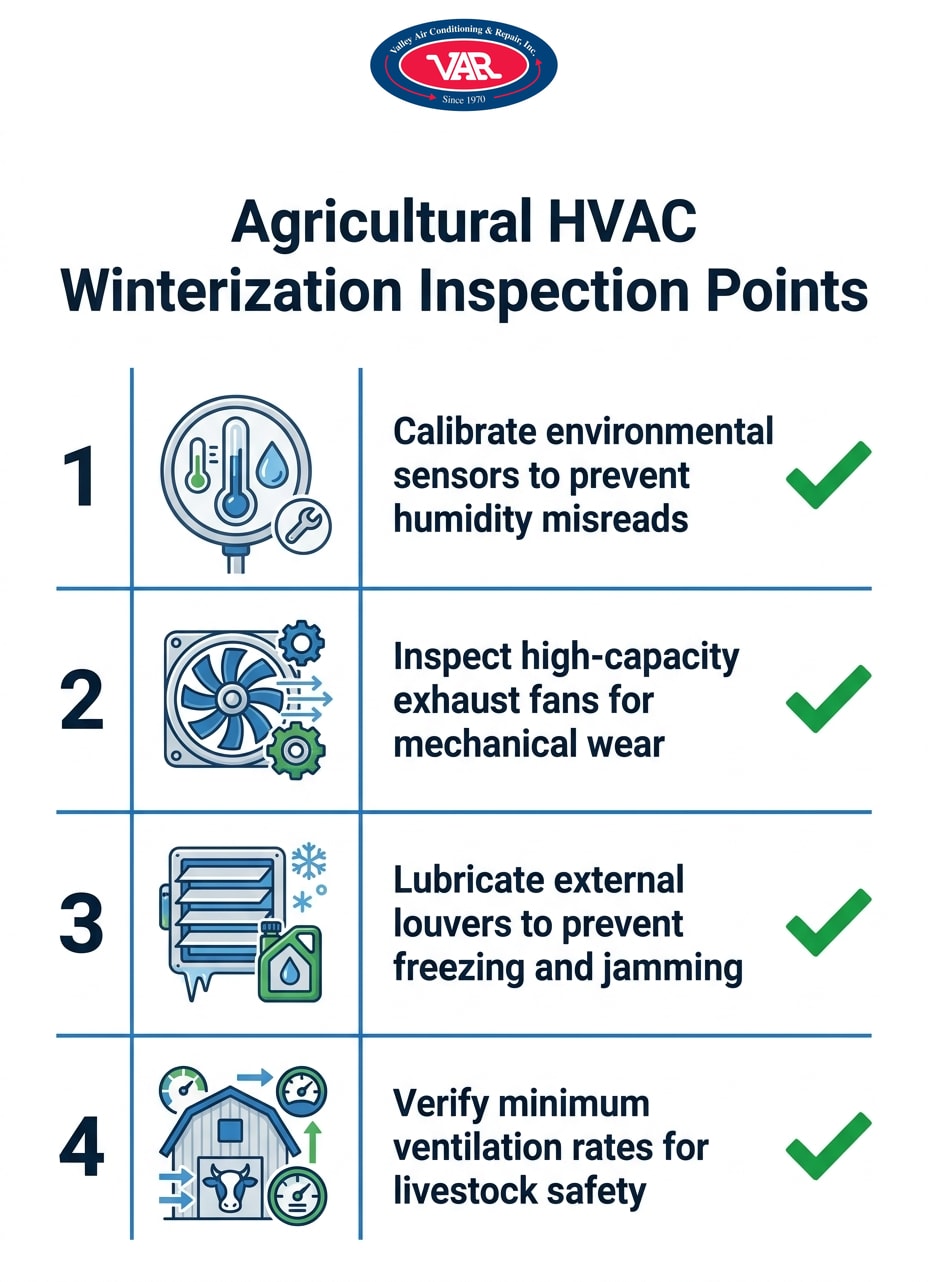
Modern agricultural ventilation systems are highly automated. They rely entirely on a network of environmental sensors to trigger fans, open louvers, and engage heating systems. If these sensors are inaccurate, the entire system fails to protect the herd.
Sensors naturally degrade over time. Dust, ammonia gas, and constant moisture coat the sensitive probes, causing them to misread humidity and temperature. Central Valley winter inversion layers trap cold, damp air at ground level, causing environmental sensors to misread humidity if they are not perfectly clean and calibrated. When November pre-winter temperature drops hit, an uncalibrated sensor might read the barn as warmer or drier than it actually is.
The professional recalibration process involves several precise steps. Technicians use handheld, laboratory-grade psychrometers and thermometers to measure the actual conditions in the barn. They then compare these readings to what the automated control panel sees. If there is a discrepancy, they clean the sensor probes with specialized electronic contact cleaners and adjust the software offsets.
The risks of ignoring sensor calibration are severe. If a temperature sensor reads too high, it may trigger high-speed exhaust fans during a freeze, causing a dangerous temperature drop inside the barn. Conversely, if a humidity sensor reads too low, the system may shut fans down prematurely, leading to a massive, dangerous ammonia spike that threatens livestock health.
Ventilation systems do not operate in a vacuum; they must work in tandem with heavy-duty heating to maintain optimal barn conditions. Pulling cold, damp air into a facility requires supplemental heat to lower the relative humidity and keep the animals comfortable.
Inspecting heating elements is just as vital as checking the fans. Technicians verify that burners are clean, heat exchangers are free of cracks, and gas pressures are correct. They also focus on insulating exposed water lines associated with boiler systems or evaporative cooling pads that have been shut down for the season. Proper integration of heavy-duty heating systems ensures that the ventilation process doesn't inadvertently freeze the facility.
In our experience supporting agricultural operations throughout the Fresno area, we've found that facility managers benefit immensely from enrolling in a structured preventative maintenance plan. Proactive identification of mechanical wear saves significant downtime in emergency repairs and lost productivity.
• Scheduled interventions: Maintenance happens before peak winter conditions hit, ensuring systems are ready for the first freeze.
• Predictive part replacement: Technicians replace worn belts and failing contactors before they break in the middle of the night.
• System optimization: Regular tuning ensures that heating and ventilation systems work together efficiently, reducing overall energy consumption.
• Historical tracking: Professional logs track the degradation of motors and sensors over time, allowing for planned capital replacements rather than sudden emergency expenses.
This level of integration requires a licensed commercial HVAC professional. Central Valley dairy facilities near Fresno rely on this expertise to keep their operations running smoothly, knowing that agricultural mechanics demand a higher standard of care.
Many facility managers find that keeping up with these rigorous mechanical demands is much easier when they have a structured preventative maintenance plan in place. Here are the most common questions we hear regarding winter preparation for agricultural facilities.
Maintaining winter ventilation requires balancing continuous minimum airflow with supplemental heating to remove moisture without freezing the barn. Professional technicians achieve this by inspecting high-capacity exhaust fans, lubricating external louvers, and calibrating environmental sensors. Relying on automated systems with properly tuned equipment ensures that stale air and ammonia are exhausted consistently. It is essential to have a licensed professional perform this maintenance to prevent catastrophic equipment failure.
Pre-winter maintenance prevents sudden mechanical breakdowns when temperatures drop and environmental stress on the equipment is at its highest. November pre-winter temperature drops cause condensation and humidity spikes inside closed barns, forcing ventilation systems to work harder. Proactive inspections catch worn belts, failing motors, and jammed louvers before they compromise livestock health. Waiting until a fan fails during a freeze often results in severe respiratory issues for the herd.
Controlling these elements requires continuous, mechanically driven minimum ventilation to exhaust humid, gas-heavy air and replace it with fresh air.
• Calibrate environmental sensors to ensure fans trigger at the correct humidity thresholds.
• Utilize supplemental heating to lower the relative humidity of incoming cold air.
• Adjust internal circulation fans to break up stagnant air pockets where ammonia pools near the floor.
Attempting to manage these factors by simply closing vents or turning off fans leads to toxic indoor environments.
The minimum ventilation rate varies based on the size of the facility and the density of the herd, but it generally ranges from 35 to 50 CFM (cubic feet per minute) per mature cow. This baseline airflow is required to remove the moisture generated by animal respiration and waste. Professional HVAC technicians calculate these specific requirements and tune the exhaust fans to maintain this exact volume. Falling below this rate causes rapid condensation and poor air quality.
Freezing fog coats the metal blades and hinges of external louvers with ice, causing them to jam or freeze completely shut. If an exhaust fan kicks on while the louver is frozen closed, it can burn out the fan motor or damage the fan blades. Technicians mitigate this risk by thoroughly cleaning the louver assemblies and applying specialized, low-temperature dry lubricants during the pre-winter inspection. Regular testing of the automated actuators also ensures they have the necessary torque to open in harsh conditions.
Sensors must be recalibrated because dust, moisture, and agricultural gases cause them to drift and report inaccurate temperature and humidity readings over time. If a sensor reads the air as drier than it actually is, the automated system will not run the exhaust fans enough, leading to dangerous moisture and ammonia buildup. Professional technicians use laboratory-grade instruments to clean and reset these sensors, ensuring the control panel makes accurate decisions based on real indoor conditions.
Protecting your herd and your mechanical infrastructure requires far more than a basic visual check. A professional breakdown of what commercial HVAC technicians prioritize during an inspection reveals the complexity of agricultural ventilation. From calibrating sensitive environmental controls to lubricating heavy-duty exhaust louvers, every step is designed to prevent moisture buildup, ammonia concentration, and mechanical freezing.
Proactive maintenance protects both livestock health and the heavy machinery that keeps your operation running. Central Valley dairy facilities near Fresno cannot afford to wait until the first freeze causes a system failure. By scheduling your pre-winter inspections early, you ensure that your facility is prepared for whatever the colder months bring. Reach out to a local commercial mechanical expert to discuss your facility's specific winterization needs.

As a business with many AC units, it is essential to have a responsive AC company. Valley Air Conditioning understands our needs. They are always responsive and our AC is up and running very quickly.
I had them do an AC check on the home I was buying, they were honest and quick. I hired them to do the summer and Fall maintenance for $149. Happy with this company!
100% recommend. I called, same day they came out and gave me estimate. Conley was honest and didn't try to recommend/sell us anything we didn't need. When I called him with questions before making a decision, he happily answered and was not annoyed by me contacting him. Conley and VAR
This is a group of good people. Very professional and knowledgeable. They take the time to listen and find the best solution that fits best for any situation. There's no way you can go wrong in choosing VAR.
We have used Valley Air for over fifteen years. The last two years ,Matt came to our house to service twice a year. Always on time, so polite and so professional. This is a very honest company and you can always depend on them and trust them. The office always treats everyone cheerfully and always want to do what you need done very fast YOU CAN COUNT ON THIS Company


