.webp)


Heat Pump vs. Gas Furnace: Heating Options Comparisons for Homeowners
Deciding between a heat pump and gas furnace this fall? See our options comparisons for homeowners to evaluate winter performance. Compare your options today.

Is a heat pump right for your desert home is one of the most common questions we hear from homeowners across Modesto, Turlock, Fresno, and the broader Central Valley — and the short answer is: yes, for most desert homes, a heat pump is an excellent fit.
Here's a quick breakdown to help you decide:
That said, the right answer depends on your specific home, insulation, ductwork, and budget. The checklist below walks you through everything you need to evaluate before making a decision.
Desert climates like California's Central Valley put HVAC systems through some of the toughest conditions imaginable — scorching summers that push past 110°F, heavy dust and dry air, rapid temperature swings between day and night, and a cooling season that stretches for months on end. For decades, the standard answer was a gas furnace paired with a central air conditioner. But that equation is changing fast. High-efficiency heat pumps, especially inverter-driven models with SEER2 ratings of 20 or higher, are now purpose-built for exactly this kind of climate. They move heat rather than generate it, making them dramatically more efficient than traditional systems. And because Central Valley winters are relatively mild, these systems never face the sub-freezing conditions that can limit heat pump performance in colder parts of the country.
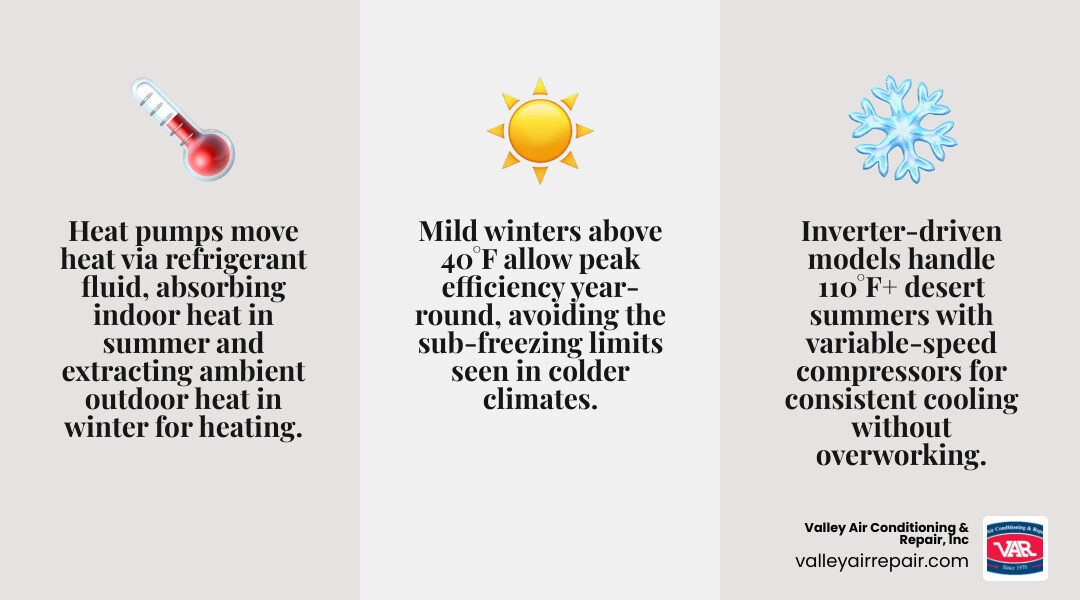
To understand why we often recommend these systems, you first have to understand the "magic" of heat transfer. Unlike a furnace, which burns fuel to create heat, or an electric baseboard heater that uses resistance to get hot, a Heat Pump simply moves heat from one place to another.
In the summer, it acts exactly like a high-efficiency air conditioner. It uses refrigerant fluid to absorb the heat inside your home and pump it outdoors. In the winter, the process reverses: the unit finds ambient heat in the outdoor air (yes, even when it feels "cold" to us!) and moves it inside.
One of the biggest concerns for our neighbors in Fresno or Madera is whether a heat pump can handle those brutal 110°F+ July days. Older models sometimes struggled, but modern units equipped with variable-speed compressors (also known as inverter technology) are game-changers. These compressors act like cruise control for your cooling. Instead of just "blasting" on and off, they adjust their speed to match the exact cooling needs of your home. This allows them to maintain full cooling capacity even when the mercury climbs toward 120°F. However, because they work so hard in these conditions, it is vital to monitor for Common Heat Pump Pressure Problems that can arise from extreme thermal stress.
When we look at the numbers, the argument for heat pumps in our region becomes very strong. Because these systems move heat rather than creating it, they can achieve efficiency levels approaching 400%. That means for every one unit of electricity consumed, the system delivers four units of heating or cooling energy. Compare that to a high-end gas furnace, which tops out at about 98% efficiency.
| Feature | Traditional AC + Gas Furnace | High-Efficiency Heat Pump |
|---|---|---|
| Cooling Efficiency | 13–16 SEER | 18–22+ SEER2 |
| Heating Efficiency | 80%–98% AFUE | 300%–400% Efficiency |
| Energy Source | Electricity + Natural Gas | 100% Electricity |
| Annual Savings | Baseline | Up to $1,000+ |
| System Lifespan | 15–20 Years | 15–22 Years (Premium) |
By choosing a professional Heat Pump Installation in Madera, CA, you are setting your home up for long-term savings. In fact, switching from an older 12 SEER system to a modern heat pump can save homeowners in places like Biola, CA over $1,000 annually in combined utility costs.
In the heart of the summer, your home's "envelope" is just as important as the HVAC unit itself. A heat pump works best when your home has a strong thermal barrier—think high-quality insulation and sealed windows. Because inverter-driven units provide a consistent, steady flow of cool air, they are much better at dehumidifying (even in our dry climate, some moisture removal is necessary for comfort) and maintaining a stable temperature than old-school units that "kick on" only when the house gets too hot. If you notice your current system struggling during a heatwave, it might be time for a Heat Pump Repair in Fresno, CA to check if your refrigerant levels or compressor are ready for the peak summer load.
The Central Valley is truly a "heat pump haven." In colder states, heat pumps can struggle when temperatures drop below freezing because there isn't enough ambient heat to pull from the air. But in Kingsburg, CA and surrounding areas, our winters are remarkably mild. Since temperatures rarely stay below the 40°F threshold for long, a heat pump remains in its "sweet spot" of efficiency all winter. For those rare, unusually chilly desert nights, most systems include an electric backup heater or hybrid controls to ensure you stay cozy without a hitch.
The desert is beautiful, but it is also incredibly dusty. For a heat pump to work efficiently, it needs to "breathe." Dust, sand, and even tumbleweeds can clog the outdoor coils, forcing the system to work harder and use more energy.
We cannot stress enough the importance of Proper HVAC Maintenance for Desert Climate. In the Central Valley, we recommend:
One of the biggest mistakes a homeowner can make is buying a system that is the wrong size. If it's too small, it won't keep up with 110°F heat. If it's too large, it will "short-cycle," turning on and off too frequently, which wastes energy and wears out the parts.
We always perform a Manual J load calculation before any installation. This takes into account your square footage, window orientation, and insulation levels. For the best results, we recommend checking out our Best Heat Pump Replacement Guide Fresno, CA to understand how we tailor these systems to local architecture. Adding attic insulation or sealing leaky ducts can also significantly boost your new system’s effectiveness, as detailed in our comprehensive Heat Pump Replacement Guide Fresno, CA.
Before you commit to a new system, we need to look at your "lungs"—your ductwork. Heat pumps often require slightly different airflow calibrations than old gas furnaces. If your ducts are undersized or leaky, you could lose 20-30% of your treated air before it ever reaches your living room.
If you are looking for an Affordable Heat Pump Replacement Guide Fresno, CA, consider whether a "zoned" system or a ductless mini-split might be better for your home layout. For those in specific areas, our Heat Pump Replacement Kingsburg, CA Guide offers localized advice on managing ductwork integrity in older valley homes.
As of May 2026, there has never been a better time financially to make the switch. Because heat pumps are so much better for the environment and the power grid, there are massive incentives available:
For a full list of what you might qualify for, refer back to our Heat Pump Replacement Guide Fresno, CA for the latest 2026 updates.
Absolutely. While older technology had limits, modern inverter-driven heat pumps are designed to operate efficiently even when temperatures soar to 115°F or 120°F. The key is proper sizing and ensuring the outdoor coils are kept clean of Central Valley dust.
With proper maintenance, a high-quality heat pump can last 15 to 22 years. In our region, the main "lifespan killers" are lack of maintenance and UV damage. Regular bi-annual tune-ups are the best way to protect your investment.
Yes, by a wide margin. Heat pumps run entirely on electricity and produce zero direct emissions. As California moves toward a greener power grid, your heat pump becomes even cleaner over time. Plus, they eliminate the risk of carbon monoxide leaks in your home.
So, is a heat pump right for your desert home? For the vast majority of residents in Fresno, Madera, Clovis, and the surrounding communities, the answer is a resounding yes. The combination of our mild winters, the advancement of inverter technology for extreme heat, and the massive financial incentives available in 2026 makes it the most logical choice for home comfort.
At Valley Air Conditioning & Repair, Inc., we’ve been serving "the Valley" since 1970. We built our business on a customer-first philosophy and honorable intentions. Whether you are in Sanger, Reedley, or Kerman, we are here to help you evaluate your home and find the perfect Heat Pump solution. Ready to see if your home is a candidate for $1,000 in annual savings? Give us a call today!

As a business with many AC units, it is essential to have a responsive AC company. Valley Air Conditioning understands our needs. They are always responsive and our AC is up and running very quickly.
I had them do an AC check on the home I was buying, they were honest and quick. I hired them to do the summer and Fall maintenance for $149. Happy with this company!
100% recommend. I called, same day they came out and gave me estimate. Conley was honest and didn't try to recommend/sell us anything we didn't need. When I called him with questions before making a decision, he happily answered and was not annoyed by me contacting him. Conley and VAR
This is a group of good people. Very professional and knowledgeable. They take the time to listen and find the best solution that fits best for any situation. There's no way you can go wrong in choosing VAR.
We have used Valley Air for over fifteen years. The last two years ,Matt came to our house to service twice a year. Always on time, so polite and so professional. This is a very honest company and you can always depend on them and trust them. The office always treats everyone cheerfully and always want to do what you need done very fast YOU CAN COUNT ON THIS Company