.webp)


AC Repair in Fresno, CA: Troubleshooting Summer Wear and Fall Heating Startup
Smelling burning dust on that first chilly night? Decide with confidence using our home maintenance tips and troubleshooting steps for safe fall HVAC startups.

Do you need to replace your AC because of refrigerant changes? For most homeowners in Modesto and the Central Valley, the answer is no — not right now, and not because of regulations alone.
Here is the quick answer:
The 2025 EPA rules under the AIM Act targeted new equipment manufacturing, not the millions of systems already installed in American homes. If you have heard otherwise, you are not alone — a lot of homeowners across Modesto, Ceres, Turlock, and surrounding Central Valley communities have been getting mixed signals about what these changes actually require.
The confusion is understandable. Words like "phase-out" and "banned refrigerant" sound alarming. But the reality is more nuanced, and knowing the facts can save you from making a rushed or unnecessary decision — especially heading into another hot Central Valley summer.
This guide walks you through exactly what changed, what it means for your specific system, and how to think clearly about whether repair or replacement is the right move for your home.
The short answer is a resounding no. You do not have to run out and buy a brand-new air conditioning system just because the Environmental Protection Agency (EPA) has updated its refrigerant standards. If your current system is keeping your home perfectly cool during the blazing Central Valley summers, you are legally free to keep running it until it naturally reaches the end of its operational lifespan.
To understand why, it helps to understand the scope of the federal regulations. The American Innovation and Manufacturing (AIM) Act, which guides these changes, focuses on the manufacturing and importation of new HVAC equipment. It does not mandate the decommissioning or replacement of existing, operational systems.
For homeowners with a functional R-410A system, the transition is a gradual process rather than an overnight cliff. If your system was installed within the last ten years, it is highly likely to be an R-410A unit. You can continue to schedule routine maintenance, fix minor electrical issues, and even repair refrigerant leaks without violating any environmental laws.
However, the regulatory landscape does shift how we manage older systems over time. As the production of older refrigerants is systematically phased down, the supply of these chemical compounds shrinks. While you are not legally required to upgrade, the long-term practicality of keeping an older, leaking system alive will shift. To learn more about how these shifting standards influence your day-to-day comfort and system management, read our detailed guide on How Refrigerant Changes Affect Homeowners.
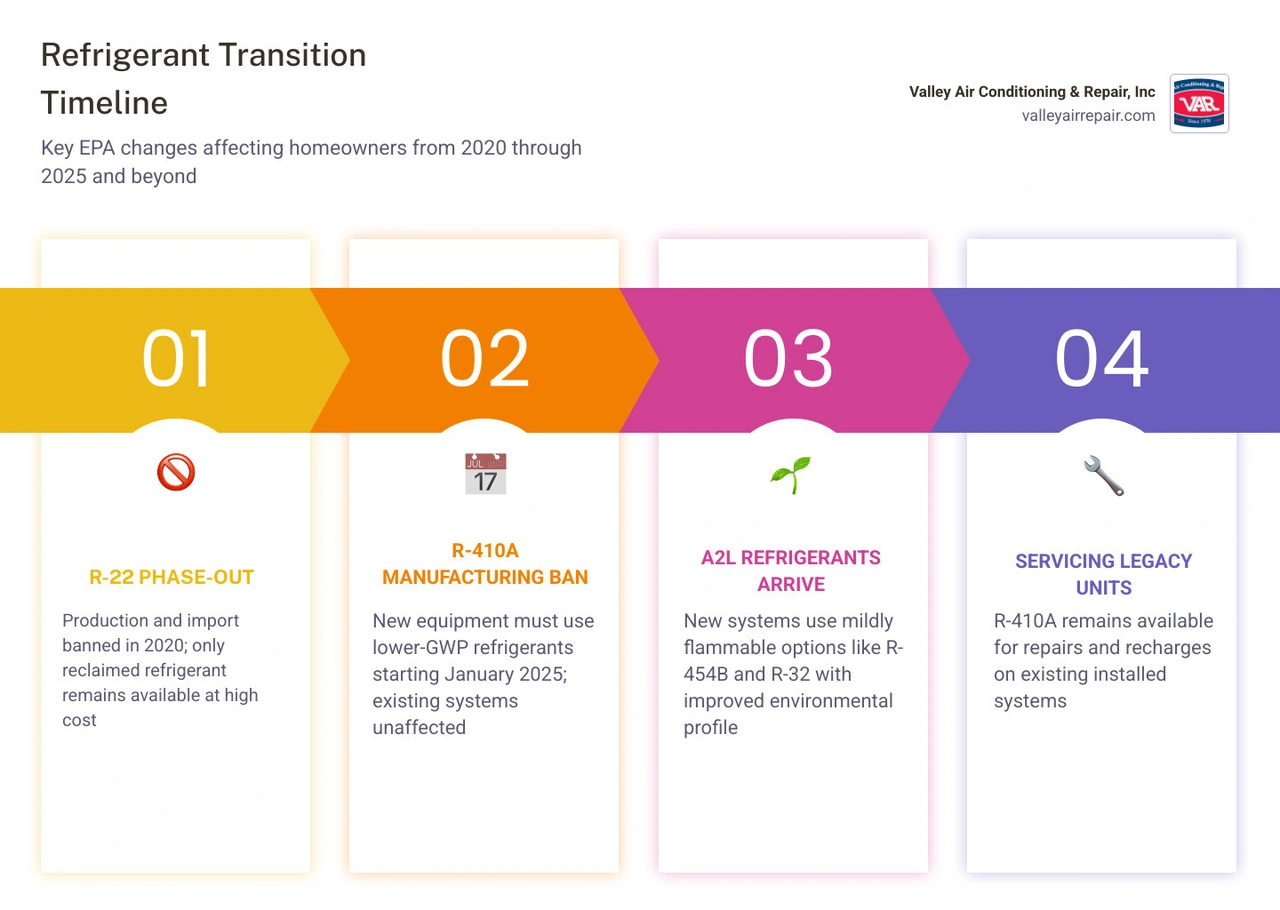
The history of home air conditioning is closely tied to the evolution of refrigerants. For decades, the industry relied on HCFC-22 (commonly known as R-22 or Freon). Because R-22 contains chlorine, it was found to contribute significantly to the depletion of the Earth's ozone layer. Under the Montreal Protocol, the U.S. phased out the production and import of virgin R-22, culminating in a complete ban on new production on January 1, 2020.
To replace R-22, the industry adopted R-410A (often referred to by brand names like Puron). R-410A is an HFC (hydrofluorocarbon) that does not deplete the ozone layer. However, R-410A has a very high Global Warming Potential (GWP). Specifically, R-410A has a GWP of approximately 2,088, meaning it is more than 2,000 times more potent than carbon dioxide as a greenhouse gas when released into the atmosphere.
Because of this high GWP, the EPA initiated a phasedown of HFCs, establishing a GWP limit of 700 for newly manufactured residential air conditioning and heat pump systems. This regulation effectively brought an end to the manufacture of new R-410A systems.
To meet these strict new standards, manufacturers have transitioned to a new class of refrigerants known as A2Ls. These refrigerants are classified as mildly flammable but boast incredibly low global warming impacts. The two primary A2L refrigerants dominating the modern residential HVAC market are R-454B and R-32.
Here is a quick look at how these refrigerants compare:
| Refrigerant Type | Classification | Global Warming Potential (GWP) | Environmental Impact | Status in New Equipment |
|---|---|---|---|---|
| R-22 (Freon) | HCFC (Class 1) | 1,810 | High Ozone Depletion & High GWP | Banned from production/import since 2020 |
| R-410A | HFC (Class 1) | 2,088 | Zero Ozone Depletion but High GWP | Banned in newly manufactured systems |
| R-454B | HFC/HFO Blend (A2L) | 466 | Zero Ozone Depletion & 78% lower GWP than R-410A | Current standard for many major manufacturers |
| R-32 | HFC (A2L) | 675 | Zero Ozone Depletion & 68% lower GWP than R-410A | Current standard for select major manufacturers |
These new A2L refrigerants represent a major leap forward in environmental design. For example, R-454B has 78% less global warming potential than R-410A, making it a highly sustainable choice for the next generation of home cooling.
If your home is still cooled by an air conditioner that runs on R-22, your decision framework is very different from that of an R-410A owner. Because R-22 has been completely phased out of production and importation since 2020, the only source of R-22 left for repairs is reclaimed and recycled gas.
From 2000 to 2018, refrigerant reclaimers reported reclaiming more than 140 million pounds of HCFC-22. While that sounds like a massive supply, that stockpile has been steadily dwindling over the years. This extreme scarcity means that if your R-22 system develops a significant refrigerant leak, repairing it can be highly impractical.
Furthermore, R-22 systems still running today are, by definition, quite old. Most were installed well before 2010, meaning they are far past their expected service life of 12 to 15 years. When an older system suffers a major component failure—such as a burnt-out compressor or a severely corroded evaporator coil—investing in scarce refrigerant and intensive repairs is rarely the wisest path forward.
If you find yourself nursing an older system through another blistering summer, it is highly beneficial to weigh your options carefully. To help you decide whether to keep patching up your veteran system or finally make the transition, explore our guide on Is It Worth Fixing an Old AC Unit in the Desert.
For homeowners with systems running on R-410A, there is absolutely no need to panic. If your air conditioner was installed between 2010 and 2024, it is designed around R-410A, and it remains a reliable, serviceable piece of machinery.
The phase-down of R-410A is designed to be gradual. The EPA allows the manufacturing of R-410A components specifically labeled for servicing existing equipment. This means that if your outdoor fan motor fails, or if a capacitor blows, those parts can be easily replaced. Even if your system develops a small leak, certified technicians can still source R-410A to recharge your system.
However, because virgin R-410A production is being phased down under the AIM Act, the wholesale supply of this refrigerant will continue to tighten over the next decade. As the supply decreases, sourcing R-410A for repairs is expected to become more challenging.
This means that while minor repairs remain straightforward, a major refrigerant leak on an older R-410A system will eventually present a difficult decision. If your system is approaching its teen years and begins to leak refrigerant, you will want to evaluate whether to invest in a major recharge or transition to a modern, high-efficiency system. For a deeper look at navigating this specific choice, read our analysis on Should You Repair or Replace Your AC.
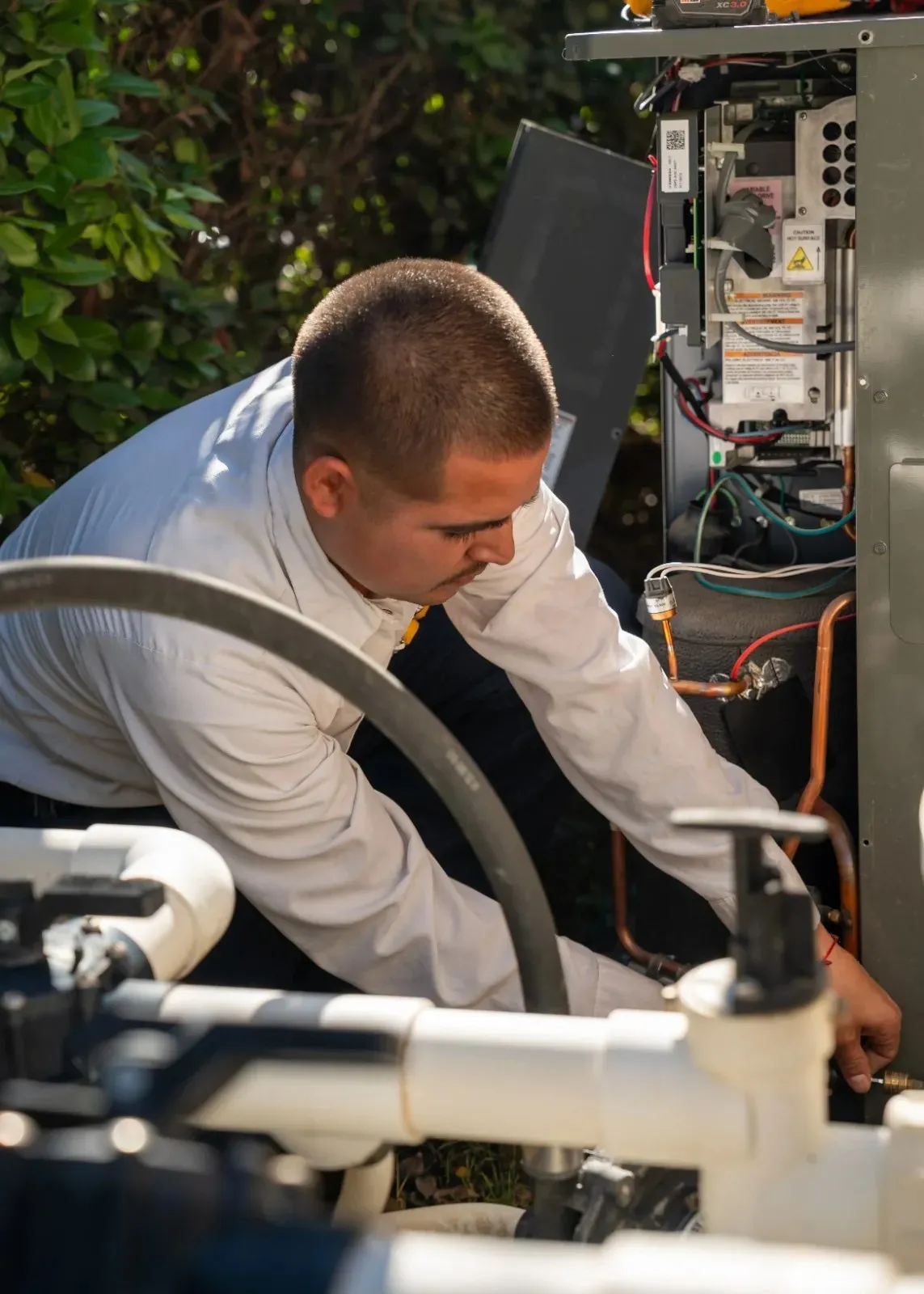
When faced with a cooling system that is blowing warm air or making strange noises, Central Valley homeowners must weigh the long-term benefits of a repair against the long-term advantages of a replacement. This decision is particularly vital in our region, where summer temperatures routinely climb into the triple digits, making a reliable air conditioner a necessity for household safety and comfort.
To make an informed choice, we recommend using a classic industry benchmark known as the 50% Rule. If the required repairs for your existing air conditioner are extensive compared to the overall value of a brand-new system, replacement is almost always the more sensible path. This is especially true for systems that are more than 10 to 12 years old, as they are already entering the twilight of their expected operational lifespan.
To help you evaluate your specific situation, we have put together a comprehensive comparison in our article on the Cost of Repairing Old AC vs Buying a New System.
Beyond the immediate repair needs, there are several compelling reasons to consider upgrading to a new system utilizing low-GWP A2L refrigerants:
If you decide that upgrading is the best path forward for your family's comfort, working with experienced professionals is key to ensuring your new system is sized and installed perfectly. You can learn more about what to expect during this process by reading about our approach to Residential AC Installation.
For homeowners living in specific communities, we have tailored guides to help you navigate local building codes, permitting, and climate considerations. If you reside in the foothill communities, see our AC Replacement Contractors Coarsegold CA Guide and our AC Replacement Coarsegold CA Complete Guide. If you are closer to the Fresno area, check out our AC Replacement Clovis CA Complete Guide or our AC Replacement Laton CA Complete Guide.
Navigating environmental rules can feel like trying to read a foreign language. Here are some of the most common questions we hear from homeowners across the Central Valley regarding the transition.
Yes, absolutely. You can still have your R-410A system repaired, serviced, and recharged in 2026. The EPA phase-down does not outlaw the servicing of existing systems.
To keep these systems running, the industry relies heavily on reclaimed R-410A. Reclaimed refrigerant is gas that has been recovered from older systems during replacement, sent to a specialized facility, and purified to meet strict AHRI-700 purity standards. This ensures it performs identically to virgin refrigerant.
However, because the overall supply of R-410A is gradually decreasing, we highly recommend focusing on leak detection and routine maintenance. Simply "topping off" a leaking system year after year will become increasingly impractical. If your system has a leak, it is always best to have a certified technician locate and repair the leak rather than just adding more gas.
Yes, they are exceptionally safe. The transition to A2L refrigerants has been carefully planned and tested by safety organizations, manufacturers, and international bodies for years.
The "2L" in the name designates that these refrigerants are "mildly flammable." While this sound scary, the practical risk in a residential setting is incredibly low. To put it in perspective, A2L refrigerants are much harder to ignite than common household items like hairspray, rubbing alcohol, or aerosol cooking sprays. They require a highly concentrated direct flame and a specific air mixture to ignite, and even then, they burn very slowly.
To ensure absolute safety, modern HVAC units designed for R-454B or R-32 are built with advanced mitigation features. These include integrated leak detection sensors, robust electrical components, and heavy-duty tubing. If a leak is detected, the system is designed to automatically shut down or run the indoor fan to safely disperse the gas, keeping your household completely safe.
No, you cannot put an A2L refrigerant like R-454B or R-32 into a system designed for R-410A. Doing so is highly unsafe and will ruin your equipment.
A2L refrigerants operate under different pressures, require different lubricating oils, and utilize specific safety controls and sensors that are not present in older R-410A systems. Additionally, because A2L refrigerants are mildly flammable, putting them into a system not specifically certified for them violates safety codes and voids your manufacturer's warranty.
If your R-410A system experiences a major breakdown, you must either repair it using R-410A or replace the entire indoor and outdoor system with equipment specifically engineered to handle the new A2L refrigerants safely.
At the end of the day, the 2025–2026 refrigerant transition is a positive step forward for our planet. Phasing out ozone-depleting and high-GWP substances is a monumental environmental effort, projected to avoid more than 280 million cases of skin cancer and 1.6 million skin cancer deaths in the U.S. alone among individuals born between 1890 and 2100.
But as a homeowner, this environmental transition does not mean you need to make a panic-driven financial decision. Your existing R-410A system remains perfectly legal to operate, maintain, and repair for years to come.
When the time does come to upgrade, you can look forward to a modern system that is safer for the environment, highly reliable, and far more energy-efficient.
Since 1970, Valley Air Conditioning & Repair, Inc. has served families across the Central Valley with a customer-first philosophy built on trust, honorable intentions, and honest advice. Whether you live in Modesto, Ceres, Turlock, Manteca, Ripon, Oakdale, or Riverbank, we are here to help you navigate these changes without the high-pressure sales tactics.
If you have questions about your current system's refrigerant, or if you want an honest assessment of whether to repair or replace your air conditioner, reach out to us today. Visit our Valley Air Conditioning page to schedule a professional inspection and keep your home cool all summer long.

As a business with many AC units, it is essential to have a responsive AC company. Valley Air Conditioning understands our needs. They are always responsive and our AC is up and running very quickly.
I had them do an AC check on the home I was buying, they were honest and quick. I hired them to do the summer and Fall maintenance for $149. Happy with this company!
100% recommend. I called, same day they came out and gave me estimate. Conley was honest and didn't try to recommend/sell us anything we didn't need. When I called him with questions before making a decision, he happily answered and was not annoyed by me contacting him. Conley and VAR
This is a group of good people. Very professional and knowledgeable. They take the time to listen and find the best solution that fits best for any situation. There's no way you can go wrong in choosing VAR.
We have used Valley Air for over fifteen years. The last two years ,Matt came to our house to service twice a year. Always on time, so polite and so professional. This is a very honest company and you can always depend on them and trust them. The office always treats everyone cheerfully and always want to do what you need done very fast YOU CAN COUNT ON THIS Company