


.webp)


Why Is My AC Blowing Warm Air? Fall HVAC Troubleshooting & Startup Smells
Smelling burning dust this fall? Get clear answers with our home maintenance tips and troubleshooting to know when to call a pro for your heating system.
With the late-summer harvest season (August/September) fast approaching in Fresno and the surrounding Central Valley, our team at Valley Air Conditioning & Repair, Inc. knows that Preparing Your Home Air Quality for the Upcoming Harvest Season Dust is the most critical step you can take for your family's comfort and your cooling system's survival. As August rolls into September, the local climate delivers a brutal combination: relentless triple-digit heat overlapping with the first massive waves of agricultural activity. Tractors begin sweeping the orchards, kicking up massive clouds of topsoil and organic matter that drift directly into residential neighborhoods.
This seasonal shift creates a unique dual challenge for homeowners. On one hand, you need maximum cooling power to combat the severe end-of-summer heat. On the other hand, you face a massive influx of airborne particulate matter that threatens to clog your equipment. We constantly remind our customers that they have to upgrade their filtration to catch the incoming dirt, but they must do it without suffocating their air conditioner.
Navigating this core tension requires a proactive approach. By exploring professional indoor air quality solutions before the dust peaks, you can protect your indoor environment. Setting up the right pre-season HVAC preparation ensures your home remains a clean, cool sanctuary even when the valley sky turns hazy.
Not all dust is created equal. In our experience, to protect your home, you first have to understand exactly what you are trying to filter out. The Central Valley agricultural cycle produces a very specific type of airborne debris that behaves differently than normal household lint or pet dander.
Defining PM10: Farm operations—specifically tilling, sweeping, and gathering crops like almonds and grapes—generate massive amounts of PM10. This stands for particulate matter that is 10 micrometers or less in diameter. It is considered coarse particulate matter.
Contrasting with smoke: PM10 is significantly larger and heavier than the ultra-fine PM2.5 particulates generated by wildfires. Because harvest dust is heavier, it travels on the valley breeze and settles rapidly onto window sills, porches, and eventually, into your air return vents. Our technicians see firsthand how understanding the specific mechanics of Central Valley almond and grape harvest dust cycles is crucial, as this organic matter is often mixed with oils and plant material that aggressively stick to HVAC components.
The low capture rate: When this sheer volume of regional dust hits a standard 1-inch fiberglass filter—the cheap, see-through blue filters found at most hardware stores—the system is overwhelmed almost immediately. These basic filters are designed only to catch large debris like hair and carpet fibers to protect the equipment, not to clean the air you breathe.
The bypass risk: Because fiberglass filters have such a low capture rate, heavy agricultural particulates simply pass right through the media. Once inside, this farm dust coats the indoor evaporator coil. Since the coil is constantly wet with condensation during the summer, the dust turns into a thick layer of mud, insulating the coil and destroying the system's ability to cool your home.
When homeowners in Fresno and the surrounding Central Valley notice the sky filling with dust, we often see their first instinct is to buy the thickest, highest-rated air filter they can find. While the intention is good, this common mistake can completely cripple an air conditioning system during the hottest part of the year.
The danger of high static pressure: Your HVAC system is designed to move a specific volume of air. When you install an overly dense filter, you increase the static pressure—the resistance to airflow within the ductwork. If the filter is too restrictive, it chokes off the vital air supply your equipment needs to operate safely.
Our technicians recently rescued one Fresno homeowner who learned this the hard way when their air conditioner stopped working entirely during a 110-degree heatwave while they were stuck at home. Our team arrived quickly, diagnosed the issue as a severe airflow restriction caused by a clogged filter that had completely frozen the system, and completed the repair within an hour, restoring much-needed relief.
To avoid sudden breakdowns, you must ensure your air conditioning services are backed by proper airflow management.
The refrigeration cycle: Your air conditioner does not actually create cold air; it removes heat from your home. It relies on a steady stream of warm return air blowing over the indoor evaporator coil to keep the refrigerant inside from dropping below freezing.
The freezing process: If a dense filter blocks that warm air, the temperature of the coil plummets. The natural condensation on the outside of the coil instantly turns to solid ice. Within hours, the entire indoor unit can become a block of ice, stopping all cooling completely.
Mechanical strain: When air is blocked by a dense filter, the blower motor has to work twice as hard to pull the required cubic feet per minute (CFM) through the system.
Premature burnout: This continuous strain causes the motor to run hot. During a late-summer heatwave, when the system is already running non-stop, this added resistance frequently leads to premature motor burnout and expensive sudden failures that our repair crews see all too often.
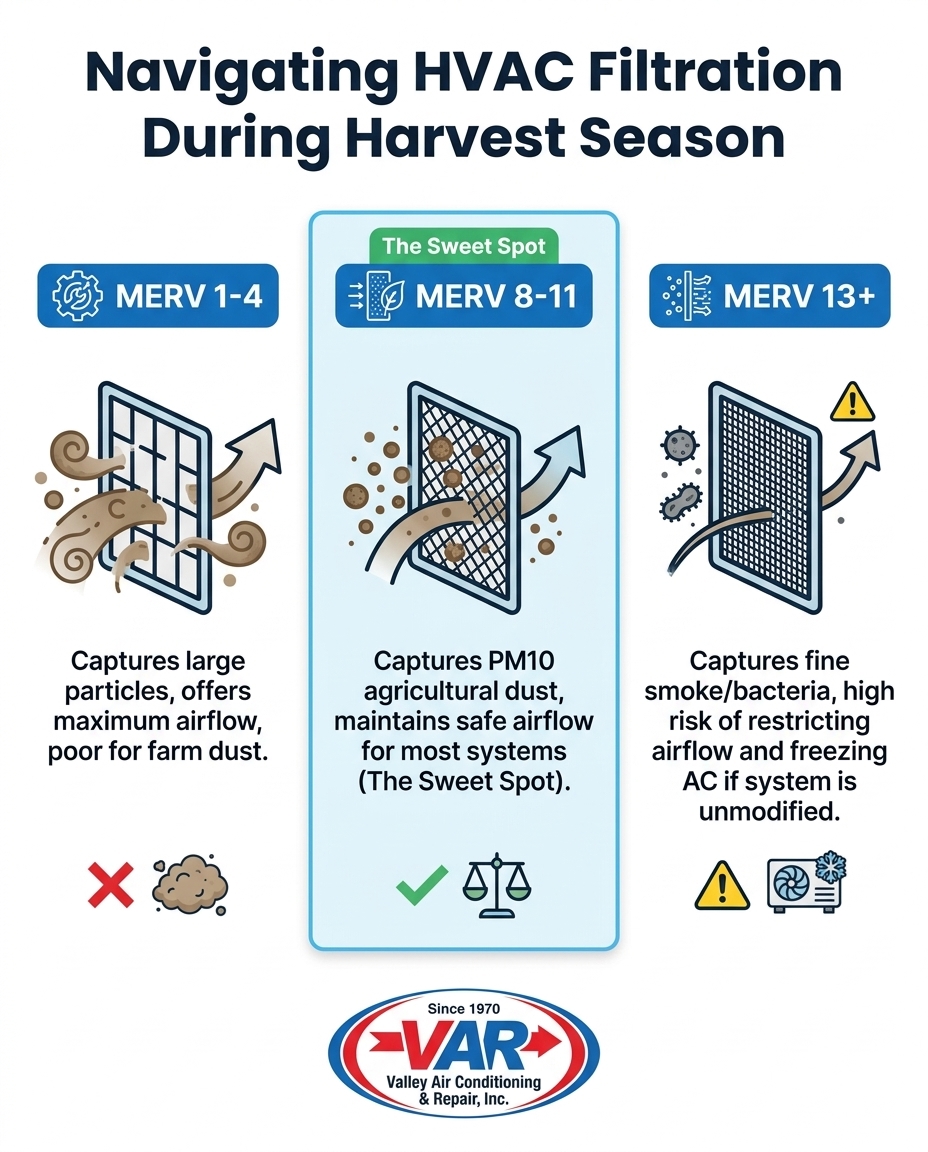
To capture agricultural dust safely, you need to navigate the MERV scale. MERV stands for Minimum Efficiency Reporting Value, and it rates how effectively a filter captures microscopic particles. The higher the number, the finer the filtration—but also the higher the resistance to airflow.
For the homes we service in Fresno and the surrounding Central Valley dealing with PM10 harvest dust, the goal is to find the "sweet spot" that cleans the air without choking the standard residential blower motor.
• MERV 1 to 4 — Filter Type & Capture Ability: Spun fiberglass. Captures less than 20% of particles. Misses farm dust. — Airflow Impact: Very low resistance. Excellent airflow, but poor protection. — Best Use Case: Basic equipment protection in low-dust environments. Not recommended for harvest season.
• MERV 8 to 11 — Filter Type & Capture Ability: Pleated cotton or synthetic. Captures up to 85% of PM10 agricultural dust. — Airflow Impact: Moderate resistance. Safe for most modern residential blowers. — Best Use Case: The Sweet Spot: Ideal for Central Valley homes during peak harvest months.
• MERV 13 to 16 — Filter Type & Capture Ability: Deep pleated or high-efficiency. Captures bacteria and fine smoke (PM2.5). — Airflow Impact: High resistance. High risk of freezing standard AC units. — Best Use Case: Only use if a professional has measured your static pressure and confirmed compatibility.
A word of caution: Never upgrade to a MERV 13 or higher filter without consulting a professional first. An HVAC technician from our team can measure your system's static pressure using a manometer to determine exactly how much filtration your specific ductwork and blower can handle safely.
The standard advice printed on most filter packaging tells you to change the media "every 90 days." During the late-summer harvest season (August/September), following that advice is a recipe for disaster. The rapid clogging rate caused by regional agricultural dust requires a highly localized and accelerated replacement timeline.
Our service professionals see the reality of this heavy environmental load every day. For instance, when our commercial division manages the complex HVAC infrastructure for a large campus with dozens of units, our technicians must perform highly frequent heating and cooling maintenance, adjustments, and filter replacements just to keep the systems breathing against the constant influx of dust. Your residential system faces the exact same environmental pressure, just on a smaller scale.
To keep your home safe, you must dramatically increase your inspection frequency. Relying on a routine HVAC maintenance plan ensures that the deeper components of your system remain clean and calibrated, even when the outdoor air quality is at its worst.
How to inspect: During peak harvest operations, pull your air filter out every two weeks. Hold it up to a bright light source, like a ceiling fixture or a window. If you cannot easily see light shining through the pleats, the filter is fully saturated and must be thrown away.
When to replace: Do not wait for a date on the calendar. When agricultural dust is severe, a high-quality pleated filter may need replacement every 30 days, or sometimes even every two weeks. A dirty filter is a blocked filter, and a blocked filter will shut down your cooling system.
As HVAC professionals, we always remind customers that your HVAC filter is your second line of defense against farm dust. Your home's physical envelope—the walls, windows, doors, and roof—is the first. Providing non-HVAC strategies to reduce the overall dust load entering the home eases the heavy burden on your filtration system.
If you are serious about dealing with dusty indoor air, you must stop the dirt at the perimeter.
• Lock down during high wind: Keep all windows and doors tightly closed on windy harvest days. Even a cracked window can let in millions of PM10 particulates in a matter of minutes.
• Upgrade weatherstripping: Inspect the rubber and felt seals around your exterior doors and windows. If you can see daylight around a door frame, dust is pouring through it. Replace worn weatherstripping immediately.
• Seal the ductwork: Much of the dust inside a home doesn't come from the front door; it comes from the attic or crawlspace. If your ductwork has leaks or disconnected joints, the blower motor acts like a giant vacuum, sucking dusty, unconditioned air from the attic directly into your living space.
• Check the threshold sweeps: Ensure the sweeps at the bottom of your exterior doors make solid contact with the floor to block low-blowing dirt from sweeping operations.
In our years of serving Fresno and the surrounding Central Valley, we've found that for homes requiring exceptional air quality—due to severe allergies, asthma, or proximity to active orchards—standard 1-inch filters may never be enough. These homes require professional-grade solutions that deliver maximum filtration without compromising air conditioning performance.
The strategic use of dedicated IAQ (Indoor Air Quality) products can reduce indoor particulate matter by over 50% compared to outdoor levels. However, installing whole-home purification systems requires a professional assessment from our team to ensure the new equipment integrates seamlessly with your existing blower and ductwork.
Increased surface area: A whole-home mechanical air cleaner replaces your standard 1-inch filter slot with a large metal cabinet housing a 4-inch or 5-inch thick media filter. Because these filters are so deep, they contain massively more surface area. This allows them to carry a high MERV rating (excellent filtration) while maintaining a very low pressure drop (excellent airflow).
Longer lifespan: Unlike 1-inch filters that choke on farm dust in weeks, a 4-inch deep pleated filter can often last 6 to 12 months, even in heavy agricultural zones. They capture a massive volume of PM10 dust without restricting the vital air your AC needs to survive.
Supplemental HEPA purification: To support the main HVAC system, homeowners can also deploy standalone HEPA air purifiers in high-traffic rooms, such as the master bedroom or living room, to scrub the air locally without altering the central system's static pressure.
A MERV 8 to MERV 11 filter is generally what we recommend as the best choice for agricultural dust in residential systems. These ratings are highly effective at capturing coarse PM10 particulates generated by farming. They provide an excellent balance, cleaning the air without causing dangerous airflow restrictions for most standard blower motors.
You should inspect your filter every two weeks and expect to replace it every 30 days or less during peak harvest. The massive influx of dirt from sweeping and tilling operations clogs standard filters incredibly fast. Relying on a traditional 90-day schedule during late summer will likely lead to restricted airflow and system failure.
Yes, harvest season drastically affects indoor air quality by introducing high volumes of PM10 coarse particulate matter into the environment. This organic farm dust easily infiltrates homes through small cracks, open doors, and leaky ductwork. Once inside, it circulates through the HVAC system, triggering allergies and increasing the need for constant dusting.
The most effective way to stop farm dust is to tightly seal your home's envelope. Keep windows and doors closed during windy days, replace worn weatherstripping, and ensure your door sweeps are intact. Additionally, having a professional seal your ductwork prevents the system from pulling dusty air out of your attic or crawlspace into your living areas.
Yes, a filter with a very high MERV rating (like MERV 13 or above) can easily cause an AC to freeze if the system wasn't designed for it. High-MERV filters are dense and restrict the flow of warm return air over the evaporator coil. Without enough warm air passing over it, the coil drops below freezing, turning natural condensation into a solid block of ice.
Surviving the late-summer harvest in Fresno and the surrounding Central Valley requires a delicate balancing act. You must deploy proper filtration to capture heavy agricultural dust, but you must do so while maintaining the critical cooling airflow your system needs to battle the August heat. We've seen too many systems fail because homeowners waited until their evaporator coil froze solid or their indoor air became unbreathable.
Take control of your home's environment before the dust reaches its peak. By scheduling professional pre-season HVAC preparation with our team, you can ensure your equipment is properly calibrated, your filter sizing is safe, and your family can breathe easy all season long.

As a business with many AC units, it is essential to have a responsive AC company. Valley Air Conditioning understands our needs. They are always responsive and our AC is up and running very quickly.
I had them do an AC check on the home I was buying, they were honest and quick. I hired them to do the summer and Fall maintenance for $149. Happy with this company!
100% recommend. I called, same day they came out and gave me estimate. Conley was honest and didn't try to recommend/sell us anything we didn't need. When I called him with questions before making a decision, he happily answered and was not annoyed by me contacting him. Conley and VAR
This is a group of good people. Very professional and knowledgeable. They take the time to listen and find the best solution that fits best for any situation. There's no way you can go wrong in choosing VAR.
We have used Valley Air for over fifteen years. The last two years ,Matt came to our house to service twice a year. Always on time, so polite and so professional. This is a very honest company and you can always depend on them and trust them. The office always treats everyone cheerfully and always want to do what you need done very fast YOU CAN COUNT ON THIS Company


