


.webp)


Why Is My AC Blowing Warm Air? Fall HVAC Troubleshooting & Startup Smells
Smelling burning dust this fall? Get clear answers with our home maintenance tips and troubleshooting to know when to call a pro for your heating system.
You know your aging heater is on its last legs, but navigating San Joaquin Valley air pollution rules when replacing a gas furnace often catches homeowners completely off guard. At Valley Air Conditioning & Repair, Inc., our team typically sees it happen like this: you decide to proactively upgrade your old system during the September pre-heating season. You expect a simple, one-to-one equipment swap. Instead, you are told that the standard gas furnace you intended to buy cannot be legally installed in your home. For many residents in Fresno CA and the greater San Joaquin Valley, hitting this regulatory roadblock is a frustrating and confusing experience.
Understanding your local HVAC system regulations is the first step to making an informed, stress-free upgrade. Local emission standards now strictly dictate exactly what type of equipment can be legally installed in residential properties. Because of these mandates, you can no longer purchase a conventional gas furnace off the shelf. Instead, you face a critical decision point: you must either upgrade to highly specific, compliant gas technology or transition your home entirely to an electric heating solution. By learning the rules before your system fails, you can smoothly navigate these requirements and ensure your home stays warm and compliant all winter long.
To understand why these strict local mandates exist, you have to look at the unique geographical and meteorological realities of the San Joaquin Valley. Fresno CA and the surrounding communities sit on the valley floor, essentially forming a massive geographical bowl. The region is bordered by the towering Sierra Nevada mountain range to the east, the Coast Ranges to the west, and the Tehachapi Mountains to the south. While this topography is excellent for agriculture, it creates a perfect trap for air pollution.
During the winter months, the valley experiences severe temperature inversions. Normally, warm air rises and carries pollutants up and away into the upper atmosphere. However, during a winter inversion, a layer of cold air gets trapped near the ground, pinned down by a layer of warmer air above it. This meteorological lid effectively seals the valley floor, trapping smog, wood smoke, and fine particulate matter (PM2.5) right where we live and breathe. As the winter progresses, the air quality can deteriorate rapidly, leading to hazardous conditions for residents.
The role of residential heating: While industrial and automotive emissions are major factors, residential heating plays a surprisingly large role in this seasonal crisis. Traditional gas furnaces produce nitrogen oxides (NOx) during the combustion process. When thousands of homes run their non-compliant gas heaters simultaneously on a cold winter night, the cumulative NOx emissions are massive. These nitrogen oxides act as primary precursors to smog and PM2.5 formation. Because the valley's topography and winter inversions trap these gases locally, the regional air district was forced to implement strict emission limits on residential heating equipment to protect public health.
The regulatory framework governing your furnace replacement is managed by the San Joaquin Valley Air Pollution Control District (SJVAPCD). Specifically, homeowners need to understand SJVAPCD Rule 4905. In plain English, this rule was established to drastically reduce the amount of nitrogen oxides emitted by residential heating systems. It mandates that any newly installed natural gas-fired, fan-type central furnace must meet an ultra-low emission standard.
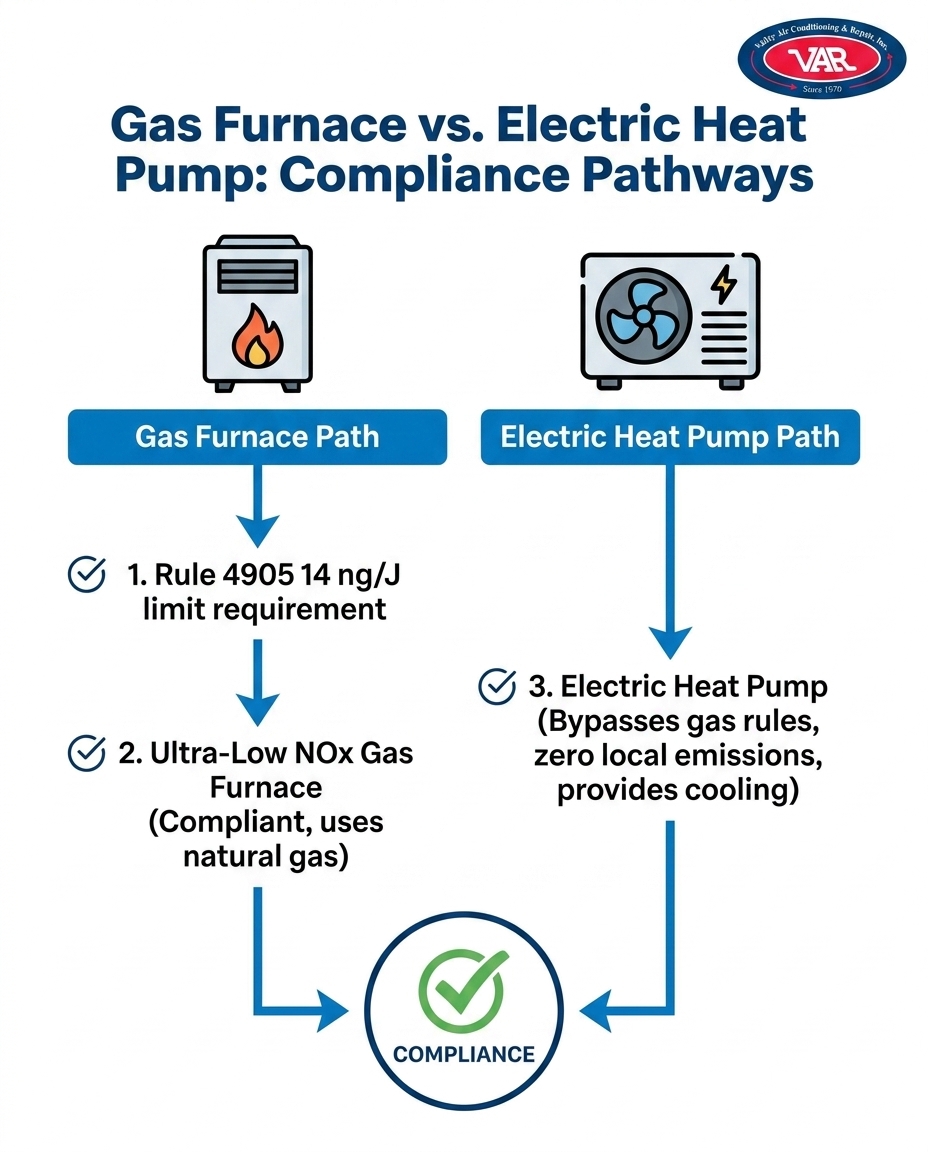
The core of Rule 4905 is the strict 14 ng/J NOx emission limit. The abbreviation "ng/J" stands for nanograms per joule of useful heat output. A standard gas furnace operates well above this limit, producing significantly more nitrogen oxides during combustion. To legally install a new gas heater in the valley today, the equipment must be certified to produce no more than 14 nanograms of NOx per joule. This is a massive reduction in emissions compared to older technology.
It is important to note that these regulations apply strictly to new installations and replacements. If you currently have an older, standard furnace that is operating safely and efficiently, you are not legally required to rip it out and replace it immediately. The rule only triggers when you decide to install a new unit. However, when that day comes, purchasing a standard unit from out of state or trying to bypass the rule is illegal and carries significant penalties.
To meet the stringent 14 ng/J limit, manufacturers had to completely redesign how a gas furnace burns fuel. An Ultra-Low NOx compliant gas furnace relies on advanced burner technology to achieve a cleaner, cooler combustion process.
• Pre-mixed combustion: Unlike standard furnaces that mix gas and air at the point of ignition, Ultra-Low NOx models pre-mix the fuel and oxygen in precise ratios before it reaches the burner.
• Specialized burner inserts: These units utilize specialized stainless steel burner inserts that absorb and dissipate heat, lowering the overall flame temperature. Since high temperatures are what create excess nitrogen oxides, cooling the flame drastically reduces NOx output.
• Consistent heating comfort: Despite the complex internal changes, an Ultra-Low NOx compliant gas furnace provides the exact same level of heating comfort, airflow, and warmth as a traditional model. You will not notice a difference in how your home feels, only in how cleanly the system operates.
The Problem: You might be told during a routine fall tune-up that your older unit is failing and must be replaced immediately, throwing you unexpectedly into the complex world of emission regulations.
The Cause: Misdiagnoses or aggressive sales tactics can sometimes lead homeowners to believe a system is condemned when it actually only requires standard maintenance or a minor repair. Because upgrading to compliant equipment is a major investment, prematurely replacing a unit that still has safe, operational years left is a costly mistake.
The Solution: Proper diagnostics and proactive maintenance are your best defenses. By scheduling a thorough evaluation during the September pre-heating season, you can determine the true condition of your heat exchanger, burners, and venting system. If the unit is safe, preventive maintenance can extend its life legally, delaying the need to navigate the new equipment regulations.
Getting a second opinion is absolutely critical if you are told your system is unsafe. We see this scenario play out frequently in our service area. Recently, a local homeowner called us for a second opinion after being previously told during a maintenance check that their unit had a dangerous carbon monoxide leak and needed immediate replacement. Our technicians verified the system with advanced diagnostic tools and found absolutely no issues. The homeowner was informed their heater was perfectly fine, saving them from an unnecessary, premature replacement. Always ensure you are working with a technician who prioritizes accurate diagnostics over a quick sale.
If you are facing a mandatory replacement and want to avoid the complexities of gas emission rules altogether, transitioning to an electric heat pump is the premier alternative. Because heat pumps run entirely on electricity and do not burn fossil fuels, they produce zero localized NOx emissions. By choosing this technology, you completely bypass SJVAPCD Rule 4905.
Heat pumps work by transferring heat rather than generating it. In the winter, they extract ambient heat from the outside air and move it indoors. In the summer, the process reverses, pulling heat out of your home to provide powerful air conditioning. This dual-benefit means you are upgrading both your heating and cooling systems simultaneously. Furthermore, because electric heat pumps align with state and federal energy goals, generally applicable energy rebates and federal tax credits may apply to qualifying heat pump installations. (Homeowners should always verify current programs and eligibility with their utility provider or a tax professional).
• Fuel Source — Ultra-Low NOx Gas Furnace: Natural Gas — Electric Heat Pump: Electricity
• Local NOx Emissions — Ultra-Low NOx Gas Furnace: Meets 14 ng/J limit — Electric Heat Pump: Zero localized emissions
• Rule 4905 Status — Ultra-Low NOx Gas Furnace: Complies with mandates — Electric Heat Pump: Bypasses mandates entirely
• Cooling Capability — Ultra-Low NOx Gas Furnace: Heating only (requires separate AC) — Electric Heat Pump: Provides both heating and cooling
• Infrastructure Needs — Ultra-Low NOx Gas Furnace: Requires gas lines and exhaust venting — Electric Heat Pump: May require electrical panel upgrades
When you do decide to move forward with a compliant heating replacement, understanding the red tape is just as important as choosing the equipment. In Fresno CA and the greater San Joaquin Valley, pulling a permit is absolutely mandatory for any furnace installation. This process ensures that the equipment being installed meets the air district's strict emission standards and that the installation itself adheres to all local building and safety codes.
The risks of black market installations: Some homeowners, frustrated by the rules, may be tempted to hire unlicensed individuals to install non-compliant, out-of-state equipment without a permit. This is highly risky. Non-compliant installations can lead to severe fines from the air district. Furthermore, unpermitted work often results in safety hazards, such as improper gas line connections or inadequate venting. When it comes time to sell your home, a failed inspection due to an illegal furnace installation can derail the entire real estate transaction.
If your current unit is older, you don't necessarily have to rush into a permitted replacement if the system is still safe. For example, proactive care can keep even a 13-year-old HVAC unit running like new. By performing ongoing preventive maintenance and thoroughly cleaning the heat exchanger, technicians can keep an aging system in excellent, safe working condition—delaying the regulatory paperwork entirely. In our years of serving Fresno CA, our team at Valley Air Conditioning & Repair, Inc. has developed a deep understanding of SJVAPCD regulations, ensuring that whether you are maintaining an older system or upgrading to a new one, you get fully compliant, permit-approved service without the regulatory headaches.
It is a practical reality that advanced, regulatory-compliant equipment represents a significant investment in your home's infrastructure. Whether you are installing a specialized Ultra-Low NOx compliant gas furnace or transitioning your entire home to an electric heat pump system, the upfront costs are higher than they were a decade ago. Planning your budget before the cold weather sets in gives you the time to explore all available avenues.
Fortunately, there are flexible pathways to manage the cost of a new system. Many homeowners choose to break the investment into predictable monthly payments rather than draining their savings all at once. By exploring financing options for new heating systems, you can ease the transition and ensure your home remains comfortable and compliant without financial strain. Taking the time to review your options in the fall ensures you aren't forced into a rushed financial decision during a mid-winter breakdown.
While local air district emission rules are the most immediate hurdle for heating, they aren't the only regulations changing in the HVAC industry. If you are considering replacing your entire HVAC system—including the air conditioner or transitioning to a heat pump—you must also factor in upcoming national refrigerant transitions. The federal government is mandating a shift away from older refrigerants due to their environmental impact.
Specifically, the industry is moving away from R-410A and toward new, mildly flammable (A2L) refrigerants that have a much lower global warming potential. This means that future cooling equipment, including the cooling side of an Ultra-Low NOx compliant gas furnace setup, will utilize entirely different chemical formulations. Homeowners should consider both heating emissions and cooling refrigerants when planning a comprehensive system replacement. To learn more about how this impacts your cooling choices, you can read our detailed guide on the upcoming R410A refrigerant phase-down.
What is an ultra low NOx furnace?
An ultra low NOx furnace is a heating system specially designed to produce extremely low levels of nitrogen oxides during combustion. These units utilize advanced pre-mixed burner technology to keep the flame temperature cooler, drastically reducing harmful emissions. They are required by law in certain air districts to help combat regional smog and poor winter air quality.
Are gas furnaces being banned in California?
Gas furnaces are not universally banned across the state, but their emissions are being strictly regulated. In areas like the San Joaquin Valley, you cannot install standard gas furnaces; you must use Ultra-Low NOx models. While some new construction codes and future statewide proposals aim to phase out gas appliances in favor of electric heat pumps, you can still legally install compliant gas furnaces in existing homes under current rules.
What is SJVAPCD Rule 4905?
SJVAPCD Rule 4905 is an air quality mandate enforced by the San Joaquin Valley Air Pollution Control District. It requires that all newly installed natural gas-fired, fan-type central furnaces emit no more than 14 nanograms of NOx per joule of heat output. The rule applies to both residential and commercial replacements to reduce the smog-forming gases trapped in the valley during winter.
Do I need a permit to replace a furnace in Fresno?
Yes, pulling a permit is absolutely mandatory when replacing a furnace in Fresno and the surrounding communities. The permitting process ensures that the newly installed equipment complies with local emission standards (like Rule 4905) and meets all safety and building codes. Failing to secure a permit can result in fines, safety hazards, and complications when trying to sell your home.
Can I install a standard gas furnace if I purchase it out of state?
No, purchasing a standard gas furnace out of state and installing it in the San Joaquin Valley is illegal. Local building codes and air district regulations dictate what can be installed within the district's boundaries, regardless of where the equipment was purchased. An unpermitted, non-compliant installation will fail inspection and can result in significant penalties.
How do winter temperature inversions affect my heating equipment choices?
Winter temperature inversions trap cold air and pollutants close to the valley floor, creating severe smog and poor air quality. Because standard gas furnaces release nitrogen oxides that worsen this trapped pollution, local authorities mandate the use of Ultra-Low NOx furnaces or zero-emission electric heat pumps. Your equipment choices are directly dictated by the need to protect the region's air quality during these specific weather events.
Navigating San Joaquin Valley air pollution rules when replacing a gas furnace doesn't have to be an overwhelming process. By understanding your options—whether that means installing a compliant Ultra-Low NOx unit or transitioning to a highly efficient electric heat pump—you can make an informed decision before the winter cold sets in. A clear, locally-accurate strategy ensures your home stays perfectly warm while remaining fully compliant with all regional mandates. Our team at Valley Air Conditioning & Repair, Inc. is always here to help you evaluate your specific home and find the best, most compliant path forward.

As a business with many AC units, it is essential to have a responsive AC company. Valley Air Conditioning understands our needs. They are always responsive and our AC is up and running very quickly.
I had them do an AC check on the home I was buying, they were honest and quick. I hired them to do the summer and Fall maintenance for $149. Happy with this company!
100% recommend. I called, same day they came out and gave me estimate. Conley was honest and didn't try to recommend/sell us anything we didn't need. When I called him with questions before making a decision, he happily answered and was not annoyed by me contacting him. Conley and VAR
This is a group of good people. Very professional and knowledgeable. They take the time to listen and find the best solution that fits best for any situation. There's no way you can go wrong in choosing VAR.
We have used Valley Air for over fifteen years. The last two years ,Matt came to our house to service twice a year. Always on time, so polite and so professional. This is a very honest company and you can always depend on them and trust them. The office always treats everyone cheerfully and always want to do what you need done very fast YOU CAN COUNT ON THIS Company


