


.webp)


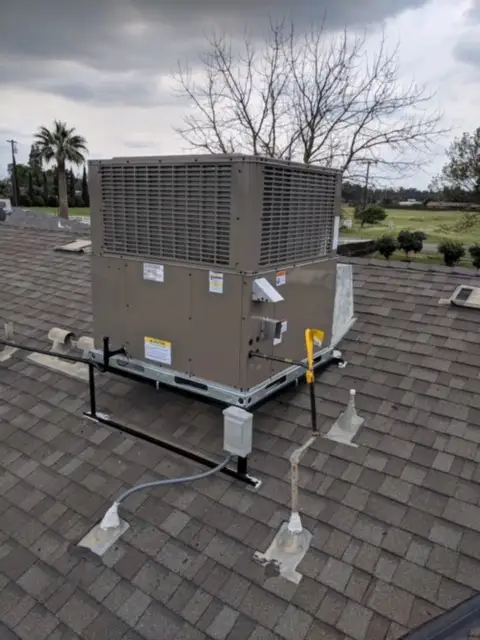

Why Is My AC Blowing Warm Air? Fall HVAC Troubleshooting & Startup Smells
Smelling burning dust this fall? Get clear answers with our home maintenance tips and troubleshooting to know when to call a pro for your heating system.
If you've been wondering what the R-410A phase-down means for your current system, here's the short answer: you do not need to replace your air conditioner right now. Your existing system can keep running, and technicians can still service it. What is changing is how R-410A refrigerant is produced and supplied — and that will affect availability and pricing over the coming years.
Here's what the R-410A phase-down means for homeowners at a glance:
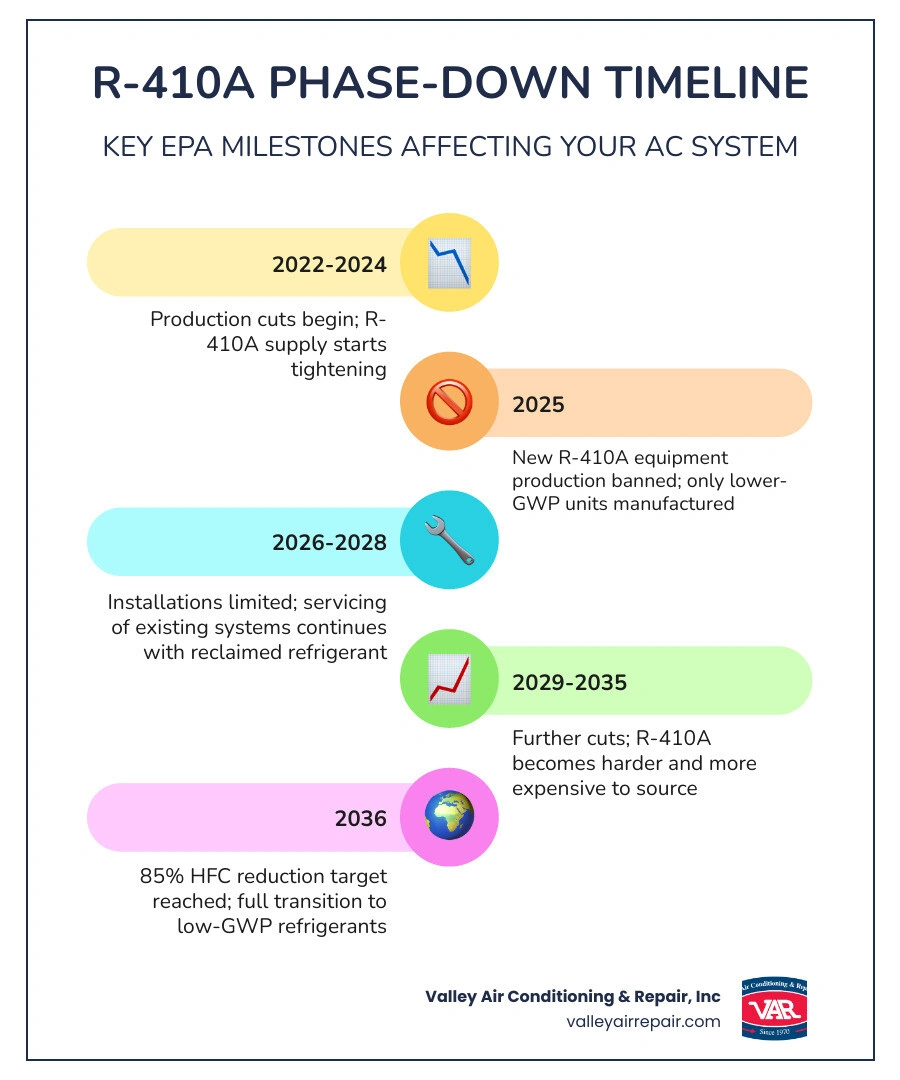
The EPA's AIM Act (American Innovation and Manufacturing Act of 2020) is the regulation driving all of this. It requires an 85% reduction in HFC production — including R-410A — by 2036. R-410A has a Global Warming Potential (GWP) of 2,088, which is significantly higher than the newer refrigerants now entering the market. That environmental impact is the core reason regulators are phasing it down.
For Central Valley homeowners in Modesto, Turlock, Ceres, and the surrounding area, this news can feel confusing — especially when headlines make it sound like your air conditioner might suddenly become illegal or impossible to service. It won't. But it does pay to understand the timeline and know what to watch for as the transition unfolds.
Important what the r410a phase down means for your current system terms:
If you are currently running an R-410A air conditioner or heat pump in your Fresno, Clovis, or Sanger home, the most important takeaway is that your system is grandfathered in. The Environmental Protection Agency (EPA) does not require you to pull out a perfectly good, working system. You can continue to run your air conditioner until it naturally reaches the end of its useful life.
Typically, a modern air conditioning system has a lifespan of 10 to 15 years. Because the phasedown schedule extends all the way to 2036, the vast majority of homeowners will naturally transition to a new refrigerant when their current system breaks down or becomes too old to run efficiently.
However, understanding what the r410a phase down means for your current system requires looking at the economics of ongoing maintenance. While your system is legal to operate, the raw materials needed to service it are becoming scarcer. The AIM Act works on a quota system, progressively slashing the amount of virgin HFCs (hydrofluorocarbons) that can be produced or imported. As of 2024, production was cut by 40%. The next massive drop occurs in 2029, when the allowance plunges to just 30% of the baseline.
This structural squeeze means that while we can still service your unit, the cost of R-410A refrigerant is rising. If your air conditioner develops a major leak, refilling it will become increasingly expensive as the years go on. To get a better sense of how these changing regulations affect your day-to-day comfort and home budget, check out our guide on how ac refrigerant changes affect homeowners.
The HVAC industry is transitioning away from R-410A because of its high Global Warming Potential (GWP). GWP is a measure of how much heat a greenhouse gas traps in the atmosphere relative to carbon dioxide (which has a GWP of 1). R-410A has a GWP of 2,088. Its replacements, R-454B and R-32, are much more environmentally friendly.
R-454B has a GWP of 466, which is a massive 78% reduction compared to R-410A. R-32 has a GWP of 675, representing a 68% reduction. Both of these alternatives belong to a class of refrigerants known as A2L.
While older refrigerants like R-410A are classified as A1 (non-flammable), A2L refrigerants are classified as mildly flammable. This sounds alarming at first, but in practice, A2L refrigerants are exceptionally difficult to ignite. They require a direct, high-energy open flame and a highly concentrated, stagnant volume of gas to catch fire—conditions that are virtually impossible to replicate inside a residential home. Furthermore, modern HVAC systems designed for A2L refrigerants are built with integrated safety mitigation systems, such as leak detection sensors that automatically shut down the system and run the indoor blower to safely disperse any escaping gas.
If you are planning an upgrade, it is helpful to know how these new formulas compare. You can read more about what to expect during your next equipment purchase in our detailed post on how the refrigerant transition affects your next ac purchase.
| Refrigerant Type | Safety Classification | Global Warming Potential (GWP) | GWP Reduction vs. R-410A | Primary Usage Status |
|---|---|---|---|---|
| R-410A | A1 (Non-Flammable) | 2,088 | Baseline | Phased down; no longer used in new manufacturing |
| R-454B | A2L (Mildly Flammable) | 466 | 78% Lower | Primary replacement for many leading brands |
| R-32 | A2L (Mildly Flammable) | 675 | 68% Lower | Popular replacement; highly efficient single-component gas |
Because the supply of R-410A is shrinking, proactive maintenance is no longer just a good habit—it is a financial shield. Air conditioners do not consume refrigerant like a car consumes gasoline. An HVAC system is a closed loop; if it is low on refrigerant, it means there is a physical leak somewhere in the copper lines, the evaporator coil, or the condenser coil.

Regular maintenance helps protect your R-410A system in several critical ways:
By keeping your existing system clean and well-maintained, you can easily extend its life and avoid the need for premature replacement.
How do you know if your home in Madera, Selma, or Kerman is using an R-410A system? You do not have to guess. Every outdoor condenser unit has a metal data plate or manufacturer label affixed to its side. This label lists key technical details, including the model number, serial number, electrical specifications, and the exact type of refrigerant used.
Look for terms like R-410A, R410A, or Suva 410A. If your system was manufactured and installed between 2010 and 2024, it almost certainly uses R-410A. If your system is much older and was installed before 2010, it might use R-22 (often called Freon), which has already been completely phased out.
If you look at the data plate and see a small flame symbol, that indicates your system is a newer model designed for an A2L refrigerant like R-32 or R-454B. If you cannot find the label or it has faded under the hot Central Valley sun, a professional technician can easily identify the gas type during your next service visit. For a deeper look at whether a change in refrigerant means you need to start shopping for a new air conditioner, read our analysis: do you need to replace your ac because of refrigerant changes.
When an older air conditioner experiences a breakdown, homeowners are faced with a classic dilemma: do you fix it or replace it? The R-410A phasedown adds a new layer to this decision.
If your air conditioner is less than 8 to 10 years old and suffers a minor mechanical failure—such as a failed capacitor, a worn-out fan motor, or a bad contactor—repairing the unit is almost always the smartest move. These parts are standard, widely available, and have nothing to do with the refrigerant loop.
However, if your system is over 12 years old and suffers a major component failure—such as a burned-out compressor or a severely leaking evaporator coil—the decision shifts. Replacing a major component requires opening the refrigerant loop, evacuating the old gas, fixing the physical leak or replacing the part, and charging the system with fresh R-410A. Because the cost of R-410A is rising, the total bill for this type of repair can be incredibly high.
In these scenarios, investing that money into a modern, highly efficient system that uses a modern, future-proof refrigerant like R-454B is often the more practical long-term financial choice. To help you weigh these options for your home, explore our guide on should you repair or replace your ac.
For specific scenarios, you can also read:
To make sense of the transition, it helps to look at the official timeline established by the EPA under the AIM Act. This is not an overnight ban, but rather a carefully managed, multi-year step-down designed to give the industry and consumers plenty of time to adapt.
Navigating regulatory shifts can bring up many questions. Here are the answers to the most common concerns we hear from local homeowners.
Yes. You can absolutely still get your R-410A system recharged if it develops a leak. The AIM Act restricts the production of new refrigerant, but it does not outlaw its use or sale for servicing existing equipment.
As virgin production continues to step down, the industry is shifting toward reclaimed refrigerant. When old systems are replaced, technicians recover the existing R-410A and send it to specialized processing facilities. There, it is purified back to factory-grade standards and packaged for resale. This reclaimed supply will keep R-410A available for repairs for many years to come, though you should expect the cost of this service to rise as the market supply tightens.
Yes, they are exceptionally safe. While refrigerants like R-454B and R-32 carry an A2L "mildly flammable" classification, this is a far cry from highly flammable gases like propane.
A2L refrigerants are incredibly difficult to ignite. To give you an idea of how stable they are, you could spark a static electricity charge or drop a burning cigarette into a cloud of A2L gas, and it would not ignite. It requires a high-energy, continuous flame to burn, and if the flame source is removed, the refrigerant self-extinguishes. Additionally, manufacturers have redesigned modern HVAC cabinets with safety sensors and spark-proof electrical components to eliminate any realistic risk of ignition inside your home.
No, there is absolutely no reason to replace a perfectly healthy, working R-410A air conditioner. Doing so would be an unnecessary expense.
If your system is cooling your home reliably and is not suffering from frequent breakdowns, the most sensible approach is to keep running it. Simply schedule regular annual maintenance to keep it clean, prevent leaks, and maximize its efficiency. If your system is reaching the end of its useful life and you are wondering whether to keep pouring money into it, check out our guide on Is It Worth Fixing an Old AC Unit in the Desert.
Additionally, if you do decide to upgrade, there are excellent incentives available to offset the cost of modern, eco-friendly systems. You can read about these in our post on Federal Tax Credits for Heat Pump and AC Upgrades.
The R-410A phasedown is a major environmental milestone, but it is designed to be a smooth, manageable transition for homeowners. Your current air conditioner remains completely legal, safe, and serviceable. By understanding the timeline and focusing on proactive maintenance, you can keep your home comfortable while making smart, stress-free decisions about when to eventually upgrade.
At Valley Air Conditioning & Repair, Inc., we have been serving Central Valley families in Fresno, Clovis, Madera, Sanger, Selma, and the surrounding areas since 1970. Our business was built on a foundation of trust, honorable intentions, and a customer-first philosophy. We are here to help you navigate these industry changes with honest advice and dependable service.
Whether you need a routine seasonal tune-up to protect your existing R-410A system or you want to discuss your options for a modern, low-GWP upgrade, our experienced team is ready to help. Contact us today to schedule your appointment or explore our professional air conditioning services to keep your home cool and comfortable all year long.

As a business with many AC units, it is essential to have a responsive AC company. Valley Air Conditioning understands our needs. They are always responsive and our AC is up and running very quickly.
I had them do an AC check on the home I was buying, they were honest and quick. I hired them to do the summer and Fall maintenance for $149. Happy with this company!
100% recommend. I called, same day they came out and gave me estimate. Conley was honest and didn't try to recommend/sell us anything we didn't need. When I called him with questions before making a decision, he happily answered and was not annoyed by me contacting him. Conley and VAR
This is a group of good people. Very professional and knowledgeable. They take the time to listen and find the best solution that fits best for any situation. There's no way you can go wrong in choosing VAR.
We have used Valley Air for over fifteen years. The last two years ,Matt came to our house to service twice a year. Always on time, so polite and so professional. This is a very honest company and you can always depend on them and trust them. The office always treats everyone cheerfully and always want to do what you need done very fast YOU CAN COUNT ON THIS Company


