.webp)


AC Repair in Fresno, CA: Troubleshooting the Fall HVAC Transition After a Brutal Summer
Why we emphasize safe fall heating startups. Use these home maintenance tips and troubleshooting steps to decide with confidence when to call a pro.
August in the Central Valley brings a familiar and punishing rhythm: comfortable, mild mornings followed by blistering, relentless afternoons. If you have ever wondered why your house feels perfectly crisp at 9:00 AM but starts feeling sticky and warm by 4:00 PM, you are experiencing the limits of residential cooling dynamics. Understanding exactly how thermal expansion valves respond to fluctuating August temperatures is the key to knowing whether your system is simply working hard or actually breaking down.
For comprehensive air conditioning services, having a baseline understanding of your system's internal mechanics can save you from unnecessary panic—and prevent catastrophic compressor failure.
The core challenge for any cooling system in our region is the massive diurnal temperature variation. A standard summer day often features a 100°F+ afternoon peak vs 70°F morning baseline. That 30-degree swing places an immense mechanical burden on your air conditioner. Your system is sized to handle a specific heat load, but as the sun beats down on your roof and the ambient air temperature skyrockets, the physical properties of the refrigerant flowing through your pipes change drastically.
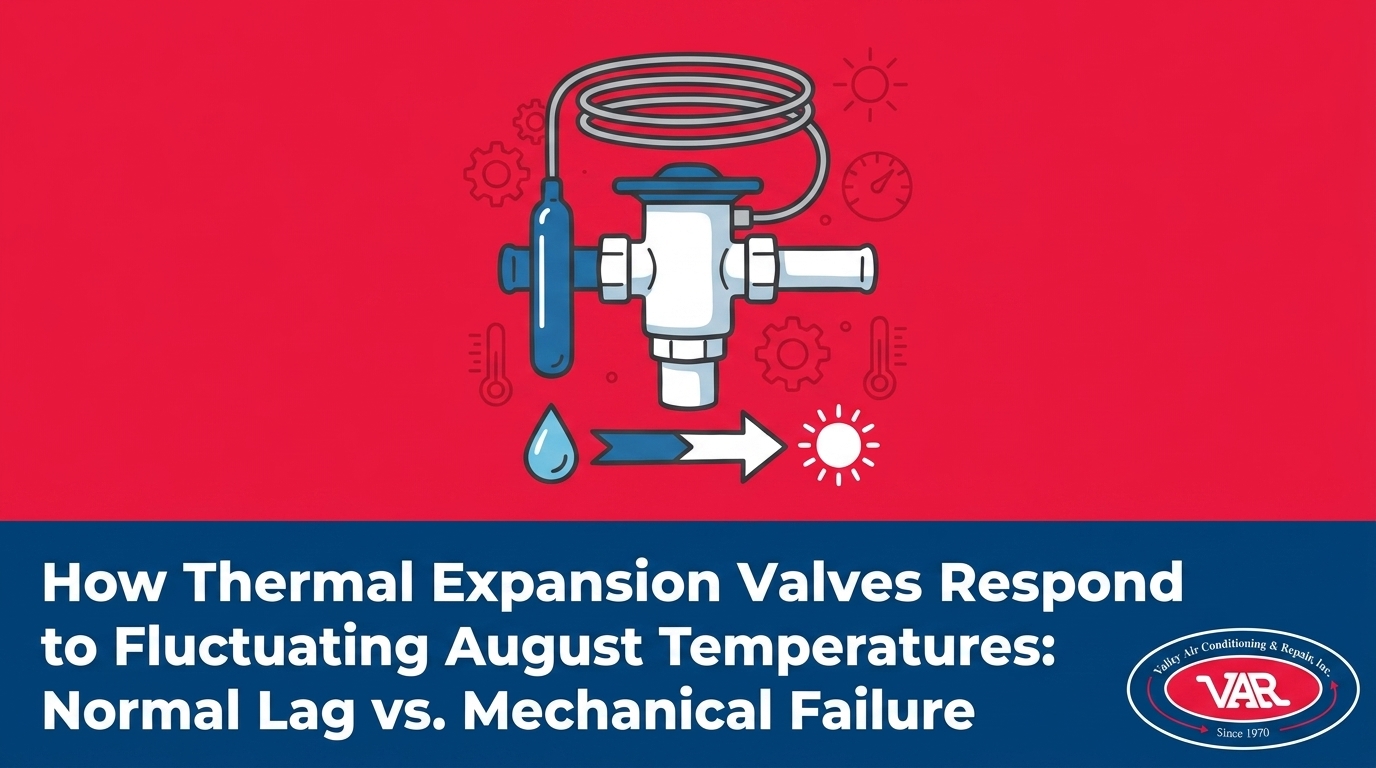
To manage this extreme shift, your air conditioner relies on a small but incredibly vital component: the Thermal Expansion Valve (often abbreviated as the TXV). This valve acts as the throttle for your entire cooling cycle. When the morning is cool, the valve restricts the flow of refrigerant because the house doesn't need maximum cooling power. But as the afternoon heat sets in, the TXV must open wider, allowing more refrigerant into the indoor coil to absorb the massive influx of heat.
The frustration for many homeowners lies in a simple decision point: determining if that late-afternoon midday lag is a normal mechanical response to extreme weather, or a clear sign of a failing TXV. When your system seems to lose its edge just when you need it most, paying attention to how the air feels—and how long the system runs—can help you make the right call.
To understand why late-summer August in the Central Valley is so hard on your air conditioner, you have to look past the large metal boxes outside and inside your home. The real magic of air conditioning happens at the molecular level, governed by the TXV. Rather than being a static pipe or a simple on/off switch, the thermal expansion valve is a dynamic, constantly moving mechanical device that reacts in real-time to the temperature of your home.
Your air conditioner cools your home by absorbing indoor heat into cold, liquid refrigerant, which then boils into a gas. The TXV sits right before your indoor evaporator coil. Its primary job is to act as a precision metering device. It controls exactly how much liquid refrigerant enters the coil. If too much liquid enters, it won't all boil off, and liquid refrigerant will travel back to the compressor—a dangerous condition known as "flooding" that can destroy the compressor motor. If too little enters, the coil starves, the system loses its cooling capacity, and the coil can actually freeze solid.
The TXV balances this flow by measuring "superheat." Superheat is simply the number of degrees the refrigerant gas has warmed up above its boiling point by the time it leaves the evaporator coil. By maintaining a precise superheat, the TXV ensures maximum cooling efficiency while protecting the compressor.
The TXV achieves this delicate balance using three main mechanical forces:
• The Sensing Bulb: Strapped to the suction line leaving the evaporator coil, this bulb contains a specialized fluid. As the line gets warmer, the fluid inside the bulb expands.
• The Internal Diaphragm: The expanding fluid from the sensing bulb pushes down on a thin metal diaphragm inside the valve housing.
• The Spring Pressure: A mechanical spring pushes back up against the diaphragm, trying to close the valve.
When the heat load in your home increases, the suction line gets warmer. The fluid in the sensing bulb expands, pushing the diaphragm down, which overcomes the spring pressure and opens the valve wider. This allows more liquid refrigerant into the coil to absorb the extra heat. It is a brilliant, entirely mechanical feedback loop that requires no electronics to operate.
The TXV is an engineering marvel, but it is not immune to the laws of physics or the realities of mechanical wear and tear. When we look at Fresno's specific August weather patterns—highlighted by a rapid transition from mild, comfortable mornings to blistering, dangerous afternoons—we see exactly why these valves are put to the ultimate test.
During a 70°F morning, your air conditioner has an easy job. The heat load inside the house is low, and the outdoor unit can easily reject heat into the cool morning air. The TXV operates efficiently, modulating slightly to let a small, steady stream of refrigerant into the evaporator coil. The internal diaphragm makes minor, gentle adjustments.
However, as the sun reaches its peak and the outdoor temperature spikes, a mechanical frenzy begins inside your AC system. The attic bakes, the walls absorb solar radiation, and the indoor heat load skyrockets. The sensing bulb on the TXV detects this massive increase in heat and forces the diaphragm down to its maximum operational limit, opening the valve as wide as it can go to flood the coil with enough refrigerant to keep your house cool.
The toll of extreme stress: Prolonged exposure to these peak afternoon temperatures forces the valve to hold that maximum open position for hours on end. The metal components expand and contract continuously over the course of the season. Over time, especially in older or poorly maintained systems, this daily 100°F+ afternoon peak vs 70°F morning baseline takes a toll. The internal spring can lose its tension, the diaphragm can stiffen, or microscopic debris in the refrigerant lines can wedge into the valve seat.
When a valve begins to stick or respond sluggishly under this specific stress, it can lead to a sudden loss of cooling. During a prolonged stretch of 110-degree heat, one local homeowner on quarantine experienced a total cooling failure when their system couldn't keep up. A technician arrived quickly, diagnosed that the valve had failed under the extreme thermal load, and completed the repair to restore the system within an hour. If you notice your AC not responding to temperature changes properly as the afternoon heats up, the TXV's ability to modulate may be compromised.
Because late-summer August in the Central Valley pushes every piece of HVAC equipment to its absolute design limits, it is very common for a perfectly healthy air conditioner to struggle slightly around 4:00 PM. No residential cooling system is designed to maintain 68°F indoors when it is 105°F outside—the equipment would have to be massively oversized, which would cause humidity issues during milder weather.
The challenge for homeowners is distinguishing between a system that is simply working at its maximum capacity (normal lag) and a TXV that has mechanically failed and is losing ground (abnormal lag). If your system is experiencing abnormal lag, you might find yourself wondering why your AC is running but not cooling.
• Indoor Temperature — Normal Heat-Load Adjustment (System is Healthy): Rises 2-4 degrees above the thermostat setting during peak afternoon heat, but recovers after sunset. — Abnormal Lag (Potential TXV Failure): Continues to rise uncontrollably (5+ degrees above setting) and never recovers, even late at night.
• Airflow from Vents — Normal Heat-Load Adjustment (System is Healthy): Air feels slightly less frigid than in the morning, but is still noticeably cooler than room temperature. — Abnormal Lag (Potential TXV Failure): Airflow feels completely warm, or the volume of air blowing from the vents is drastically reduced.
• System Cycle Times — Normal Heat-Load Adjustment (System is Healthy): The AC runs continuously for hours in the afternoon without shutting off to keep up with the heat. — Abnormal Lag (Potential TXV Failure): The system short-cycles (turns on and off rapidly every few minutes) while the house remains hot.
• Physical Signs — Normal Heat-Load Adjustment (System is Healthy): The larger copper line outside is cold and sweating; the smaller line is warm to the touch. — Abnormal Lag (Potential TXV Failure): Thick ice builds up on the indoor coil or the outdoor copper lines, or the outdoor unit makes loud groaning noises.
The danger of DIY assumptions: When a home starts losing ground against the afternoon heat, a common misconception is that the system just "needs a little more Freon." This is a dangerous assumption. If your TXV is stuck closed, it restricts refrigerant flow, making it look like the system is low on charge. Adding more refrigerant to a system with a stuck TXV will severely overcharge the unit, creating massive head pressure that can permanently destroy the compressor. Refrigerant is in a closed loop—it never "burns up." If there is a problem with cooling capacity, it requires professional diagnosis, never a DIY top-off.
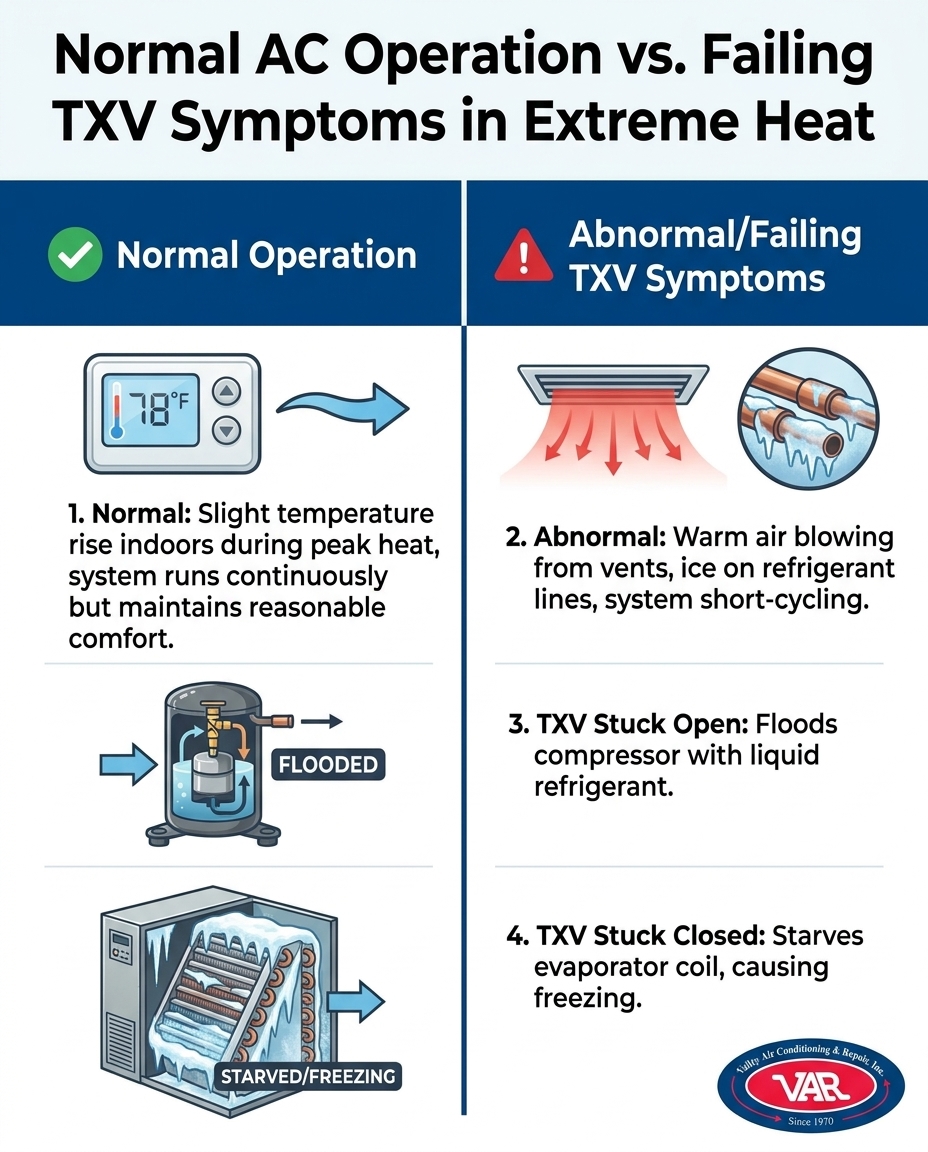
When a thermal expansion valve fails, it typically fails in one of two ways: it gets stuck in the closed position, or it gets stuck in the open position. Because the TXV dictates the flow of refrigerant for the entire system, a failure here cascades rapidly through the rest of the equipment. Knowing the specific warning signs can help you turn off the system before expensive secondary damage occurs, especially when facing a 100°F+ afternoon peak vs 70°F morning baseline.
1. Symptom 1: Warm air blowing from the registers during peak heat. If the TXV gets stuck closed (or partially closed), it starves the indoor evaporator coil of refrigerant. Without enough liquid refrigerant entering the coil, the system cannot absorb the heat from your home's air. The blower fan continues to push air over a warm coil, resulting in room-temperature or warm air blowing from your vents.
2. Symptom 2: Ice buildup on the indoor evaporator coil or outdoor refrigerant lines. This is a direct consequence of a starving coil. When the TXV restricts flow too much, the pressure inside the evaporator coil drops significantly. According to the laws of thermodynamics, a drop in pressure results in a drop in temperature. The coil gets so cold that the natural humidity in your home's air freezes onto the metal fins instead of draining away as liquid condensation. This solid block of ice further restricts airflow, compounding the problem.
3. Symptom 3: The compressor short-cycling or overheating. If the TXV gets stuck in the open position, the opposite problem occurs. It allows far too much liquid refrigerant into the evaporator coil. The heat in the home isn't enough to boil all of this liquid into a gas. As a result, liquid refrigerant travels down the suction line directly into the compressor. Compressors are designed to pump gas, not liquid. This liquid "slugging" causes the compressor to overheat, groan loudly, and trip its internal thermal overload switch, leading to rapid short-cycling.
It is crucial to reiterate that these symptoms perfectly mimic other serious AC issues, such as a refrigerant leak, a failing blower motor, or a clogged filter. Confirming a bad TXV requires specialized diagnostic tools to measure subcooling, superheat, and system pressures simultaneously.
Many homeowners are frustrated when an air conditioner fails in August, especially if they had a preventative maintenance check performed back in April. The unfortunate reality is that a sluggish TXV might only reveal its flaws when subjected to maximum thermal load.
During a basic spring tune-up, the outdoor temperature might only be 75°F. The heat load on the home is minimal. The technician hooks up their gauges, and the static pressures look completely normal. The TXV is modulating just fine for the mild conditions. It isn't until late-summer August in the Central Valley, when the sensing bulb is demanding maximum flow, that the valve's internal diaphragm gets stuck or fails to open wide enough.
This highlights the massive difference between a basic visual inspection and advanced, dynamic performance testing. Working with technicians who possess deep technical expertise in diagnosing complex, heat-driven component strains ensures that your system isn't just "checked"—it is rigorously evaluated. Professionals who understand the nuances of extreme temperature swings will dynamically measure superheat and subcooling, looking for how the valve responds to changing loads, rather than just taking a static snapshot.
While routine preventative maintenance is absolutely vital for keeping coils clean and electrical connections tight, diagnosing a sticky TXV requires an understanding of thermodynamics that goes far beyond simply changing a filter.
Your AC struggles in the afternoon because the thermal load on your home peaks when the sun has been beating down on the roof for hours. As the outdoor temperature rises, the heat transfer process becomes much more difficult for the system. The TXV must open wider to allow more refrigerant into the coil to absorb this massive heat influx, and if the system is undersized or the valve is sluggish, it will lose ground until the sun sets.
A thermal expansion valve acts as a precision metering device that controls exactly how much liquid refrigerant enters your indoor cooling coil based on the current heat load. By sensing the temperature of the refrigerant leaving the coil, the valve opens and closes to ensure maximum cooling efficiency. It prevents the coil from starving (which causes freezing) and prevents liquid from flooding back to the compressor.
The primary indicators of a failing TXV include warm air blowing from your vents during the hottest part of the day, thick ice building up on your indoor coil or outdoor copper lines, and a compressor that short-cycles rapidly. You may also notice that your system runs constantly but the indoor temperature continues to rise significantly above your thermostat setting. Because these symptoms mimic other issues, professional diagnosis is required.
Yes, a malfunctioning TXV can absolutely cause a compressor to overheat and fail. If the valve is stuck closed, it starves the compressor of the cool refrigerant vapor it relies on to keep its internal motor from overheating. If the valve is stuck open, it floods the compressor with liquid refrigerant, which washes away vital lubricating oil and causes catastrophic mechanical failure.
No, replacing a thermal expansion valve is strictly a job for a licensed HVAC professional. The process requires legally recovering all the refrigerant from the system, un-brazing the old valve with a torch, brazing in the new valve while flowing nitrogen to prevent oxidation, pulling a deep vacuum to remove moisture, and precisely recharging the system. Attempting this without the proper EPA certifications and specialized equipment is both dangerous and illegal.
Surviving late-summer August in the Central Valley requires an air conditioner that can handle massive daily temperature swings. While a slight rise in indoor temperature during the late afternoon is a normal heat-load adjustment, continuous warm air, rapidly rising indoor temperatures, or freezing coils are clear signs that your system is losing the battle. The components inside your unit, especially the thermal expansion valve, endure incredible stress to keep you comfortable.
If you suspect your system is struggling beyond normal parameters, do not wait for a total breakdown on a 105-degree afternoon. Having a professional evaluate the dynamic performance of your refrigerant cycle can save you from costly compressor damage. Take the guesswork out of your comfort by scheduling a comprehensive AC diagnostic service, ensuring your system has the precision and power to tackle whatever the late-summer heat brings.

As a business with many AC units, it is essential to have a responsive AC company. Valley Air Conditioning understands our needs. They are always responsive and our AC is up and running very quickly.
I had them do an AC check on the home I was buying, they were honest and quick. I hired them to do the summer and Fall maintenance for $149. Happy with this company!
100% recommend. I called, same day they came out and gave me estimate. Conley was honest and didn't try to recommend/sell us anything we didn't need. When I called him with questions before making a decision, he happily answered and was not annoyed by me contacting him. Conley and VAR
This is a group of good people. Very professional and knowledgeable. They take the time to listen and find the best solution that fits best for any situation. There's no way you can go wrong in choosing VAR.
We have used Valley Air for over fifteen years. The last two years ,Matt came to our house to service twice a year. Always on time, so polite and so professional. This is a very honest company and you can always depend on them and trust them. The office always treats everyone cheerfully and always want to do what you need done very fast YOU CAN COUNT ON THIS Company