.webp)


AC Repair in Fresno, CA: Troubleshooting the Fall HVAC Transition After a Brutal Summer
Why we emphasize safe fall heating startups. Use these home maintenance tips and troubleshooting steps to decide with confidence when to call a pro.
You flip the thermostat from cool to heat for the first time in months, and within minutes, an unfamiliar burning smell fills the hallway. When you are looking for reliable home maintenance tips and troubleshooting, the seasonal transition from cooling to heating is often the most critical time of year. Safely starting up a residential heating system for the first time in mid-fall after heavy summer AC usage presents a unique set of challenges. The immediate decision point for most homeowners is determining whether initial startup smells and sounds are normal seasonal transition phenomena or signs of mechanical failure that require a licensed professional.
For comprehensive support through this seasonal shift, explore our air conditioning services to ensure your equipment is thoroughly evaluated.
In our years serving Fresno and the Central Valley, our team at Valley Air Conditioning & Repair, Inc. has seen firsthand how the shift in seasons acts as a severe stress test for residential HVAC systems. Ensuring safe operation is the absolute top priority before overnight temperatures drop significantly and your family relies on consistent heating. This definitive guide covers safe preparation, establishes strict boundaries for what you can handle yourself, and highlights exactly when it is time to rely on professional diagnostics to keep your home comfortable and safe.
Many homeowners assume their air conditioner and furnace operate completely independently, but these systems share critical internal components. Months of continuous cooling operation inevitably degrade electrical parts and stress mechanical systems. Fresno's extreme summer heatwaves routinely exceeding 100 degrees place prolonged strain on these shared HVAC components, necessitating careful inspection before the autumn heating transition.
We see this pattern frequently. Recently, one of our local customers reached out during a 110-degree summer heatwave when their air conditioner suddenly stopped working. Our technician arrived quickly, diagnosed the overloaded system, and restored cooling to prevent health risks in the extreme heat. This type of severe summer workload leaves a legacy of wear and tear on the system that must be addressed before winter.
Here is how the transition impacts your shared system components:
1. The indoor coil and blower motor: Both heating and cooling modes rely on the exact same indoor blower motor to circulate air through the ductwork.
2. Electrical capacitor fatigue: The capacitors that help start the blower motor endure massive electrical loads during summer. Transitioning a fatigued capacitor directly into the heating season increases the risk of a sudden breakdown.
3. Airflow restrictions: Dust and debris accumulated during heavy summer use can choke the system, causing the furnace to overheat rapidly upon its first startup.
To reduce this excessive wear during peak heat, some homes utilize evaporative cooling solutions to mitigate the strain on traditional compressor systems.
Blower motors run almost non-stop during summer heatwaves just to maintain basic indoor temperatures. This continuous, high-speed operation accelerates the wear on internal bearings and electrical connections. When a motor is already running hot and struggling with friction, switching it over to distribute heated air can push it past its breaking point. If the blower fails to engage when the furnace ignites, the heat exchanger can rapidly overheat, triggering an automatic safety shutdown or potentially damaging the heating unit entirely.
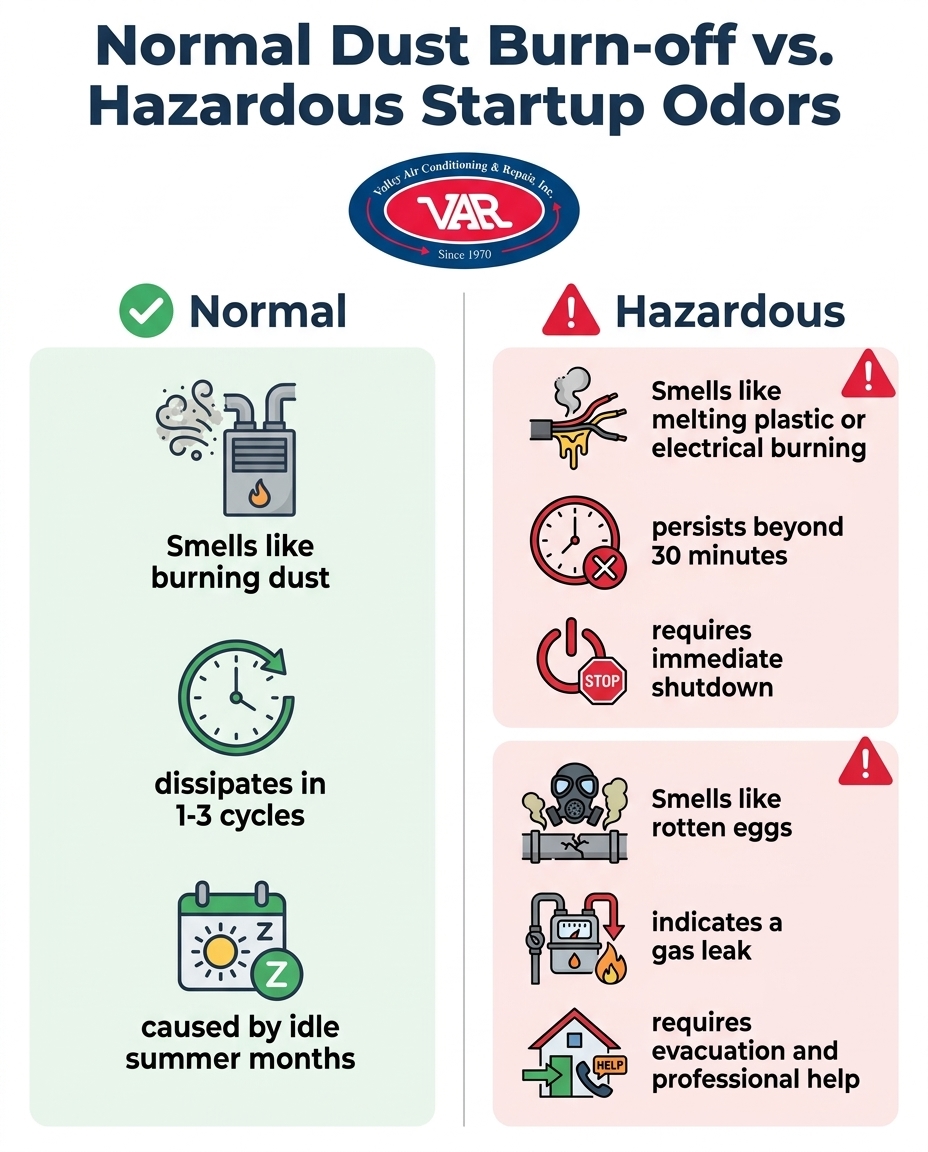
When preparing for an October pre-winter heating startup, the most common cause for alarm is the distinct odor coming from the vents. It is vital to differentiate clearly between normal dust burn-off smells and hazardous electrical or gas odors.
Dust naturally settles on the heat exchanger over the idle summer months. When the furnace ignites for the first time, this layer of dust incinerates. This normal dust burn-off typically dissipates within the first few heating cycles. However, strict warning signs of hazardous odors require an immediate system shutdown and professional intervention.
• Burning Dust / Musty — Likely Cause: Accumulated dust on the heat exchanger burning off after idle months. — Action Required: Monitor. Should dissipate within 1 to 3 full heating cycles.
• Acrid / Electrical Burning — Likely Cause: Failing blower motor, melting wire insulation, or overheated capacitor. — Action Required: Shut down system immediately at the thermostat and call a professional.
• Melting Plastic — Likely Cause: Foreign object in the ductwork or melting internal casing components. — Action Required: Shut down system immediately and inspect visible vents.
• Rotten Eggs / Sulfur — Likely Cause: Natural gas leak near the furnace or gas line connections. — Action Required: Evacuate the home immediately, leave doors open, and call the gas company.
While a brief dusty smell is harmless, you must take immediate action if an acrid, electrical burning smell persists beyond 30 minutes. Furthermore, if your carbon monoxide detector sounds an alarm at any point during the startup sequence, evacuate the home. If there is any distinct odor of natural gas near the unit or vents, do not attempt to investigate it yourself—shutting down the system and leaving the premises is the only safe course of action.
Establishing a strict safety boundary between basic homeowner maintenance and dangerous DIY mechanical diagnostics is essential for protecting both your family and your equipment. Before an October pre-winter heating startup, there are several highly effective tasks you can perform safely to ensure the system is ready to operate.
According to Department of Energy data, replacing a dirty, clogged filter with a clean one can lower an HVAC system's energy consumption by 5% to 15%. This simple step also prevents the furnace from overheating during its initial cycles. For homes using alternative setups like ductless mini-split systems, cleaning the reusable indoor filters is equally vital for efficiency.
• Replace the air filter: Check your primary return filter and install a fresh one. A clean filter ensures maximum airflow over the heat exchanger, preventing high-limit switch trips.
• Clear the outdoor unit: Even though you are switching to heat, heat pumps still require clear airflow. Remove leaves, twigs, and debris from a two-foot radius around the outdoor cabinet.
• Check the thermostat: Test the thermostat settings by switching from "cool" to "heat" and raising the temperature a few degrees above the current room temperature.
• Replace thermostat batteries: Swap out the batteries before the first cold snap to ensure uninterrupted communication between the thermostat and the furnace.
• Open all supply vents: Ensure rugs, furniture, or curtains are not blocking the floor or wall registers, which can cause pressure imbalances in the ductwork.
Homeowners should never attempt to clean internal heat exchangers or blower wheels themselves. The internal components of a furnace are delicate and highly sensitive. Electrical testing, gas pressure adjustments, and refrigerant pressure checks must be left entirely to licensed professionals. Touching internal capacitors poses a severe shock hazard, even when the main power is disconnected, as they store lethal amounts of electricity.
When the basic homeowner checklist is complete but the system still struggles, you need clear criteria for when to escalate to professional diagnostics. Modern HVAC systems are equipped with built-in safety switches that prevent operation if a critical fault is detected. These safety mechanisms exist to prevent fires and carbon monoxide leaks, and they should never be bypassed or ignored.
Because our team brings deep local expertise in Central Valley climate challenges, we understand exactly how to provide reliable solutions tailored to systems that have just survived extreme summer heat. Professional diagnostics eliminate the guesswork and ensure the system operates safely throughout the winter.
Watch for these mechanical warning signs:
• Grinding or shrieking noises: These sounds usually point to failing motor bearings or a loose blower belt that requires immediate replacement.
• Short-cycling: If the heater turns on for only a minute or two before shutting off, it is likely overheating due to airflow restrictions or a failing flame sensor.
• Failure to ignite: If you hear a clicking sound but no heat is produced, the igniter or gas valve may be compromised.
If you are experiencing ignition failures, reviewing a guide on troubleshooting an AC that won't turn on can offer insights into shared electrical issues, though heating failures require their own specific professional diagnostics.
If your system fails to start entirely, verify that the circuit breaker hasn't tripped and the thermostat is definitively set to 'heat'. If those basic checks pass but the system remains unresponsive, internal component failure is highly likely. Avoid repeatedly resetting the system at the breaker, as sending repeated surges of electricity to a failing component can cause severe electrical damage and turn a minor repair into a major replacement.
Systems over 10 years old are particularly vulnerable during the first startup of the season. The metal of a heat exchanger expands and contracts every time the furnace cycles on and off. Over a decade of use, this constant thermal stress can lead to micro-cracks. A cracked heat exchanger is incredibly dangerous because it allows carbon monoxide to leak directly into the home's air supply.
During an October pre-winter heating startup inspection, the professional process involves thoroughly cleaning the heat exchanger and inspecting it for these microscopic fractures. Proactive tune-ups restore efficiency, prevent mid-season breakdowns, and extend the lifespan of aging equipment by catching friction and wear before they cause a catastrophic failure. If a replacement ultimately makes more sense, keep in mind that federal tax credits or local utility incentive programs may apply to qualifying high-efficiency installations (always verify current programs with your utility or tax professional).
We recently saw the benefits of this proactive approach when one of our customers scheduled regular service for a 13-year-old AC unit. Our technician performed ongoing preventive maintenance and a thorough cleaning of the heat exchanger. This comprehensive attention to detail kept the aging equipment running smoothly and safely, proving the value of consistent care. Enrolling in a structured preventative maintenance plan provides year-round peace of mind, ensuring that both the cooling and heating transitions are handled by experts.
When a heating system sits idle for months, dust naturally accumulates on the internal heat exchanger. As the furnace ignites for the first time during an October pre-winter heating startup, this settled dust burns off, creating a distinct odor. This temporary smell is completely normal and should dissipate within the first few heating cycles. If the smell turns acrid or persists for hours, it is time to shut the system down and call for help.
The safest and most impactful maintenance a homeowner can perform is replacing the air filter regularly. You can also safely clear leaves and debris from around the outdoor unit, ensure all indoor vents are open and unblocked, and replace the batteries in your thermostat. Any task requiring the removal of equipment access panels or handling internal wiring crosses the safety line and must be left to a licensed professional.
You should call a professional immediately if you detect the smell of melting plastic, electrical burning, or rotten eggs. While a brief dusty smell is a normal part of the fall transition, an electrical odor indicates overheating wires or a failing motor. The smell of rotten eggs is a clear indicator of a natural gas leak, requiring immediate evacuation and emergency professional assistance.
Start by changing your air filter, as a summer of heavy AC use likely left it clogged with dust and allergens. Next, clear the perimeter around your outdoor unit to ensure proper airflow for the upcoming season. Finally, schedule a professional pre-winter inspection to evaluate the blower motor and electrical components that endured extreme stress during the summer heatwaves.
Yes, a severely clogged air filter can absolutely cause a furnace to shut down. The dirt restricts airflow over the heat exchanger, causing the internal temperature of the furnace to spike rapidly. When the system detects this dangerous temperature rise, a high-limit safety switch will automatically shut the burner down to prevent a fire hazard.
What looks like smoke coming from a heat pump in the fall or winter is almost always steam from the unit's normal defrost cycle. When frost builds up on the outdoor coils in cold weather, the heat pump temporarily reverses operation to melt the ice, releasing visible steam. However, if the vapor has a burning electrical smell or is coming from the indoor vents, shut the system off and contact a technician.
Distinguishing between normal startup quirks, like a brief dusty smell, and genuine mechanical issues is the key to a safe and comfortable winter. By following a definitive, easy-to-understand checklist of safe homeowner preparations alongside professional oversight, you can protect your equipment from unnecessary wear and tear. Do not wait for the first freezing night to discover your heating system is compromised. Schedule your pre-winter inspection with Valley Air Conditioning & Repair, Inc. today to ensure your system operates safely, efficiently, and reliably all season long.

As a business with many AC units, it is essential to have a responsive AC company. Valley Air Conditioning understands our needs. They are always responsive and our AC is up and running very quickly.
I had them do an AC check on the home I was buying, they were honest and quick. I hired them to do the summer and Fall maintenance for $149. Happy with this company!
100% recommend. I called, same day they came out and gave me estimate. Conley was honest and didn't try to recommend/sell us anything we didn't need. When I called him with questions before making a decision, he happily answered and was not annoyed by me contacting him. Conley and VAR
This is a group of good people. Very professional and knowledgeable. They take the time to listen and find the best solution that fits best for any situation. There's no way you can go wrong in choosing VAR.
We have used Valley Air for over fifteen years. The last two years ,Matt came to our house to service twice a year. Always on time, so polite and so professional. This is a very honest company and you can always depend on them and trust them. The office always treats everyone cheerfully and always want to do what you need done very fast YOU CAN COUNT ON THIS Company