.webp)


AC Repair in Fresno, CA: Troubleshooting Your Fall HVAC Transition
Why we take fall furnace smells seriously. Get clear answers with these home maintenance tips and troubleshooting for a safe heating startup.
Is your furnace actually circulating dirty air, or is that strange odor completely normal? When you notice a distinct burning dust smell during that September first furnace start-up, it is easy to assume the worst. You might immediately wonder, Should I clean my ducts before turning on the heat this fall? That sudden, unpleasant scent on the first chilly morning often sends homeowners into a panic, making them rush to book expensive cleaning services they might not actually need.
Here is the reassuring truth: that initial burning smell is rarely a sign of a severe ductwork problem. In most cases, it is simply the result of standard summer dust burning off your furnace's internal components. Before you make a decision, understanding how your HVAC system handles indoor air quality can save you from paying for services you do not actually require.
This guide will walk you through exactly what happens inside your heating system during its first fall cycle. We will help you diagnose the difference between harmless surface dust and genuine contamination, so you can make an informed, cost-effective decision that keeps your home comfortable and safe all season long.
To understand why your heater smells like a campfire on the first chilly morning of September, you have to look past the air ducts and focus on the heart of your furnace: the heat exchanger. This critical component is responsible for heating the air that eventually circulates through your home.
During the long summer cooling months, your furnace sits idle. Even with a good air filter in place, microscopic dust particles naturally settle on the cold metal surface of the heat exchanger over those dormant months. When you finally switch your thermostat to "heat" for that September first furnace start-up, the burners ignite, and the heat exchanger rapidly climbs to temperatures exceeding several hundred degrees.
The problem: Months of settled dust are suddenly exposed to extreme heat. The cause: The heat exchanger literally incinerates those microscopic dust particles on contact. The solution: Allow the system to run so the dust can burn off completely.
Because the surface area of a heat exchanger is relatively small compared to your entire duct network, the amount of dust burning off is actually quite limited. This brings us to a standard industry benchmark: the 30 to 60-minute rule. If the smell is purely summer dust, the odor should peak within the first ten minutes and dissipate entirely within an hour of continuous operation.
It is vital to distinguish between normal dust burn-off and a dangerous malfunction. A dusty, slightly smoky smell is expected. However, if you detect the sharp, acrid scent of melting plastic, ozone, or electrical burning, you are dealing with a completely different issue. If you are unsure about the odors you are experiencing, learning why your furnace smells like burning dust can help you identify when a smell crosses the line from normal to hazardous.
The burning dust phenomenon happens everywhere, but it is particularly intense in our region due to the unique local climate and agricultural cycles. Living in Fresno and the Central Valley means dealing with environmental factors that homeowners in other states simply do not face.
Late summer and early fall mark the peak of the agricultural harvest in the San Joaquin Valley. As tractors, harvesters, and trucks work the fields, they kick up massive amounts of soil and organic matter. This activity significantly increases ambient particulate matter in the air—specifically PM10 (coarse dust) and PM2.5 (fine, inhalable particles).
Because the Central Valley acts as a geographical basin, this heavy harvest dust gets trapped in the stagnant summer air. Even with your windows tightly closed, this fine agricultural dust infiltrates your home through microscopic gaps in doors, windows, and attic spaces. Over the course of the summer, it gets pulled into your return vents and settles heavily onto your idle furnace components.
Because of this heavy regional dust load, the accumulation on your heat exchanger is often much thicker than it would be in a non-agricultural region. Consequently, the burn-off smell during that first autumn start-up can be quite strong.
Homeowners often mistake this intense smell for filthy ductwork, but it is simply a byproduct of our local harvest season. Recognizing this pattern is a key part of proper pre-season heating preparation. Heavier dust accumulation on the heat exchanger is a normal regional phenomenon, not necessarily a sign of failing or contaminated ductwork. The focus should be on stopping that agricultural dust before it reaches the furnace, rather than assuming the ducts themselves are the source of the odor.
If the start-up odor is just dust burning off the heat exchanger, when is duct cleaning actually required? One of our core commitments as a local service provider is prioritizing honest, cost-effective solutions over using start-up odors as a scare tactic to sell unnecessary services.
The Environmental Protection Agency (EPA) provides very clear guidance on this topic. They state that routine duct cleaning is not always necessary and should only be performed under specific, verifiable conditions. Routine start-up odors do not automatically dictate a need to clean your ductwork.
According to the EPA and industry standards, you should only invest in professional duct cleaning if you meet one of the following criteria:
• Visible mold growth: Hard surface ducts (like sheet metal) show substantial, verified mold growth on the inside walls or on other system components.
• Pest infestations: There is clear evidence of rodents, insects, or other pests living inside the ductwork, leaving behind droppings or nesting materials.
• Excessive debris: The ducts are visibly clogged with excessive amounts of dust and debris that are actively restricting airflow and blowing back into your living space.
• Post-construction cleanup: You recently completed a major home renovation that generated heavy drywall dust or sawdust without sealing off the return vents.
If your system is blowing clean, odor-free air after the initial 60-minute burn-off period, and you live in a typical home in Fresno and the Central Valley, your ducts are likely perfectly fine. Do not let a temporary September smell convince you to authorize a major service you do not need.
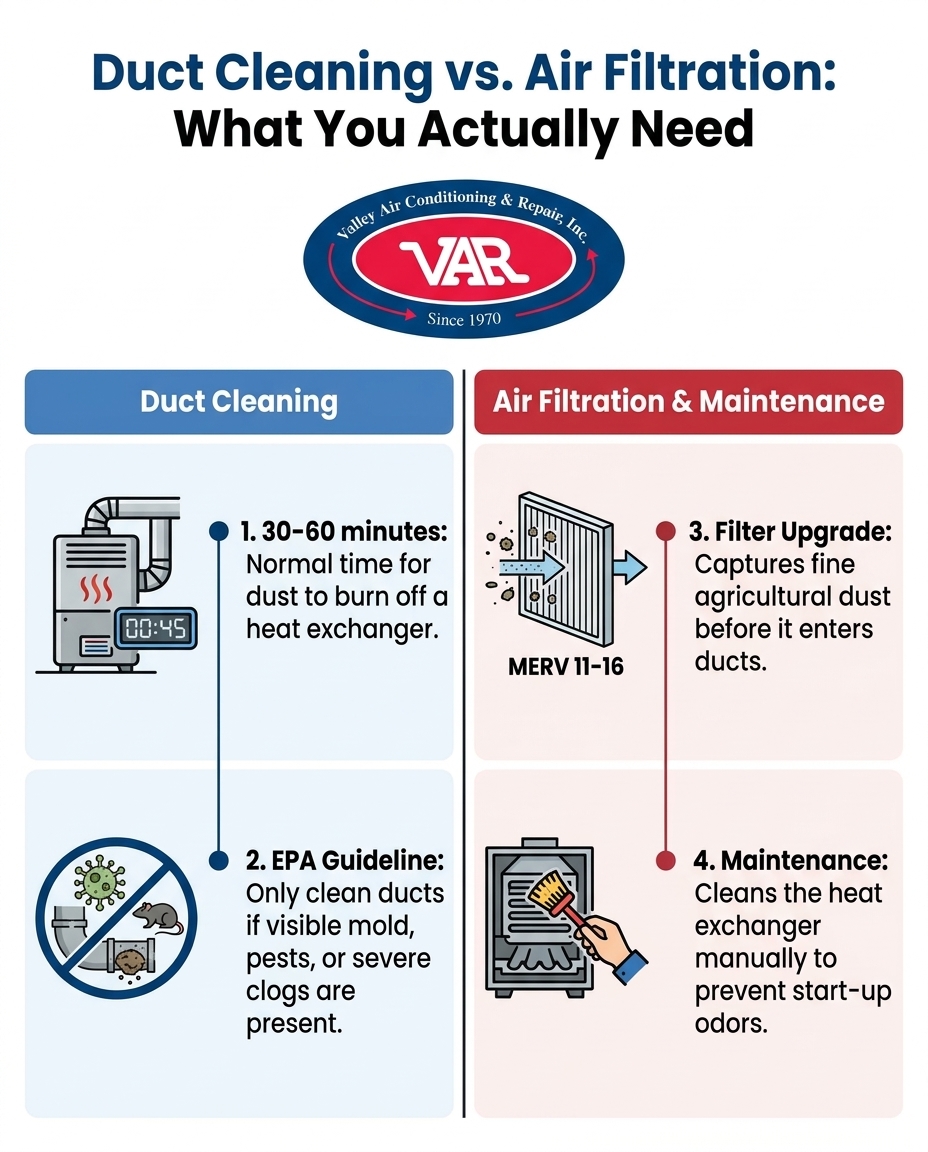
If your goal is to eliminate dust and improve indoor air quality, your first line of defense should always be the air filter. A high-quality, properly fitted air filter captures the majority of airborne agricultural dust before it ever has a chance to enter the ductwork or settle on the heat exchanger.
A typical pattern we see is homeowners being pressured into massive, expensive overhauls based on a simple diagnostic misunderstanding. For instance, one homeowner was told during a routine check that they had a red-flagged carbon monoxide leak requiring a completely new unit. A second opinion revealed there was no leak at all, allowing them to keep their existing system safely running. The same principle applies to indoor air quality: do not let a temporary start-up odor push you into a major duct service when a simple, honest filter upgrade is often the correct fix.
Understanding the MERV (Minimum Efficiency Reporting Value) rating system is crucial for capturing fine agricultural dust without restricting your system's airflow. Here is how upgrading your filter compares to a full duct cleaning:
• Primary Benefit — High-Quality Air Filter (MERV 8-11): Actively prevents dust from entering the system — Professional Duct Cleaning: Removes existing debris from inside the metal paths
• Effect on Start-Up Odors — High-Quality Air Filter (MERV 8-11): Reduces future dust buildup on the heat exchanger — Professional Duct Cleaning: Has zero effect on dust already sitting on the heat exchanger
• Frequency Needed — High-Quality Air Filter (MERV 8-11): Every 1 to 3 months depending on harvest season — Professional Duct Cleaning: Only every 3 to 5 years (if at all)
• Impact on Airflow — High-Quality Air Filter (MERV 8-11): Maintains proper static pressure if sized correctly — Professional Duct Cleaning: Can improve airflow if ducts were severely clogged
Changing your filter at the start of the heating season, especially right before that September first furnace start-up, is the most effective way to improve indoor air quality immediately. It provides ongoing protection against Central Valley dust at a fraction of the cost of unnecessary duct services.
While upgrading your filter prevents future dust buildup, what can you do about the dust that has already settled over the summer? The safest and most effective solution is professional preventive maintenance. Bridging the gap between a simple filter change and a full system cleaning is exactly what a fall tune-up is designed to do.
When a professional technician performs fall maintenance, they do much more than just look at the unit. They open the cabinet and physically clean the interior components. By manually wiping down and vacuuming the heat exchanger before the burners are ever ignited, the technician physically removes the settled agricultural dust. Because the dust is gone, there is nothing left to incinerate—meaning the burning smell is eliminated entirely.
Routine care makes a massive difference, especially for older equipment. One typical pattern we see involves aging systems that just need a thorough, professional cleaning to perform safely. For example, during a tune-up on a 13-year-old unit, a technician performed ongoing preventive maintenance that included carefully cleaning the heat exchanger. That targeted attention kept the aging unit running like new, without the need for expensive duct overhauls or premature replacement.
Beyond preventing odors, having a professional inspect your heat exchanger is critical for safety. The heat exchanger separates the combustion gases (like carbon monoxide) from the breathable air in your home. Over time, metal expands and contracts, which can lead to microscopic cracks. A thorough HVAC maintenance plan ensures that a certified technician inspects this vital component for structural integrity before the heavy winter usage begins in Fresno and the Central Valley.
While a brief burning dust smell is standard during the September first furnace start-up, persistent odors are a major red flag. If the smell does not dissipate, or if the character of the odor changes, you need to take immediate action to protect your home and your family.
If the smell lasts longer than 60 minutes, it indicates that something other than surface dust is burning, or that the system is severely overheating. Follow these steps if the odor persists:
1. Turn off the furnace immediately: Go to your thermostat and switch the heating function to "off." Do not let the system continue to run if the smell is getting worse.
2. Check your air filter: A persistently clogged filter restricts airflow so severely that the blower motor has to work overtime. This can cause the motor to overheat, producing a burning smell that mimics incinerated dust. If the filter is solid gray or black, replace it.
3. Identify the specific odor: Pay attention to the type of smell. The scent of melting plastic often indicates a foreign object has fallen into a vent. An electrical burning smell (like ozone or hot wires) suggests a failing blower motor or a short circuit in the control board.
4. Look for smoke: If you see visible smoke coming from your supply vents, evacuate the house and call emergency services immediately.
5. Call a professional: If the filter is clean and the smell persists, do not attempt to open the furnace cabinet yourself. Modern heating systems involve high-voltage electricity and combustible gas.
Attempting dangerous DIY repairs on a malfunctioning furnace can void your warranty and put your home at risk. Instead, rely on professional heating services to accurately diagnose the root cause of the persistent odor. A local technician can safely resolve electrical issues, remove foreign objects from the heat exchanger, and ensure your system is ready for the winter ahead.
The short answer is that dust settles on your furnace's internal components during the idle summer months. When you turn on the heater for the first time in the fall, the heat exchanger gets extremely hot and incinerates this settled dust. This process produces a distinct, temporary burning odor that is completely normal for the first cycle of the season.
Yes, it is entirely normal for a heater to produce a dusty, burning smell during its first start-up of the season. This is simply the system burning off the microscopic debris that accumulated over the summer. As long as the smell dissipates quickly and does not smell like melting plastic or electrical wires, there is no cause for concern.
You generally only need to clean your air ducts if you have visible mold growth, a verified pest infestation, or excessive debris visibly restricting airflow. The EPA does not recommend routine duct cleaning just for standard seasonal maintenance. Usually, upgrading to a high-quality air filter is a much more effective way to improve your indoor air quality before winter.
The burning dust smell should peak within the first ten minutes and completely dissipate within 30 to 60 minutes of continuous operation. If the odor lasts longer than an hour, or if the smell gets progressively worse, you should turn off the heating system and contact a professional technician to investigate.
Yes, a severely clogged air filter can cause a burning smell by restricting the necessary airflow to the system. When the furnace cannot pull in enough air, the blower motor has to work excessively hard, which can cause it to overheat and emit an electrical burning odor. Replacing the dirty filter often resolves this specific issue.
Burning dust smells like a dry, dusty campfire and fades away within an hour. An electrical fire produces a sharp, acrid scent similar to melting plastic, hot wires, or ozone, and the smell will persist or worsen as the system runs. If you detect an electrical odor, shut off the system immediately at the thermostat and call a professional.
Dealing with strange start-up odors on the first chilly morning can be stressful, but you do not have to figure it out alone. Schedule your pre-season tune-up before the heavy winter weather hits to ensure your heat exchanger is clean, safe, and ready to perform. A clear, reassuring diagnostic check is the best way to gain true peace of mind this heating season.

As a business with many AC units, it is essential to have a responsive AC company. Valley Air Conditioning understands our needs. They are always responsive and our AC is up and running very quickly.
I had them do an AC check on the home I was buying, they were honest and quick. I hired them to do the summer and Fall maintenance for $149. Happy with this company!
100% recommend. I called, same day they came out and gave me estimate. Conley was honest and didn't try to recommend/sell us anything we didn't need. When I called him with questions before making a decision, he happily answered and was not annoyed by me contacting him. Conley and VAR
This is a group of good people. Very professional and knowledgeable. They take the time to listen and find the best solution that fits best for any situation. There's no way you can go wrong in choosing VAR.
We have used Valley Air for over fifteen years. The last two years ,Matt came to our house to service twice a year. Always on time, so polite and so professional. This is a very honest company and you can always depend on them and trust them. The office always treats everyone cheerfully and always want to do what you need done very fast YOU CAN COUNT ON THIS Company