


.webp)


Why Is My AC Blowing Warm Air? Fall HVAC Troubleshooting & Startup Smells
Smelling burning dust this fall? Get clear answers with our home maintenance tips and troubleshooting to know when to call a pro for your heating system.
Why did my furnace smell like burning dust when I tested it? If you are asking yourself this question right now, you are certainly not alone. As the September pre-heating season arrives, many proactive homeowners decide to turn on their heating systems just to make sure everything is operational before the real cold sets in. Within minutes, a distinct, acrid smell of burning dust begins pouring out of the air vents, often triggering immediate panic. You might find yourself frantically checking the vents, wondering if something has caught fire inside your ductwork or if your heating system is experiencing a catastrophic electrical failure.
The good news is that a brief burning dust odor is usually a completely normal seasonal symptom rather than an immediate fire hazard. However, understanding the difference between normal dust burn-off and a dangerous mechanical or gas issue is absolutely critical for your home safety. If you are ever in doubt, the smartest move is to shut the system down at the thermostat and reach out for professional heating services to safely evaluate your equipment.
To understand why your heating system produces this unsettling odor, you have to look at what happens inside the cabinet during the spring and summer months. The core component responsible for warming your home is called the heat exchanger. This metal chamber gets incredibly hot when the furnace is running, safely transferring heat to the air circulating through your house.
However, throughout the hot Fresno / Central Valley summer, that heat exchanger sits completely dormant. Even if you are running your air conditioner daily, the heating components remain inactive. Here is exactly how the burning smell develops over those months:
1. The Accumulation Phase: Over several months of inactivity, airborne particles settle on the internal heating components. Even with a high-quality air filter in place, microscopic household dust, pet dander, lint, and skin cells manage to bypass the filtration system and coat the cold metal of the heat exchanger.
2. The Summer Drying Effect: Because the internal environment of your HVAC system can be quite dry during the summer, this layer of dust essentially bakes onto the metal surfaces, creating a fine, stubborn film over the burners and heat exchanger.
3. The Incineration Event: When you finally switch your thermostat to "heat" for the first time in the fall, the burners ignite, and the heat exchanger rapidly climbs to hundreds of degrees. That accumulated layer of dust is instantly incinerated. The smoke and odors from this microscopic flash-burning are then picked up by your blower motor and pushed out through every vent in your home.
This is a natural physical reaction to the system waking up after a long hibernation. If you are already dealing with dusty indoor air in Fresno, the volume of dust resting on those components will naturally be higher, resulting in a stronger, more noticeable odor during that initial test run.
When you are anxiously standing in your hallway sniffing the air, time can feel like it is moving at half speed. Having clear, definitive timeframes can help you know exactly when to relax and when to take action. A normal dust burn-off smell should dissipate within 30 to 60 minutes of continuous operation.
During the first half-hour of your September pre-heating season test, the smell will likely be at its strongest. The initial ignition burns away the thickest layer of settled debris. During this window, you should keep the system running. If you turn the heater off after just five minutes because you are scared of the smell, you are only pausing the process. The next time you turn it on, the remaining dust will start burning all over again. To help clear the air, you can briefly open a few windows or turn on ceiling fans to ventilate the house while the burn-off completes.
As the system approaches an hour of continuous heating, the odor should fade significantly. You might still catch a faint whiff of warm air, but the sharp, acrid scent of burning dust should be mostly gone. The heat exchanger is now clean, and the air circulating through your home should smell neutral.
If the smell persists beyond a full hour of continuous operation, or if the odor seems to be getting stronger rather than fading, this is your signal to act. A lingering smell means that the issue is no longer just settled summer dust. At this point, you should shut the system down completely at the thermostat to prevent any potential damage or safety hazards.
While the smell of burning dust is a harmless nuisance, there are several other odors that can mimic a dusty burn-off but actually indicate a severe mechanical failure or safety hazard. Establishing strict boundaries between normal seasonal smells and dangerous odors is essential for any homeowner in the Fresno / Central Valley area.
Below is a breakdown of specific odors to watch out for, what they usually mean, and how you should react if you detect them coming from your vents.
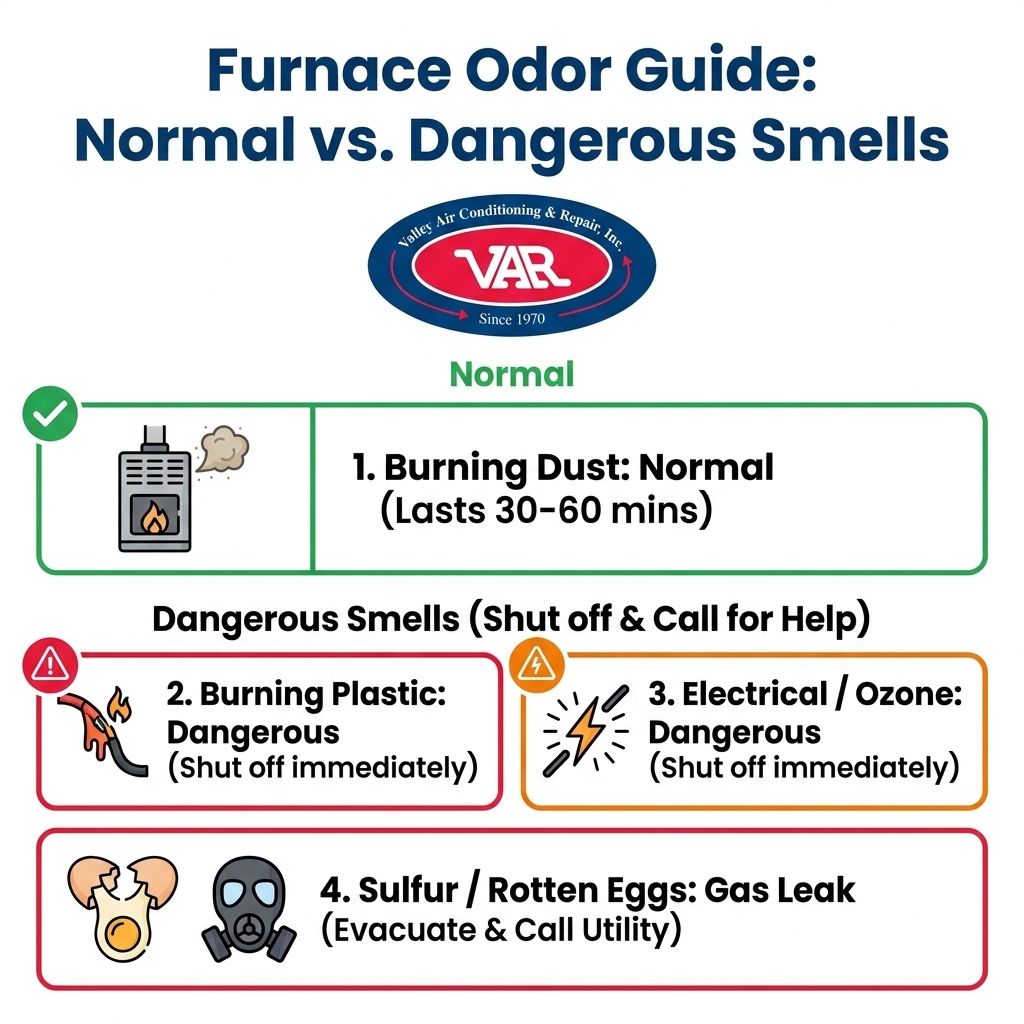
• Warm, Dusty Odor — Likely Cause: Normal accumulation of household dust burning off the heat exchanger after summer dormancy. — Required Action: Monitor for 30 to 60 minutes. Keep the system running to allow the dust to fully clear.
• Burning Plastic or Rubber — Likely Cause: Melting wire casings, a failing capacitor, or a foreign object (like a child's toy) dropped down a duct. — Required Action: Shut off immediately. Do not run the system. Call a licensed professional for electrical diagnostics.
• Electrical, Metallic, or Ozone — Likely Cause: An overheating blower motor, seized bearings, or failing electrical components sparking inside the cabinet. — Required Action: Shut off immediately. Electrical failures can lead to fires. Request an emergency inspection.
• Sulfur or Rotten Eggs — Likely Cause: A natural gas leak. Utilities add a chemical called mercaptan to natural gas to give it this distinct warning smell. — Required Action: Evacuate the home immediately. Do not touch light switches or thermostats. Call your local utility provider or 911 from outside.
• Formaldehyde or Chemical — Likely Cause: A cracked heat exchanger leaking toxic combustion gases (like carbon monoxide) into your breathing air. — Required Action: Shut off immediately. Open windows to ventilate the home and contact a professional for a safety inspection.
If you have recently moved to the area, you might notice that the first heater test of the year smells noticeably stronger than it did in previous homes. This is not your imagination. The severity of the burn-off smell is directly tied to the unique environmental conditions of our region.
During the long, dry San Joaquin Valley summers, our area experiences elevated levels of particulate matter, specifically PM10 and PM2.5. This is largely driven by agricultural activity, dry soil, and seasonal winds. Agricultural dust is incredibly fine and pervasive. Unlike standard household lint or pet hair, this microscopic silica and soil dust easily bypasses standard, low-efficiency fiberglass air filters.
As your air conditioner pulls air through the house all summer long, this fine Fresno / Central Valley dust is constantly circulating. A significant portion of it settles directly onto the dormant heating components. Because agricultural dust is denser and more mineral-rich than typical indoor dust, it requires more energy to incinerate, leading to a stronger, more pungent odor when the burners finally ignite in the fall.
Upgrading your home's filtration system can drastically reduce the volume of dust that reaches the internal components of your HVAC system. By exploring advanced indoor air quality solutions, you can capture these fine particulates before they have a chance to coat your heat exchanger, resulting in a cleaner system and a much milder burn-off odor next season. Valley Air Conditioning & Repair specializes in combating these specific San Joaquin Valley air quality issues, helping local homeowners breathe easier year-round.
When you are dealing with a burning smell during the September pre-heating season, it is easy to let anxiety take over. While it is important to monitor the situation, it is equally important to do so safely. Trying to investigate the source of the smell on your own can quickly lead to dangerous situations, especially if you are dealing with high-voltage electrical components or natural gas lines.
Here is a safe, actionable checklist for monitoring your system during that first test run:
• DO monitor the clock: Note the exact time you turned the thermostat to heat. Track the 30-to-60-minute window carefully. If you lose track of time, you won't know if the system has been burning dust for twenty minutes or two hours.
• DO check your air filter: A severely clogged air filter restricts airflow. When the furnace cannot pull enough air over the heat exchanger, the system can overheat, producing a hot, dusty smell that mimics a normal burn-off. If your filter is gray and completely blocked, replace it immediately.
• DO NOT open the furnace cabinet: This is the most critical safety rule. Inspecting internal components like the burners, blower motor, or heat exchanger requires specialized training and licensing. Opening the cabinet exposes you to live electrical wires, moving mechanical parts, and potential combustion hazards. Leave the internal diagnostics to a professional.
• DO shut the system off at the thermostat if you see smoke: A normal dust burn-off produces an odor, but it should never produce visible smoke billowing from your vents. If you see smoke, or if you detect the distinct smell of melting plastic or electrical ozone, turn the thermostat off immediately.
If your system fails the observation test, or if you simply want the peace of mind that comes with a professional safety check, scheduling residential pre-season heating preparation is the safest next step.
Testing your heater early in the fall is absolutely the right move. Discovering a mechanical issue in September gives you plenty of time to address it before freezing temperatures arrive in late fall and winter. However, there is a way to test your system without having to endure the panic-inducing burning smell at all: proactive, professional maintenance.
When you schedule a professional tune-up during the September pre-heating season, a licensed technician thoroughly cleans the internal components of your system before it is ever turned on. They carefully remove the accumulated summer dust from the burners, the heat exchanger, and the blower assembly. Because the dust is removed manually, there is nothing left to incinerate when the burners ignite, completely eliminating the burn-off odor.
Beyond just preventing a bad smell, regular maintenance is vital for the safety and longevity of your equipment. For example, one customer recently reached out for preventive maintenance on their older, 13-year-old unit. A technician performed a comprehensive cleaning, specifically focusing on clearing out the heat exchanger and checking for safe operation. Because of this proactive approach, the older unit was kept running like new, and the homeowner avoided both the burning dust smell and potential mid-winter breakdowns.
Enrolling in a routine HVAC maintenance plan ensures that your system receives this level of detailed care every single year, protecting your investment and guaranteeing a safe, odor-free start to the heating season.
Even with a solid understanding of why your system smells, you likely still have a few specific questions about safety and operation. Below are direct answers to the most common concerns homeowners have when testing their heating systems in the Fresno / Central Valley area.
A normal dust burn-off smell should typically last between 30 to 60 minutes. During this time, the accumulated summer dust is safely incinerated off the heat exchanger. If the smell persists beyond an hour of continuous operation, you should shut the system down and call a professional for an inspection.
A dusty burning smell is usually harmless, but odors resembling plastic or electrical burning are highly dangerous. The normal dust burn-off is just a physical reaction to the system heating up after months of inactivity. However, if you smell melting wire casings, ozone, or sulfur, it indicates a severe hazard that requires immediate professional intervention.
You should keep the system running for up to 60 minutes if it only smells like burning dust, but turn it off immediately for any other burning odor. Shutting the system down prematurely during a normal dust burn-off just pauses the process, meaning it will smell again next time. Conversely, running a system that smells like electrical smoke can lead to catastrophic damage or fire.
A cracked heat exchanger often smells like formaldehyde, strong chemicals, or produces physical symptoms like sudden headaches and nausea. It is important to note that carbon monoxide itself is completely odorless and invisible. If you suspect a cracked heat exchanger, shut the system off immediately, ventilate the home, and contact a licensed technician.
Yes, a severely clogged air filter blocks essential airflow, causing the blower motor and heat exchanger to overheat. When the system overheats, it can produce a hot, dusty, or even an electrical burning smell as the motor struggles against the static pressure. Always check and replace your air filter before performing your first seasonal heater test.
Experiencing a brief, unpleasant odor during your first heater test of the year is a common rite of passage for homeowners in the Fresno / Central Valley area. Now that you know the answer to "why did my furnace smell like burning dust when I tested it?", you can approach your fall preparations with confidence. Remember that a 30-to-60-minute dusty odor is just your system waking up from its long summer hibernation.
However, you should never ignore your instincts when it comes to home safety. If the smell lingers too long, if it smells like electrical components or plastic, or if you simply want the peace of mind that your system is operating safely, do not hesitate to seek help. Scheduling a professional evaluation ensures that your heating system is clean, safe, and ready to keep your family comfortable all winter long.

As a business with many AC units, it is essential to have a responsive AC company. Valley Air Conditioning understands our needs. They are always responsive and our AC is up and running very quickly.
I had them do an AC check on the home I was buying, they were honest and quick. I hired them to do the summer and Fall maintenance for $149. Happy with this company!
100% recommend. I called, same day they came out and gave me estimate. Conley was honest and didn't try to recommend/sell us anything we didn't need. When I called him with questions before making a decision, he happily answered and was not annoyed by me contacting him. Conley and VAR
This is a group of good people. Very professional and knowledgeable. They take the time to listen and find the best solution that fits best for any situation. There's no way you can go wrong in choosing VAR.
We have used Valley Air for over fifteen years. The last two years ,Matt came to our house to service twice a year. Always on time, so polite and so professional. This is a very honest company and you can always depend on them and trust them. The office always treats everyone cheerfully and always want to do what you need done very fast YOU CAN COUNT ON THIS Company


