


.webp)


Why Is My AC Blowing Warm Air? Fall HVAC Troubleshooting & Startup Smells
Smelling burning dust this fall? Get clear answers with our home maintenance tips and troubleshooting to know when to call a pro for your heating system.
If you are packing your bags for a final back-to-school getaway and wondering, "Should I turn my AC off completely when away on late summer weekends?" you are certainly not the only one asking. It seems like logical math: you will not be in the house for two days, so shutting off the cooling system should save energy and lower your utility bill. However, this common assumption ignores the severe concrete problem of letting a house bake in extreme heat. When you turn the air conditioner completely off, you are allowing your home to absorb massive amounts of heat energy. By the time you return, you force your system to work exponentially harder to undo the damage.
The core decision point for any homeowner is balancing actual energy savings against severe mechanical strain. No, you should not turn your AC off completely when away for a late summer weekend. Instead, utilize a strategic temperature setback. Turning the system off completely allows the home's physical structure to absorb extreme heat. This forces your compressor to run non-stop for hours upon your return, which consumes vast amounts of energy and dramatically increases the risk of a breakdown.
With the intense late August Central Valley heat, an unconditioned home's temperature spikes rapidly. At Valley Air Conditioning & Repair, our team frequently sees the aftermath of this mistake. Rather than shutting the system down, adjusting the thermostat a few degrees higher keeps the indoor environment manageable. If you are concerned about your system's ability to handle the end-of-season workload, reaching out for professional HVAC services is the best way to ensure your equipment is prepared for the demand.
To understand why turning the system off is a bad idea, you have to look at the physics of how your air conditioner actually cools your home. Most people assume the AC only cools the air floating inside the rooms. In reality, your air conditioner is responsible for cooling the "thermal mass" of your entire house.
What is thermal mass? Thermal mass refers to all the solid objects inside your home. This includes your drywall, hardwood floors, cabinetry, heavy furniture, countertops, and even your clothing. Solid objects absorb and retain heat much longer than ambient air. When your house gets hot, the heat does not just sit in the air; it sinks deep into the bones of the house.
Your air conditioner has to extract heat from these solid objects to truly cool a room. If the walls and floors are hot, they will constantly radiate heat back into the air, even after the air itself feels cool. This creates a prolonged, energy-intensive process. Cooling the air takes a relatively short amount of time, but extracting deep-set heat from baked-in thermal mass takes hours of continuous mechanical effort.
• Ambient Air — Heat Absorption Rate: Fast (heats up quickly) — Cooling Time Required: Quick (minutes to an hour) — Energy Demand: Low to Moderate
• Thermal Mass (Walls, Floors) — Heat Absorption Rate: Slow (absorbs deep heat over time) — Cooling Time Required: Prolonged (several hours) — Energy Demand: High (requires continuous operation)
When you leave the system running at a slightly elevated temperature, you prevent the thermal mass from absorbing that deep heat. The AC occasionally cycles on to remove the surface heat, keeping the structural materials relatively neutral. If you shut the system off completely, you surrender the thermal mass to the intense outdoor temperatures.
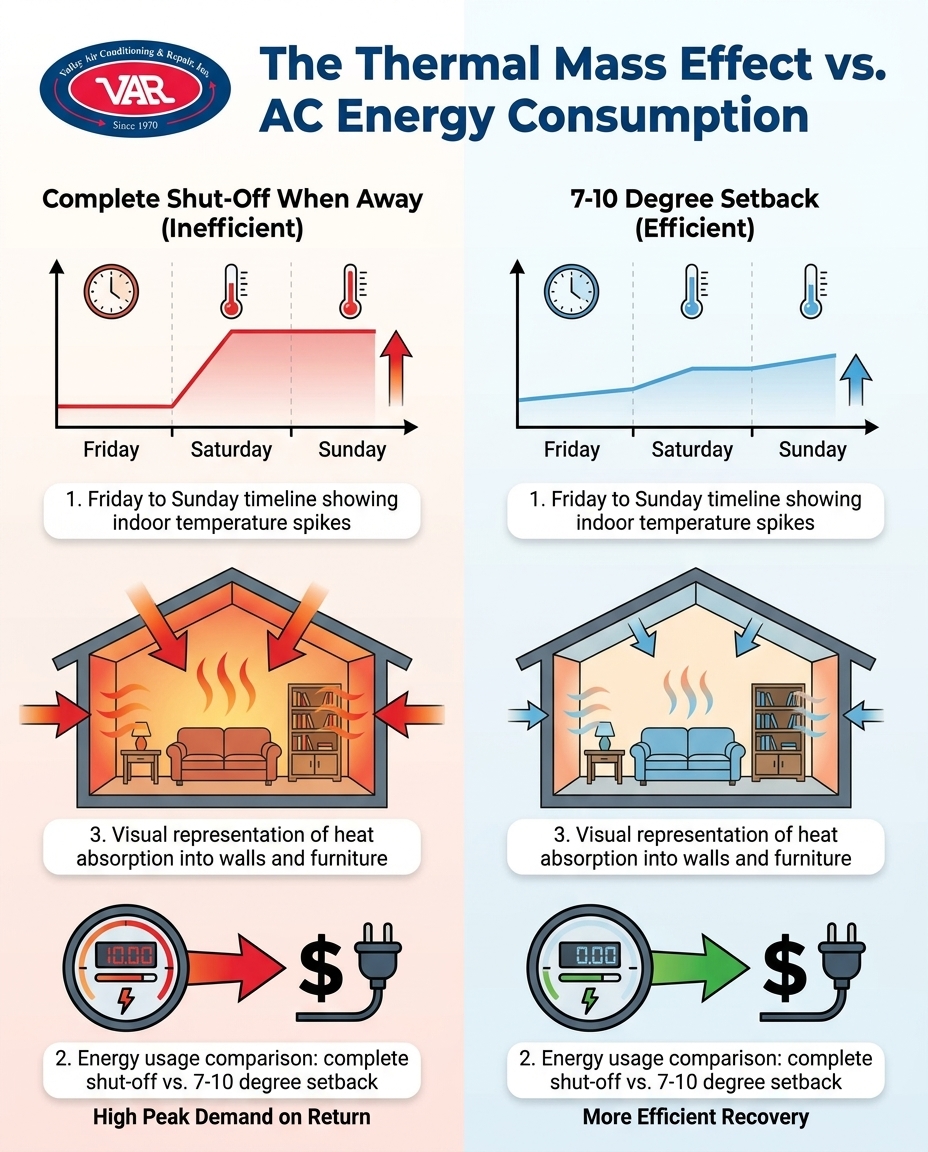
Leaving a home completely unconditioned during a peak summer weekend initiates a compounding chain reaction of heat absorption. The timeline of a two-day bake reveals exactly why shutting the system down is so detrimental to your home and your wallet.
Friday Evening: You turn the AC off and leave for the weekend. The ambient air inside the house begins to warm up immediately. Because the walls and furniture are still relatively cool from the previous air conditioning cycles, the house does not feel like an oven right away. However, the defense mechanisms are down.
Saturday Peak: The dry, extreme regional heat begins to take its toll. Solar heat gain—the radiation from the sun beating down on your roof and shining through your windows—accelerates the warming process. Without the air conditioner circulating air and removing thermal energy, indoor temperatures can easily exceed outdoor temperatures. The heat sinks deep into the drywall, the attic insulation, and the heavy furniture.
Sunday Afternoon: By the time Sunday afternoon rolls around, the house is fully saturated with heat. The energy you "saved" on Friday and Saturday is about to be entirely consumed by the massive cooling load required on Sunday evening. Our technicians recently responded to a call where a Fresno homeowner ultimately needed a complete system replacement because their equipment could not handle the relentless demand of extreme end-of-season heatwaves. This is the exact environment your house is sitting in when you leave it to bake.
Emphasizing Fresno's dry, 100-degree-plus late summer climate is vital here. In this type of environment, a house without climate control acts like a greenhouse. The structural materials expand slightly, and the sheer volume of trapped heat means that simply turning the AC back on will not provide immediate relief.
The real damage of a weekend shutdown occurs the moment you walk back through the front door and switch the thermostat back to your normal comfort setting. This forces your air conditioning system into prolonged recovery operation.
When an AC enters recovery operation to battle a severely overheated house, the compressor must run non-stop for hours. The compressor is the heart of your cooling system; it pumps refrigerant through the lines to absorb and disperse heat. Under normal conditions, the compressor cycles on and off, resting between cooling phases. When forced to extract two days' worth of baked-in heat from your home's thermal mass, the compressor is denied those necessary resting periods.
This relentless operation causes extreme wear-and-tear. Overworking a compressor in extreme heat is a leading cause of premature system failure. For example, our emergency dispatch team recently helped a local homeowner who experienced a total system breakdown during a stretch of 110-degree extreme heat; we had to dispatch a technician immediately to diagnose the issue and complete the repair within an hour to restore safety and comfort. Forcing an aging system to run a marathon on a Sunday evening is a fast track to similar emergency repairs.
Beyond the mechanical strain, there is a significant financial impact to consider. In California, many utility companies utilize Time-of-Use (TOU) pricing. The most expensive electricity rates typically occur on late weekday and weekend afternoons and evenings. If you return home at 5:00 PM on a Sunday and force your AC to run continuously for the next four hours, you are buying the most expensive electricity of the week.
Saving a few hours of runtime over the weekend is quickly negated by the massive energy draw during peak pricing hours. Understanding your thermostat's recovery mode is essential. Modern thermostats will attempt to reach the target temperature as efficiently as possible, but if the gap between the current indoor temperature and the target temperature is too large, the system has no choice but to run at maximum capacity.
If turning the system completely off is a bad idea, and leaving it at your normal comfort setting wastes energy, what is the correct approach? The answer lies in finding the ideal weekend thermostat setting that balances utility savings with mechanical preservation.
The U.S. Department of Energy provides a clear recommendation for optimal away-from-home settings. Rather than a total shutdown, you should utilize a 7-10 degree thermostat setback from your normal comfort level. This moderate adjustment prevents the home's thermal mass from absorbing deep heat while still reducing the frequency of the cooling cycles.
1. Determine your normal baseline: If you typically keep your home at 74 degrees when you are there, this is your starting point.
2. Apply the 7-10 degree thermostat setback: Adjust the thermostat to sit between 81 and 84 degrees before you leave.
3. Close the blinds and curtains: Block out direct sunlight to reduce solar heat gain, which helps the AC maintain the setback temperature with even less effort.
4. Ensure all vents are open: Do not close vents in unused rooms, as this alters the pressure in your ductwork and makes the blower motor work harder.
This strategy keeps the indoor environment just cool enough to protect the drywall and furniture from heat saturation. The system will cycle on occasionally during the hottest parts of the day, but it will use significantly less energy than it would if set to 74 degrees.
Smart thermostats make this process incredibly easy. You can program a "vacation mode" or simply use an app on your phone to adjust the temperature. A major benefit of a smart thermostat is the ability to monitor the indoor conditions remotely and lower the temperature a few hours before you arrive home, allowing the system to recover the house before peak utility rates hit.
Even with a perfect 7-10 degree thermostat setback, systems enduring heavy summer usage face a tremendous amount of stress. The intense heat of late summer demands that your equipment is in peak physical condition to handle the necessary end-of-season cooling loads efficiently.
Systems need clean condenser coils, unblocked air filters, and proper refrigerant levels to handle recovery periods efficiently. If your outdoor unit is caked in dust and debris, it cannot release the heat it absorbs from your home. If the refrigerant charge is low, the compressor has to work twice as hard to achieve the same cooling effect. Routine checks prevent sudden breakdowns during peak heat waves by catching these minor inefficiencies before they cascade into major mechanical failures.
Well-maintained older systems can still perform efficiently if cared for properly. Our maintenance team recently helped one local family keep their 13-year-old system running like new, simply through ongoing preventative maintenance and routine cleaning of the internal components. Age is less of a factor than the quality of care the equipment receives. Upgrading to a modern high-efficiency heat pump or AC system may also qualify you for generic utility incentive programs or federal tax credits, but maintaining your current unit is always your immediate first line of defense.
Taking a proactive approach to system health before leaving town for a late-summer trip gives you peace of mind. Frame preventative maintenance as the ultimate safeguard against the heavy mechanical strain caused by late summer heat. By enrolling in a routine AC maintenance plan, you ensure that your system is calibrated, cleaned, and prepared to handle weekend setbacks and recovery cycles without skipping a beat.
You should set your thermostat 7 to 10 degrees higher than your normal comfort setting. Do not turn the system off completely, as this allows extreme heat to build up in the walls and furniture. Applying this recommended setback ensures the temperature prevents deep heat saturation while still saving energy during your absence.
Turning the AC off saves energy while you are gone, but it often costs significantly more upon your return. Continuous operation to remove deep heat from a baked house often negates the weekend savings entirely. Furthermore, you must factor in the potential repair costs from overworked compressors that fail under the strain of a massive recovery load.
Leaving the AC on at a higher, stable temperature is much more cost-effective than turning it off. Maintaining a baseline temperature requires less energy than executing a massive recovery to cool a heavily overheated house. The moderate setback strategy prevents the thermal mass from absorbing heat, keeping your overall utility usage in check.
Cooling the ambient air may take an hour, but cooling the thermal mass takes several hours of continuous operation. The exact time depends heavily on your system's capacity, the quality of your home's insulation, and the outdoor temperatures. Expect the compressor to run for a prolonged period as it extracts heat from the drywall and furniture.
Yes, forcing a system to cool a deeply heated house often consumes more energy than maintaining a moderate setback temperature. The massive energy draw required to overcome thermal mass saturation, especially during peak utility rate hours, makes the complete shutdown strategy financially inefficient.
A smart thermostat allows you to monitor indoor conditions remotely and adjust the temperature from your phone. It enables you to begin the cooling recovery process a few hours before you arrive home, ensuring the house is comfortable when you walk in. This also allows you to time the recovery cycle to avoid peak utility rates.
The science is clear, and in our years serving the Central Valley, we always recommend the same approach: strategic temperature management always beats a complete shutdown. By utilizing a 7-10 degree thermostat setback, you protect your home's thermal mass from absorbing the brutal late August Central Valley heat. This approach saves energy over the weekend without forcing your compressor into a damaging, relentless recovery cycle upon your return.
Your goal should always be returning to a comfortable home without overworking the equipment. If you notice your system struggles to recover the temperature even after a moderate setback, it may be time for a professional inspection. Ensuring your air conditioning system is fully optimized and maintained is the best way to handle end-of-season demands efficiently and keep your home cool for years to come.

As a business with many AC units, it is essential to have a responsive AC company. Valley Air Conditioning understands our needs. They are always responsive and our AC is up and running very quickly.
I had them do an AC check on the home I was buying, they were honest and quick. I hired them to do the summer and Fall maintenance for $149. Happy with this company!
100% recommend. I called, same day they came out and gave me estimate. Conley was honest and didn't try to recommend/sell us anything we didn't need. When I called him with questions before making a decision, he happily answered and was not annoyed by me contacting him. Conley and VAR
This is a group of good people. Very professional and knowledgeable. They take the time to listen and find the best solution that fits best for any situation. There's no way you can go wrong in choosing VAR.
We have used Valley Air for over fifteen years. The last two years ,Matt came to our house to service twice a year. Always on time, so polite and so professional. This is a very honest company and you can always depend on them and trust them. The office always treats everyone cheerfully and always want to do what you need done very fast YOU CAN COUNT ON THIS Company


