


.webp)


Why Is My AC Blowing Warm Air? Fall HVAC Troubleshooting & Startup Smells
Smelling burning dust this fall? Get clear answers with our home maintenance tips and troubleshooting to know when to call a pro for your heating system.

Is your garage too hot to use for back-to-school projects, hobbies, or a home gym? When evaluating window units vs. mini-splits for cooling a hot Fresno garage, our team at Valley Air Conditioning & Repair, Inc. knows that the right choice determines whether that space becomes a comfortable retreat or remains an unbearable oven. As the late-summer / August heat sets in, trying to convert a heat-trapping space into a usable area without overtaxing your home's main AC becomes a pressing challenge. You need a solution that actually works against extreme ambient temperatures, forcing a decision between a localized window unit and a dedicated ductless system.
If you are ready to upgrade your home's comfort and reclaim your space, explore our air conditioning solutions and professional ductless mini-split installation services to find the perfect fit for your property.
Cooling a standard room inside your home is entirely different from cooling a garage. In the Central Valley, extreme ambient temperatures regularly exceed 100 degrees, turning uninsulated spaces into literal ovens. Standard indoor cooling strategies and basic BTU rules of thumb consistently fail in these environments because they do not account for the massive thermal loads unique to outbuildings and attached garages. Overcoming a 30-day streak of 100-degree weather requires robust, dedicated cooling solutions rather than temporary fixes.
In our years serving Fresno homeowners, we see the impact of this intense dry heat every season. We recently worked with a local homeowner who realized they needed a new air-conditioning system for the house just to keep up with the overwhelming summer temperatures. They qualified for financing and had the system installed within one week, resulting in a system that worked wonderfully and restored their comfort. That same level of urgency and need for proper equipment applies directly to your garage space. If your primary AC struggles during a heatwave, a basic window unit in an uninsulated garage will face an even tougher battle.
Fresno residential garages face a unique set of thermal challenges that standard bedrooms never encounter. As our installation crews frequently explain during home assessments, the primary culprit is radiant heat.
• Concrete slabs: Your garage floor acts as a massive thermal battery. It absorbs heat from the sun-baked driveway outside and radiates it upward into the space long after the sun goes down.
• Metal garage doors: A standard, uninsulated metal garage door transfers outdoor heat directly inside. When the afternoon sun hits that metal surface, it essentially becomes a giant radiator.
• Vehicle heat: Parking a car inside after a commute introduces a massive engine heat load that gets trapped within the four walls of the garage.
Because of these factors, the heat load in a garage is vastly different from a standard interior room. A cooling unit must work twice as hard just to neutralize the heat radiating from the structure itself before it can even begin to lower the air temperature.
From the hundreds of Central Valley properties we visit each year, we find that most garages lack the drywall, fiberglass insulation, and thermal barriers found in the main house. Without these protective layers, there is nothing to stop rapid heat gain during the day. The sun beats down on the roof, transferring heat directly through the exposed rafters and into your workspace. Standard window units are designed for enclosed, insulated rooms where the conditioned air stays trapped inside. In a typical garage, the cold air produced by a small unit is immediately overwhelmed by the constant influx of outdoor heat seeping through the walls and roof.
When you are fighting the late-summer / August heat, raw cooling power dictates your comfort. The temperature delta is the difference between the outdoor temperature and your desired indoor temperature. If it is 105 degrees outside and you want your garage to be 75 degrees, your cooling system must overcome a massive 30-degree delta. This is where the differences between cooling technologies become glaringly obvious.
Proactive planning for high-heat spaces is critical. If you are looking to get your home ready for extreme weather, proper residential cooling preparation ensures your systems can handle the load.
High-efficiency mini-splits are engineered specifically to handle extreme temperature deltas without losing capacity. The secret lies in their advanced inverter technology. Unlike traditional compressors that only operate at one speed, an inverter-driven compressor adjusts its speed dynamically based on the real-time cooling demand.
• Variable speeds: The compressor ramps up to maximum power to quickly cool the space, then scales back to a lower speed to maintain the temperature efficiently.
• Consistent output: This technology allows the system to maintain consistent temperatures even when outdoor heat spikes unexpectedly.
• Superior air distribution: Ductless air handlers are designed to throw conditioned air far across a room, ensuring even spread in a large, open garage.
Standard window units rely on single-stage compressors. This means they are either running at 100% capacity or they are completely turned off. In a sun-baked garage, this creates significant problems.
• Continuous running: Because the heat load is so high, a window unit will often run continuously without ever reaching your setpoint.
• Temperature swings: The on-and-off cycling leads to hot and cold spots, failing to provide a comfortable, even temperature across the workspace.
• Weak airflow: The fans in window units lack the power to push cold air deep into a two-car garage, leaving the areas furthest from the window completely unconditioned.
• Cooling Technology — Ductless Mini-Split: Variable-speed inverter compressor — Standard Window Unit: Single-stage (on/off) compressor
• Air Distribution — Ductless Mini-Split: Wide spread, long air throw — Standard Window Unit: Localized, weak air throw
• Temperature Control — Ductless Mini-Split: Precise, consistent maintenance — Standard Window Unit: Fluctuating, prone to hot spots
• High-Heat Performance — Ductless Mini-Split: Maintains capacity in 100+ degrees — Standard Window Unit: Struggles to reach setpoints
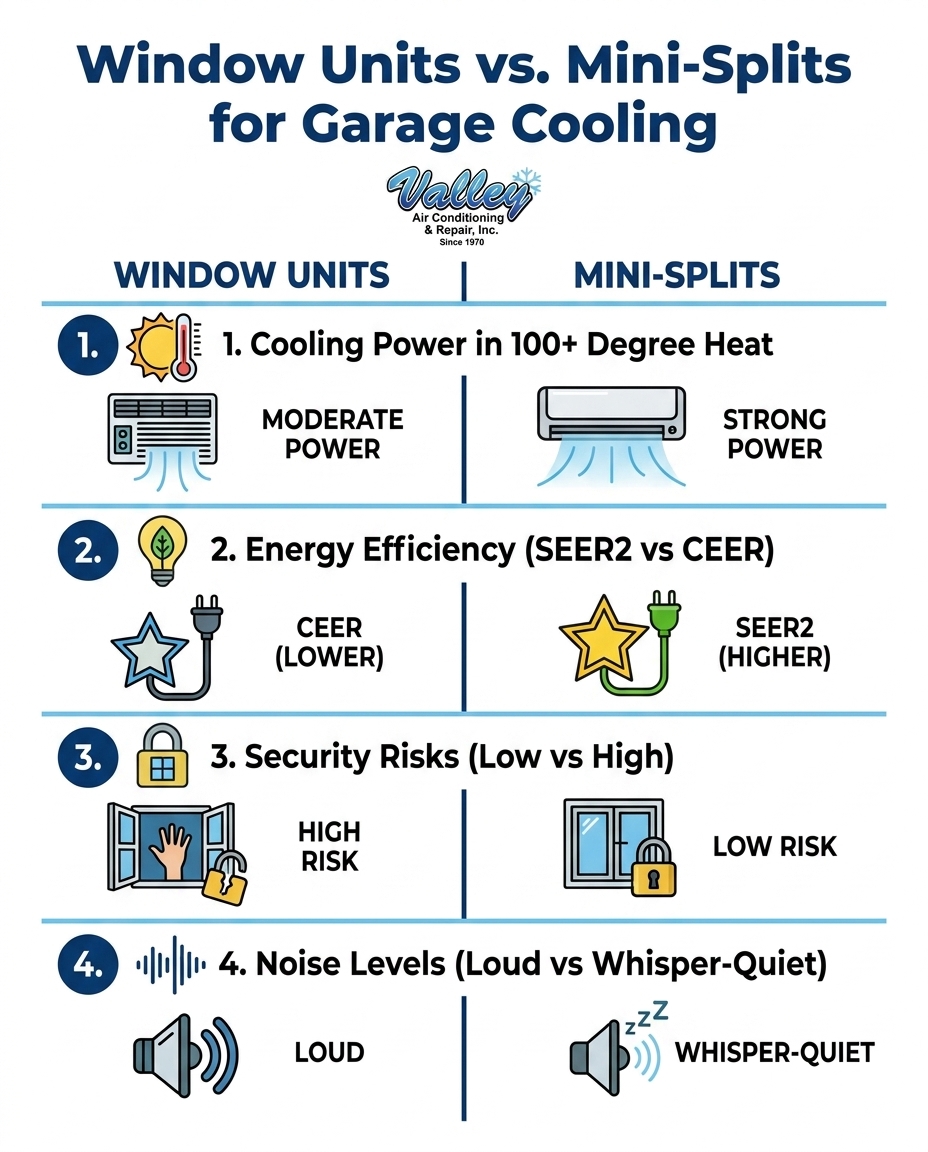
Understanding the long-term operational costs of your cooling choice requires a look at efficiency metrics. Upgrading your cooling approach impacts your overall household energy use, especially when conditioning a difficult space like a garage. If you are considering broader HVAC system upgrades, efficiency ratings should be your primary focus.
The HVAC industry uses specific acronyms to measure how effectively a system converts electricity into cooling power.
SEER2 (Seasonal Energy Efficiency Ratio 2): This metric is used for central air conditioners and ductless mini-splits. It measures the total cooling output over a typical cooling season divided by the total electrical energy input. SEER2 provides a highly accurate picture of seasonal efficiency under varying outdoor temperatures. The higher the SEER2 rating, the less energy the system wastes.
CEER (Combined Energy Efficiency Ratio): This metric is used for room air conditioners, including window units. It measures the combined energy efficiency, accounting for the energy consumed while the unit is running and the standby power used when it is turned off. While helpful for comparing window units to one another, CEER ratings generally reflect much lower overall efficiency than SEER2 ratings.
While window units have a lower upfront purchase price, our team routinely warns homeowners that their operational cost in extreme heat is significantly higher. Running a single-stage window unit continuously in a hot garage draws a massive amount of electricity. Over a long Central Valley summer, those monthly utility bills add up rapidly.
Conversely, inverter-driven mini-splits offer a better return on investment through monthly energy savings. Because they scale their power usage down once the room reaches the desired temperature, they draw far less electricity to maintain comfort in Fresno residential garages. Additionally, federal tax credits and local utility rebates may apply to qualifying high-efficiency heat pump installations, which can further offset the initial investment. We always advise checking current programs with your utility provider or a tax professional to see what incentives are available for energy-efficient upgrades.
Cooling power and efficiency are paramount, but secondary factors often dictate how usable your newly conditioned space actually becomes. If your garage is going to serve as a home office, a gym, or a study area, you must consider the physical security of the installation, the acoustic comfort of the room, and the quality of the air you will be breathing.
Installing a traditional unit in a ground-level garage window introduces immediate physical security risks.
1. Easy access for intruders: Window units can often be forcefully pushed in from the outside, leaving a wide-open entry point into your garage and, potentially, your main home.
2. Compromised locking mechanisms: Securing a window with an appliance resting in it prevents the sash from locking properly, requiring makeshift braces that are easily bypassed.
3. Weather sealing issues: The accordion-style side panels provided with window units offer zero insulation and poor weather sealing. They allow hot air, humidity, and pests to enter the garage freely, undermining your cooling efforts.
In contrast, mini-splits maintain the structural integrity and security of your home. The installation only requires a small 3-inch hole drilled through the wall to connect the indoor air handler to the outdoor compressor. The windows remain fully operational and securely locked.
Noise matters significantly if the garage is being used as a study space, a home office, or a hobby workshop. A standard window unit houses all of its components—including the loud, vibrating compressor—in a single box that sits halfway inside your room. The loud hum and constant cycling on and off can make phone calls impossible and disrupt concentration.
Ductless air handlers operate at whisper-quiet decibel levels. Because the noisy compressor is located entirely outside the building, the only sound inside the garage is the gentle hum of the circulation fan. Furthermore, ductless systems offer superior dust and particulate handling. They feature washable, reusable filters that capture sawdust, pollen, and debris far more effectively than the thin mesh screens found in standard window appliances, which is crucial for maintaining air quality in a garage workshop.
Proper installation dictates the lifespan and performance of any cooling system. When battling the late-summer / August heat, guessing what size unit you need is a recipe for failure. Technical requirements must be met, and professional sizing is absolutely non-negotiable for extreme environments.
If you are exploring alternative methods for modifying your home's comfort, understanding your options for adding cooling without ductwork is the first step toward a successful project.
Before installing any new cooling equipment in a garage, you must assess your current electrical panel's capacity. Standard garage outlets are typically wired for 110v and share a circuit with other high-draw appliances like refrigerators, power tools, or garage door openers.
The quick fix is often dangerous: Plugging a large window unit into a shared 110v outlet frequently leads to tripped breakers and overloaded circuits. This poses a significant safety risk. High-efficiency mini-splits, depending on their size, may require a dedicated 110v or 220v circuit. A professional assessment ensures your electrical panel can safely handle the new continuous load without risking a fire or damaging your equipment.
Guessing BTU (British Thermal Unit) requirements leads directly to system failure. Because we've seen so many undersized units burn out, Valley Air Conditioning & Repair's deep local expertise ensures that our technicians perform accurate load calculations, perfectly right-sizing the system for difficult, heat-trapping spaces without wasting energy.
• Oversized units fail to dehumidify: If a unit is too large, it cools the air too quickly and shuts off before it has a chance to remove humidity from the room. This leaves the garage feeling cold but clammy and damp.
• Undersized units burn out: If a unit is too small, it will run constantly in a futile attempt to reach the set temperature. This continuous operation burns out the compressor prematurely and drives your energy bills through the roof.
Professional load calculations account for garage-specific variables: the lack of insulation, the direction the garage door faces, the square footage, and the regional climate. This ensures the equipment matches the exact thermal load of the space.
Yes, a properly sized mini-split can easily cool a standard two-car garage. The key is ensuring the system's BTU capacity matches the specific heat load of the space, factoring in insulation levels and radiant heat. A professional load calculation will determine the exact size needed to maintain comfortable temperatures even on the hottest days.
It is significantly cheaper to run a ductless mini-split over the long term. While window ACs have a lower initial purchase price, their single-stage compressors draw large amounts of electricity to cool uninsulated spaces. Mini-splits use inverter technology to adjust their power draw dynamically, resulting in much lower monthly energy consumption and better overall efficiency.
Standard BTU rules of thumb do not apply to hot garages due to the lack of insulation and high radiant heat. While a typical interior room might need 20 BTUs per square foot, a sun-baked garage in the Central Valley often requires significantly more. You must have a professional perform a load calculation that accounts for your garage door material, ceiling height, and local climate variables.
While a mini-split will function in an uninsulated garage, adding insulation dramatically improves its efficiency and cooling performance. Without insulation, the system has to work harder to overcome the constant influx of outdoor heat. Insulating your garage door and walls ensures the conditioned air stays inside, lowering your energy bills and extending the lifespan of the equipment.
Yes, mini-splits offer far better security than ground-level window units. A window unit requires an open window sash, creating a vulnerable entry point that can often be pushed in from the outside. A ductless system only requires a small 3-inch hole drilled through the wall for the refrigerant lines, allowing your windows to remain fully closed and securely locked.
Extreme heat pushes standard window units past their operational limits. Because they lack variable-speed technology, they run continuously in an attempt to combat 100-degree ambient temperatures, often failing to reach the set thermostat temperature. This constant strain leads to rapid wear and tear, high energy consumption, and an uncomfortably warm workspace.
Based on the countless garage conversions we've outfitted across Fresno, transforming your garage into a usable workspace requires a realistic, climate-specific cooling solution. While window units present a cheaper upfront option, we consistently see them fall short when battling the intense late-summer / August heat. They consume more energy, introduce security vulnerabilities, and struggle to overcome the massive thermal loads of uninsulated spaces. We recommend ductless mini-splits because they offer superior cooling power, whisper-quiet operation, and long-term energy efficiency, making them the definitively better choice for extreme heat environments.
Before the season fully transitions, ensure your space is ready for your next project. Contact our experts to schedule an inspection and explore a professional ductless mini-split installation tailored specifically to your home's needs.

As a business with many AC units, it is essential to have a responsive AC company. Valley Air Conditioning understands our needs. They are always responsive and our AC is up and running very quickly.
I had them do an AC check on the home I was buying, they were honest and quick. I hired them to do the summer and Fall maintenance for $149. Happy with this company!
100% recommend. I called, same day they came out and gave me estimate. Conley was honest and didn't try to recommend/sell us anything we didn't need. When I called him with questions before making a decision, he happily answered and was not annoyed by me contacting him. Conley and VAR
This is a group of good people. Very professional and knowledgeable. They take the time to listen and find the best solution that fits best for any situation. There's no way you can go wrong in choosing VAR.
We have used Valley Air for over fifteen years. The last two years ,Matt came to our house to service twice a year. Always on time, so polite and so professional. This is a very honest company and you can always depend on them and trust them. The office always treats everyone cheerfully and always want to do what you need done very fast YOU CAN COUNT ON THIS Company


