.webp)


Troubleshooting Your Fall Heating Startup: Burning Smells and Short-Cycling Explained
Why we shut down furnaces for certain burning smells. Apply these home maintenance tips and troubleshooting steps to safely navigate your fall startup.
How dirty filters cause frozen evaporator coils is one of the most common — and most preventable — AC problems homeowners in Modesto and the Central Valley face every summer. When your air filter gets clogged, warm air can no longer flow freely across the evaporator coil. Without that steady supply of warm air, the coil drops below 32°F, moisture freezes on its surface, and your system stops cooling your home effectively.
Here is a quick breakdown of how it happens:
A severely clogged filter can trigger this entire chain of events within just 24 to 48 hours of continuous operation — which is exactly the kind of non-stop running your system does on a hot Central Valley summer day.
The good news: in most cases, a dirty filter is the first thing to check, and fixing it is straightforward. This guide walks you through the science, the warning signs, how to safely thaw your system, and how to keep it from happening again.

To truly understand how dirty filters cause frozen evaporator coils, we have to look at the physics of heat exchange. Your air conditioner does not actually "create" cold air. Instead, it works by removing heat and humidity from your indoor living spaces.
Inside your home's indoor unit sits the evaporator coil, which has cold, pressurized liquid refrigerant flowing through its copper loops. Your system's blower motor pulls warm, humid air from your rooms through the return vents, pushes it through the air filter, and blows it directly across this cold coil.
As the warm air passes over the coil, two crucial physical reactions happen simultaneously:
However, this heat exchange process relies entirely on balanced, steady airflow. Standard residential air conditioning systems are engineered to move between 350 and 400 Cubic Feet per Minute (CFM) of air per ton of cooling capacity.
When you neglect Dirty Air Filters on Your HVAC System, dust and debris form a thick, felt-like barrier. This creates a massive pressure drop across the filter, choking the airflow.
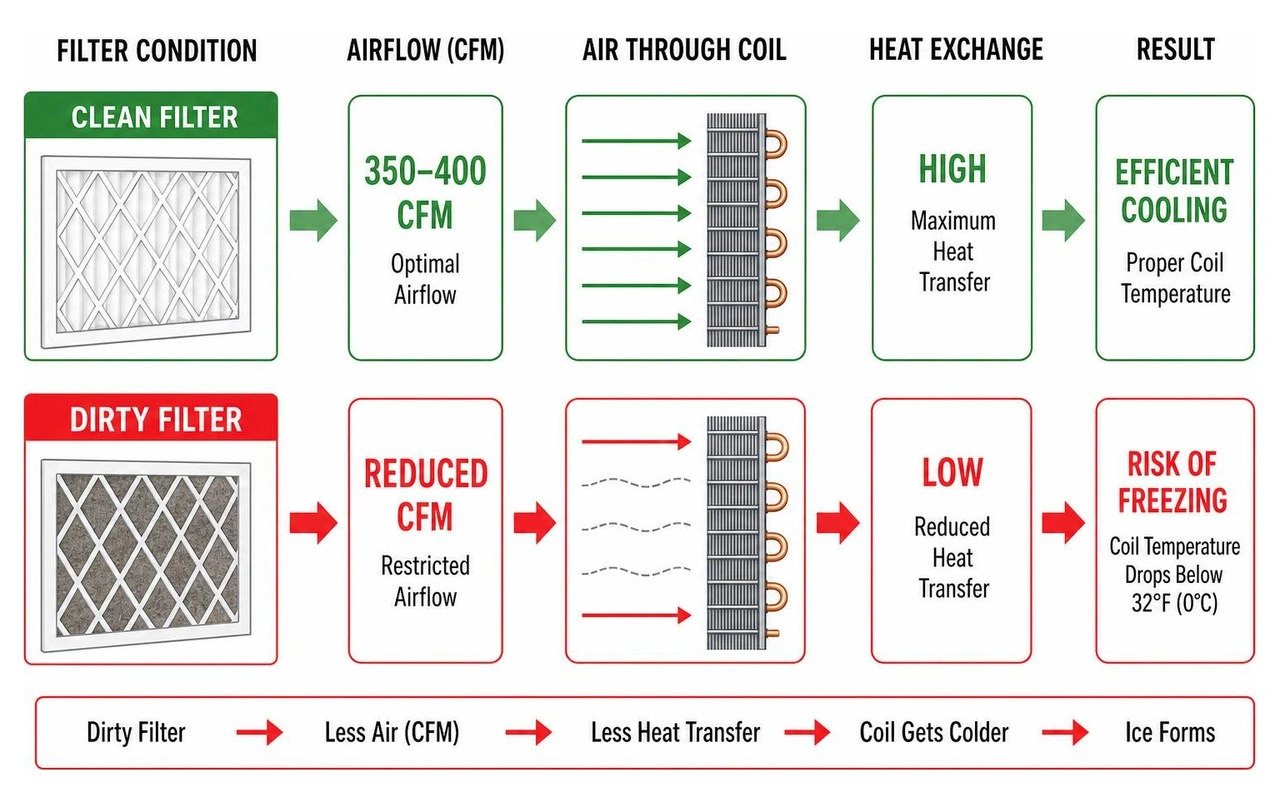
When airflow drops below the critical 350 CFM per ton threshold, your system can lose up to 30% of its cooling capacity almost immediately. Because there is not enough warm air passing over the evaporator coil to transfer heat to the refrigerant, the temperature of the refrigerant inside the coil drops rapidly.
Once the coil’s surface temperature falls below the 32°F (0°C) freezing threshold, the condensation building up on the copper fins immediately freezes into frost. This initial layer of frost acts as an insulator, blocking what little warm air is left from reaching the refrigerant. This creates a self-reinforcing "snowball effect." The colder the coil gets, the more moisture freezes, and the thicker the ice grows until your evaporator coil is completely encased in a block of ice.
This issue is especially aggressive in our region. Knowing How Dirty Air Filters Destroy Your AC in Dusty Climates is vital for Central Valley homeowners, where dry summer winds, agricultural dust, and pollen can clog a standard filter much faster than in other parts of the country.
Detecting a frozen system early can save you from a major headache. While a solid block of ice on your indoor unit is a dead giveaway, you will usually notice several warning signs long before the system completely succumbs to the freeze.
If you notice any of these signs, you must act quickly to prevent permanent damage to your compressor—the most expensive component of your air conditioner.
If you need to Fix a Frozen AC Evaporator Coil in Clovis or any surrounding Valley communities, follow these steps to safely defrost your system before calling in a professional.
While a dirty filter is the most common culprit behind a frozen evaporator coil, it is not the only cause. A system can also freeze due to low refrigerant levels, usually caused by a leak.
Distinguishing between these two issues is critical because while you can easily replace a dirty filter yourself, handling refrigerant requires a licensed professional.
| Symptom / Diagnostic Indicator | Airflow Restriction (Dirty Filter / Blower Issue) | Low Refrigerant (System Leak) |
|---|---|---|
| Airflow Strength | Extremely weak or barely noticeable from all vents. | Normal airflow strength, but the air is warm. |
| Ice Location | Even ice coverage across the entire evaporator coil. | Ice often starts on a single section of the coil or only on the suction line. |
| Suction Line Temp | Warm or moderately cool, but lacks proper heat transfer. | Extremely cold near the indoor coil, but warm at the outdoor compressor. |
| Coil Cleanliness | Heavy dust layer on filter and/or coil fins. | Filter and coil may look completely clean. |
| System Sounds | Blower motor may strain, rattle, or sound unusually quiet. | Hissing or bubbling noises along the copper refrigerant lines. |
| Efficiency Loss | Immediate cooling capacity loss (up to 30%). | Gradual drop in cooling efficiency over weeks or months. |
When refrigerant is low, the overall pressure inside the system drops. In accordance with the laws of thermodynamics, a drop in pressure results in a corresponding drop in temperature. Even with perfect airflow, a system with just a 10% refrigerant undercharge can see its coil surface temperatures fall 5°C to 8°C lower than designed, plunging it well below freezing.
Additionally, a dirty evaporator coil can mimic the effects of a dirty filter. If a dirty filter is neglected for too long, dust bypasses the filter and settles directly on the wet coil fins. A tiny 0.02-inch layer of dust on your evaporator coil can reduce its heat transfer efficiency by up to 15%, causing the coil to freeze even if you just put in a brand-new air filter.
The best way to handle a frozen evaporator coil is to prevent it from ever happening in the first place. With a few simple, routine maintenance steps, you can keep your system running reliably all summer long.
In the hot, dry climate of the Central Valley, our air conditioners face incredibly high cooling demands. During July and August, systems often run continuously for hours on end to keep up with outdoor temperatures exceeding 100°F.
When a system runs continuously with a dirty filter, there is no "off-cycle" to allow minor frost to melt naturally. The restricted airflow causes a steady, uninterrupted drop in coil temperature. Within 24 to 48 hours of continuous operation under these conditions, a slightly dusty coil can easily transition into a solid block of ice.
Absolutely not. Running your air conditioner with frozen coils can lead to liquid slugging. Your AC compressor is designed to compress gas, not liquid.
When the evaporator coil is frozen, the liquid refrigerant passing through it cannot absorb enough heat to vaporize into a gas. This cold liquid refrigerant travels back down the suction line directly into the compressor. Because liquid cannot be compressed, it can shatter the compressor's internal valves and pistons, leading to permanent system failure and a highly expensive replacement.
You should call a professional HVAC technician if:
A frozen evaporator coil can quickly turn your home into an uncomfortable hothouse, but keeping your air filters clean is the easiest way to prevent this common issue. By understanding the science of airflow and taking quick, safe action to thaw your system when ice appears, you can protect your AC from serious damage and keep your home comfortable.
At Valley Air Conditioning & Repair, Inc., we have been serving homeowners throughout the Central Valley since 1970. Built on a customer-first philosophy, honorable intentions, and trusted word-of-mouth growth, we are proud to be your local comfort experts. Whether you need a quick system diagnosis, a professional coil cleaning, or emergency repairs, we are here to help.
If your air conditioner is struggling to keep you cool, don't wait for the ice to take over. Schedule Professional HVAC Maintenance with the team at Valley Air Conditioning & Repair, Inc. today!

As a business with many AC units, it is essential to have a responsive AC company. Valley Air Conditioning understands our needs. They are always responsive and our AC is up and running very quickly.
I had them do an AC check on the home I was buying, they were honest and quick. I hired them to do the summer and Fall maintenance for $149. Happy with this company!
100% recommend. I called, same day they came out and gave me estimate. Conley was honest and didn't try to recommend/sell us anything we didn't need. When I called him with questions before making a decision, he happily answered and was not annoyed by me contacting him. Conley and VAR
This is a group of good people. Very professional and knowledgeable. They take the time to listen and find the best solution that fits best for any situation. There's no way you can go wrong in choosing VAR.
We have used Valley Air for over fifteen years. The last two years ,Matt came to our house to service twice a year. Always on time, so polite and so professional. This is a very honest company and you can always depend on them and trust them. The office always treats everyone cheerfully and always want to do what you need done very fast YOU CAN COUNT ON THIS Company