


.webp)


Why Is My AC Blowing Warm Air? Fall HVAC Troubleshooting & Startup Smells
Smelling burning dust this fall? Get clear answers with our home maintenance tips and troubleshooting to know when to call a pro for your heating system.
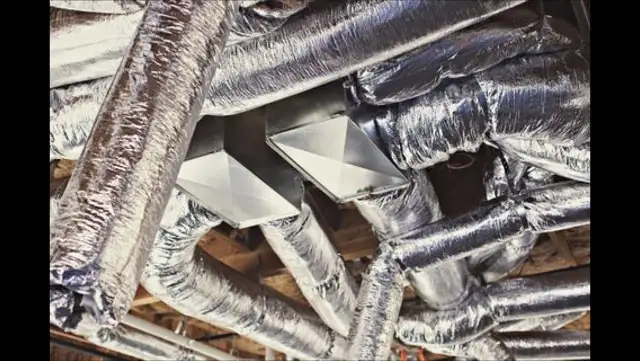
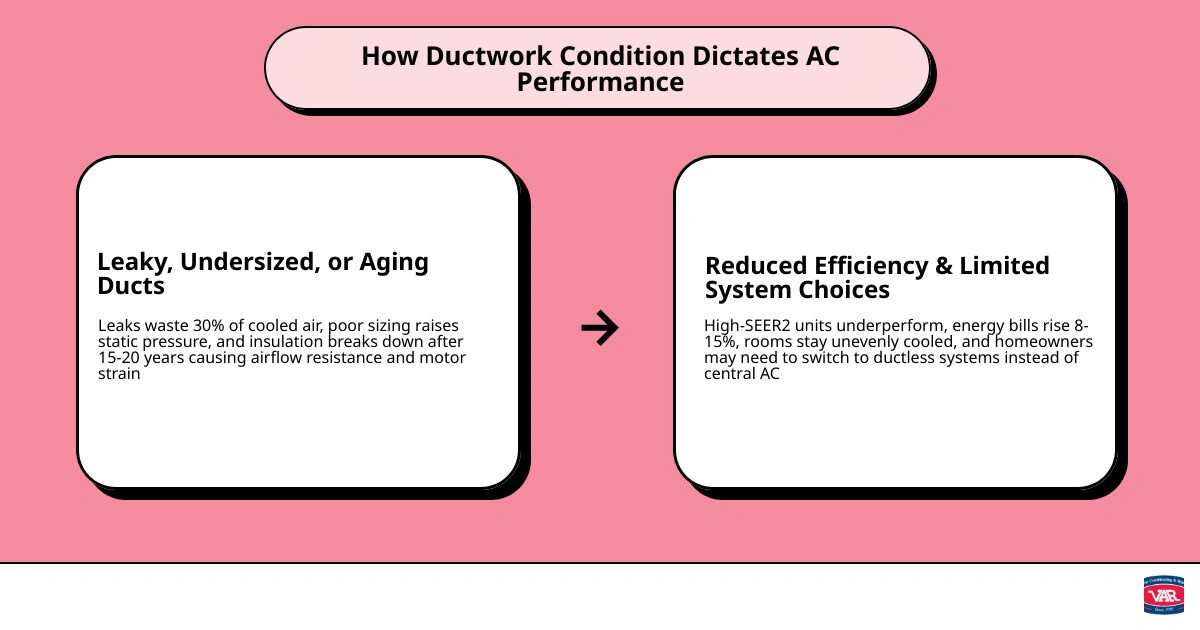
How your existing ductwork affects your AC choices is something every homeowner in the Central Valley should understand before spending money on a new system. In short, your ducts are not just pipes — they are the delivery system for every dollar your AC spends cooling your home. If they are leaky, undersized, or aging, even a brand-new, high-efficiency unit will underperform from day one.
Here is a quick summary of the key ways your ductwork shapes your AC decision:
Most homeowners focus entirely on the AC unit itself — the brand, the SEER rating, the features. The ductwork stays hidden behind walls and ceilings, easy to overlook. But as HVAC professionals often put it, upgrading your AC without checking your ductwork first is like putting a high-performance engine into a car with worn-out, clogged fuel lines. The engine cannot do its job if the fuel system is compromised.
In Modesto and across the Central Valley, where summer temperatures regularly push past 100°F, this is not a minor detail. It is the difference between a home that cools reliably and one that runs constantly, drives up your energy bill, and still leaves certain rooms stuffy and uncomfortable.
This guide walks you through everything you need to know — from how to spot duct problems to how duct conditions should influence whether you choose central AC, a heat pump, or a ductless system.
When we think about home comfort, we usually picture the outdoor condenser humming away or the cool air blowing from our registers. However, the ductwork is the vital circulatory system of your Air Conditioning setup. In places like Fresno, Clovis, Madera, and Sanger, our summers are unforgiving. We rely on our HVAC systems to perform flawlessly for months on end. If your ductwork is not up to the task, your comfort and your wallet will suffer.
Ductwork has a typical life expectancy of 15 to 25 years, depending on the materials used, how well it has been maintained, and the environmental conditions in your attic or crawl space. As ducts age, the adhesive on duct tape dries out, joints expand and contract with temperature swings, and flexible ducts can sag, kink, or be damaged by pests.
If your home's ductwork is older than 15 years, it should always be thoroughly inspected before you choose a new Residential Air Conditioning system. Installing a modern, high-efficiency AC unit on top of deteriorating ducts is a recipe for disappointment.
Leaky ductwork can waste up to 30% of your conditioned air before it ever reaches your living spaces. Imagine buying a gallon of milk, but 30% of it leaks out of the jug before you get home from the store. That is exactly what happens to your cooled air in a hot attic when your ducts have unsealed joints or tears.
Furthermore, restricted airflow caused by pinched flex ducts or poor design can reduce your new AC system's efficiency by up to 15%. When you combine the energy lost to leaks with the efficiency drop from restricted airflow, your brand-new system could easily perform worse than a properly matched mid-efficiency system installed on optimized ducts.
To understand how your existing ductwork affects your AC choices, we have to look at a little bit of HVAC science. The two most critical terms you will hear our technicians discuss are CFM (Cubic Feet per Minute) and static pressure.
CFM measures the volume of air your system moves. As a general industry rule, a standard residential air conditioner requires 350 to 400 CFM of airflow per ton of cooling capacity. For example, a 3-ton AC system needs to move about 1,050 to 1,200 CFM of air to operate correctly.
Static pressure is the resistance to that airflow within your duct system. Think of it like blood pressure: if the resistance is too high, the heart (or in this case, your blower motor) has to work much harder to pump air through the house. The ideal external static pressure for a residential duct system is between 0.3 and 0.5 Inches of Water Column (IWC). When static pressure climbs above 0.8 or 1.0 IWC, your system is in serious trouble.
Modern high-efficiency AC systems, especially those built to meet the latest SEER2 standards, utilize advanced variable-speed blower motors. These motors are incredibly smart; they adjust their speed to maintain the proper airflow. However, if they are connected to highly restrictive, undersized, or poorly designed ductwork, they will ramp up to their maximum speed to overcome the high static pressure. This leads to:
Modern high-efficiency cooling coils also tend to have more physical surface area and denser aluminum fins to transfer heat more effectively. This density naturally creates more physical resistance to airflow than the older, wider-spaced copper coils of the past. If your legacy ductwork was designed for a 10 SEER system from twenty years ago, it simply may not have the capacity to handle the airflow resistance of a modern 18 SEER2 variable-capacity system.
Before we install any new HVAC system, we perform diagnostic testing to ensure your home's infrastructure can support your equipment choices.
To ensure your new air conditioner performs at its rated efficiency, our team utilizes scientific design standards. We do not use rules of thumb or guess based on your home's square footage. Instead, we rely on calculations developed by the Air Conditioning Contractors of America (ACCA):
If you are upgrading to a high-efficiency system, your existing return air ductwork is often the biggest bottleneck. Many older homes in areas like Clovis, Kerman, and Reedley were built with return grilles that are far too small. A modern variable-speed system requires a generous amount of return air to balance the pressure in the system.
When airflow is restricted due to undersized returns, the system's capacity drops dramatically. In fact, a moderate 12.5% reduction in airflow (dropping from 400 CFM down to 350 CFM per ton) can cause a staggering 24% loss in sensible cooling capacity. This means your 4-ton AC might only deliver the cooling power of a 3-ton system, all while consuming the electricity of a 4-ton unit.
To avoid this, we often recommend making key duct modifications during installation, such as adding a second return air pathway or expanding the main return plenum. For more details on preparing your home for a seamless installation, take a look at our HVAC Installation Fresno Tips.
How do you know if your existing ductwork is ready for a new AC, or if it needs some professional attention first? There are several warning signs you can look out for in your home:
If you notice these issues, we can perform a professional duct blaster test. During this test, we temporarily seal your registers and pressurize your duct system with a specialized fan. This allows us to measure exactly how much air is escaping through leaks and pinpoint where those leaks are located.
Depending on what we find, there are three primary ways to address ductwork issues before installing your new AC:
To help you understand your options, we have put together a comparison of these three approaches:
| Solution | Best For | Expected Benefits | Lifespan |
|---|---|---|---|
| Duct Sealing | Structurally sound ducts with minor joint leaks | Stops up to 30% air loss; improves indoor air quality; lowers energy bills | 10 to 15 years |
| Duct Repair | Minor localized damage, sagging flex ducts, or localized airflow bottlenecks | Restores balanced airflow; eliminates hot/cold spots in specific rooms | Varies by repair area |
| Full Duct Replacement | Ducts over 20 years old, contaminated with mold/asbestos, or severely undersized | Maximizes new AC lifespan and efficiency; ensures perfect airflow balance | 20 to 30 years |
If you are preparing for a new system in Fresno, check out our AC Installation Fresno Complete Guide. If you live in Clovis, our AC Replacement Clovis CA Complete Guide offers localized insights to help you make the best decision for your home.
Your existing ductwork does not just affect the efficiency of your new system; it can completely dictate which type of HVAC technology you should install. Today, homeowners have more choices than ever, including traditional central AC systems, electric heat pumps, and ductless mini-splits.
If you have functional, well-designed ductwork, upgrading to a modern central AC or an electric heat pump is a straightforward process. Heat pumps are especially popular in our region because they handle both heating and cooling beautifully. However, keep in mind that heat pumps often require slightly higher airflow rates to deliver equivalent heating compared to a traditional gas furnace. If your ducts are slightly undersized, they will need some minor optimization to work perfectly with a heat pump.
If your home has no ductwork, or if your existing ducts are in such poor condition that replacing them is impractical, ductless mini-splits are an incredible alternative. Mini-splits use individual indoor blower units mounted on your walls or ceilings, connected to an outdoor compressor by small refrigerant lines.
Ductless systems offer outstanding zoning capabilities, allowing you to cool only the rooms you are currently using. Because they do not use ducts, they completely eliminate duct-related energy losses, making them one of the most efficient comfort options available on the market today. You can learn more about how these systems function by visiting our Mini Split service page.
When deciding between a ducted and a ductless system, you have to weigh the long-term performance benefits against your home's structural realities. If your home has plaster walls, vaulted ceilings, or a flat roof with no attic space, installing new ductwork can be incredibly invasive and disruptive.
In these scenarios, going ductless is often the smartest move. To help you compare your options, we have compiled several detailed resources:
In many cases, yes, but it requires professional testing first. Modern high-SEER2 systems use larger, denser cooling coils that create more physical resistance to airflow. If your existing ducts are undersized or have high static pressure, installing a high-SEER2 unit can cause severe blower motor strain, noisy operation, and frozen coils. We always recommend a static pressure test to verify compatibility before you purchase a high-efficiency system.
A heat pump requires proper airflow to transfer heat efficiently, especially during the heating season. Our technicians will perform load calculations and measure your duct capacity to ensure your system can handle the required CFM. If your ducts are in decent shape but have minor restrictions, we can often optimize them by straightening out flexible runs, sealing leaks, or adding a dual-fuel system that pairs your heat pump with a gas furnace for the ultimate hybrid comfort setup.
The most common signs of leaky ducts include:
At Valley Air Conditioning & Repair, Inc., we have been serving homeowners throughout the Central Valley since 1970. Our business was built on a simple, customer-first philosophy centered on trust, honorable intentions, and honest word-of-mouth recommendations. We are proud to serve our neighbors in Biola, Clovis, Coarsegold, Del Rey, Dinuba, Fowler, Fresno, Friant, Kerman, Kingsburg, Laton, Lemoore, Madera Ranchos, Madera, O’Neals, Parlier, Reedley, Riverdale, Sanger, Selma, and Yosemite Lakes.
We understand that buying a new air conditioner is a major investment. That is why we do not just swap out your old unit and hope for the best. We look at your home as a complete system, ensuring your ductwork is fully optimized to support your new equipment for years to come.
Are you ready to ensure your home's infrastructure is prepared for a high-efficiency comfort upgrade? Schedule an air conditioning and ductwork assessment today with the trusted team at Valley Air Conditioning & Repair, Inc.

As a business with many AC units, it is essential to have a responsive AC company. Valley Air Conditioning understands our needs. They are always responsive and our AC is up and running very quickly.
I had them do an AC check on the home I was buying, they were honest and quick. I hired them to do the summer and Fall maintenance for $149. Happy with this company!
100% recommend. I called, same day they came out and gave me estimate. Conley was honest and didn't try to recommend/sell us anything we didn't need. When I called him with questions before making a decision, he happily answered and was not annoyed by me contacting him. Conley and VAR
This is a group of good people. Very professional and knowledgeable. They take the time to listen and find the best solution that fits best for any situation. There's no way you can go wrong in choosing VAR.
We have used Valley Air for over fifteen years. The last two years ,Matt came to our house to service twice a year. Always on time, so polite and so professional. This is a very honest company and you can always depend on them and trust them. The office always treats everyone cheerfully and always want to do what you need done very fast YOU CAN COUNT ON THIS Company


